Trump-Xi-Putin Summit: What Happened? | The Capital Cable #147
November 19, 2026 • 8:45 – 9:30 am EST
Hosted by Korea Chair

Photo: MEO/Adobe Stock. Image was generated with AI
The United States is experiencing an increasingly sharp memory chip supply shortage as a limited number of suppliers prioritize high bandwidth memory (HBM) bound for hyperscaler customers building AI data centers, shifting capacity away from conventional dynamic random-access memory (DRAM) chips and contributing to rising prices for consumers.
DRAM chips, which act as a computer’s short-term memory, are found in consumer products including cell phones, laptops, gaming consoles, cars, and medical devices. They are also a key component across defense technologies: For example, drone manufacturers are leveraging DRAM to integrate increasingly autonomous capabilities. HBM, a higher-end product formed by stacking and connecting conventional DRAM chips, is shaping today’s memory market in significant ways as AI infrastructure demand skyrockets.
The vast majority of DRAM and HBM supply is produced by just three firms—Micron, SK hynix, and Samsung—and much of their limited supply is spoken for. In September, Micron announced 26 total strategic customer agreements extending into the 2030s that ensure long-term supply for well-resourced hyperscaler customers. In late October, SK hynix stated it was sold out of DRAM and HBM through 2029. Micron warned customers to expect “supply-demand conditions to be much tighter” in coming years, with the shortage unlikely to abate before 2030 as demand outstrips supply and HBM demand consumes up to 70 percent of available capacity.
These firms are meanwhile building new facilities in the United States and elsewhere to expand production. Yet future construction plans cannot alleviate today’s short-term realities, due to the expected lag time (up to four years) between investments and facilities coming online. And, in some cases, a newly announced project will not address the heart of the challenge: SK hynix’s new $4 billion Indiana facility will be used for HBM packaging and research and development, not DRAM fabrication.
The memory crunch is not limited to the United States. Supply in Asia is also stretched, with the International Data Corporation projecting that regional PC shipments would decline nearly 14 percent in 2026 as suppliers prioritize HBM. In China, leading firm CXMT’s capacity is reportedly booked through 2027, while Chinese firms are locking in their own supply.
In this constrained global market, U.S. companies seeking access to conventional DRAM chips find themselves between a rock and a hard place. They must weigh short-term needs against longer-term considerations. Sustainable solutions are urgently needed to leverage U.S. allies and partners to expand future memory chip supply, with current manufacturers’ capacity committed through the 2030s. As a result, some firms are exploring alternative solutions in the next-largest memory market: China.
Attempts to source new memory chip supply from China are sparking discussions across the tech industry and policy community. Two key suppliers form China’s memory ecosystem: CXMT (ChangXin Memory Technologies) and YMTC (Yangtze Memory Technologies). CXMT is already the fourth-largest global DRAM manufacturer, and NAND flash memory supplier YMTC’s market position is growing. Yet with Washington slow to introduce short- or long-term solutions to relieve the supply crunch and much of the Big Three’s current supply already committed, some firms are pursuing alternatives. Former Apple CEO Tim Cook reportedly engaged the Trump administration regarding using Chinese chips for China-destined products, and new CEO John Ternus recently reasserted that “all options should be on the table.” Other laptop manufacturers are already reportedly introducing CXMT DRAM chips into a limited subset of laptops for non-U.S. markets.
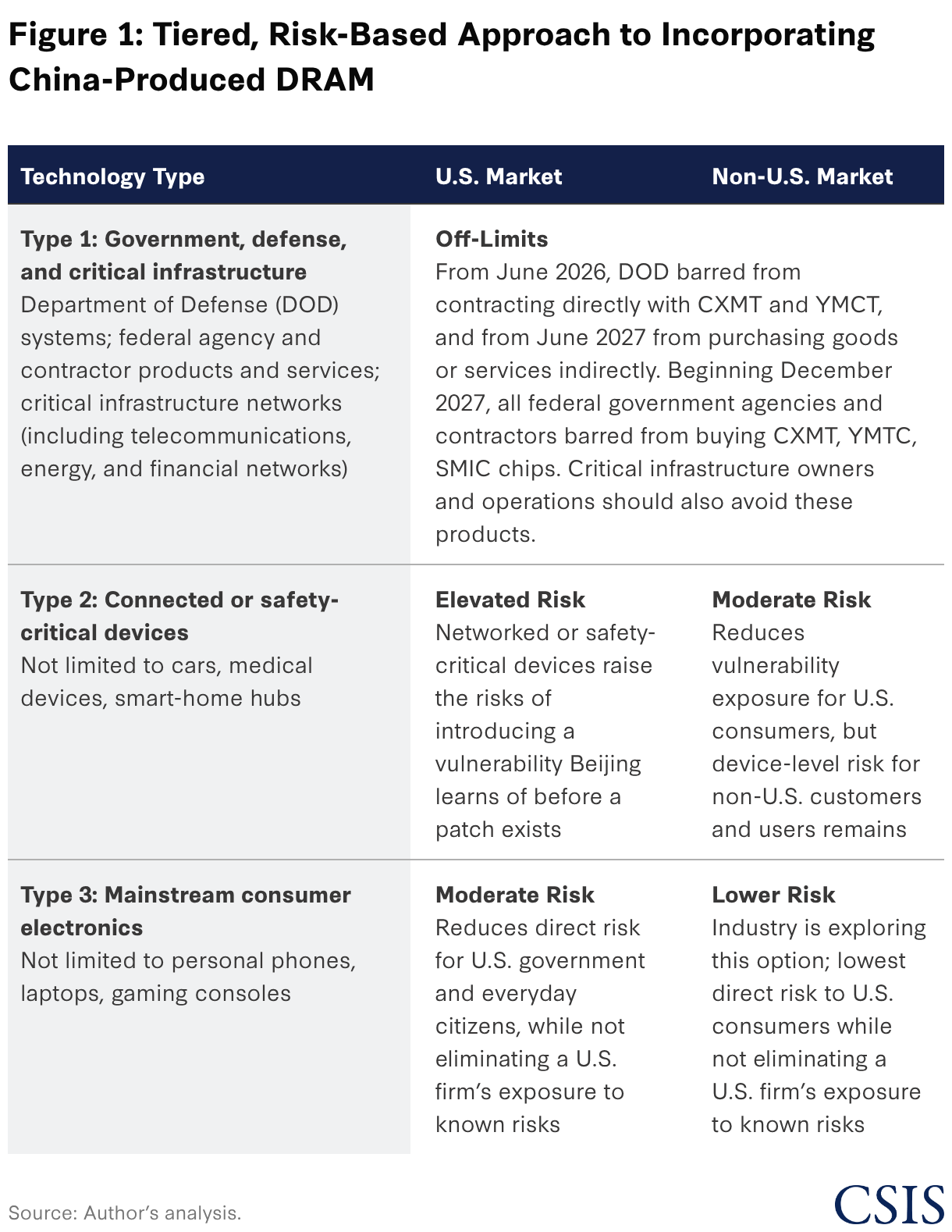
With the Beijing question unlikely to disappear while DRAM chip supply remains limited, a clear cost-benefit analysis of sourcing Chinese memory supply is essential. U.S. firms considering CXMT DRAM chips should base their evaluation on numerous risk factors, including procurement and export control considerations, cybersecurity and supply chain vulnerabilities, product sensitivities, and destination market, as well as long-term economic competitiveness. Figure 1 evaluates use of CXMT DRAM chips across these dimensions and introduces a tiered risk framework for consideration by policymakers and companies alike.

Today, companies looking to Chinese DRAM as an emergency measure should consider whether their use introduces procurement exposure, and whether possible export controls could make future sourcing unsustainable. Companies face two categories of U.S. policy hurdles. The first is procurement restrictions, limiting whether the U.S. government and its contractors can do business with CXMT and YMTC. These include the Pentagon’s 1260H List, which includes both firms, and the FY 2023 National Defense Authorization Act (NDAA) Section 5949 prohibition, coming December 2027. The second is export controls, including the Entity List, which currently includes YMTC but not CXMT. The Department of Commerce limits what U.S. technology can flow to firms on the list. While export controls do not prevent a U.S. company from buying Chinese DRAM, they do shape whether China is a sustainable source and how U.S. companies might think about anything beyond off-the-shelf purchases.
The Pentagon’s 1260H List, established in the FY 2021 NDAA, lists by name firms it considers “Chinese military companies” with ties to the People’s Liberation Army. As of June 8, 2026, both CXMT and YMTC are included on the list (after being briefly removed in February 2026). Listing carries legal consequences under Section 805 of the FY 2024 NDAA. The Department of Defense has been barred since June 30, 2026, from contracting directly with 1260H-listed companies, and from June 30, 2027, from purchasing goods or services from these entities indirectly through third parties. U.S. companies incorporating CXMT chips as components are not directly implicated, but should be aware of possible reputational consequences and heightened scrutiny from defense customers.
Additionally, the FY 2023 NDAA Section 5949 statute specifically prevents federal agencies and government contractors from buying semiconductors from CXMT, YMTC, and SMIC—another Chinese firm—beginning December 2027, a prohibition that will apply across the federal government. While this does not formally prevent U.S. firms from procuring DRAM from these companies, or individuals from purchasing laptops with these chips, it is likely to heighten scrutiny on business with these firms and should impact U.S. firms’ calculus.
Perhaps most well-known, the Department of Commerce’s Entity List requires a license for exports, reexports, and in-country transfers of items to listed foreign parties subject to U.S. export controls. Since December 2022, YMTC has been a listed entity, with a license requirement covering all such items and a presumption of denial. CXMT is not currently on the Entity List, but a possible listing is a prospective risk, though the Department of Commerce has not published new additions since October 2025 amid active trade discussions with Beijing. As experts have noted, if listed, CXMT could face reduced access to the U.S. tools, materials, and servicing its facilities require, impacting long-term reliability. And, while U.S. firms buying off-the-shelf chips is not considered an export, activities such as sharing product roadmaps or producing customized products with a listed supplier could require an export license that is likely to be denied.
Chinese DRAM also raises distinct cybersecurity and supply chain questions. Potential risks of embedding Chinese memory in U.S. companies’ products, none of which are particularly new, could arise on two different fronts.
Discussions around alternative chip supply take place against a backdrop in which U.S.-based Micron, and South Korea-based SK hynix and Samsung, are market-leading suppliers, accounting for roughly 90 percent of global DRAM revenue as of mid-2026, while CXMT holds a smaller, growing position. Samsung holds the largest revenue share at roughly 39 percent in Q2 2026, after reclaiming the top spot from SK hynix, which leads in HBM.
All three major firms are investing in manufacturing capacity on U.S. soil. Micron has committed more than $250 billion to U.S. fabrication and research and development through 2035, while SK hynix’s U.S. footprint centers on a roughly $4 billion HBM packaging plant in Indiana, with mass production targeted for 2029. Samsung’s largest U.S. project, its $37 billion Taylor, Texas, facility, is a logic foundry, so neither Korean firm’s U.S. investment has as yet added DRAM fabrication capacity.
In 2026, the Trump administration regularly threatened tariffs to pressure South Korean suppliers many U.S. firms currently rely on, a measure likely to exacerbate current challenges. In this context, introducing CXMT or YMTC chips into the U.S. market even for Type 2 or 3 products with moderate or low risk profiles could be inconsistent with broader administration efforts to onshore and friendshore chip capacity (see Figure 1). Further, with CXMT today accounting only for about 10 percent of global DRAM revenues (up from 4 percent in 2025), some experts are skeptical that introducing Chinese memory supply will meaningfully address current shortages.
How short-term introduction of CXMT chips into the U.S. market could affect competitiveness of U.S. and allied firms is a critical question for policymakers in search of solutions. Policymakers should consider whether potential purchases could affect the competitiveness of U.S. and allied memory suppliers over time. If they adopt measures to facilitate sales, they should tailor policies to ensure that any approach, including a temporary one, does not undermine U.S. and allied long-term memory investments.
Policymakers evaluating Chinese-supplied DRAM chips should take a clear-eyed approach to weighing risks against potential benefits. In addition to the factors described above, a risk-based approach should also consider any potential benefits of permitting consumer firms to incorporate limited CXMT chips for non-U.S. customers. These include the fact that any additional chip supply allows U.S. companies to produce consumer products they might otherwise forgo (or raise prices on during a supply shortage), while also strengthening their ability to maintain market share. In limiting potential products containing CXMT DRAM to Chinese markets, U.S. firms could reallocate memory supplied by U.S. and South Korean firms to U.S. and allied customers while potentially establishing a stronger foothold with Chinese customers.
Today’s export control and procurement landscape makes opportunities for introducing CXMT DRAM into U.S.-destined products high-risk for companies, particularly for Type 1 U.S. government, defense, and critical infrastructure uses. Type 2 connected or safety-critical products, such as cars, medical devices, or smart-home products, also face elevated risks due to China’s regulatory and cybersecurity landscape. Finally, Type 3 mainstream consumer products sold exclusively in China would present less exposure to sensitive U.S. government systems and U.S.-based users—though the company could still face cybersecurity and compliance risks (see Figure 1).
If, as some firms argue, limited use of CXMT DRAM could enable the manufacture of consumer products that would otherwise not be produced, then non-U.S. market segmentation could be one limited, short-term approach introducing the least risk to Americans. However, it is not a complete safeguard.
There are few easy solutions to today’s memory chip supply crunch. As U.S. companies urgently seek sources of conventional DRAM and supply is increasingly constrained by demand for HBM to fuel data centers, previously unheard-of policy solutions are now openly discussed. U.S. companies considering incorporating CXMT chips into their supply chains should take into account the risks presented in this analysis.
As policymakers actively develop solutions to U.S. firms’ and consumers’ needs, they should avoid binaries and consider the following risk-informed recommendations:
Lauryn Williams is deputy director and senior fellow in the Strategic Technologies Program at the Center for Strategic and International Studies in Washington, D.C.

Critical Questions by Lauryn Williams — July 31, 2026