Understanding the Memory Chip Crunch & the Way Ahead
November 20, 2026 • 10:00 – 11:00 am EST
Hosted by Strategic Technologies Program

Photo: WILLIAM WEST/AFP via Getty Images
Earlier this year, Tuvalu became the fourth nation in the Pacific to establish a law governing deep-sea mining (DSM) activities in its waters. Amid the global race for critical minerals, the idea of mining the deep seabed floor—sometimes at a depth of more than 6,000 meters—has increasingly gone from a far-fetched dream to near-term reality. In creating this new law, Tuvalu joined fellow Pacific Island Countries (PICs) the Cook Islands, Fiji, and Tonga in trying to get ahead of international interest in a way that both protects national sovereignty and resources and ensures national economic benefit.
Even as some Pacific nations consider future mining opportunities, others have expressed reservations or outright opposition. Palau and several other countries have proposed a resolution to the United Nations calling for a full moratorium on DSM. Meanwhile, external powers such as China, the United States, and Japan are actively pursuing mining exploration in national and international waters. Doubling down on President Trump’s 2025 executive order directing the United States to “unleash America’s critical minerals and resources,” the United States recently announced that it would open bidding for companies to mine in some of its territorial waters in the Pacific, and some analysts predict that commercial mining there could begin as early as 2027.
One nation at the forefront of this discussion is the Cook Islands, a Pacific nation of around 17,000 people in free association with New Zealand. With a large deposit of mineral resources within its own exclusive economic zone (EEZ), the Cook Islands has been considering the prospect of DSM for decades and already has DSM governance structures far ahead of most of the world. With numerous known seabed mineral deposits, the Cook Islands has also been courted by both China and the United States to partner on mining.
In this second essay in the CSIS Australia Chair’s DSM series, we explore how the Cook Islands has approached the DSM debate, including balancing public sentiment with economic opportunity and how it aims to manage growing external interest on DSM. While other Pacific nations may take their own path regarding DSM, the Cook Islands will likely be the first to pursue a fully articulated DSM strategy. What the Cook Islands does and how it manages the wide range of competing interests will matter—both for how other countries decide to pursue their own strategies, and for how external partners engage on DSM.
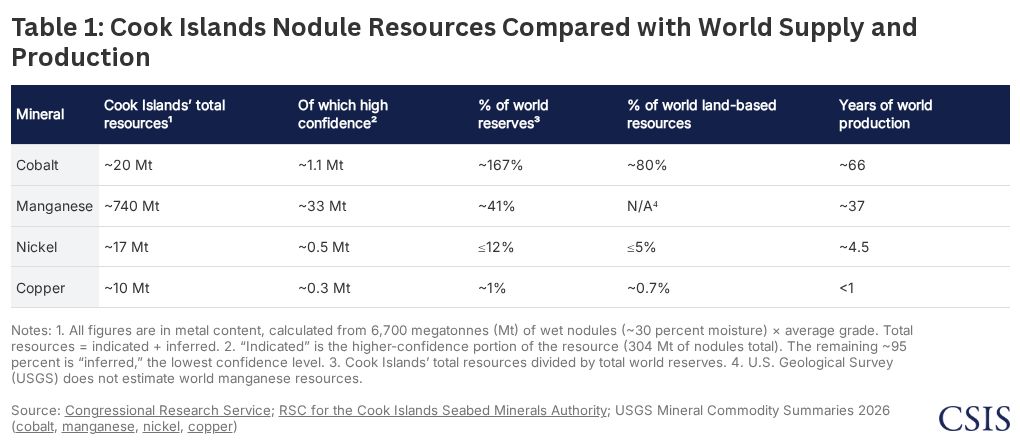
Exploration of seabed minerals within the Cook Islands EEZ has been underway for decades. The United States and Soviet Union separately carried out exploration there in the 1960s, including collecting some nodule samples through dredging the ocean floor. Subsequent missions from the 1970s to early 2000s revealed significant minerals both in the Cooks’ EEZ and in other areas throughout the Pacific. Total mineral deposits in the Cook Islands are estimated at 6.7 billion tonnes and contain minerals such as manganese, cobalt, nickel, copper, and rare earth elements. The estimated 20 million tonnes of cobalt have the most potential to make a global market impact, especially if the Cook Islands were able to capitalize on first-mover advantage (see Table 1).
As technical advancements have made DSM more of a reality, the industry has also faced growing pushback from environmental and civil society groups. In 2009, to foster more social license for potential mining exploration and to address concerns over environmental protection of marine life, the Cook Islands passed its first Seabed Minerals Act, which was updated in 2019. The current version mandates the establishment of a government body called the Seabed Minerals Authority (SBMA), which oversees all seabed minerals activities within the Cook Islands EEZ, works to inform the public, and advises the government on developments.
The Cook Islands government also created the Marae Moana Act in an effort to incorporate civil society into decision making. Marae Moana, the largest multiuse marine park in the world, covers the Cook Islands’ entire EEZ, totaling over 1.9 million square kilometers. The Marae Moana Council, made up of government leaders as well as private sector, NGO, and religious representatives from northern and southern islands, makes all decisions on its use, including mining and fishing. For a country that both values its rich marine ecology and depends on careful extraction of resources—including fish—Marae Moana represents the government’s effort to balance marine conservation with sustainable use of resources.
The SBMA has carefully incorporated Marae Moana into its regulatory framework and emphasizes a careful approach to mining exploration, noting that the Cook Islands “does not currently allow minerals harvesting or mining to take place—effectively acting as a moratorium,” although in theory that moratorium could end at any time.
In March 2026, Tanga Morris from the SBMA spoke at a seabed minerals conference in Bergen, Norway, where she emphasized that “The Cook Islands is taking a careful and science-led approach to seabed minerals so that any future decisions are informed by evidence and transparency.” Presenting itself as a responsible actor in the maritime domain—and as a global leader in DSM—has become central to the Cook Islands’ approach. As the SBMA often points out, the Cook Islands’ 2020 exploration regulations only allow for exploration licenses, not extraction. The first three five-year exploration licenses were issued in 2022 to CIC Ocean Research, Cobalt Seabed Resources, and Moana Minerals; the Cook Islands has not yet approved any extensions to these licenses, which expire in 2027.
The SBMA’s remit is to expand knowledge and advise the government. During a conversation with this author, John Parianos, knowledge management director at the SBMA, noted that ultimately the SBMA will not make the final call on when and if the Cook Islands progresses beyond exploration to resource extraction. He said the SBMA’s role is to oversee and manage existing seabed mining regulations and activity, and then to work with ministers on an assessment—but the final recommendation will be made by a committee before approval by the cabinet.
Ultimately, according to Cook Islands regulations, the onus is on the exploration license holders to execute sufficient impact assessments that stand up to peer review and scrutiny by the government. When there are gaps in the data, the SBMA directs companies to redo their assessments. The SBMA is also executing its own effects assessments to evaluate each possible risk by a measure of severity (how extreme an effect, such as sound, would be on the environment) and extent (how widespread a given effect would be). These effects are then extrapolated for various habitat types to replicate the ocean’s ecological variety. Furthermore, the SBMA is considering cross-boundary impacts, especially when two countries have bordering EEZs.
Parianos stressed that these evaluations are complex, including advanced calculations and predictive technology, especially in what is referred to as a cumulative effects assessment—where multiple effects are considered in a compounded manner, and at differing distances from each other. These results must then be weighed against an agreed value set to determine what is acceptable, which leads to inevitable questions given varying stakeholder priorities. Is any environmental degradation unacceptable? Or is the goal to conserve a certain percentage of each habitat type—for example, to ensure sustainable fish stocks over time? These are questions that the Cook Islands continues to grapple with.
The current Cook Islands government is largely supportive of DSM—or at least exploring the possibility of conducting DSM—as a way to diversify its narrow economy beyond tourism. But success of any potential extraction will depend on public support, which requires the government to prove that DSM is economically beneficial, technically possible, and, most importantly, environmentally sustainable.
The economic and technical questions are black and white in that they depend upon relatively objective data. However, the question of environmental sustainability—and acceptable environmental effects—is largely subjective. This is why public outreach has become a critical component of the SBMA’s work. According to Parianos, the SBMA and the Cook Islands government have conducted over 300 public consultations on DSM in recent years.
Despite this consistent outreach, the topic of DSM is far from settled in the Cook Islands. Several local NGOs, such as Kerero O Te 'Orau and Te Ipukarea Society, are active in either opposing DSM or pushing for more scientific research. Recent election polling also points to a large split, with just over 50 percent of voters opposed to the practice, although a significant minority are also in favor. Interestingly, this polling revealed that younger voters were more undecided on the issue, pointing to a gap in outreach.
In addition to environmental concerns, the public is also keen to ensure that local communities benefit from any potential mining. Concern that outside industry will reap most of the benefits of resource extraction is shared elsewhere in the Pacific. One challenge to ensuring local benefit is the limited human resources and technical expertise resident in countries with small populations. This, again, is where the SBMA can provide some safeguards for local populations by advising for equitable distribution of future profits.
The Cook Islands government has long known that, given its small size, engagement with external partners will be essential for any future DSM endeavors. And partners are interested: Over the past year, both China and the United States have signed DSM-related agreements with the Cook Islands. China signed a comprehensive strategic partnership (CSP) with the Cook Islands that included work on ports and seabed exploration, and the United States and the Cook Islands established a cooperative development framework for DSM. China has engaged other Pacific partners such as Kiribati in its pursuit of critical mineral resources, but no PICs are as far along in their approach and understanding of the DSM ecosystem as the Cook Islands, making it a particularly attractive destination.
Engagement with the Cook Islands is just one piece of the United States’ broader DSM efforts, which have ramped up significantly over the past 15 months since President Trump’s executive order declaring seabed minerals a “core national security and economic interest.” Since that time, the United States has pursued exploration off of American Samoa and the Commonwealth of the Northern Mariana Islands as well as in international waters. Doubling down on its interest in the Cook Islands, at this year’s Pacific Islands Forum Leaders’ Meeting, the United States announced plans to upgrade the country’s Omoka Port in partnership with New Zealand, a project directly linked to the aforementioned U.S.–Cook Islands critical minerals framework.
This heightened interest can be beneficial. According to Parianos, the Cook Islands has a scientific program “wish list” for partners that includes funding for environmental programs, mineral occurrence mapping, and capacity building for local scientists and administrators. Thus far, most engagement with external partners has centered around research, and work with China includes planning for future maritime research cruises. While discussions with the United States have been primarily focused on mining itself, the SBMA is in discussions with the U.S. National Oceanic and Atmospheric Administration (NOAA) and the Department of the Interior’s Bureau of Ocean Energy Management about studying transboundary impacts. As part of this collaboration, from July to August 2026, the NOAA research vessel Okeanos Explorer executed a 26-day expedition in the Cooks’ EEZ. This cruise, conducted in partnership with the SBMA, mapped over 24,000 square kilometers of ocean floor and collected various polymetallic, sediment, and water samples. While this expedition increased knowledge of the Cook Islands’ seabed floor, it also concluded that further study is needed to determine which locations have sufficient nodules to allow for economically viable extraction and to better understand the surrounding marine environment.
This interest also brings with it the overtones of great power competition, which has motivated a surge of partner interest in the Pacific islands in recent years—especially in security-related engagement such as policing, port and airfield infrastructure, and maritime security. It is within this context that China signed its CSP with the Cook Islands, which, while not explicitly a security agreement, did include security-adjacent sectors such as disaster relief, port infrastructure, and DSM—all of which sparked concern from the Cooks’ traditional partners, such as New Zealand.
On August 6, 2026, Ambassador Jared Novelly made history when he traveled to the Cook Islands from his post in Wellington, New Zealand, to present his credentials as the first U.S. ambassador accredited to the country. In his short time as ambassador to New Zealand, Samoa, and the Cook Islands, Novelly has already clarified that the Cook Islands, with its rich seabed mineral resources, is “1a or 1b” on his priority list. In a sign of DSM’s intersection with great power competition, Novelly has also warned the Cook Islands and other Pacific nations that dealing with China comes with inherent risks.
Novelly’s words are a reminder that even as the Cook Islands government executes what it views as a measured approach to DSM, its efforts are not done in isolation of external forces. As the global race for critical minerals intensifies, balancing the economic urgency of pursuing mining—and potential pressure from larger powers—with ensuring resource extraction remains environmentally sustainable will grow increasingly complex.
The Cook Islands’ government has clearly recognized the importance of building social license and working with a broad range of stakeholders, from environmental NGOs to civil society leaders, even as it pursues exploration. Whether it can maintain this deliberate approach while navigating external interest amid U.S.-China great power competition, however, is yet to be seen. Yet one thing is clear: Given the Cook Islands’ position at the front of the pack of countries considering seabed mining, how, if, and when the Cook Islands proceeds with DSM will likely shape the future of mining—and great power competition—across the Pacific.
Kathryn Paik is deputy director and senior fellow with the Australia Chair at the Center for Strategic and International Studies in Washington, D.C.

Commentary by Kathryn Paik and John Augé — September 3, 2026

Critical Questions by Kathryn Paik and Gracelin Baskaran — August 20, 2025
