Capturing National Security Benefits from Offshore Wind
October 20, 2026 • 9:30 – 10:30 am EDT

Photo: JOHNNY BEASLEY/AFP via Getty Images
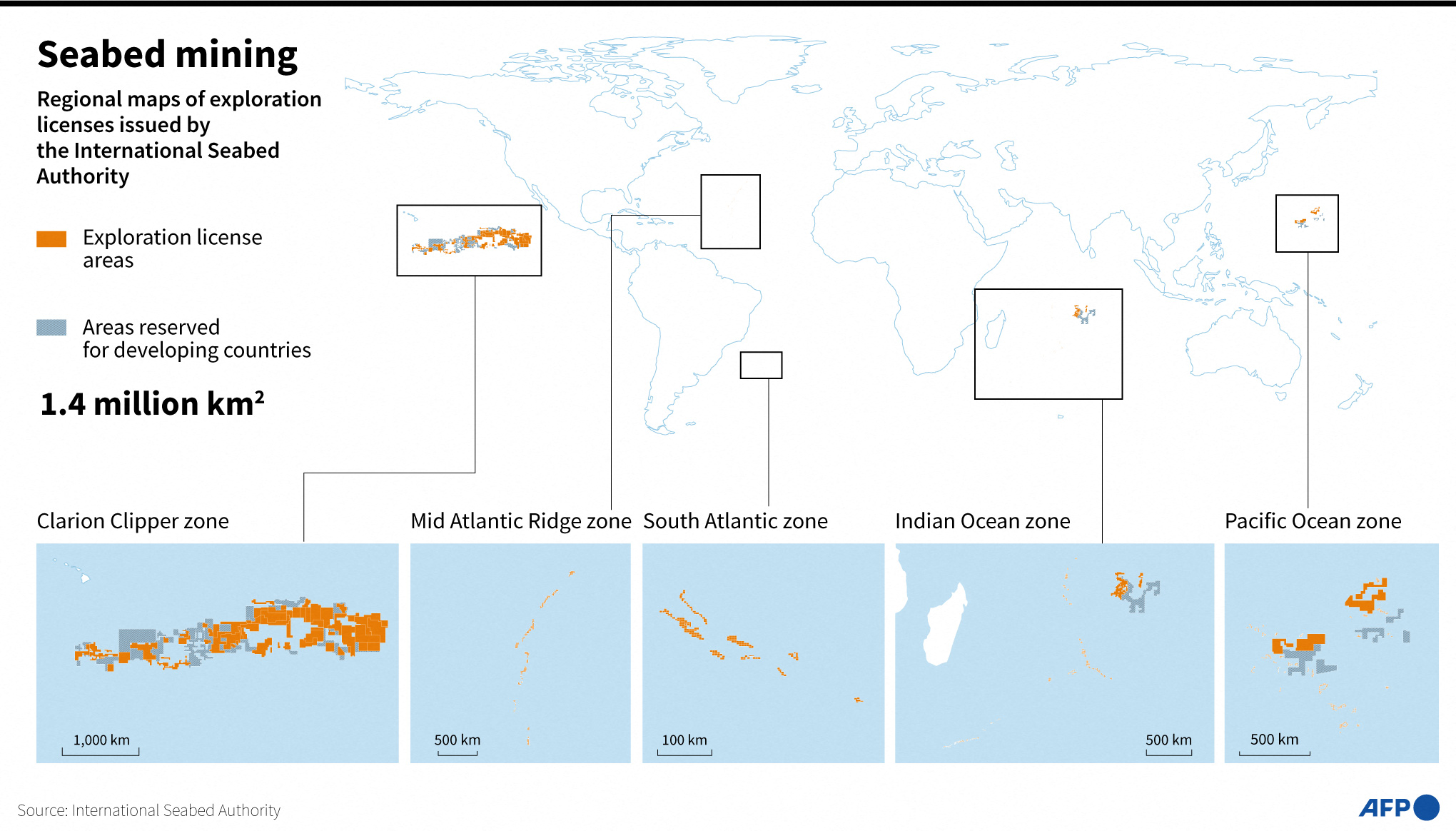
As countries race to secure critical minerals to power their economies, they are pursuing major deals, initiatives, and agreements to develop and acquire mineral resources. The latest front of this race is not taking place on land, however, but in the depths of the ocean, where governments and industry alike have begun to turn to the promise of vast mineral resources on the seabed floor. The Pacific Islands region, which stretches across almost a fifth of the world’s surface and holds vast amounts of untapped mineral resources, sits at the heart of this issue—and is ground zero for determining how the international community will approach deep-sea mining (DSM) in the future.
The broad confluence of issues surrounding mining the seabed floor—including considerations around geostrategy, development, environment, regional cohesion, and economic security—has yet to be comprehensively addressed. Yet all these factors make the debate over DSM particularly acute across the Pacific, as it both promises significant economic rewards but also potentially threatens the critical marine environment.
To help fill some of this gap, the CSIS Australia Chair has launched a new roundtable and essay series on DSM in the Pacific to highlight the major actors at play and examine the challenges and opportunities that this development portends. This first essay provides a background on the evolution of DSM in the Pacific, offers some insight into the range of actors and activities across the Pacific, and finally lays out some of the major developments to watch for in the months and years ahead. While many questions remain about the future of DSM, what is clear is that whatever happens in the Pacific—whether that is a move toward full extraction, a pause for further research, or a full moratorium—will affect the debate globally.
While the existence of minerals on the seabed floor has been well known for years, technological advances and increased urgency over securing essential minerals have given the topic renewed prominence in national security discussions and mainstream global news sources.
In recent years, the Pacific has emerged as a focus region for early exploration and the proliferation of DSM-related agreements. A shift in U.S. posture has spurred much of this activity. In April 2025, President Trump released an executive order directing his administration to “accelerate the responsible development of seabed mineral resources,” thereby drastically shifting U.S. policy to be aggressively in favor of pursuing DSM. The United States is also actively exploring opportunities off its territories in American Samoa and the Commonwealth of Northern Marianas Islands (CNMI), as well as indicating a willingness to circumvent the International Seabed Authority (ISA) by potentially pursuing mining in international waters.
While some Pacific nations have welcomed this shift to align with what they view as an economic opportunity, others have voiced alarm. The Pacific region is intensely vulnerable to global economic shocks and climate change and is heavily dependent on its maritime resources—including its valuable tuna stocks, which supply up to 60 percent of the world’s tuna. Thus, the risks and benefits of DSM are front of mind for Pacific nations, and the topic remains one of the more divisive issues in the region.
The Pacific is already an arena of great power competition given its strategic location, but the mineral wealth on the Pacific’s sea floor has brought with it increased attention from larger powers vying for influence in order to pursue their own objectives throughout the region. Over the last year, both China and the United States signed agreements with the Cook Islands on DSM: For the United States this was a cooperative development framework, and for China this was in the form of a broader comprehensive strategic partnership. More broadly, China has also explored cooperation with Kiribati and regularly conducts seabed mapping expeditions in the Pacific to expand and secure its knowledge of and access to potential seabed mineral wealth.
China and the United States are not the only large powers actively pursuing DSM in the Pacific. In January 2026, Japan sent an exploration crew to Minamitori Island in the northwest Pacific and announced in July that it would test the island’s coastal seabed for rare earth muds. Following Japanese Prime Minister Sanae Takaichi’s White House visit with President Trump in March 2026, the two nations announced plans to increase cooperation on the development of deep-sea critical minerals, including rare earth muds around Minamitori Island.
In the Pacific itself, stances on DSM vary widely, from actively courting interested investors to pursuing a full moratorium. Naoero’s President David Adeang laid out his country’s pro-DSM posture when he stated that “the greatest risk we face is not the potential environmental impacts of mineral recovery but the risk of inaction. There is a risk of failing to seize the opportunity to transform to renewable energy and decarbonize our planet.” The Cook Islands, which has large seabed mineral resources within its exclusive economic zone, is also allowing exploration within its waters and is currently conducting research to inform future government decisions.
Conversely, other nations are pursuing a full moratorium to protect what they view as highly vulnerable marine resources. The French territory of New Caledonia has instituted one of the most anti-DSM policies in the Pacific, implementing a 50-year ban on DSM across its entire maritime zone. New Zealand has also supported an international ban on DSM since 2022, although it considered withdrawing its support in February 2025.
Australia, also a Pacific Islands Forum (PIF) member, has been more circumspect in its approach, although it sometimes cites environmental, regulatory, and economic concerns. Despite being a large, land-based mining nation, it has avoided taking an open stance on DSM itself, including omitting it from its Critical Minerals Strategy 2023–2030, likely in an effort to avoid alienating any one PIF member as it drives toward solidifying security agreements across the Pacific.
At the regional level, there have been efforts by the Pacific Islands Forum Secretariat (PIFS) to reconcile differences while promoting Pacific traditions of respect and consensus. In February 2025, the PIFS hosted a high-level meeting on deep-sea minerals that brought together the region’s leaders to discuss DSM. At the meeting, PIFS Secretary General Baron Waqa highlighted that “this is not a negotiation, but rather, today, as a first step, we now have an opportunity to actually speak to each other.” One of the key areas of consensus has been on strengthening science, data, and traditional knowledge. There is also support for the establishment of an independent regional knowledge hub, seabed minerals atlas, and research on transboundary impacts. At the 2025 Pacific Islands Forum Leaders Meeting, leaders supported a member-led regional approach to deep-sea minerals.
The ISA has recognized the Pacific’s centrality in this sector, and in May 2026, it convened representatives from Pacific nations and regional organizations for the Pacific Small Island Developing States Regional Workshop on Deep Seabed Sustainable Blue Growth Initiative. Latishia Maui-Mataora from the Cook Islands Seabed Minerals Authority highlighted that workshops such as these allow Pacific nations to build their knowledge base on DSM, inform their decisionmaking, and have a voice on the global stage.
A growing number of companies have expressed interest in seabed mining, even as the industry has yet to demonstrate that the practice is economically feasible. The dramatic shift in U.S. posture has played a significant role in opening new opportunities in the DSM field. In 2025, The Metals Company (TMC), a Canadian firm, attempted to bypass the UN process by applying for U.S.-sponsored ocean mining permits in international waters.
Challenging TMC’s sectoral dominance is the American Ocean Minerals Corporation (AOMC), which recently merged with Odyssey Marine Exploration. AOMC has investments in two of the three licensed exploration projects in the Cook Islands: Moana Minerals Ltd. and CIC Ltd. At a U.S. Department of State roundtable discussion in August 2026 featuring senior-level U.S. administration officials and the mining industry, AOMC Chairman Tom Albanese gifted President Trump a gold polymetallic nodule replica “celebrating a new golden age of American minerals.”

President Trump holds a solid gold replica of a deep sea nodule gifted by Tom Albanese, chairman of the American Ocean Minerals, during a roundtable on the American mining industry at the U.S. Department of State in Washington, D.C., on August 7, 2026. | Photo: Kent Nishimura/AFP via Getty Images
Impossible Metals is also an active player in this space. In April 2025, it asked the U.S. government to launch a competitive lease process for nodules in American Samoa’s waters. Other interested companies include Glomar Minerals, which, through its subsidiary UK Seabed Resources, began its fourth exploration campaign of the Clarion Clipperton Zone in July 2026, and Deep Sea Minerals Corporation, which has begun conversations with Pacific countries on exploration.
Source: AFP via Getty Images.
As interest in DSM has grown, so have concerns over potentially devasting environmental effects, including the potential for direct ecological damage, reductions in biodiversity, and changes to the structure and function of ecosystems caused by new and relatively untested methods of extracting minerals from the deep ocean floor. There is also the potential for severe impacts on fisheries and coastal communities because of reductions in fish stocks and damage to marine habitats. Another risk is ocean noise pollution, whereby mining itself introduces unnatural and excessive sounds that can disrupt the natural behavior of marine life in a way interferes with migration and reproduction. Mining activities also discharge waste plumes, introducing nutrient-poor sediment into the water that could starve zooplankton and micronekton and affect larger food chains. The release of carbon could also weaken the ocean’s ability to moderate temperatures. While there are many risks, however, the extent to which any one of these factors—or multiple factors compounded in one area—will actually affect marine ecosystems remains unclear. This is due both to insufficient knowledge of deep-sea ecosystems and to gaps in understanding of the full extent of the impacts of DSM on these ecosystems.
Civil society has emerged as an important voice in shaping the Pacific’s debate over DSM, with positions ranging from advocating for permanent moratoriums to pushing for additional research and stronger regulations. Concerns regarding the environmental impacts, equitable distribution of profits, and whether governments can secure social consent from local communities continue to be raised at local, national, and international levels. Many environmental NGOs are also active in this space. Greenpeace, a global nonprofit organization, has started a petition to ban DSM, intervened at mining conferences, and conducted peaceful actions in the ocean. Some organizations, such as Fa‘asao Amerika Samoa and the Conservation Council for Hawai‘i, have filed lawsuits against the U.S. government. Pacific governments considering DSM must therefore navigate a difficult line between pursuing potential economic opportunities and securing domestic support.
How things play out in the Pacific region will lay the groundwork for how DSM proceeds globally. The stakes are high—for the environment, for great powers vying for critical minerals, and for Pacific Islanders themselves.
As this complex issue evolves, there are several key areas that warrant further attention:
DSM has moved from a theoretical discussion toward actual engagement through exploration, investment, and political activity. However, fundamental questions remain about whether the industry can be economically viable and proceed without unacceptable environmental and social costs. The decisions and actions made in the coming months and years, including U.S. and international regulatory actions as well as the results of environmental and commercial testing, will help determine whether DSM becomes a viable source of critical minerals or remains largely aspirational. For better or worse, the Pacific is ground zero for answering many of these questions, and for shaping the future of seabed mining globally.
Kathryn Paik is deputy director and senior fellow in the Australia Chair at the Center for Strategic and International Studies (CSIS) in Washington, D.C. John Augé is program manager for the Australia Chair at CSIS.

Critical Questions by Kathryn Paik and Gracelin Baskaran — August 20, 2025