The UN is Due for a Reboot
November 24, 2026 • 9:15 – 10:00 am EST
Hosted by Global Development

Photo: Create Image/Getty Images (Non-AI)
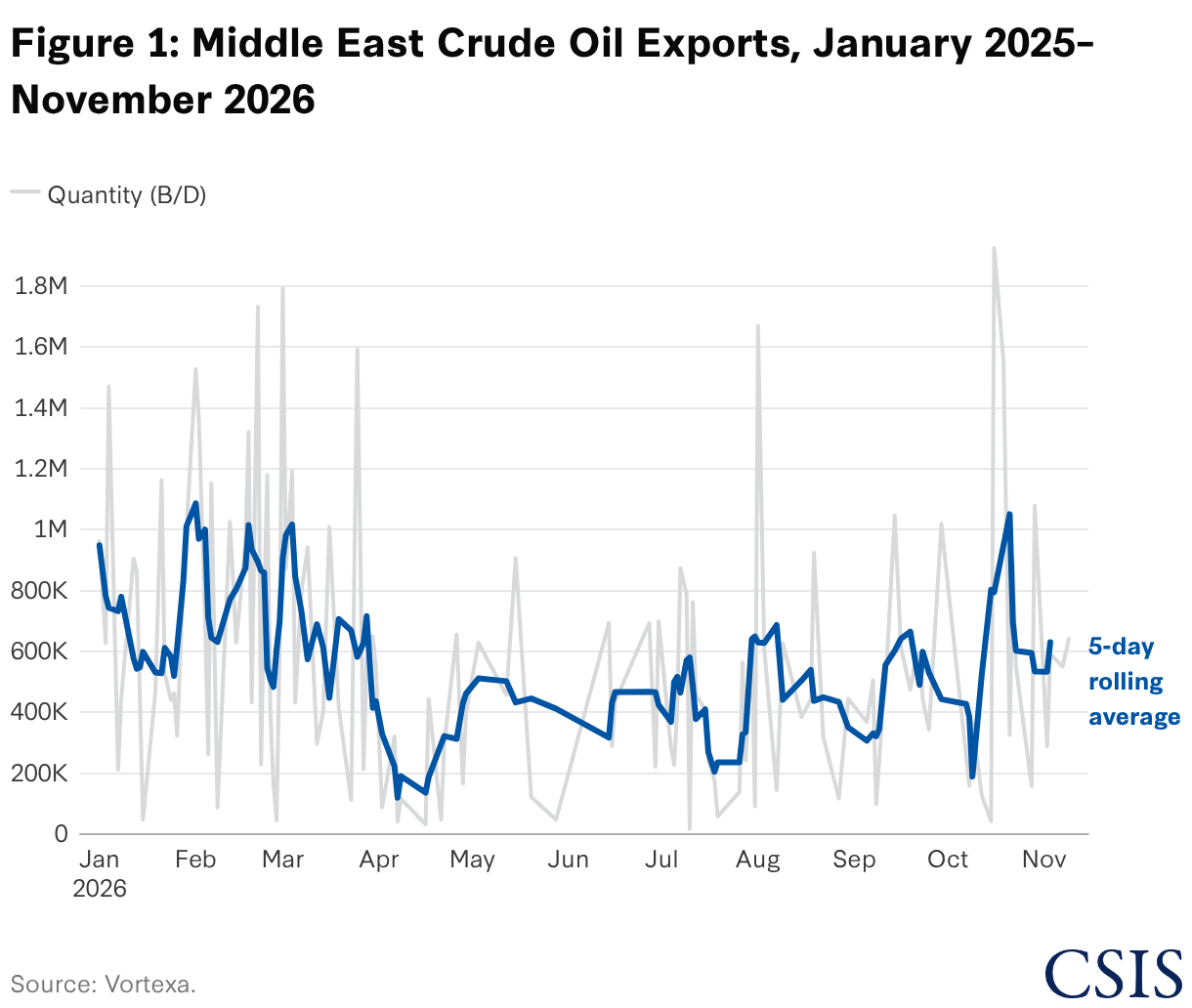
In a recent 60 Minutes interview, President Trump asserted that the Strait of Hormuz remains open, allowing for commercial shipping to move through the waterway. Since March, Iran has throttled merchant vessel movement through the strait without completely closing the waterway. In May 2026, the U.S. Navy created a security corridor for commercial vessels and instituted a blockade preventing the export of Iran’s crude. By September, the amount of crude oil passing through the Strait of Hormuz reached prewar levels. The price of crude oil has since declined and even briefly slipped below $90 per barrel as hopes of an end to the conflict have increased. However, prices of refined products, including diesel, jet fuel, and gasoline, as well as freight and insurance, have remained elevated.
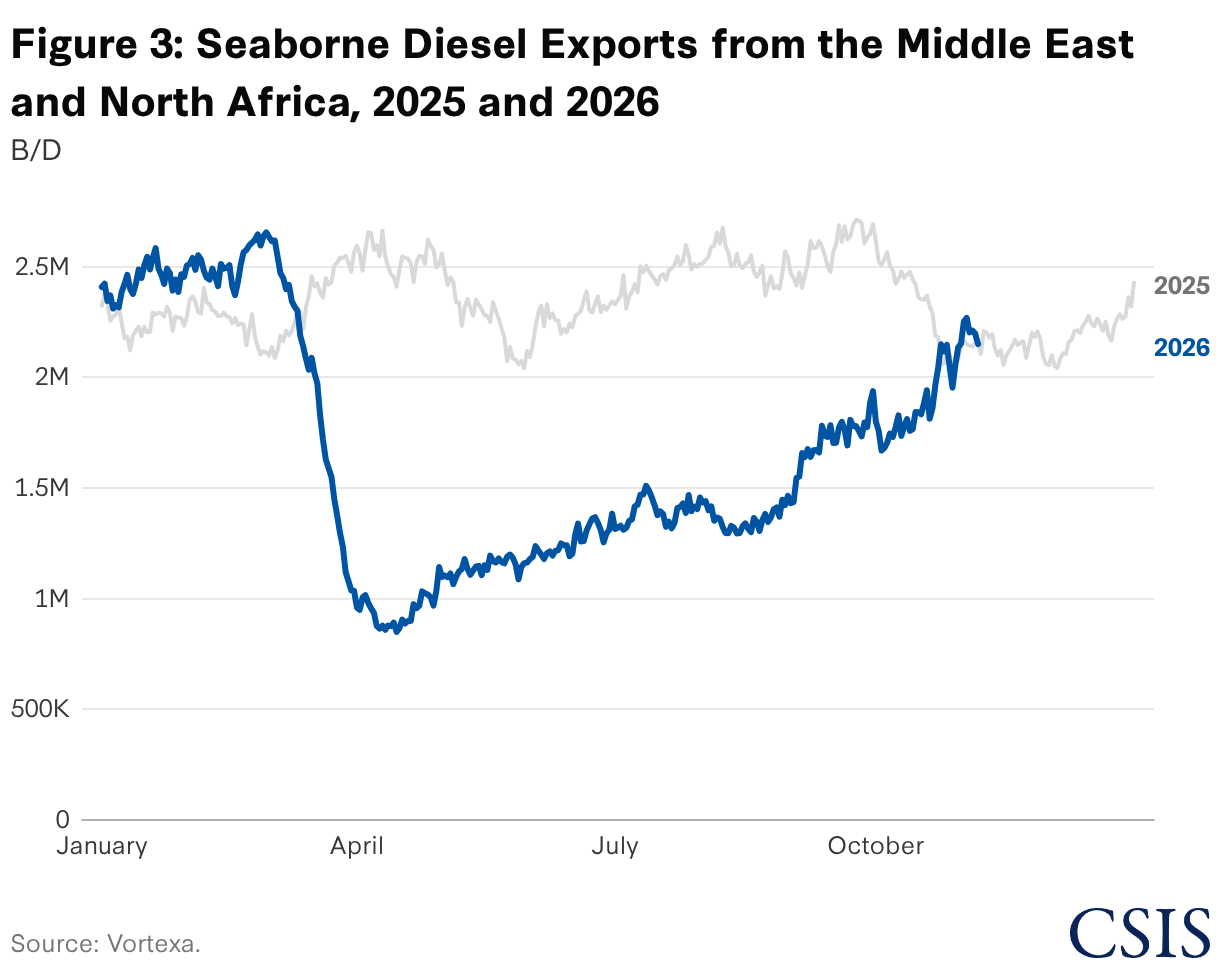
Refined product prices remain resiliently high for four reasons: (1) the Strait of Hormuz is not yet open to all petroleum products; (2) damage to refineries has resulted in shortages and high prices, acting as a constraint on the ability to refine the higher volume of crude moving through the strait; (3) International Energy Agency (IEA) members released 330 million barrels (mb) of crude oil from their strategic petroleum reserves (SPRs) but have thus far protected domestic reserves of refined products; and (4) the conflict has increased risk insurance premiums and imbalances in the supply and demand of tankers carrying crude oil and refined products, pushing transit costs to historic highs.


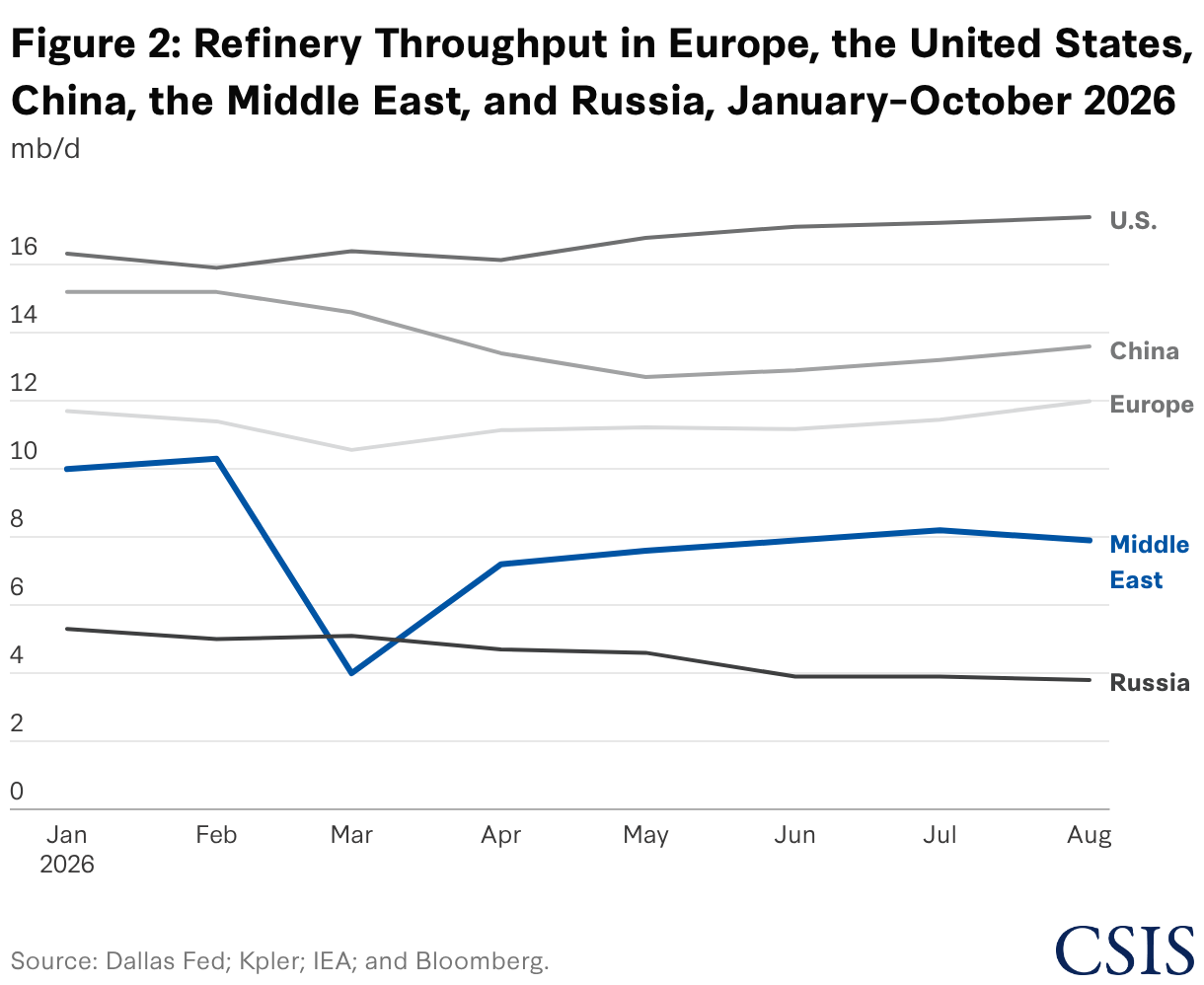
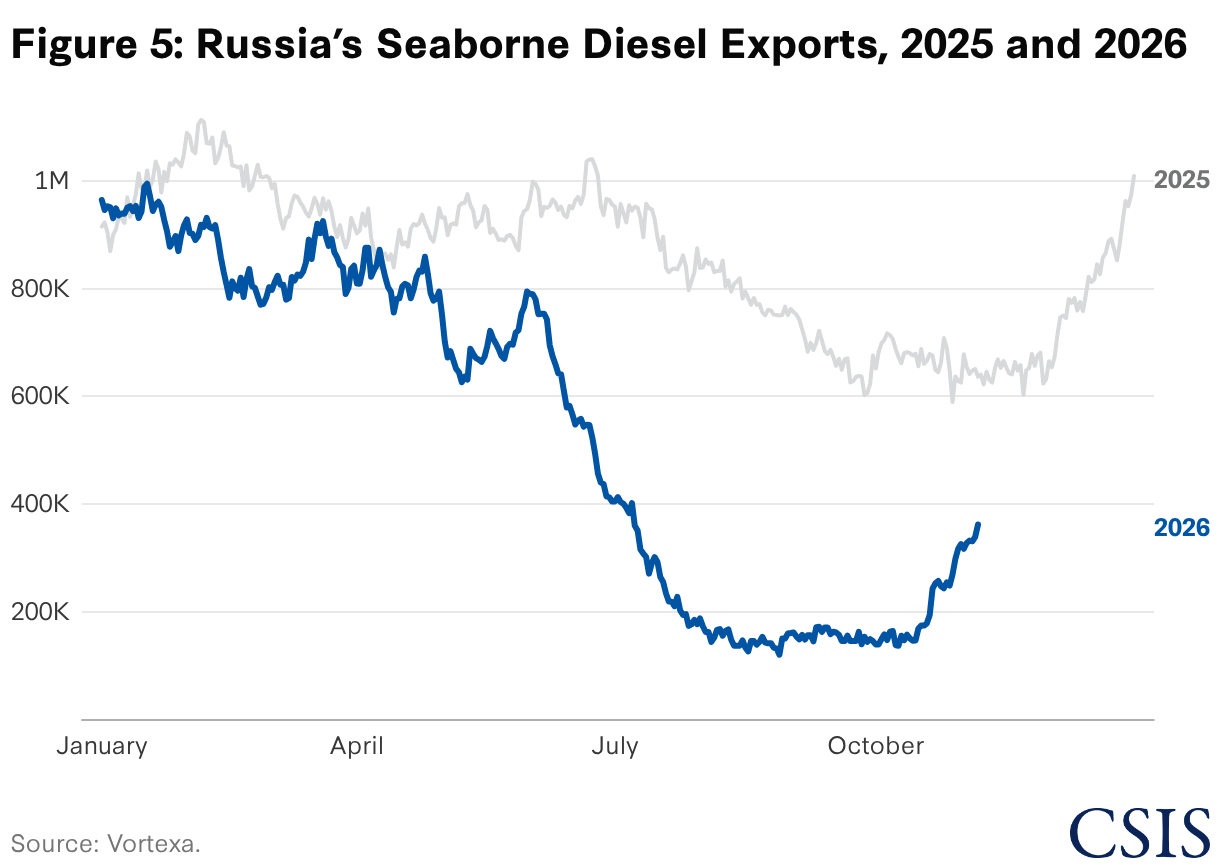
Ukraine’s attacks on Russia’s refining facilities have resulted in a 60 percent decrease in refining capacity. Domestic shortages forced Moscow to extend its July 2026 ban on diesel exports and other refined products to January 2027 and import refined fuel from India, Egypt, and South Korea. Ukraine’s attacks on Russia’s refineries continue, with six targeted in the first week of November.
According to the IEA, diesel market tightness persists due to supply disruptions, counter-seasonal stock draws ahead of peak winter fuel demand, and autumn refinery maintenance in the United States, Canada, and parts of Europe. In September 2026, global refinery throughput, or the volume of products refined from crude oil, declined from 83 mb/d to 82 mb/d month on month.

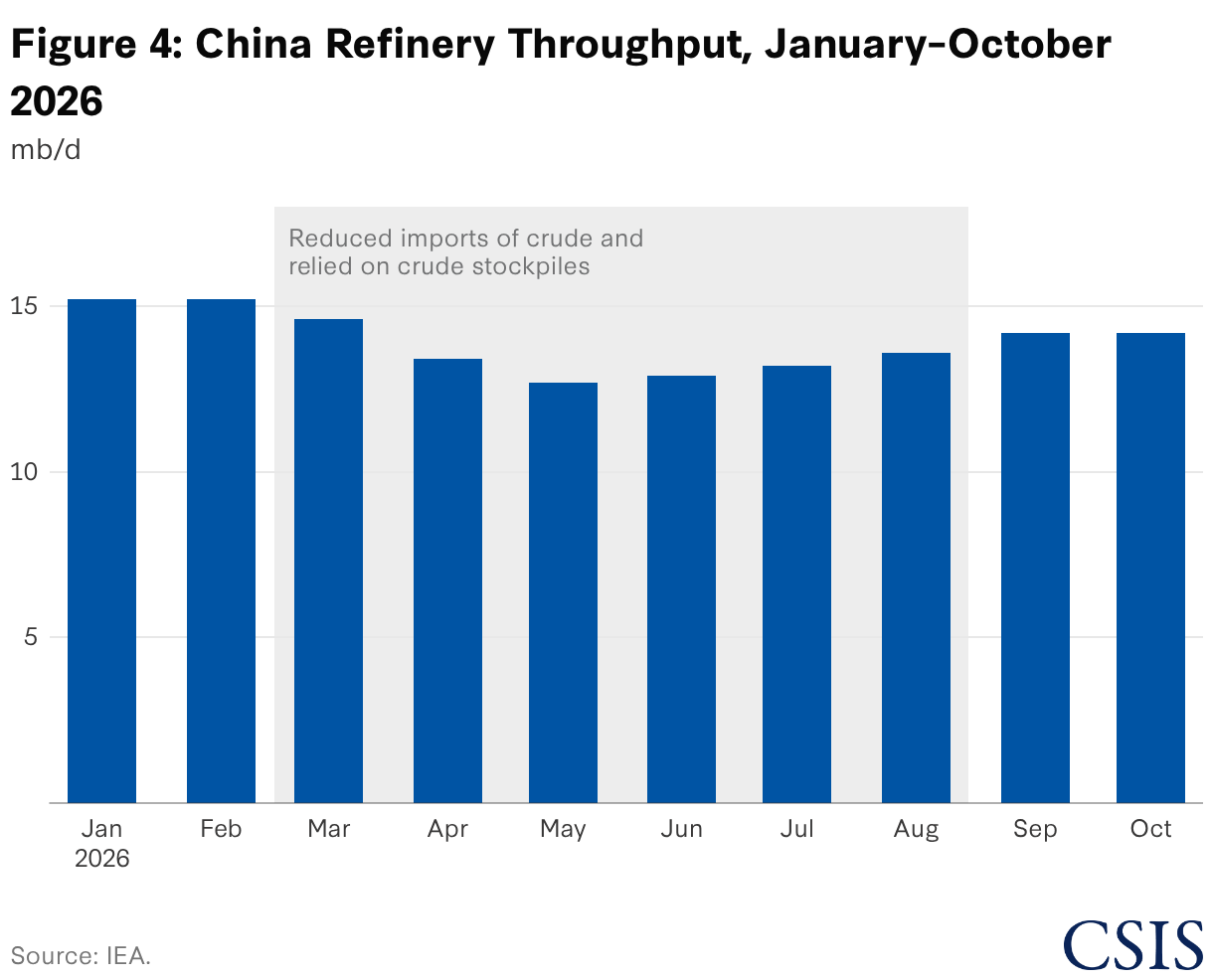
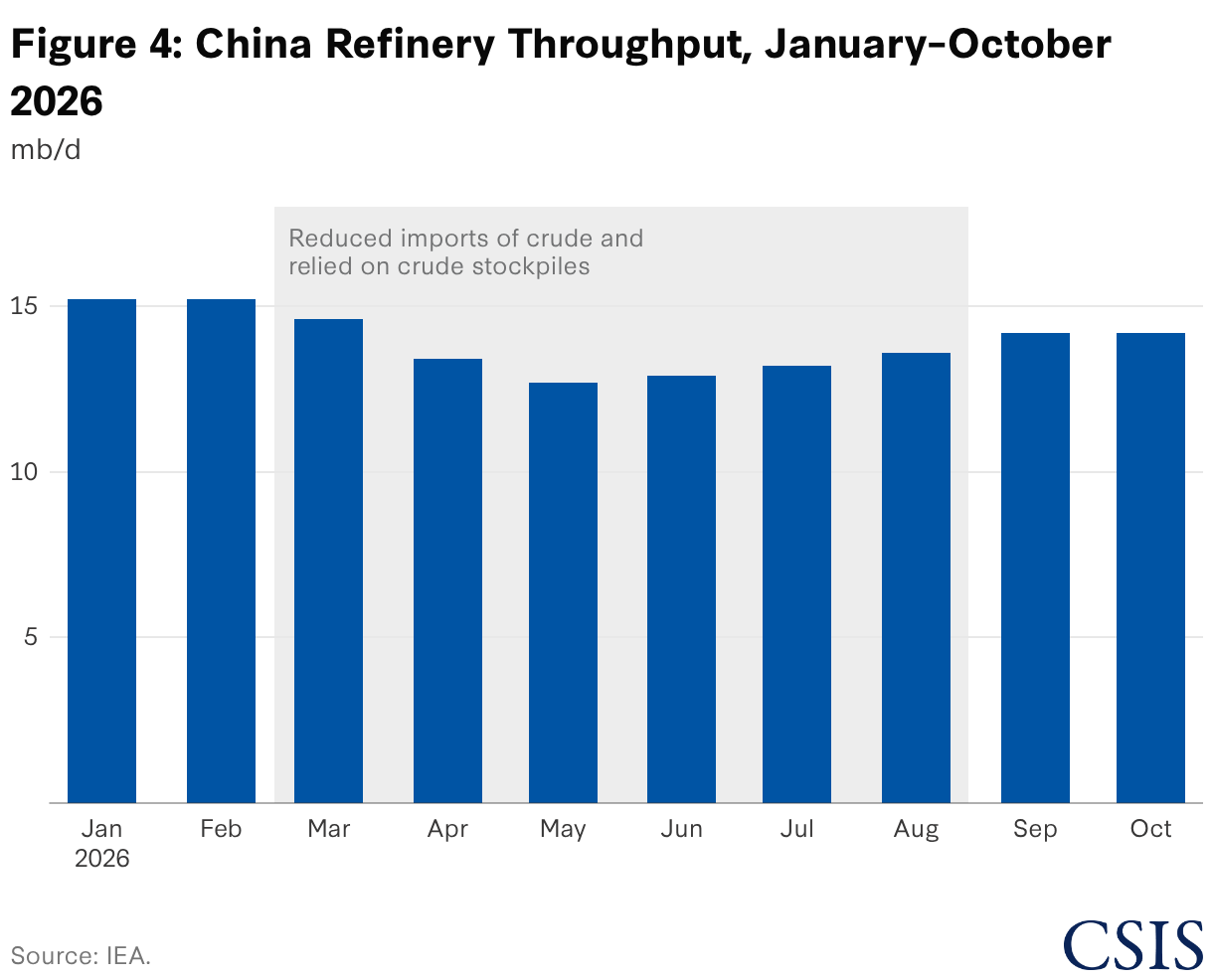
China carefully manages strategic stockpiling of crude oil and refined products. China reduced imports of crude during the first six months of the U.S.-Israeli conflict with Iran, relying on significant crude stockpiles. This move was likely aimed to insulate China’s consumer goods export markets in East and Southeast Asia. To protect its domestic market, China has carefully managed monthly shipments of refined products since the start of the conflict, throttling exports of refined fuels from March to July and allowing exports in August and September. However, from January to August 2026, China’s total exports of refined products declined by 9 percent year on year, contributing to market tightness for refined products. China’s tight domestic diesel inventories risk renewed government restrictions on the export of diesel in November, putting more stress on an already tight market. However, a November 19 statement following the meeting of President Trump, President Xi, and President Putin said the United States, China, and Russia committed to increase production and supply of refined products “for the benefit of all nations.” The timeline, production targets, and extent of each country’s commitment remain unclear.
A series of policy efforts to address energy market imbalances have thus far have provided little to no relief for consumers:
The U.S.-Russia October 2026 deal on diesel faces logistical and legal challenges.
On October 9, President Donald Trump and Russian President Vladimir Putin agreed for Russia to sell diesel to the United States. Moscow carved out an exception for diesel sales with the United States but extended the partial export ban until January 31, 2027. The U.S. Department of the Treasury issued General License 135, a waiver of sanctions on Russian energy products imposed by the Lindsay Graham Act of 2026 until April 7, 2027. The bipartisan Special Russian Sanctions Authority Act of 2022, which bans imports of Russia’s oil and refined products until it withdraws from all Ukrainian territory, remains in place, raising the risk of sanctions related to imports of Russian energy products.
The volume of promised Russian diesel is not enough to bring down the price of diesel in the United States. The first shipment of 2.25 mb for one month, or 74,500 b/d, represents 1.4 percent of daily diesel production by American refineries and 0.3 percent of global diesel demand of 28 mb/d. The shipment scheduled to arrive in the United States in early November instead went to Brazil, as American customers deemed the risk of sanctions too high. The November and December diesel deliveries hedge on the condition of Russia’s refineries, which are producing at their lowest rates in 20 years due to continuous attacks by Ukraine. Even if Russia overcame the hesitation of customers and refinery damage to produce additional diesel, Russia would not export it. Russia produces winter-grade diesel in October and November for domestic use and sells off summer-grade diesel stock every fall to make space to store winter diesel.
The Jones Act waiver and the U.S. Navy security corridor have helped bring some cost savings and restore crude flows through the strait.
The waiver to the Jones Act and the U.S. naval security corridor in the Strait of Hormuz worked relatively well but provided limited economic relief to U.S. consumers. The Trump administration has temporarily lifted Jones Act restrictions that require goods shipped between U.S. ports to move on U.S.-flagged, -built, and -crewed ships. The administration extended this waiver on November 15, allowing refiners to continue saving around $0.82 per barrel of diesel.
The U.S. Navy facilitated the return of crude tankers transiting the Strait of Hormuz to prewar levels. However, using the military to facilitate commerce comes at high cost to the United States. The sustainability of this arrangement remains unclear going forward.
However the U.S.-Iran conflict evolves, the Strait of Hormuz will remain a chokepoint for 20 percent of the world’s seaborne crude oil. Gulf producers’ aggressive expansion into refining over the last 20 years secured around 80 percent of Asia’s refined products market. To offset the risk of disruptions in the future, producers in the Gulf can increase investments into refining capacity and storage closer to their customers in Japan, India, China, and South Korea. Gulf producers can also invest in storage in the United States, further reducing the risk of significant shut-ins due to renewed conflict in the region.
Domestically, this crisis has disproportionately affected American farmers and truckers, who use machinery that runs on diesel. In the long run, reducing reliance on diesel helps insulate the agricultural sector from global shocks. Regular engine maintenance, route optimization, and amending driving habits can potentially generate 10 to 20 percent savings on the cost of diesel. Bulk purchases of diesel can also help but is only a viable solution when the price of diesel declines. Practices such as managing driving speed, reducing idling, and smoothing acceleration can make a 20 to 30 percent difference in the consumption of diesel. Regularly cleaning air filters, calibrating injectors, ensuring the correct tire pressure, and using the right kind of engine oil ensures that the vehicle runs at peak efficiency, reducing excess consumption of diesel related to poor maintenance. Finally, planning routes from departure, pickup of product, and delivery can reduce unnecessary diesel consumption. Similarly, farmers can reduce diesel costs by switching from conventional tillage to a no-till system, which helps reduce the use of diesel from 6.6 gallons to 3.6 gallons per acre; replacing diesel-powered irrigation pumps with solar pumps; optimizing equipment to maximize fuel efficiency; or switching to electric tractors, if available.
Rising fuel prices also changed the economics of producing biodiesel and renewable diesel. High fuel prices and the implementation of the 45Z clean fuel production credit can help boost incentives to produce sustainable fuels in the United States, Mexico, and Canada. The tax credit starts at $1 per gallon of transportation fuel, but since the tax credit scales up based on lower-carbon-intensity fuel, producers can earn higher credits. The tax credit includes production of ethanol, biodiesel, renewable diesel, sustainable aviation fuel, and renewable natural gas. Producing these fuels from manure, landfill gas, and crops earns 45Z credits. To meet stronger demand for biofuels and to counteract increasing prices of food, plants in the United States are buying bulk feedstocks from Brazil, Europe, China, and Malaysia.
Masha Kotkin is a fellow in the Energy Security and Climate Change Program at the Center for Strategic and International Studies in Washington, D.C. Chelsey Gilchrist is an intern with the Energy Security and Climate Change Program at CSIS.

Commentary by Masha Kotkin — September 18, 2026

Commentary by Joseph Majkut, Masha Kotkin, Caroline Russell, and Alex Garcia — September 17, 2026

Commentary by Raad Alkadiri — September 11, 2026