Unmanned Systems, U.S. Drone Investment, and Lessons from Ukraine
November 30, 2026 • 9:00 – 10:00 am EST

Photo: Sun Xiang/Xinhua via Getty Images
China ramped up its military activities across the Western Pacific in late October through early November 2026. Compared to earlier this year, these two months saw significant increases in select Chinese military activities. However, in contrast to recent media headlines claiming that China engaged in a single, large, and unprecedented unnamed exercise, there is no strong evidence to support the view that the large number of simultaneous deployments of Chinese military assets around this time constitutes a single well-coordinated military campaign or exercise. Rather, the increase in Chinese military activity in October and November coincides with the typical annual increase during this time of the year. Additionally, the varied sequencing and timing of Chinese activities also suggest that there were likely multiple operations occurring at or around the same time, each with its own set of political objectives. When viewed in isolation, most of the individual Chinese military operations in late October and early November were not new, and many did not surpass Chinese activities conducted in prior years. The major exception was the deployment of four naval task forces from three Chinese military theater commands in the Philippine Sea, which was one of China’s largest naval deployments beyond the first island chain.
Although these operations should not be assessed as a coordinated unprecedented large-scale exercise, they were significant in demonstrating China’s ability to target and coerce multiple U.S. allies and partners at the same time. The near-simultaneous execution of multiple military operations involving a large number of Chinese military assets also provides valuable training and experience for the People’s Liberation Army (PLA) in preparing for different Taiwan contingencies. There is also a risk that China could view its recent operations as successful, which could encourage it to engage in more coordinated and unnamed military activities or exercises in the future.
On October 28, Taiwan National Security Council Secretary-General Joseph Wu released an image on social media depicting 53 PLA Navy (PLAN), China Coast Guard (CCG), and maritime security vessels operating in several groups in the Philippine Sea, around Japan, near Taiwan, and in the South China Sea. The next week, on November 3, he shared an updated image showing the approximate locations of over 100 PLAN and government vessels across the region, followed by a third post on November 12 depicting 55 PLAN, CCG, and maritime security vessels. A senior Taiwan official also claimed that during this period, a Chinese submarine in the Yellow Sea launched an intercontinental ballistic missile (ICBM) that flew inland toward China. This claim was originally captured widely in media, but it disappeared from some news articles by mid-November while remaining in others.
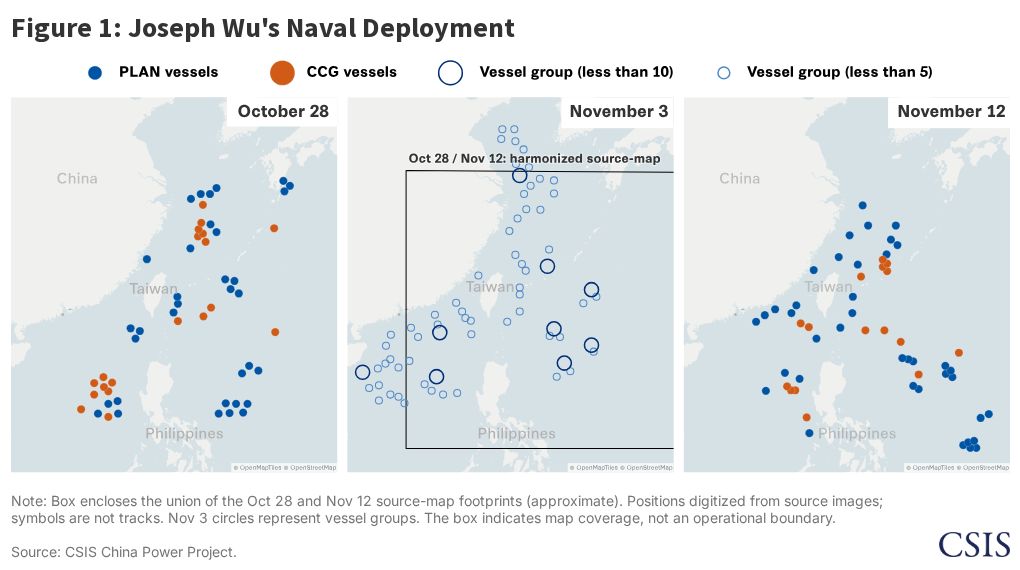
While these posts show a significant simultaneous deployment of Chinese military and government vessels across the Western Pacific since late October, a comprehensive assessment of PLA and CCG activities across the region suggests that the surge involves several overlapping operations, many following established patterns, rather than a single unprecedented exercise.
The most notable development during this period was the presence and coordinated activity of PLAN task forces from three different PLA theater commands in the Philippine Sea. Of all the observable activities in October and early November, Chinese military activities in the Philippine Sea showed evidence of coordinated activity between China’s three theater commands: the Eastern, Southern, and Northern Theater Commands (ETC, STC, and NTC). In the late October–early November deployment, as shown on Joseph Wu’s maps, the Liaoning carrier strike group (CSG) was operating in the Philippine Sea alongside three task forces, each belonging to a different theater command. There was a total of 16 PLAN vessels among the four task forces shown on the map and a couple of other PLAN vessels transiting straits leading to the Philippine Sea.
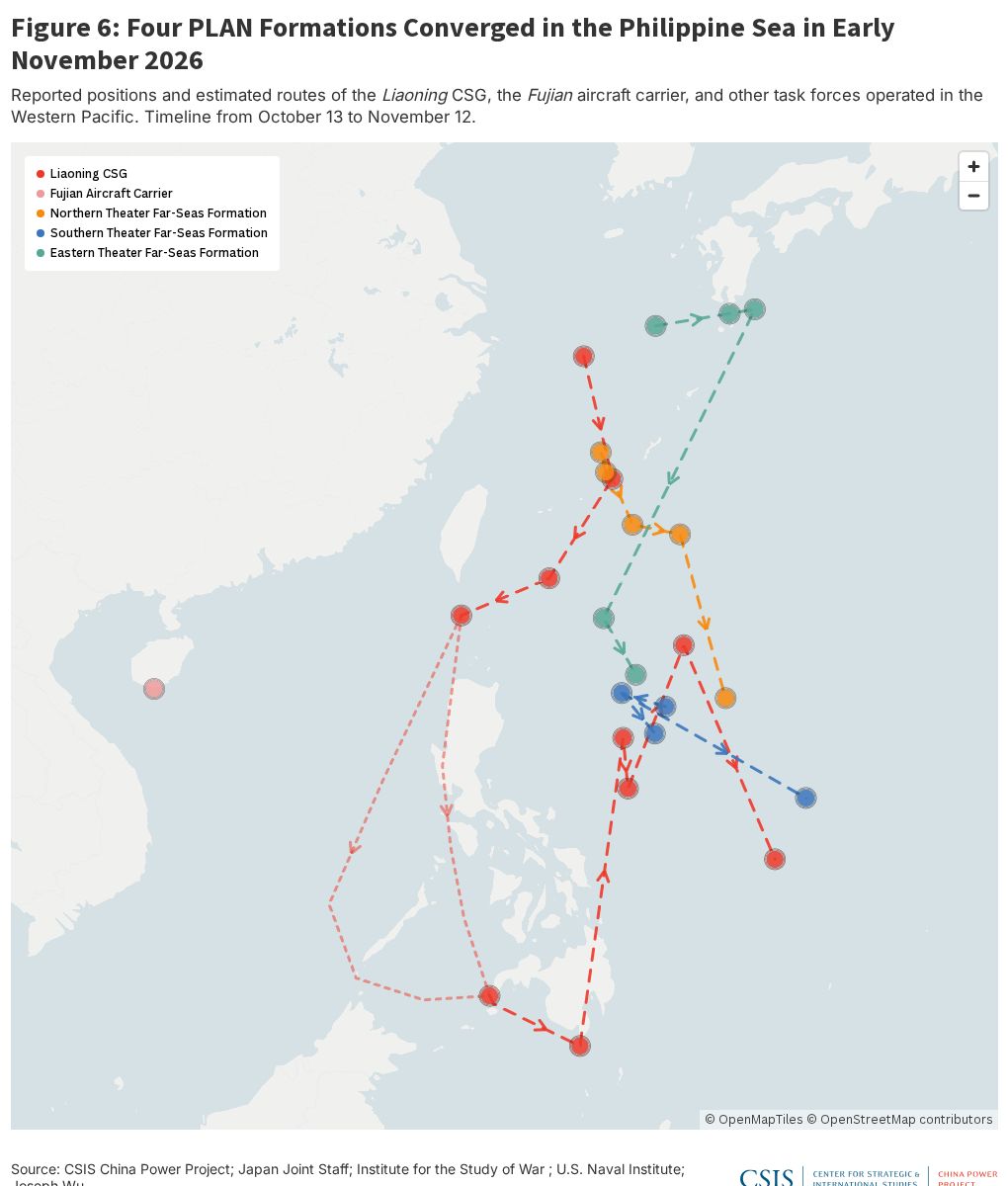
Cross-referencing Joseph Wu’s map, Philippine reports on the Liaoning CSG, and Japan Joint Staff reports on Chinese vessels crossing into the Philippine Sea, we assess that the task forces that were in the Western Pacific as of November 12 likely included:
The Liaoning CSG, whose activities will be discussed in detail in the Carrier Deployment section, circumnavigated the Philippines counterclockwise starting on October 15 and reached the Philippine Sea near the end of October. On October 27, the NTC task force crossed the Miyako Strait in two formations into the Philippine Sea and has not been observed returning to the East China Sea as of November 20. On the same day, the ETC task force crossed the Osumi Strait into the Philippine Sea and has likewise not been observed returning to the East China Sea. It is likely that these vessels are the vessels that constituted the far-seas formations in Joseph Wu’s maps.
In the Philippine Sea, these naval task forces operated in relatively close distance with each other. There is no publicly available information on how these four task forces operated beyond a snapshot of their general location in November. There is no evidence that these vessels conducted complex maritime operations.
In addition to the 16 vessels that were part of the four naval task forces, there were three other reported PLAN assets that were operating in and out of the Philippine Sea: China’s Type 052D guided-missile destroyer Qiqihar (121) from the NTC Navy and two PLAN supply ships: the Type 901 Fast Combat Support Ship Hulunhu (901) from the NTC and the Type 903A Replenishment Ship Chaohu (890) from the ETC.
These three PLAN vessels are worth noting because they demonstrated cross-theater coordination. Japan’s Ministry of Defense reported that the NTC’s Qiqihar alternated between and escorted both supply ships Hulunhu and Chaohu. The two supply ships entered the Philippine Sea largely in rotation, overlapping in the Philippine Sea for a couple of days. The Qiqihar escorted each supply ship separately in and out of the Philippine Sea on five separate voyages:
In addition to demonstrating coordinated, cross-theater operations, Qiqihar’s activities showcased the PLA practicing the rotation of supply ships that would enhance the PLA’s ability to logistically sustain a large force at sea. The Qiqihar also practiced escorting supply ships through two different maritime chokepoints.
In addition to PLAN vessels, according to Joseph Wu’s map, there were likely also five CCG vessels that operated alongside the task forces in the Philippine Sea. One of the CCG vessels was identified by the Japan Joint Staff as CCG 2307. On October 27, CCG 2307 was spotted transiting the Osumi Strait alongside the ETC task force, which observers suggest was carrying autocannons. CCG vessels have long operated alongside PLAN formations, particularly around Taiwan and in the South China Sea. This, however, marked the first time that the Japanese government confirmed CCG vessels were operating alongside the PLAN out past Japan into the Pacific. The Yomiuri Shimbun reported two other prior cases of CCG vessels accompanying PLAN vessels in the summer of 2023 and in December 2024, but neither has been confirmed by Tokyo.
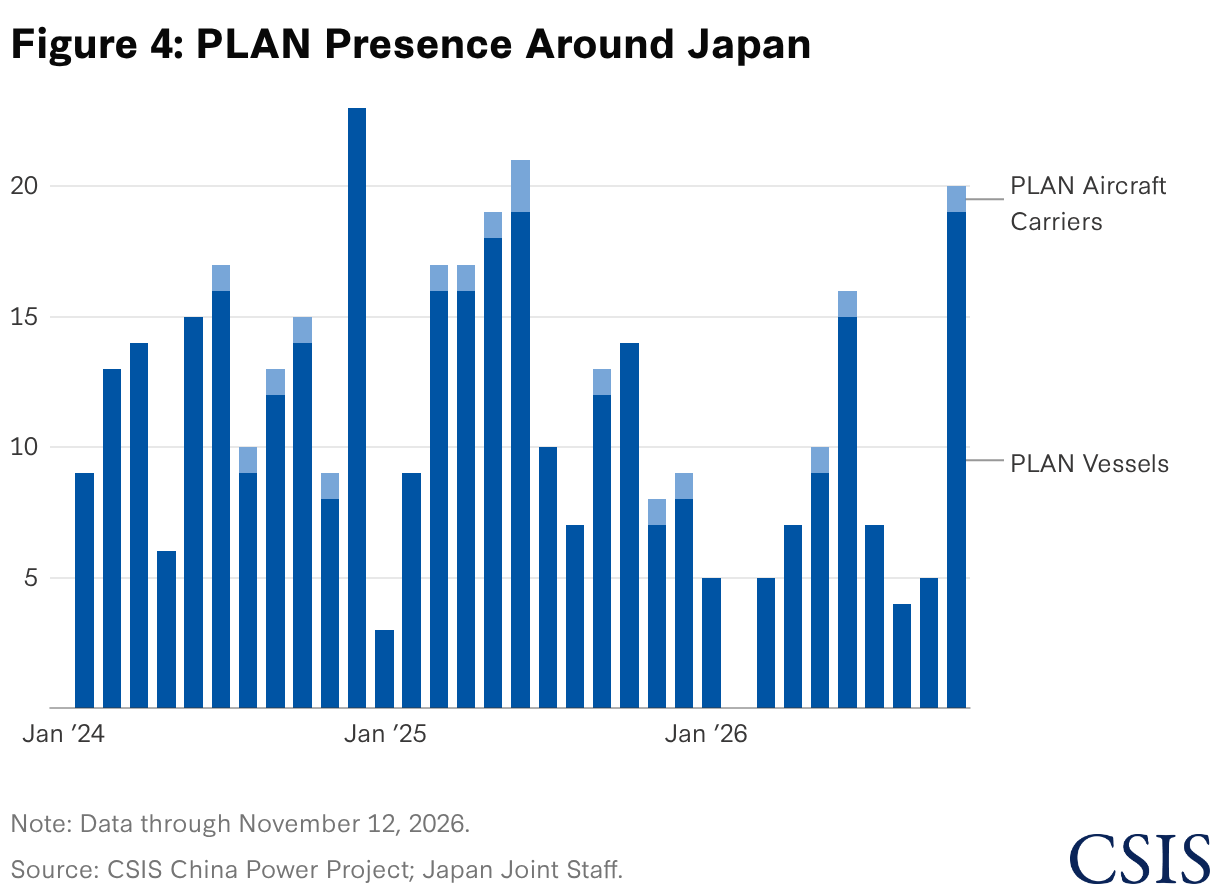
This is not the first time multiple task forces have operated around Japan. In December 2024, Japan Joint Staff observed 22 unique PLAN vessels from the ETC and NTC transiting through waterways around Japan’s southwest islands in December during the month of intense PLA naval buildup in the region. Between May and June 2025, the Liaoning CSG and the Shandong CSG crossed key waterways near Japan and operated simultaneously in the Western Pacific.
This is also not the first time Chinese military assets from three different theater commands have been observed in close proximity. During the December 2024 PLA naval buildup, the Taiwan Ministry of National Defense (MND) claimed it observed military ship formations from all three theater commands of the PLA. These formations operated in the Taiwan Strait and the Western Pacific in coordination with the CCG. Coordinating maneuvers across theater commands remains a challenge for the PLA, and these activities have shown that the PLA is actively exercising such capability.
Nevertheless, the scale of this recent activity, with China deploying at least 16 PLAN vessels and five CCG vessels beyond the first island chain, remains unprecedented. It is one of the largest observable PLAN deployments beyond the first island chain and can be seen as a continuation of the end-of-year surges in PLAN presence in East Asian waters in 2024 and 2025. The deployment marks the first time the three theater commands, alongside a CSG, operated beyond the first island chain to conduct sustained, blue-water operations.
PLA activity surged in mid-October across the East China Sea and in the waters around Japan’s southern islands. Between October 13 and November 12, Japan’s Ministry of Defense Joint Staff Office reported 20 distinct PLAN vessels and one CCG vessel transiting the Miyako and Osumi Straits. That exceeded the 16 unique Chinese vessels reported during the Liaoning’s previous deployment during May–June 2026 but fell short of the record 23 PLAN vessels observed crossing key Japanese waterways, including the Tsushima Strait, between November 30 and December 30, 2024.

During this same period in late October and early November, the Japan Coast Guard did not report any changes in Chinese vessel activities around the Senkaku/Diaoyu Islands, a disputed island chain where the CCG has frequent presence.
However, on October 27, the Japan Maritime Self-Defense Force confirmed that four vessels, three PLAN vessels and one CCG vessel, transited the Osumi Strait into the Pacific Ocean. The Japanese Ministry of Defense reported that this was the first time a CCG ship accompanied Chinese naval vessels through a strait near Japan, indicating the PLAN and CCG are strengthening their cooperation.
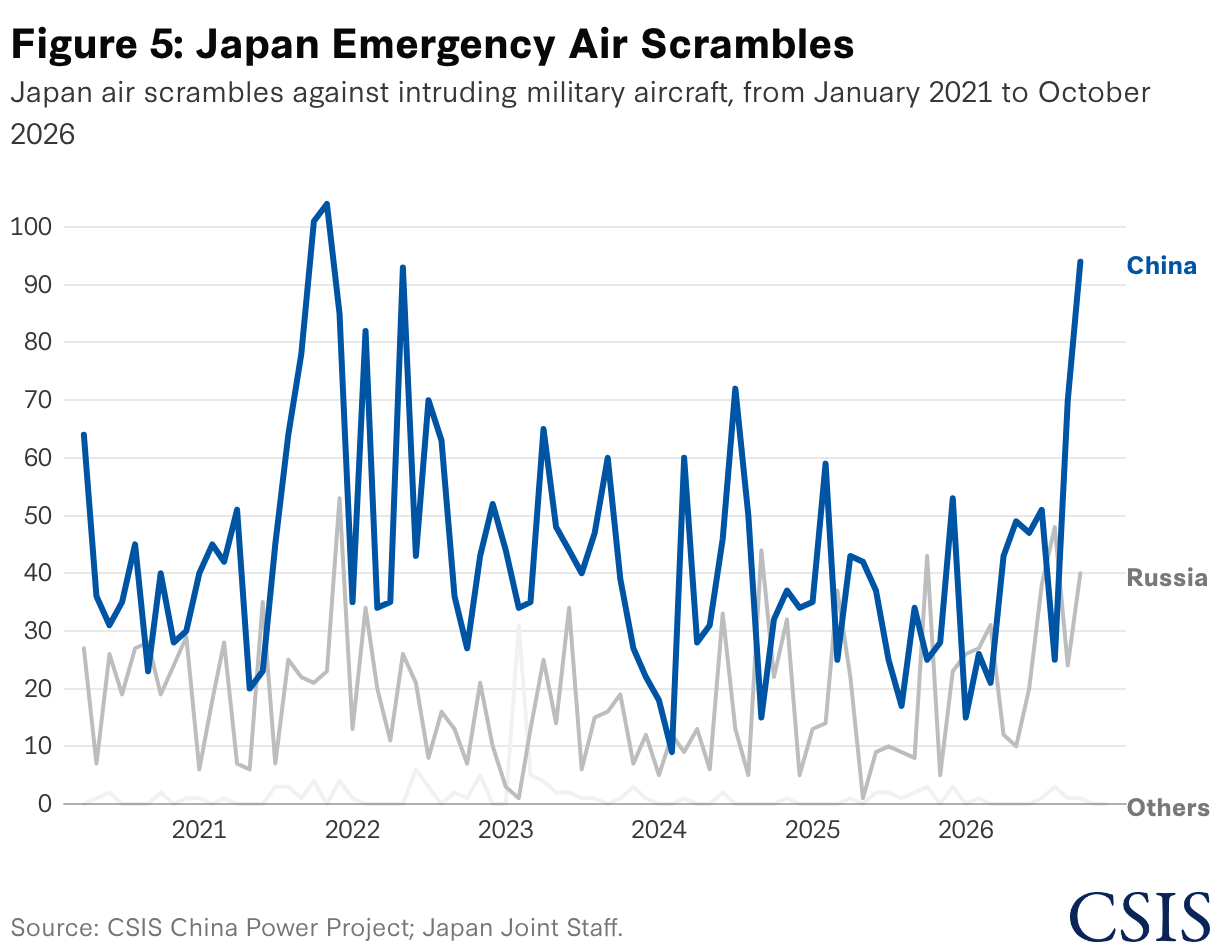
Besides naval activities, PLA aerial activities also increased during the October–November time frame. Between October 13 and November 12, China conducted repeated aerial patrols over the East China Sea with at least 12 Y-9 planes and 12 reconnaissance and attack drones. The Japanese Joint Staff also reported 94 jet scrambles against PLA aircraft in October, the highest preliminary figure since 104 scrambles were recorded in November 2021.

In the waters directly around Taiwan, late October to mid-November saw a decrease in Chinese naval activity but a record number of Chinese government “official ships,” which include CCG ships and research vessels. According to reports from the Taiwan MND, China’s naval presence around Taiwan declined slightly in October compared to previous months of the year. In October, there were a total of 198 naval vessels observed around Taiwan, an average of 6.4 vessels per day. This is lower than the daily average over the past nine months in 2026, at seven ships per day. The highest number observed this year was in August, when 237 naval vessels were recorded around Taiwan.
However, in October, the Taiwan MND recorded the highest number of official ships around Taiwan in history, with a record 165 vessels operating around the island. This escalation appears to be a continuation of a sustained, unprecedented CCG presence around Taiwan since June. Between June 1 and November 12, 2026, the Taiwan MND recorded 713 official ships around Taiwan, or a daily average of 4.3 ships. This far exceeds the combined count from the last two years, from June 2024 to May 2026, at 571 vessels, or a daily average of 0.8 ships.

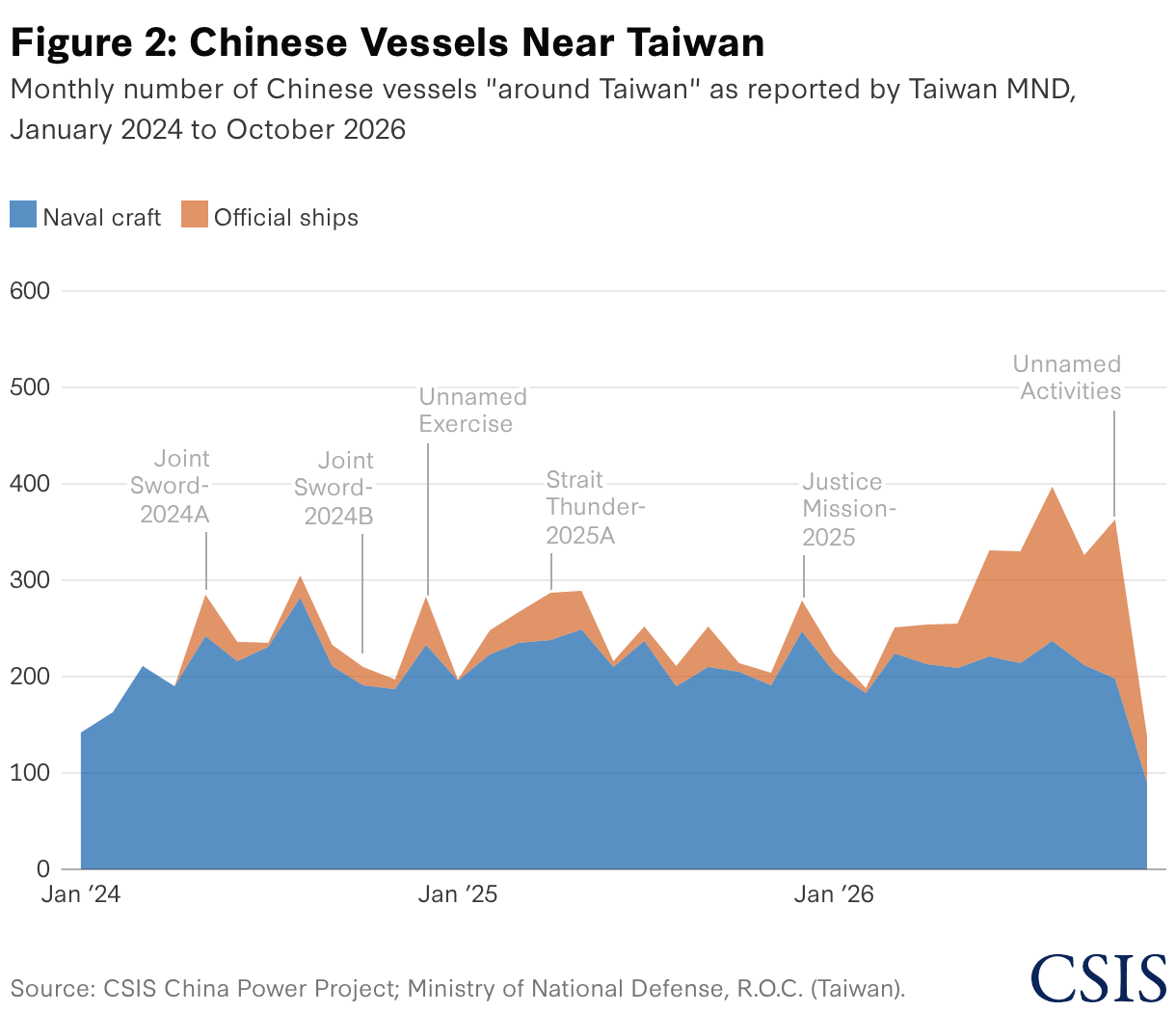
Throughout October, the Taiwan Coast Guard Administration also reported 10 incursions into waters around Taiwan by Chinese government vessels: four at Kinmen Islands, three at the Dongsha/Pratas Islands, and three near Taiwan’s main island.
The Taiwan MND also reported some of 2026’s highest daily levels of PLA air activity on October 31, November 2, and November 12. November 2 saw the year’s highest number of PLA aircraft—49 sorties—detected around Taiwan, 31 of which entered the island’s de facto air defense identification zone (ADIZ), the second highest such figure of the year. The PLA also conducted five coordinated air and naval operations called Joint Combat Readiness Patrols in October—more than any other month in 2026—followed by two more so far in November.

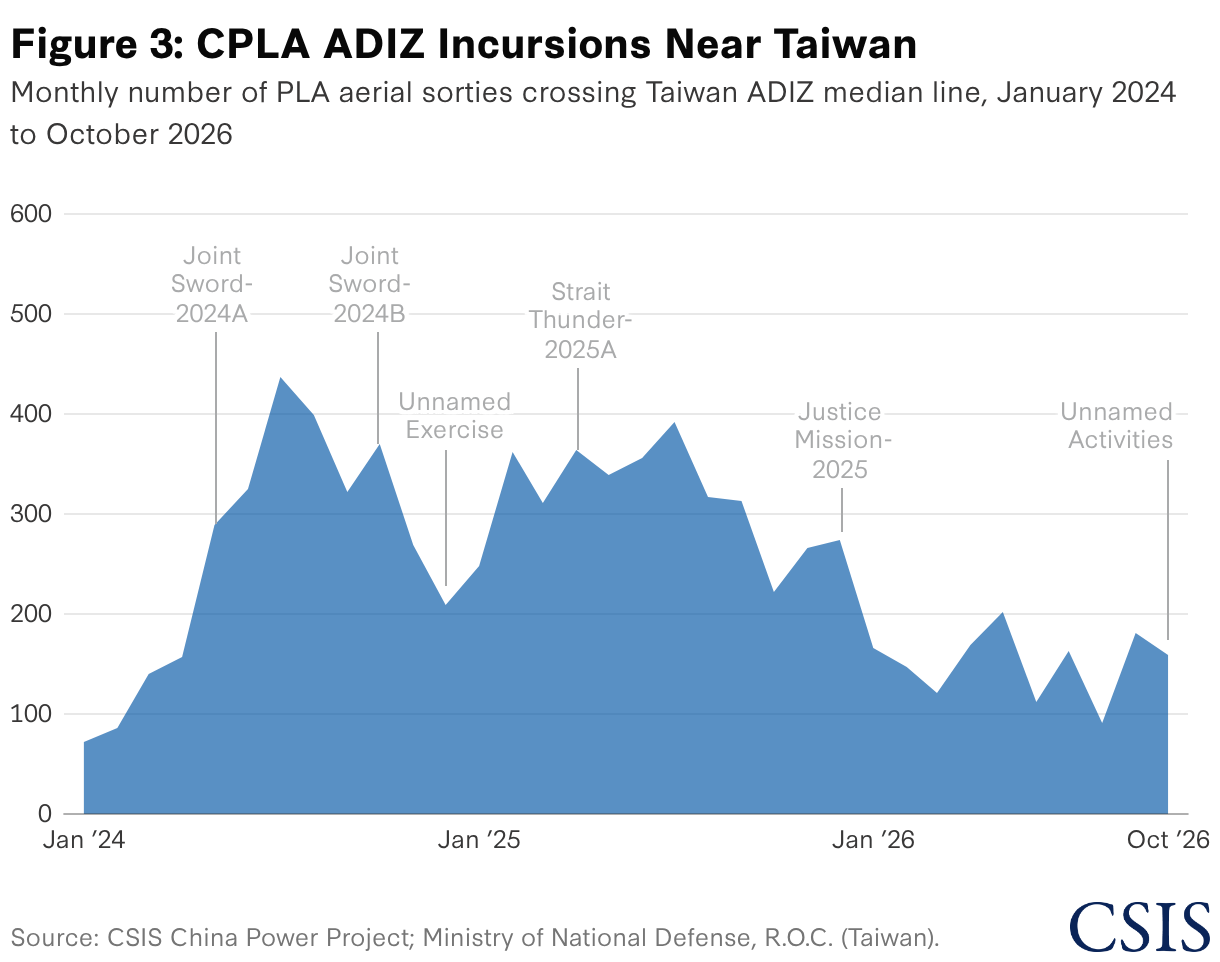
Despite spikes in October and November, PLA air incursions into Taiwan’s ADIZ have averaged just five per day in 2026, half the daily average of 10 in 2025.
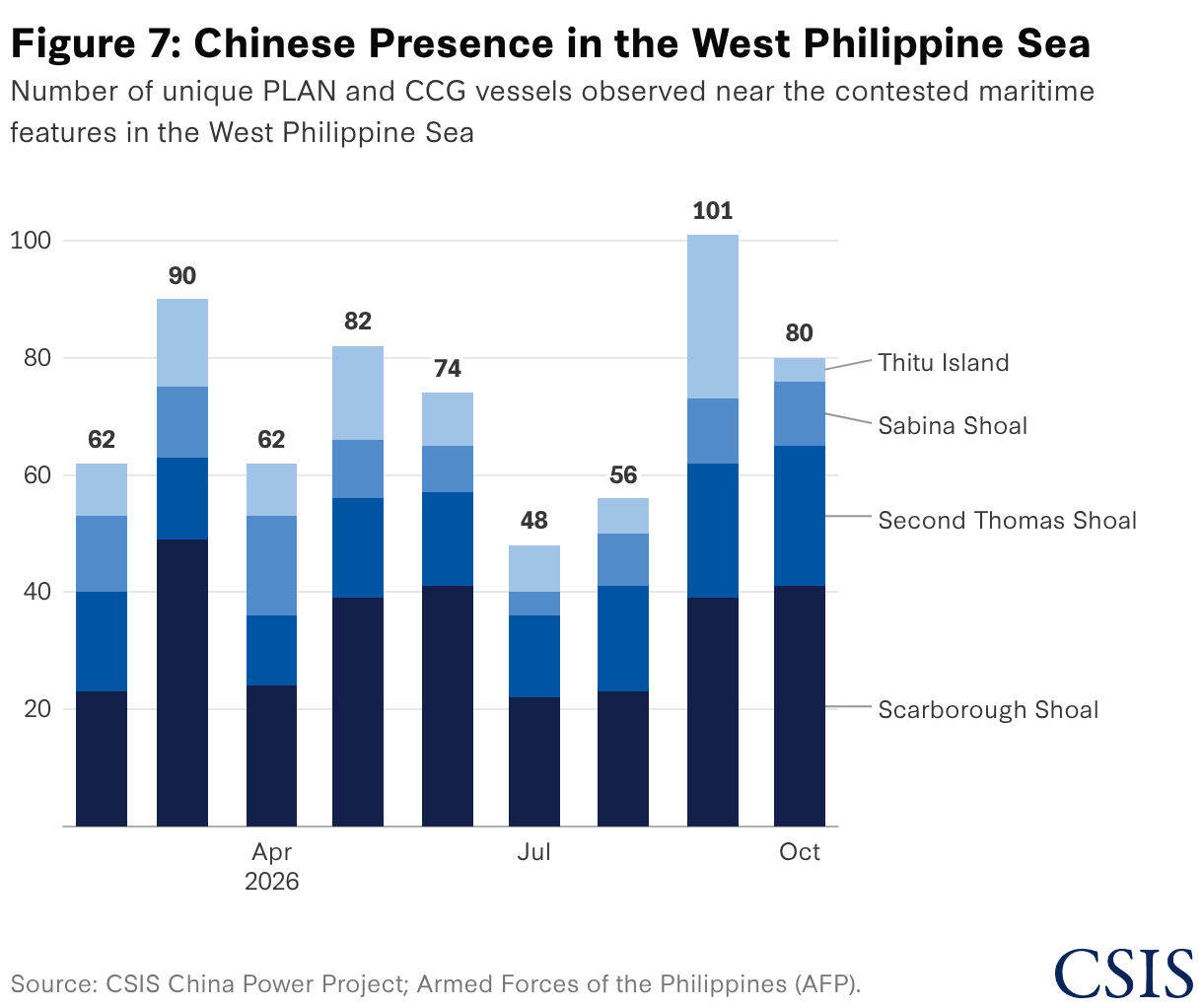
The West Philippine Sea, a subset of the South China Sea and a heavily contested geographical region, also saw elevated Chinese military activities in October and early November. In October, the Armed Forces of the Philippines recorded a total of 80 unique PLAN and CCG vessels spotted in the West Philippine Sea around the four contested maritime features (the Scarborough Shoal, the Second Thomas Shoal, the Sabina Shoal, and the Thitu Island). This is higher than the monthly average for 2026 but not the most significant spike. In September, the Armed Forces of the Philippines recorded 101 unique vessels, with a heightened CCG presence near the Thitu Island following the Philippines’ filing of an updated maritime chart to the United Nations in September that included the island.

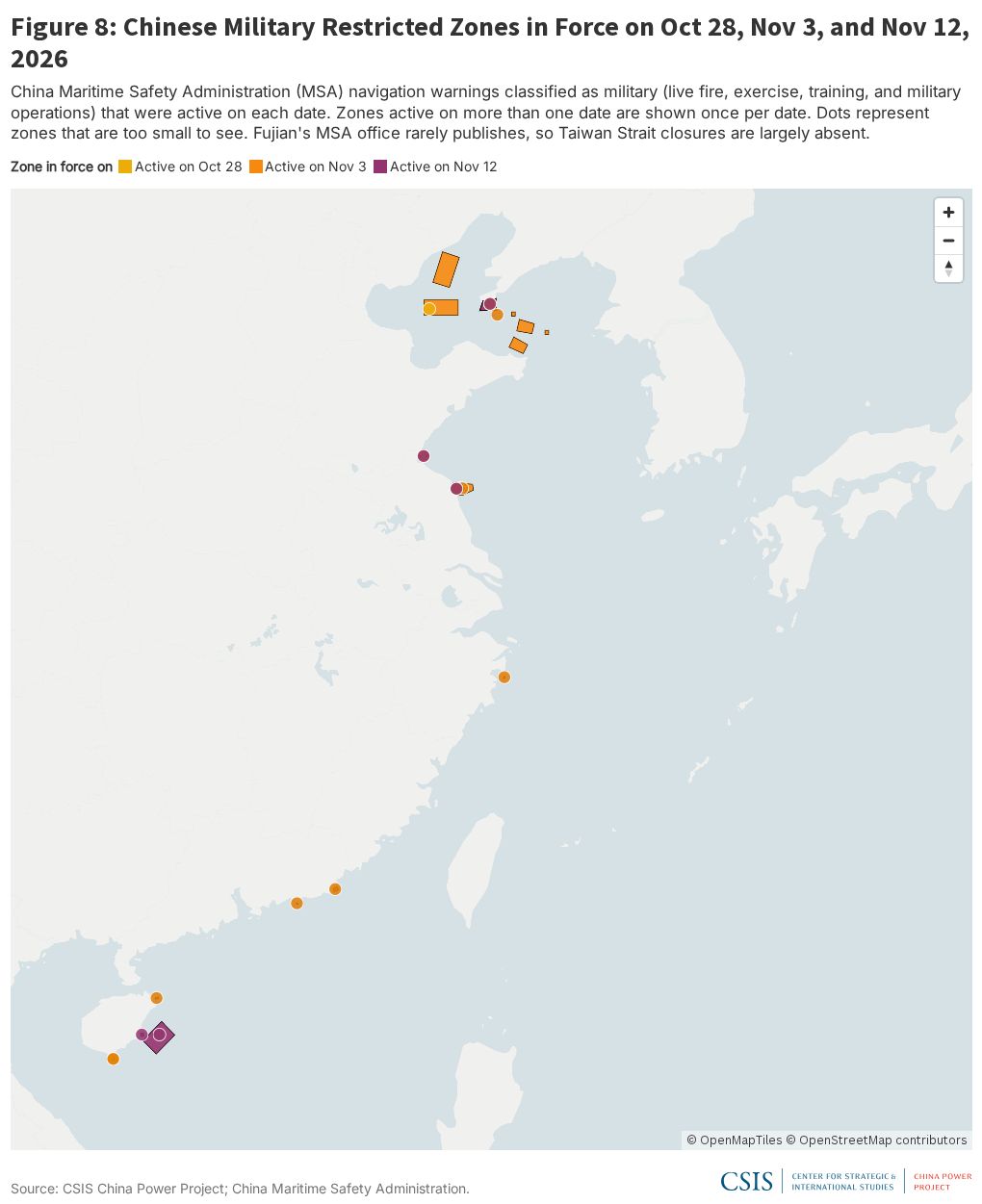
In October, the Chinese Maritime Safety Administration announced at least 15 warning zones for military trainings or activities off the coast of Hainan, Guangdong, and Guangxi. Most of these warning zones were in the early portion of the month, but many of them remained active in late October and early November.
Chinese media reported a number of Chinese military activities during this period, and some could have occurred in these zones in the South China Sea. Chinese state news reported that the PLAN deployed four of its Type 071 amphibious dock landing ships to conduct live-fire exercises “to prepare for island-reef assault, transportation and sovereignty defense missions” in the South China Sea—without providing a specific location—around October 14. On November 3, China’s third Type 075 amphibious assault ship Anhui (Hull 33) was spotted heading east from its Sanya naval base, located on China’s island of Hainan in the South China Sea. Later that week, the PLA released photos of the Type 075 Anhui conducting vertical and horizontal delivery training with Z-20J shipborne helicopters at sea.
In the waters around Scarborough Shoal—the area where Joseph Wu’s map depicted PLAN and CCG activity in the South China Sea—there were a number of notable activities. On October 3, the Armed Forces of the Philippines reported that a PLA J-16 fighter jet intercepted and flew dangerously close numerous times to a Philippine C-208 turboprop aircraft that was conducting a patrol near the shoal. On October 16, following the U.S.-Philippine Military Cooperative Activity patrol, the Philippine Navy observed four PLAN warships, two CCG ships, two unmanned aerial vehicles, and one maritime patrol aircraft around the shoal. CSIS data shows that CCG patrols around the shoal have significantly increased in 2026, reaching 933 ship-days in just the first half of 2026, compared to 1,099 days for all of 2025.
Similar activities can be seen near other contested maritime features. Near the Second Thomas Shoal on October 8, for example, CCG vessels used water cannons against—though did not hit—a Philippine patrol vessel that was on its way to evacuate an injured navy servicemember from the shoal’s disputed outpost.
On October 30, the PLA STC conducted air and naval combat readiness patrols while the CCG also carried out law enforcement patrols around Scarborough Shoal. Separately, the same day, Chinese state media reported that the CCG recently engaged in law enforcement training near Second Thomas Shoal and Sabina Shoal (but did not specify the date of activity) and simulated boarding of a foreign fishing vessel.
Beyond activities near these disputed features, the Liaoning CSG also engaged in a counterclockwise navigation around the Philippines in late October that will be covered in the section below. This represents the second known circumnavigation of the Philippines by a Chinese carrier; the first took place between September and October 2024, also by the Liaoning.
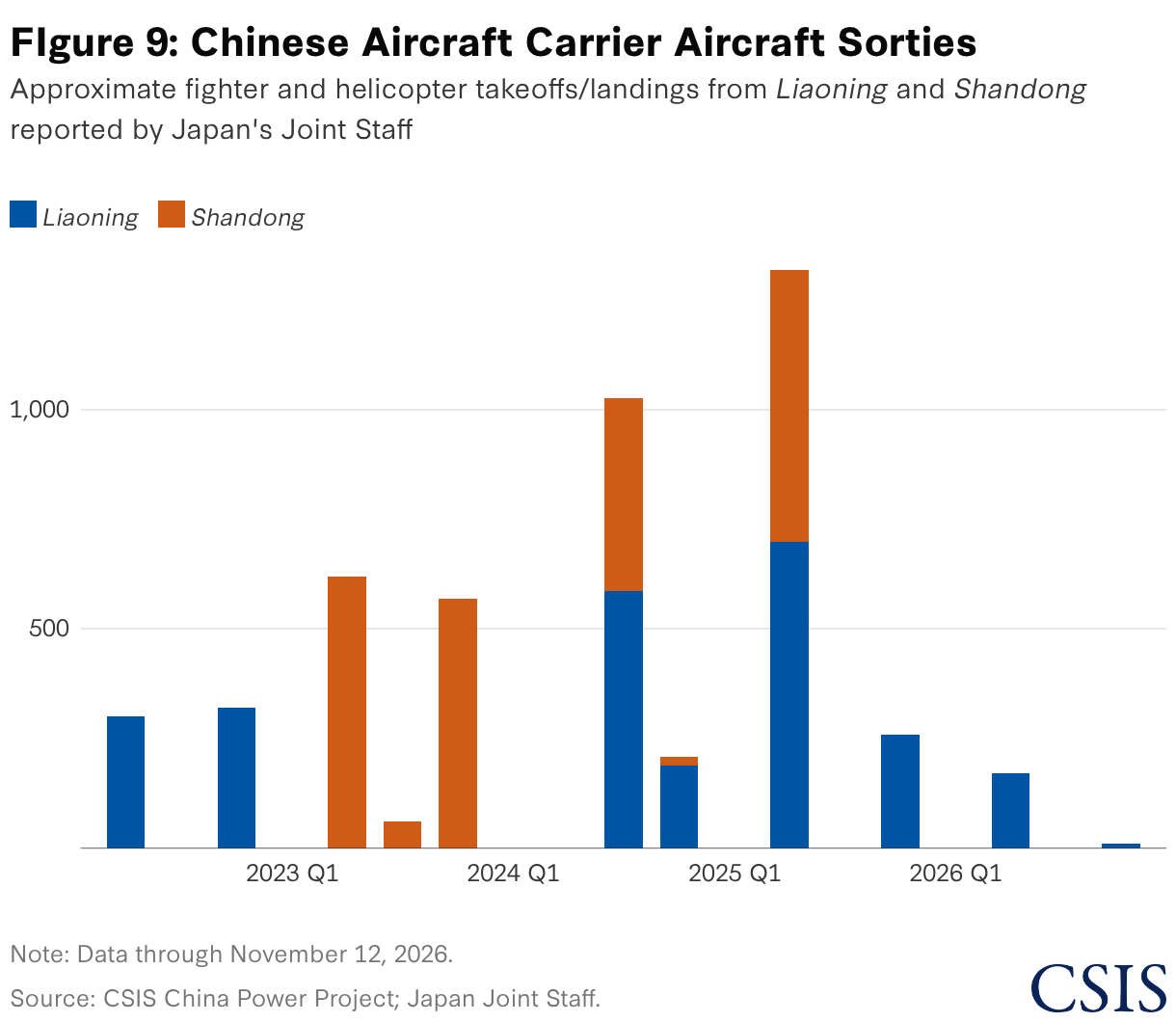
China’s Liaoning aircraft carrier, alongside two Type 055 guided-missile cruisers and one Type 052D guided-missile destroyer, was first seen traversing from the East China Sea into the Philippine Sea from October 13–14. On October 14, China’s MND announced that the Liaoning CSG was deploying for training exercises in the Western Pacific. That day, the Liaoning CSG conducted drills in the Philippine Sea, including 10 military aircraft and helicopter takeoffs and landings from the carrier. This number of takeoffs and landings is significantly lower than the average daily sortie rate—which ranged from approximately 20 sorties per day to over 50 sorties per day—that Japan reported for the Liaoning or Shandong CSGs in 2024 and 2025.
Following the drills, the Liaoning CSG proceeded to cross westward through the Luzon Strait between Taiwan and the Philippines on October 15. On October 22, the CSG was spotted crossing the Basilan Strait southwest of the Philippines. A day after, the CSG was escorted by the Philippine Coast Guard’s new patrol vessel from Taiwan, BRP Sarangani (6177), during its transit across the first island chain in the Philippines’ archipelagic waters off the coast of Southern Mindanao. A Philippine naval official claimed that this was the first time a Chinese carrier had approached within 50 nautical miles of the Philippine shoreline. By October 27, the CSG had reached the Philippine Sea east of the Luzon Island, the main northern Philippine island. The Liaoning CSG would go on to operate in the Philippine Sea alongside other PLAN and CCG vessels, and it remains in the region as of November 20 with some suspecting that Liaoning may be on track to conduct its longest Pacific deployment to date.
China’s third aircraft carrier, the Fujian, was also spotted by satellite imagery departing the Sanya naval base on November 2 sailing eastward in the northern part of the South China Sea. Footage released around November 8 suggests it is operating at sea with dozens of aircraft onboard, possibly located somewhere in the South China Sea. Commissioned in November 2025, the Fujian has been active at sea this year, but it has not yet reached full operational capacity. Chinese reporting from early November 2026 notes that the Fujian has not yet conducted dual-carrier operations with the Liaoning or Shandong; in other words, Fujian’s activities in the South China Sea are likely not coordinated with the Liaoning’s activities in the Philippine Sea in early November.
Although the Liaoning deployment is significant, China has actively deployed its aircraft carriers into farther waters for longer. The Liaoning underwent an exercise in the South China Sea and Philippine Sea for more than 40 days from May to June this year. Last year, it was deployed alongside China’s second carrier, the Shandong, on China’s first dual-carrier deployment beyond the second island chain from May to June 2025, and it was deployed again in December 2025 to the east of the Okinawa Islands to conduct drills and flight trainings.
During their deployments, Chinese aircraft carriers typically conduct a significant number of flights and takeoffs. The Shandong aircraft carrier carried out roughly 420 fighter and 150 helicopter launches and recoveries in the Philippine Sea between October 28 and November 5, 2023, operating as far east as the waters midway between the Philippines and Guam. In mid-October 2024, the Liaoning conducted 90 fighter and 50 helicopter launches and recoveries as part of the Joint Sword-2024B exercise before departing the Philippine Sea. 2025 saw the most recorded sorties from Chinese aircraft carriers, with at least 960 takeoffs and landings from the Liaoning and at least 620 sorties from the Shandong. As of November 2026, Japan has reported only 180 sorties by the Liaoning this year, representing the lowest number of aircraft carrier sorties in recent years.
There is relatively limited evidence to confirm whether China conducted an ICBM launch during this period. There are two speculations. First, one Taiwan source claimed that China fired an ICBM via a submarine from the Yellow Sea towards mainland China sometime in late October to early November. There is no other source to corroborate this claim. Some news outlets, such as the South China Morning Post, initially printed this claim and then deleted it. This test likely did not occur and, if it did, the trajectory would go against Earth’s rotation and put considerably more strain on the launched missile.
Second, between October 13 and November 12, China released three sets of Notice to Airmen (NOTAM) on October 14, October 31, and November 4, 2026, that resembled paths of missile launches. Specifically, the November 4 NOTAM identified three geographical zones in two time windows for two potential test launches of ICBMs from Taiyuan to the Korla region in Xinjiang. This NOTAM bore similarity to a mid-June 2026 NOTAM that showed a nearly identical path of travel for a potential ICBM launch. In October and November, Chinese analysts and media reports highlighted China’s Dongfeng missile series, particularly its nuclear-capable DF-61 ICBMs, and this led to speculations on whether China conducted “an inland ICBM test, potentially involving a ground-based mid-course missile interception.”
Neither the ICBM test nor the intercepting drill has been confirmed or corroborated by the Chinese or other governments. Instead, on November 2, the Chinese media showcased footage of a Central Theater Command drill that involved the HQ-9B surface-to-air missile system successfully intercepting two types of missile targets: conventional ballistic missiles and ballistic missiles that can maneuver midcourse. While the HQ-9B system has some capability to intercept shorter-range ballistic missiles, it has no demonstrated ability to intercept ICBMs.
A combination of factors likely shaped China’s military operations in late October and early November, and it is unlikely that all the military activities in this period were part of one large, highly coordinated, unnamed Chinese military exercise. There was no clear, coherent messaging from China that suggested these activities were part of one large exercise, and analysts should avoid giving Beijing or the PLA too much credit. Instead, the different timelines for when the activities began and the range in messaging from the Chinese government suggest a series of uncoordinated military activities. Several factors provide context for this analysis.
First, China typically increases its military activities and training across the board around this time of the year when weather and maritime conditions are more favorable. In prior years around this time, China has launched large military exercises such as Joint Sword-2024B in October 2024 and Justice Mission 2025 in December 2025. It is also common for China to engage in various types of military tasks or operations during the fall. China, for example, has significantly surged the count and activity of maritime vessels along its periphery in December 2024 and December 2025. It has also sent out CSGs on distant sea operations and engaged in a significant number of flights and takeoffs from the carriers.
If China did launch an ICBM sometime in late October to early November, this type of training would align with China’s growing desire to test all legs of its ICBM force. It would build on recent tests of its ICBM capability in September 2024 (a land-based DF-31AG ICBM fired from Hainan Island that landed near French Polynesia), December 2024 (testing of several silo-based ICBMs from a training center into western China), and July 2026 (a submarine launched an ICBM from the South China Sea to the Pacific). Unlike the September 2024 and July 2026 tests, there was no Chinese government acknowledgement or message accompanying either hypothesized October–November 2026 ICBM test. The trajectories of both potential recent ICBM flights over Chinese territory and the lack of a foreign impact zone also suggest a greater Chinese focus on training than public or political signaling.
Second, China has demonstrated a pattern of shadowing and increasing its military presence when the United States or U.S. allies and partners conduct a joint military exercise in the region. Often this involves conducting military operations in areas close to U.S. and allied military activities, usually around the same time. During the U.S.-Philippine Balikatan exercises from April 21 to May 9, 2025, the PLA STC conducted patrols in the South China Sea. In February 2026, as Australian, Philippine, and U.S. forces held a multilateral maritime activity in the Philippines’ exclusive economic zone, the PLA STC carried out combat readiness patrols in the South China Sea.
A major exercise that China was likely responding to during this time was Keen Sword 27, a U.S.- and Japan-led major multilateral military exercise run in waters near Japan (in the East China Sea, Sea of Japan, and Philippine Sea) from October 19 to October 29. On October 29, a Chinese MND spokesperson specifically criticized Japan for its involvement in Keen Sword 27 and labeled Japan “a real threat to regional security.” The exercise featured major military operations focused on Ishigaki Island, Yonaguni Island, and Japan’s southwestern island chain, where the United States and Japan deployed key missile and air defense systems including the Navy-Marine Expeditionary Ship Interdiction System and the Marine Air Defense Integrated System. The exercise also marked the first time the Philippine military participated in Keen Sword, upgrading its involvement from observer status. Several military activities above are likely linked to or targeted at Keen Sword or what Keen Sword represents (growing U.S., Japan, Philippines, and allied military cooperation that is relevant to the defense of Taiwan):
Third, China remains locked in ongoing tensions with the Philippines in the South China Sea with frictions emerging throughout the year across multiple disputed territories, including the Scarborough Shoal, the Second Thomas Shoal, the Thitu Island, and the Sabina Shoal. On October 16, during a regular press conference, China’s MND spokesperson pointedly accused the Philippines of “rallying external forces to stir up troubles” around each of these features and noted that China will take “effective measures to deter any sabotaging moves.”
It is likely that the surge in Chinese maritime vessels around Scarborough Shoal in late October was due to a flare-up in Chinese activities against the Philippines as well as a Chinese desire to maintain a decent presence in the region. On October 27, the Philippine Coast Guard reported the presence of Chinese naval, coast guard, and research vessels near Scarborough Shoal as the Philippine government was providing fuel to resupply its own fishermen operating around the shoal to contest Chinese claims. Although China did not interfere with the Philippine maritime resupply efforts at that particular time, China announced three days later on October 30 that PLA STC naval and air units had conducted combat readiness patrols around Scarborough Shoal and the CCG had also engaged law enforcement patrols at the same time. In both public announcements, China’s MND and CCG explicitly characterized both operations as “countermeasures” in response to the Philippines.
Fourth, although China continued to increase coercive activities against Taiwan, there was no significant grievance or pretext for China to point to as an excuse to engage in a large-scale named military exercise against the island in late October or early November. China objected to Taiwan President William Lai’s October 10 National Day speech, but there was no specific part of his speech that Chinese experts identified as significant, new, or unprecedented to warrant marked “punishment”. Similarly, there was no change or significant movement in U.S. arms sales or major U.S.-Taiwan activities around that time frame. China did in late October criticize growing U.S. and Taiwan MND cooperation, including U.S. embedding of policy officials and think tank experts within Taiwan MND and Taiwan inviting U.S. military officers to observe its Han Kuang exercise. However, Chinese public messaging about both activities did not exceed its normal opposition to U.S.-Taiwan activities that China does not like.
If anything, China’s efforts to stabilize ties with the United States this year, the Trump-Xi meeting at the Asia-Pacific Economic Cooperation forum in mid-November, and Taiwan’s upcoming local elections in late November provide incentives for China to continue to make gains where possible against Taiwan but publicly downplay its coercive activity. Historically, significant displays of coercive activity against Taiwan have strained U.S.-China relations and impacted election outcomes in Taiwan that were not favorable from China’s perspective. This year, China has already engaged in a range of new and unprecedented military or quasi-military activities against Taiwan under the guise of “normal” or routine Chinese operations. This includes a PLA reconnaissance drone over Dongsha/Pratas airspace in January, sustaining CCG patrols east of Taiwan from June onwards, flying a PLA helicopter across the Taiwan Strait median line in July and possibly conducting a coordinated helicopter-drone training exercise, and sailing a Chinese maritime militia fishing vessel to the east of Taiwan in August. In each of these incidents, China portrayed its activity as ordinary, routine, lawful, and legitimate in safeguarding its sovereignty, maritime rights, and jurisdiction. In mid-November, Chinese leader Xi Jinping’s speech during the 160th anniversary of Sun Yat-sen’s birth displayed a softer tone—China remains set on unification, but Xi emphasized his willingness to engage with Taiwanese leaders who support unification and claimed that China will “take full account of Taiwan’s realities and fully accommodate the interests and feelings of Taiwan compatriots.”
While an unnamed exercise around Taiwan could still align with China’s desire to target what leaders in Beijing label as Taiwan “separatists,” China’s activities aimed at Taiwan in late October to early November were not that notable. Even as China celebrated its new Taiwan Restoration commemoration day on October 25, China avoided the dramatic propaganda and display of military encirclement of Taiwan seen in prior years: The PLA ETC, for example, showed historical images of ties between China and Taiwan to commemorate the holiday. As discussed above, China’s PLA naval activities did not increase and its air activities only spiked relative to its low 2026 baselines; the number of Chinese aircraft that entered Taiwan’s ADIZ on October 31 and November 12 was lower than what occurred during every recent named Chinese exercise against Taiwan since 2022. The reported 49 Chinese military aircraft on November 2 is equivalent to the first day of air activity of Joint Sword-2024A, but still lower than some of the highest recorded air activities during other named Chinese military exercises.
One final potential driver of increased Chinese military activity during this period could be an attempt by leaders in Beijing to take advantage of U.S. political and military focus on the Middle East, as well as U.S. desire to have stable relations with China to engage in more military operations, including near-simultaneous targeted activities against U.S. allies and partners. It is possible that perceived U.S. preoccupation and Beijing’s improved relations with Washington caused China to believe that the United States would either have little bandwidth or less incentive to respond or criticize elevated Chinese military activities if China portrayed its activities as routine. China could have also calculated that engaging in large-scale unnamed military activities would allow it to retain the benefit of military and diplomatic pressure against Taiwan, Japan, the Philippines, and the United States without the accompanying diplomatic backlash of a named and more clearly messaged military exercise.
This year’s late October and early November activities involved elevated PLA action around Taiwan as well as visible military operations that targeted Japan and the Philippines. Some of the more notable activities against the Philippines and Japan included increased PLA air, naval, and CCG assets around select disputed features in the South China Sea; the Liaoning CSG’s counterclockwise encirclement of the Philippines; the significant elevation in PLA air activity near Japan’s southwest islands; and the Liaoning CSG and three additional naval task forces in the Philippine Sea. This is different from China’s previous large-scale unnamed military activities or exercises in December 2024 and December 2025, where each had mainly one Chinese target. The December 2024 surge involved no reported carrier activity and appeared to mainly target Taiwan (see Table 1). The December 2025 unnamed Chinese exercise involved significant carrier operations and activities aimed at Japan, including Chinese fighter jets from the Liaoning locking radar on Japanese aircraft and joint Russian and Chinese bomber patrols near Japan. The target was clear in 2025; Japanese Defense Minster Shinjiro Koizumi noted on social media then that Chinese (and Russian) military operations were “clearly intended as a show of force against our nation.”
While the recent surge in activity has been compared with previous named PLA military exercises—most notably last December’s Justice Mission 2025 exercise—it differs in terms of its duration, geography, and the political signaling surrounding it. Instead, it bears closer resemblance to another unnamed large-scale military exercise that occurred in December 2024.

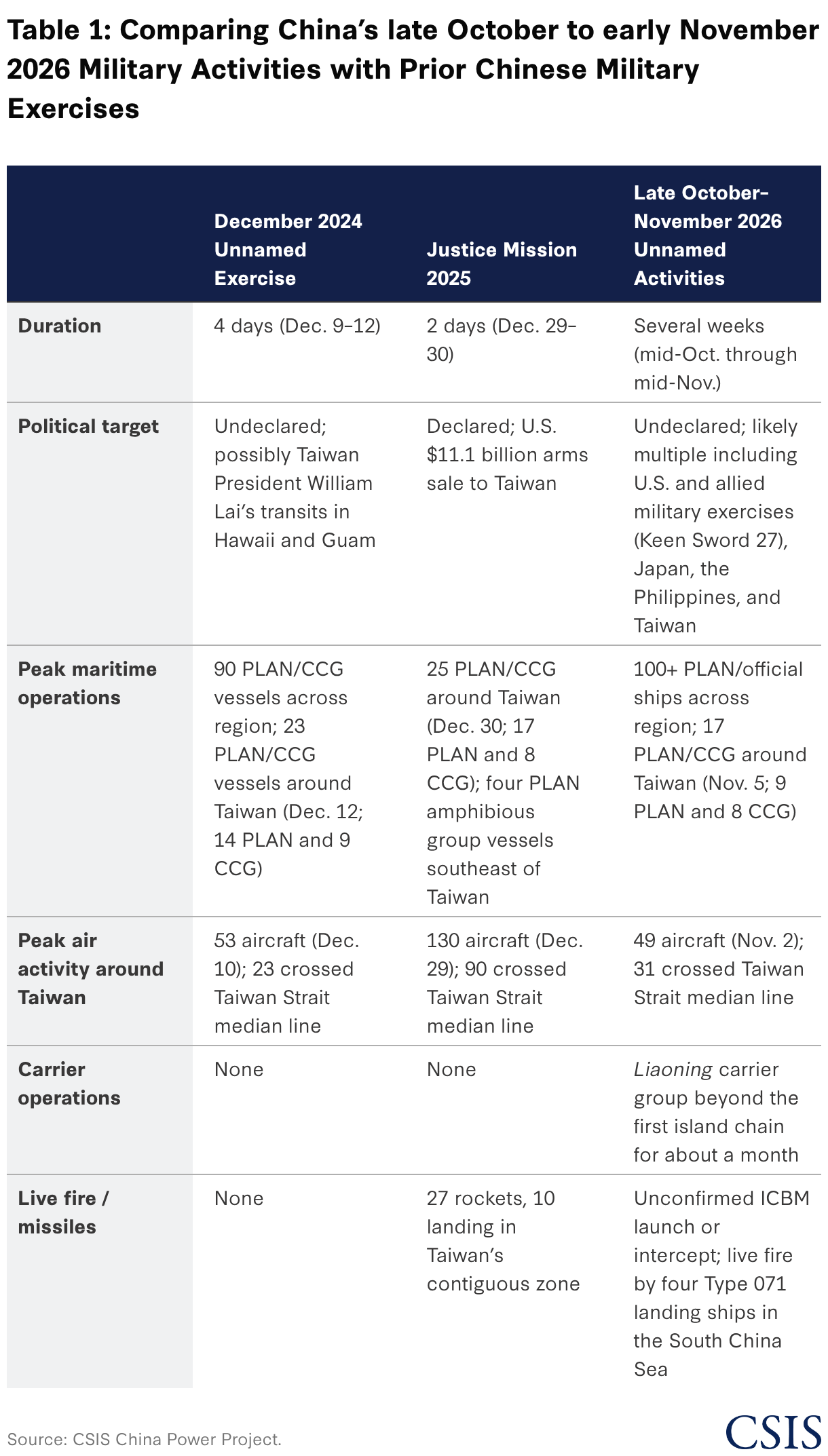
Justice Mission was a high-intensity but short-duration exercise that took place primarily in the waters around Taiwan over the course of two days. In contrast, the recent deployments unfolded over several weeks and encompassed a much larger area stretching across multiple maritime zones in the Western Pacific. This is closer in nature to the December 2024 exercises, which involved a regionwide deployment of all three PLA theater commands well beyond the waters surrounding Taiwan, although those lasted just several days.
The recent activities’ operational focus also appears to be very different from Justice Mission. The 2025 exercise was explicitly aimed at rehearsing blockades of key Taiwanese ports and conducting joint strike missions, and it included live-fire drills just off Taiwan’s coast. The recent deployments appear less narrowly focused on Taiwan, instead aimed at a broader mission of sustaining naval operations beyond the first island chain. Still, like the December 2024 unnamed exercises, these operations were likely aimed at demonstrating China’s ability to close off maritime approaches to the island through what Taiwan’s Defense Minister Wellington Koo termed “area denial drills.”
The ambiguous political signaling surrounding the recent Chinese military activities is also a clear departure from Justice Mission 2025 and other named exercises. Justice Mission directly followed the Trump administration’s approval of a record $11.1 billion arms sale to Taiwan, and China explicitly described the exercise as a “stern warning” against “‘Taiwan Independence’ separatist forces and external interference.” In contrast, Beijing has not acknowledged the recent operations as a formal military exercise, instead describing them in state media as “routine maritime patrols.” As previously mentioned, there are several plausible political drivers for the recent surge, but Beijing has refrained from explicitly tying the recent exercises to any specific event.
China’s military ramp-up across the Western Pacific in mid-October through early November resulted in alarming headlines that China was executing an unprecedented large-scale military exercise, coordinated across its different theater commands. China’s military activities during this period saw significant near-simultaneous increases in the Philippine Sea, around Japan, near Taiwan, and in the South China Sea—this is new and important and demonstrated China’s ability to target multiple U.S. allies and partners around the same time. However, there is limited evidence that suggests these activities were highly centrally coordinated and should be considered one large exercise. Varying political motivations and different timelines suggest they were disparate military operations. Further, factors such as duration, location, and signaling surrounding the operations also suggest they differ significantly from former named exercises, such as Justice Mission 2025.
Within the range of China’s recent military operations, its activities in the Philippine Sea represent a significant new development and offered the PLA an opportunity to exercise joint command and control. First, China deployed three PLAN task forces (each associated with a different Chinese military theater command) alongside the Liaoning CSG in the Philippine Sea. This deployment marks the first reported instance of such a large deployment of Chinese maritime forces—of at least 16 PLAN vessels and five CCG ships—involving all three Chinese military theater commands operating alongside a carrier strike group beyond the first island chain. Second, Japan’s Ministry of Defense reported its first case of a CCG ship accompanying PLAN vessels and transiting a strait near Japan, showcasing greater PLAN-CCG coordination. Third, China’s Type 052D guided-missile destroyer Qiqihar (121) from the NTC Navy alternated between escorting two supply ships—one from the NTC and the other from the ETC—in and out of the Philippine Sea, exercising cross-theater coordination between Chinese naval vessels and China’s ability to sustain a large force at sea.
While analysts should avoid giving Beijing too much credit in assuming the late October and November buildup was one massive and highly coordinated operation, the closely timed large set of operations and the wide geographic reach covered by Chinese military assets provide China with valuable operational experience. In Taiwan contingencies, China will likely have to simultaneously conduct operations against Taiwan and against potential foreign intervention. This involves significant activities well beyond Taiwan and in the South China Sea and the Pacific involving multiple Chinese military theater commands. China is likely to disperse surface action groups and sustain key operations beyond the first island chain, including potentially pre-positioning and sustaining a carrier strike group off the southeast coast of Taiwan to deter, delay, or intercept U.S. or allied naval vessels approaching Taiwan from the east. China’s military activities in late October and early November had many of these elements.
Moving forward, it is also important to watch whether this surge of Chinese military activities in late October and early November 2026 represents a shift in Chinese behavior. As China continues to seek greater strategic stability with the United States and the United States continues to deploy significant forces to the Middle East, there may be incentives for China to either move away from large named exercises or pair named exercises with unnamed ones.
Bonny Lin is director of the China Power Project and senior adviser at the Center for Strategic and International Studies (CSIS) in Washington, D.C. Leon Li is an associate fellow with the CSIS China Power Project. Truly Tinsley is associate director of the CSIS China Power Project. Aidan Powers-Riggs is a fellow in the CSIS Geopolitics and Foreign Policy Department. Linda Yang is program coordinator and research assistant for the CSIS China Power Project.
This report is made possible by general support to CSIS. No direct sponsorship contributed to this report.

Commentary by Joseph Rodgers, Bonny Lin, and Leon Li — July 7, 2026

Commentary by Bonny Lin, Brian Hart, and Truly Tinsley — February 5, 2026