Restoring State Sovereignty in Lebanon: Progress, Challenges, and the Road Ahead
November 23, 2026 • 9:00 – 10:00 am EST
Hosted by Middle East Program

Photo: jurani/Imazins/Getty Images
South Korea’s export success will not secure its economic future on its own. In roughly two generations, starting in the 1960s, the country’s export-driven growth model transformed a low-income country into a global technology leader. Yet the conditions that enabled the “Miracle on the Han River”—a growing workforce, sustained manufacturing investment, expanded access to global markets, and stable trade rules—are now changing.
At home, South Korea’s workforce is shrinking, capital deepening is losing momentum, and productivity gaps persist between leading manufacturers and much of the rest of the economy. Abroad, China’s continued drive for self-sufficiency is threatening the markets that South Korean firms once supplied, and Beijing has repeatedly used trade restrictions and other measures as instruments of coercion. Within the alliance, Washington’s demands for trade rebalancing are now conditioning access to its market. Beyond the United States and China, governments around the world are weaponizing trade, investment, and control over inputs to advance national interests.
South Korean policymakers seeking to chart a path forward in an increasingly uncertain geopolitical environment are encountering three competing currents in the debate on economic security. One is to pursue technological self-reliance through industrial policy and domestic demand. A second is to hedge between China, a major market and a supplier increasingly competing with South Korean industries, and the United States, a treaty ally and technology partner whose current trade demands have created uncertainty for South Korean firms. A third is for Seoul to resolve this strategic ambiguity by following one of these geopolitical competitors and accepting the costs of doing so.
None of these approaches adds up to a durable strategy. Self-reliance will be limited by demographic headwinds, energy and resource dependence, and the global nature of technology value chains. Hedging between Beijing and Washington, while appealing in some quarters, is tactical and short term when the moment calls for a long-term economic security strategy. Choosing a side, depending on its motivations, can relegate South Korea to followership, leaving its own potential global influence unexploited.
South Korea should build on its success as an export nation to become an ecosystem power—a country that shapes the technologies, standards, supplier relationships, and investment decisions on which production and innovation depend.
While the proverb “고래싸움에 새우 등 터진다” (“when whales fight, the shrimp’s back is broken”) captures reasonable South Korean fears about U.S.-China competition, it also understates South Korea’s capacity to shape outcomes. This report argues that South Korea should build on its success as an export nation to become an ecosystem power—a country that shapes the technologies, standards, supplier relationships, and investment decisions on which production and innovation depend. Without this shift, South Korea risks becoming increasingly peripheral in setting the rules of trade and investment it has to live by and increasingly exposed to external influence. That is a path toward narrowing growth prospects and diminished economic security as South Korea moves into the next generation.
South Korea has unique capabilities across the technology stack, including hard-to-replace positions in advanced memory chips and high-value shipbuilding, as well as competitive strengths in batteries, displays, and telecommunications. It also has substantial institutional capital, experienced policy banks and export-credit agencies, and established relationships in standards and development cooperation. The question is whether South Korea can convert these strengths into greater influence over the conditions and external relationships governing its economic security.
This Country Economic Security and Technology Assessment examines three capabilities essential to economic security: (1) growth, to renew South Korea’s productive strengths; (2) resilience, to protect those strengths against coercion and disruption; and (3) alignment, to translate those strengths into international influence. As this report examines in detail, and the accompanying “Country Economic Security at a Glance” illustrates in brief, South Korea has substantial assets in all three areas. The challenge is to connect domestic economic reform, credible economic defense, and revitalized trade and investment ties with developed and developing country partners through a comprehensive economic security strategy that can chart South Korea’s pathway to ecosystem power.
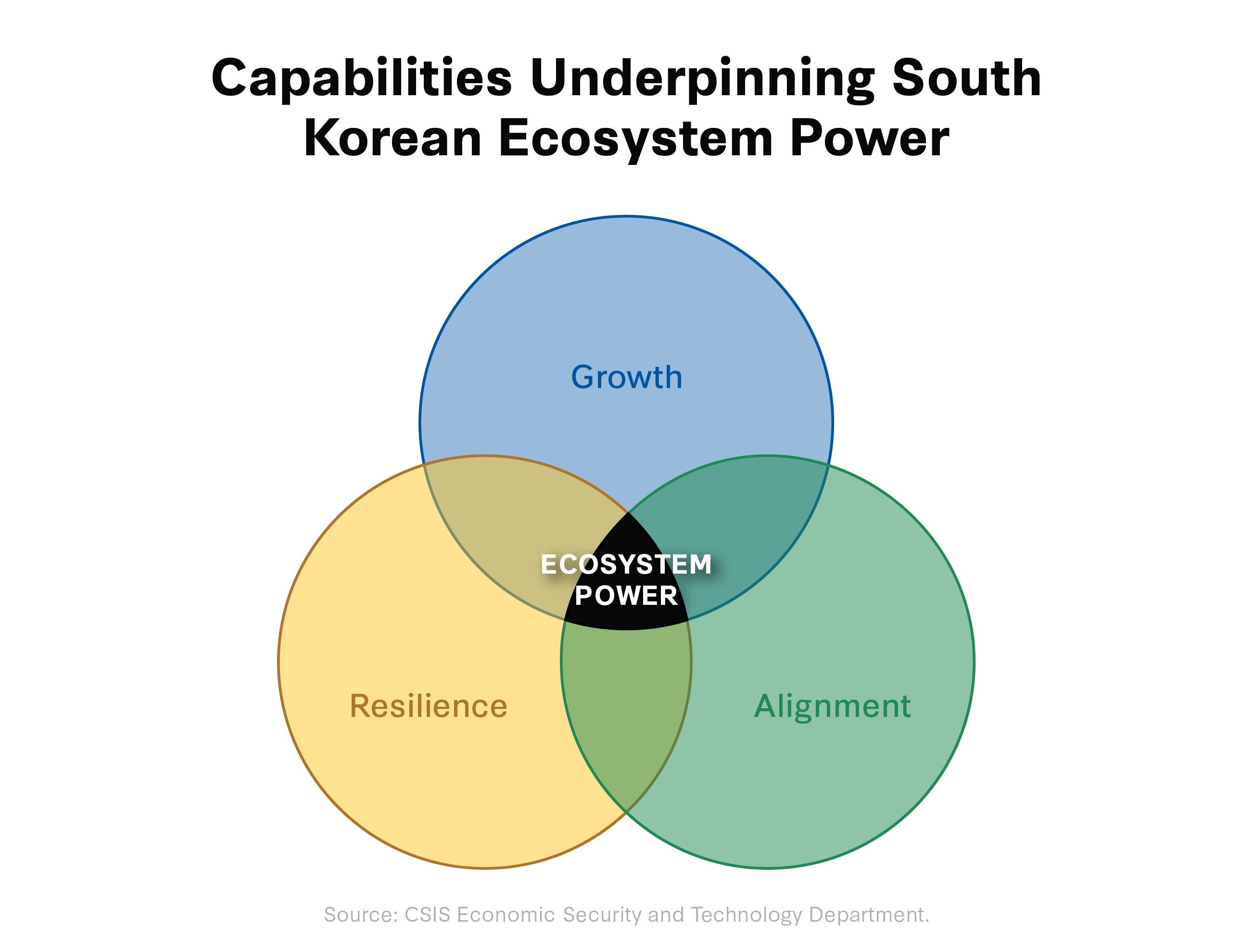
Sustained growth is a prerequisite for South Korea’s long-term security. Growth finances defense, innovation, and infrastructure, and can help meet the needs of an aging society. Yet the country’s economy faces four structural constraints: a shrinking workforce and fiscal base; weaknesses in capital markets that limit financing for productive investment; diminishing returns to capital and persistent productivity gaps across firms, sectors, and regions; and heavy reliance on a few export markets as multilateral trade rules weaken. South Korea’s ability to sustain technological leadership—an engine of growth—therefore depends on whether its domestic economy can develop skilled workers, innovative firms, competitive services, and new sources of investment.
Seoul has expanded its defensive economic tool kit across supply chain monitoring, stockpiling, investment screening, export controls, technology protection, and cyber defense. Yet that tool kit’s effectiveness remains uneven. Dependence on major export markets and concentrated supplies of energy and critical materials expose South Korean firms to external pressure and disruption. Technology theft, diversion through third countries, and cyberattacks create further vulnerabilities. Gaps in supply chain mapping, enforcement, and coordination further limit the protections that existing authorities are intended to provide.
Given its industrial strengths, technical expertise, and sovereign pools of capital, Seoul can expand its global influence in ways that augment allied technological and economic advantages. The report argues for deepening two-way trade and investment between South Korea and the United States in strategic sectors. Its shipbuilding scenarios illustrate how the United States can realize its commercial shipbuilding goals by facilitating long-term South Korean investment and knowledge transfer. Similarly, it argues that South Korea’s AI ambitions can be achieved by pursuing a full-stack partnership with the United States, including through strengthening the investment climate for the digital services sector. Beyond the United States, Seoul’s growing role in overseas development assistance can be deployed to build allied critical minerals extraction and processing capacity. South Korea’s role on standards bodies, while growing, has yet to realize its full potential for driving standards adoption within and influence over technology ecosystems.
South Korea and the United States are treaty allies. They also share long-term economic security interests essential to the prosperity of their peoples. U.S. markets, technology, and capital remain central to South Korea’s growth, while South Korean investment and capabilities across ships, chips, batteries, and other industries are critical to U.S. technology and reindustrialization goals. In addition, both countries face common challenges posed by China’s overcapacity. Because of their intertwined relationship, the effectiveness of U.S. and South Korean economic defense tools, such as export controls, depends on close alignment and coordination. Importantly, this report argues that the United States has a stake in South Korea’s evolution as a technology partner and an ecosystem power.
The 73-year U.S.-ROK treaty alliance and economic relationship were instrumental in enabling the Miracle on the Han River that established South Korea as an export nation and industrial power. The country’s next chapter will depend on whether it converts its technological capabilities, capital, and partnerships into greater influence over how the world’s most consequential technologies are developed, financed, and brought to market. Successfully navigating this transition, in alignment with the United States, will require that the South Korean government and the country’s businesses exercise economic statecraft commensurate with South Korea’s potential. Becoming an ecosystem power offers South Korea a path to interdependence on more favorable terms, and with sustained growth and greater security for its people.
This report was made possible through a combination of general support to CSIS and support from the core underwriters of the Economic Security and Technology Department’s work, including Dalio Philanthropies, Ken Griffin, and Microsoft Corporation. This effort also received generous support from Coupang, Inc. As with all CSIS research, the findings and recommendations are solely those of the authors and were developed independently of any funder.