Trump-Xi-Putin Summit: What Happened? | The Capital Cable #147
November 19, 2026 • 8:45 – 9:30 am EST
Hosted by Korea Chair

Photo: PUNIT PARANJPEPUNIT PARANJPE/AFP/Getty Images
The Modi government is at the midway point of its third term. Contrasted with U.S.-fueled global turmoil, the Indian market has been a beacon of stability. But stability is not the need of the day. Positive change through economic reform is more important than ever, and the track record during this term is mixed, as evidenced by our India Reforms Scorecard. Modi 3.0 is doing well on trade policy and has triggered a few domestic reforms. In its remaining time, the government should also prioritize FDI reforms and push states to improve their business environments.
The Modi government won re-election in 2024 but, with a reduced mandate, was forced into a coalition to retain power. But this position is not a significant detriment to reform; the BJP’s two core coalition partners, the Andhra Pradesh-based Telugu Desam Party (TDP) and Bihar-based Janata Dal-United (JD-U) are not traditionally anti-reform. The BJP continues to strengthen its hand in the upper house of Parliament, the Rajya Sabha. The party holds 117 of 244 seats. And the BJP has its all-time record of 17 chief ministers.
A year ago, there was a palpable sense in Delhi that an economic crisis was at hand. The Trump administration was unleashing a trade war with most of the world. India was targeted even more sharply. Crude oil prices had spiked—even before the United States first attacked Iran. This concern drove a few significant reforms in late 2025, notably a rationalization of the Goods and Services Tax; amendments to the Insurance Act; and amending India’s nuclear power development laws.
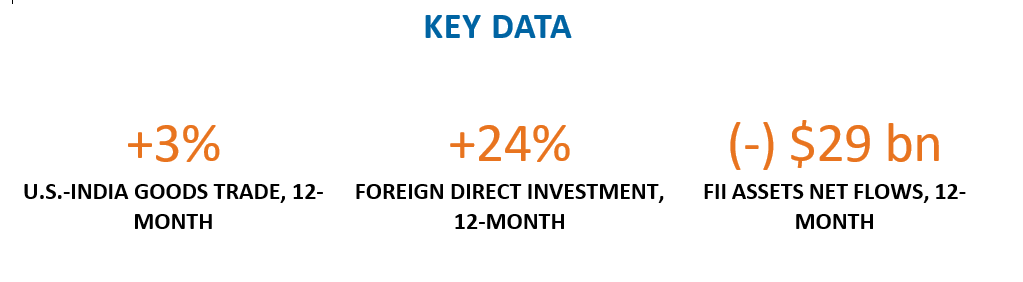
However, the “crisis” did not really materialize. The government reported 7.8% growth in the first quarter of the fiscal year. FDI inflows have remained relatively strong by Indian standards, hitting $70b from September 2025-October 2026, a 24 percent jump from the prior year. India’s goods exports are up 9 percent year-on-year, and services exports grew 10 percent year-on-year. Foreign portfolio investment (FPI) has been weak with $28b net outflows over 12 months, but India’s SENSEX stock index remains close to record levels.
The Modi government’s performance this term in pushing big domestic commercial reforms has been mixed. There have been some notable successes such as rationalizing the Goods and Services Tax, liberalizing atomic energy production through the SHANTI Bill, and decriminalizing some types of corporate offenses through the Jan Vishwas Bill. Below the headline reforms, former cabinet secretary Rajiv Gauba has been leading an effort to introduce a range of process reforms at NITI Aayog. These capture fewer headlines but certainly improve the “ease of doing business.”
Other domestic reforms such as privatization, modernizing the Electricity Act, further relaxation of labor regulations, and efficient restitution of business legal cases remains on the “to do list.”
The Modi government’s third term has been most progressive in terms of trade policy. India continues its recent pursuit of tariff-focused trade agreements with key partners. The Union Budget has tended to have more tariff line decreases than increases. And there is a subtle shift away from the use of non-tariff barriers like Quality Control Orders (QCOs).
The government still maintains local manufacturing rules in some sectors. However, this tool has been employed less aggressively this term.
The Modi government has not aggressively pursued additional FDI reforms since early in its first term. Over the last two and a half years, the government has made only a single FDI reform—a legislative change to the Insurance Act that increases the maximum FDI holding in an insurance company from 74 percent to 100 percent.
This record compares unfavorably to the Modi government’s first term (37 FDI reforms in 5 years) and second term (12 FDI reforms) and falls below the average of 20 FDI reforms per 5-year terms under the Vajpayee and Singh governments. Over thirty sectors still have some form of FDI limitation, and at least ten sectors have regulations that only apply to foreign firms.
This is the area of reform that requires the most attention. States control the core factors that will “make or break” India’s economic dreams- electricity, water-sanitation, labor, and land acquisition. Some of the Modi government’s big ideas from its first term, such as creating model policies for states’ consideration and ranking states’ business competitiveness through the Business Reform Action Plan (BRAP) have been discarded and need to be reinvigorated.
Pushing politically challenging economic reforms is challenging when topline data suggests the economy is doing well. However, future coalitions may prove to be more difficult to work with. Future prime ministers may be less business friendly. There will be periods with less center-state political uniformity. And the world is looking for beacons of growth. This could be India’s moment.

Newsletter by Richard M. Rossow — July 16, 2026

Newsletter by Richard M. Rossow — April 21, 2026

Newsletter by Richard M. Rossow — May 28, 2026
