Digital Resilience in a Post-Mythos World: A Conversation with Greg Rattray
November 18, 2026 • 9:00 – 10:00 am EST

Photo: sirylok/Adobe Stock
Welcome to the November 2026 edition of the Human Rights Initiative Director’s Note. I’m Andrew Friedman, director and senior fellow of the Human Rights Initiative (HRI) at the Center for Strategic and International Studies (CSIS). I produce this outlet monthly to talk through human rights and democracy issues that have been occupying significant space in my mind, highlight some of what we’ve been doing at HRI, and present a few articles, books, podcasts, and/or videos that have particularly struck me over the last few weeks.
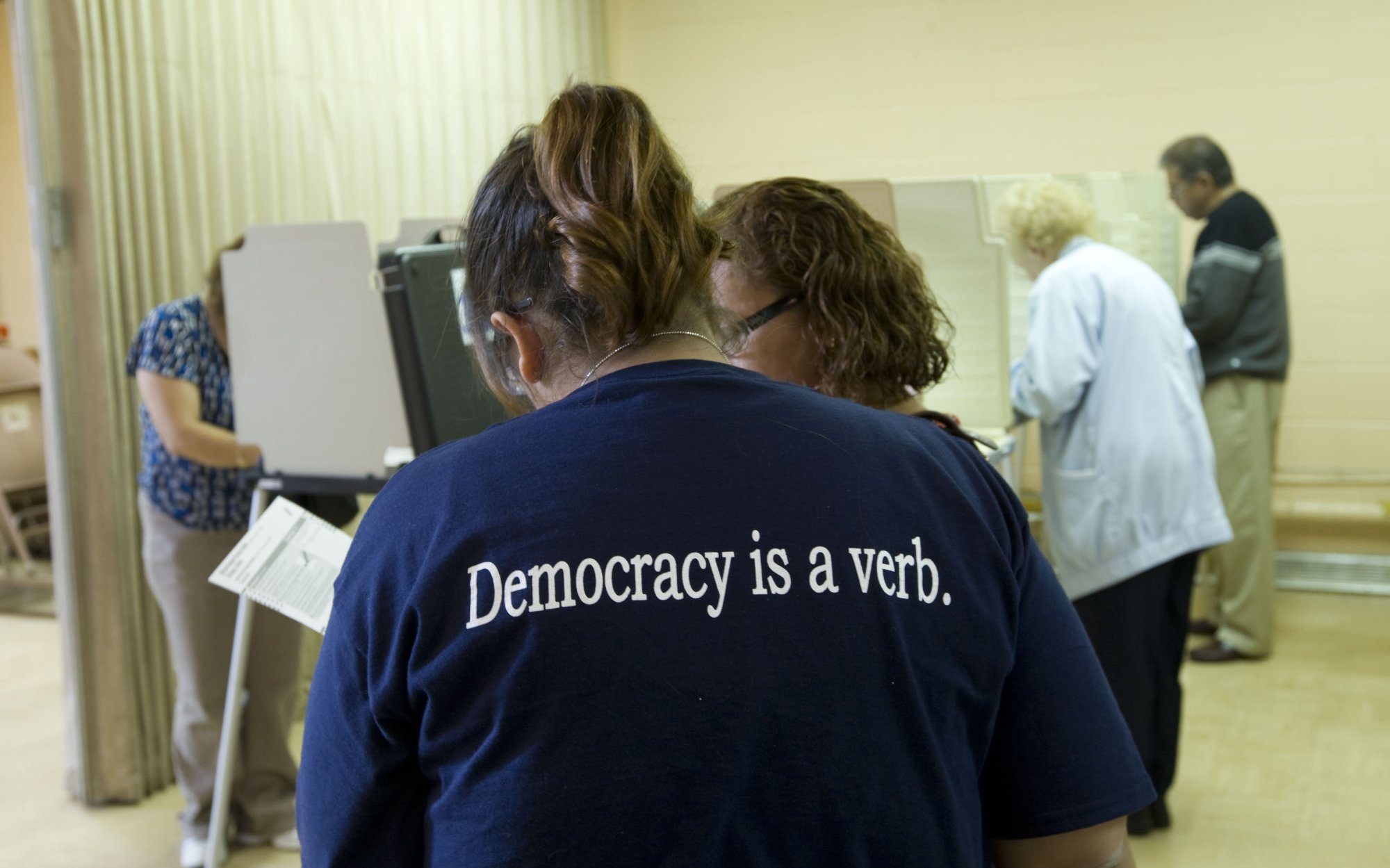
"Is democracy a goal or a tool?" This question was posed to the gathered democracy advocates by Taro Kono, former foreign minister of Japan, at the Copenhagen Democracy Summit earlier this year. Since that time, it has rung through my head, and never more than over the last few weeks.
Much of the political conversation in the United States right now is around whether a new Congress and governments in years to come should focus on delivery or accountability. That is, should the main goal be to deliver for the American people and look forward (democracy as a tool), or should there be investigations and focus on how we got here (democracy as a goal)?
Minister Kono isn’t the first to pose a version of this question. There has long been a debate in pro-democracy circles about whether individuals sour on democracy when it doesn’t “deliver” or if other forces are at play. Sure, in the medium to long term, the evidence is clear—democracy brings better health outcomes, more economic development, greater security, and countless other metrics for objectively improved human existence—but that’s the medium to long term. To defend democracy in the short term, the argument goes, new democratic systems have to prove their worth to the people, and quickly. This time frame shortens when countries are at particular risk of coups or other extraconstitutional means of changing governments, whether that’s because they have a history of coups or they see them in their neighborhood.
Democracy advocates believed in this framework strongly enough that USAID, before its dismantling, launched an initiative around it, aiming to mobilize funds and stakeholders to support democratic openings around the world. It was creatively called “Democracy Delivers.”
My two cents? “Yes, and.” People respond viscerally to those trying to take away their democratic rights, but they also respond viscerally to an inability to envision a better life for their kids, whether that’s because there’s too few jobs, no healthcare, or insecurity. The most interesting data I’ve ever seen on the topic is from Afrobarometer, which found citizens became dissatisfied with how democracy performed when they perceived declines in socioeconomic and political performance, but declines in support for democracy as a system were “most closely linked to adverse changes in political performance, such as declining election quality, increasing levels of corruption, and failure to promote the rule of law.” Put differently, governments failing at human development indicators make people angry at the function of their democracy, but disenfranchisement of voters and not seeing corrupt leaders held accountable makes them question the whole system.
That brings us back to Minister Kono’s provocative question. Is the point of democracy to have individuals play a role in the decisions that most impact their lives, or is it to facilitate greater human development? I’ve talked a lot about elections in this note—what they mean, how they feel, how chaotic and/or beautiful they can be—but this question goes to the heart of choices made after elections. If democracy is a goal, then policy decisions should prioritize deepening democracy and ensuring its survival. If it’s a tool, the priority should be to use its responsiveness for human development.
Back to my “yes, and” answer: I think there’s a middle ground that treats it as both and works towards both outcomes. The Afrobarometer data is telling. People get concerned about the function of their democracy when they can’t put food on the table. People turn against democracy as a system when they see corruption and a lack of accountability. This points to an approach that delivers, using democracy as a tool, while sharpening that tool to make sure it works and people still want to use it (as a goal).
Countering corruption, and ensuring corrupt actors are held accountable, is at the center of this “yes, and” approach. Corruption isn’t an incomprehensible sum that finds itself in the bank account of a distant oligarch. Corruption is a hospital that doesn’t have medicine or a road that doesn’t get built. Corruption is a food company paying to avoid health inspections, either making people sick or ending up with a recall that limits the supply, making food more expensive for everyone. In recent polling, 81 percent of Americans see “corruption as raising [their] costs personally.”
It’s easy to see these as separate issues in their extremes: as a goal when people in autocracies are fighting against impossible odds to hold their leaders to account, or when individuals in established democracies are fighting for that “more perfect” part of the union; as a tool when jobs and food are scarce and healthcare is out of reach in democracies and it’s time to pick leaders who craft more responsive policies.
Like any goal, it needs to be sought, and like any tool, it needs to be used and maintained. That means policy approaches should aim to improve and consolidate democracy, but also to use it to improve lives while maintaining support for it. It helps that many of the policies that seek the goal of a more democratic world also maintain the tool itself. Improving commitment to the rule of law and rooting out corruption improve people’s perception of democracy as a system while also creating a more functioning democracy. A more functional tool leads to better outcomes, as democracy is more responsive and accountable and can lead to better policies.
How Can the Future of AI Center Human Rights? - As part of our Tech for Good, Tech for Bad initiative, we hosted an event examining how AI can center human rights. I was joined by Sarah Yager from OpenAI and Jason Pielemeier from the Global Network Initiative for the discussion. A major theme of the discussion was the ability to adapt human rights law, principles, and approaches to AI. Sure, there is much that’s new about the technology, but human rights has adapted to new technology before, and figuring out what is adaptable versus what is truly novel will be a key issue in centering human rights in AI. Come for the human rights in AI conversation, stay for a truly incredible philosophical point made by Sarah.
Reimagining the Atrocities Prevention Law and Policy Architecture in the U.S. - On October 23, the Alliance for Peacebuilding hosted a full-day conference about the future of atrocity prevention work within the U.S. government. It was a fascinating series of conversations, and one of the main takeaways (which is true for all development work) is that it’s not a time to be thinking in predefined boxes, and the realm of the possible is never going to be the same as it was a few years ago, for both better and worse. It’s an important time to be reimagining what we can do and how we can do it better, rather than assuming what couldbe. A huge thanks to AfP and Megan Corrado for putting on this event, making sure the community stays together and keeps thinking about what could be.
Civic Space is Still Contested, but Not Yet Lost. It’s Time for the Big Pivot – Vukasin Petrovic - About a year ago I met with Vukasin, and as we chatted, he posed a fascinating question: What would an offensive civic space look like? For too long, civil society has been on the back foot. Civic space is closing and resources have been stripped away. Authoritarians are emboldened with new tactics in both the online and offline realms. So how does civil society go on the offensive? How can those doing the hard work pivot from defense to offense? This article goes a long way in addressing that question.
Reimagining how the United States advances development in the 21st century: At home and overseas – Ambassador Sarah Mendelson - One of the primary lessons of USAID’s dismantling is the immense disconnect between Americans whose primary work is overseas and communities across the U.S. Changing this should be one of the most pressing priorities for any future U.S. development efforts. Ambassador Mendelson (the inaugural director of HRI!) here makes the case for having a “Development Officer Corps” with domestic tours as well as international ones. This could bring needed innovation and cross learning to development efforts, make sure the work is better understood by and ingrained in domestic communities, and help break down the silos that are too common between domestic and foreign affairs. Removing this imaginary barrier is key to a more sustainable future.
Special Bonus (because I haven't read it yet): Education and Conflict in Northeast Nigeria – Dr. Vanita Datta - Alright, alright, alright. I haven't read this one yet, but I got a chance to hear about the research and drafting extensively during the process. Vanita is a good friend and a former colleague, and she just released a book based on her PhD research. Her deep knowledge of what conflict in West Africa means to development outcomes is unmatched, and I have no doubt it comes through here.
We’ll be back in December, but until then, keep up with our goings-on on the HRI homepage and on LinkedIn. If you have thoughts or questions, please feel free to reach out at [email protected], and if you were forwarded this and enjoyed it, please sign up via the homepage here.
