From Partners to Producers: U.S.-Australia Defense Cooperation
October 5, 2026 • 9:00 – 9:30 am EDT
Hosted by All About the Base

Photo: Manuel Mazzanti/NurPhoto via Getty Images
This piece is part of a commentary series called “The Foundations of Space Superiority” that analyzes the strategic, economic, and scientific drivers of securing a lasting U.S. advantage in space.
Space superiority is the unstoppable momentum that propels the United States into space faster and farther, to boldly go beyond the reach of competition from other nations.
It requires a whole-of-nation effort that includes the talent pipeline, academic research, a vibrant industrial base, and well-resourced commercial, civil, military, and national security space sectors. It also demands a generation of children who aspire to work in and for the space domain, at the frontier of human existence, to build the infrastructure and explore the resources of the future.
Space superiority is built upon strong commercial leadership in space, along with sufficient market depth to stay far above international competitors while earning the long-tail economic benefits of a growing global demand for services such as:
The launch and communications sectors are well understood, but there are also benefits to space superiority from sustainable commercial remote sensing. The primary societal outcome of access to remote sensing information is an ever-improving knowledge of planet Earth at speed and scale, which enables humanity to make the best decisions to improve societal standards of living. Decisions derived from remote sensing can be about futures and trading markets, agriculture optimization, energy exploration and production, natural resource management, urban and logistics planning, navigation, military defense, climate and disaster indications and warning, insurance payouts, information security, and more.
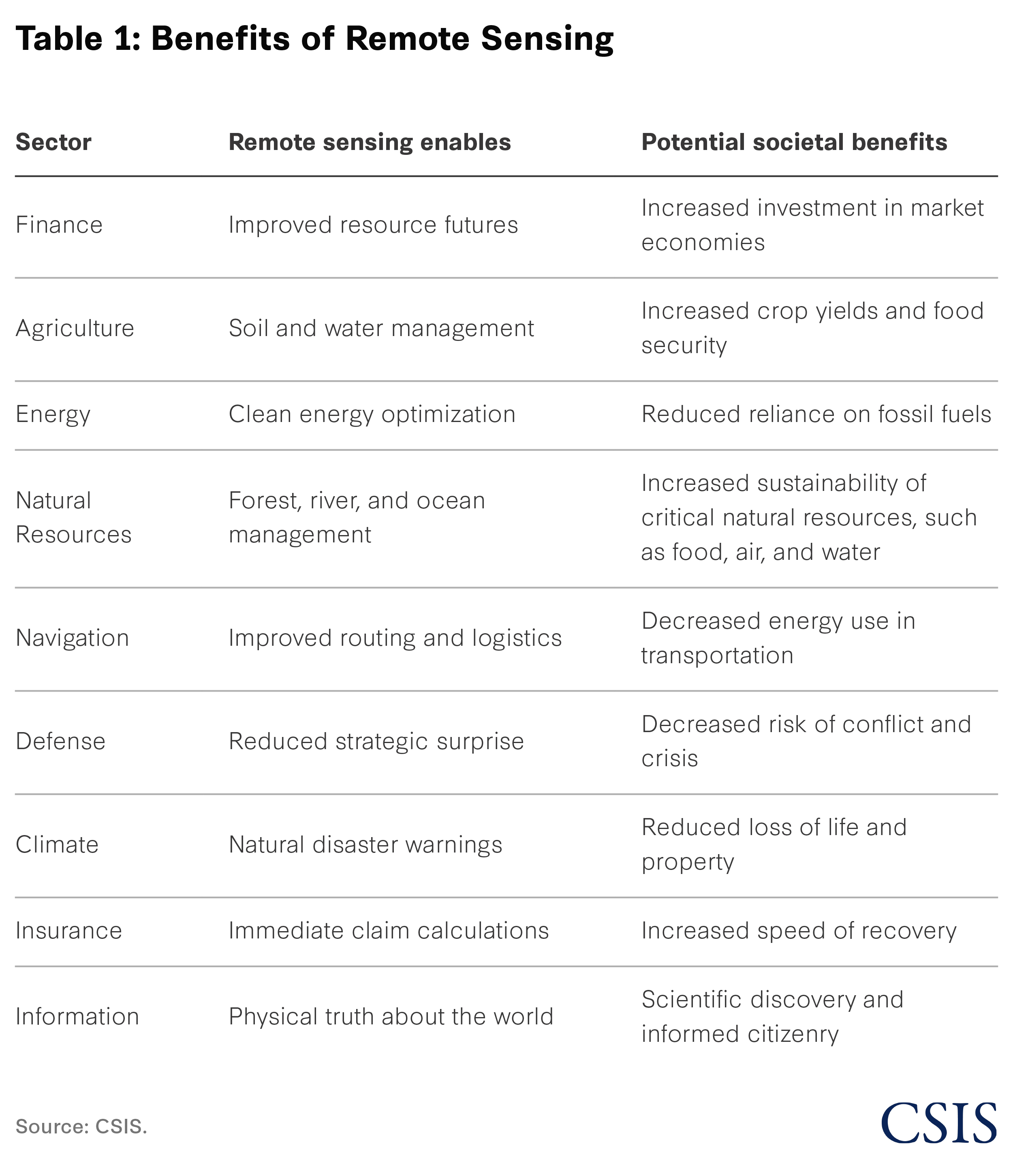
Like the explorers and merchants who transported exotic spices in the seventeenth century, today’s leading space operators deliver valuable sources of information that generate scientific and economic value for society. They build high-tech transportation capabilities and control the top logistics routes to space in the form of rocket launches and an orbital communications infrastructure. They service humanity’s insatiable demand for information. Like the wealthy industrial barons of past eras, these new age investor-entrepreneurs are enriching themselves while building a new capital infrastructure that will ultimately benefit humanity in untold ways. Access to space-based remote sensing provides critical geospatial information optimizing the “smart” design of infrastructure and resource utilization. Choosing locations for energy production and transmission facilities, managing water utilization more efficiently for improved agriculture, and optimizing urban planning for smart cities are just a few examples of the economic benefits of remote sensing data.
The CSIS report Gold Rush: The 2024 Commercial Remote Sensing Global Rankings highlights the importance of securing access to geospatial information by stating that leading nations could “control the information narrative about the entire planet, from the environment to natural resources to human conflict.” Nations that sponsor and support such infrastructure projects and geospatial information services will lead the world into a new technological era with greater access to and control over critical information. Nations that lack economic savvy and fail to sponsor these commercial space enterprises risk losing their technological edge at humanity’s frontier and being relegated to second-tier space nation status until the next disruptive technological revolution occurs. Until then, they may not be able to catch up.
While the benefits are many, the existence of commercial remote sensing in a contested space domain is constantly at risk. Russia has repeatedly and consistently messaged that their policy is to consider private space companies who aid their enemies to be treated as “legitimate targets for retaliatory measures, including military ones.” The great trading companies of prior centuries needed the ability to defend their trade to stay successful. Like today’s space companies, they assumed all the risk from threatening competition along important trade routes. Under the rules of the time, they were authorized to wage wars, negotiate treaties, and strike their own coinage. Space superiority will also require commercial ventures to defend themselves and their trade and information routes. In fact, this policy shift has recently occurred in cyber defense. Commercial space operators must be allowed to act with lethality in self-defense, negotiate multinational business partnerships free from penalties, and provide the public with access to their information.
Allowing space companies to defend with lethality is the first step toward true deterrence. In its 2024 Commercial Space Integration Strategy, the Department of Defense recognized the threat to commercial space assets and stated that it would “leverage a range of tools” to protect them. However, the Department of Defense lacks the ability to credibly defend private space systems due to the vastness of the space domain and the proliferation of commercial satellites in orbit. While the 2020 National Space Policy outlines that the U.S. government would consider retaliatory actions against nations that attack U.S. space systems, the damage to critical infrastructure and economic opportunity would already be done and could easily disrupt the future of U.S. space superiority. Put simply, a defending company must be able to conduct (or hire) in-orbit private or commercial counterattacks that render an attacking spacecraft useless. Commercial operators taking such measures would be akin to ‘hacking back’ in cyberspace, something recently allowed by a new U.S. policy.
In space, this concept has been debated but never sanctioned by the U.S. government. Only an unimpeded, timely, and lethal response can serve as a true deterrent. Until then, the United States offers its adversaries sanctuary inside a gray zone of its own making, inviting their bad behavior and enabling escalation in space without any response or consequence. Lack of policy action in this area passively creates an unsafe normal for commercial space operators. The time is now to deputize companies to fight back in actual space—like they can in cyberspace—and help the government protect the country’s off-planet industrial base and future space economy.
Successful commercial remote sensing companies also require a rare stack of high-tech talent, precision hardware, complicated aerospace systems engineering, control and optimization software, and supreme business acumen. Once achieved, these space industry capabilities are heralded as a source of national pride and are often showcased for their accomplishments. To achieve superiority on a global stage, governments must improve the many underlying structures and systems that enable space commercialization. It is necessary for nations to attract and develop top technical talent, subsidize growth in space-related manufacturing and infrastructure, and create more incubators for space entrepreneurs.
A talent pipeline is the first step, but the United States has continued to backslide relative to peers in science and math education. The U.S. education system developed for the industrial revolution and boosted by the first space race is based upon an outdated model. The space domain has a natural advantage in being able to stoke the desires and dreams of youth for exploration and glory, putting companies in a position to inspire and engage. Partnerships between industry and universities are a start, but dreams of space are often fueled at a much younger age, and primary school involvement is critical to teaching the foundational skills for the scientists, engineers, and space entrepreneurs of tomorrow. The education system could promote a space track at the primary school level to encourage students to pursue advanced math and science through their educational journey. Without an intervention that encourages mastery of difficult science and math concepts, the next generation will fall further behind their international peers. Long-term space superiority requires our education system to do better.
In summary, space superiority will come from governments sponsoring, hosting, and promoting a robust commercial industrial base, enabling their space enterprises to expand, serve consumers with the best information and products, and ensure the ability to protect and defend their infrastructure from bad actors. The superior space companies of the future will deliver better information to their customers while simultaneously defending their business territory and physical assets. This requires a policy change to allow for the legal self-defense of private space systems and a nationwide educational effort aimed at boosting the space talent pipeline. These two fundamental improvements will generate systemic and compounding gains for the entire space industry, enabling private space companies to add momentum to the race for space superiority.
David Gauthier is a senior associate (non-resident) with the Aerospace Security Project at the Center for Strategic and International Studies in Washington, D.C.
