The UN is Due for a Reboot
November 24, 2026 • 9:15 – 10:00 am EST
Hosted by Global Development

Photo: Tracy King - stock.adobe.com
As economic security has risen on the policy agenda, so has debate over national champions—dominant domestic firms backed by policy as strategic assets. Moving antitrust policy from a consumer welfare standard toward a national security framing, as has been suggested, is neither easy to do nor supported by the evidence. The arguments for more or less consolidation on national security grounds are not well supported by the data. This brief argues that any antitrust decision justified on national security concerns should clear a high evidentiary bar, and that these concerns are often better solved with other, more established policy levers, such as “promote and protect” tools. It does not argue that national security should supersede antitrust liability. Rather, the brief concludes that national security considerations should be evaluated through a disciplined, evidence-based process in instances where structural remedies in critical technology markets could affect assets relevant to national security.
Traditionally, antitrust policy has not considered national security in its decisionmaking. It has instead relied primarily on the consumer welfare standard, which addresses the negative effects of anticompetitive practices or transactions on consumers through higher prices, reduced output, or lower quality.1 In recent years, as great power competition and neo-mercantilist policies have played an increasingly critical role in key sectors, there has been a bipartisan push to adjust antitrust policy from two sides: (1) Advocates of breaking up big tech firms have argued that market concentration presents a national security risk, while (2) skeptics of antitrust policy have argued that this would merely cede market share and strategic advantages to China.2
Claims that antitrust action can either positively or negatively affect national security are not currently supported by the evidence. Historical examples of high market concentration in security-relevant sectors do not necessarily demonstrate that consolidation advances national security interests. The 1990s defense-merger wave, the 1956 and 1984 AT&T cases, and Ukraine’s fragmented drone sector all challenge the logic of consolidation for security purposes, though in different ways.
This paper recommends that any national security claim in an antitrust case be held to a two-test evidentiary standard. Otherwise, antitrust enforcement should continue to operate under its established consumer welfare mandate. It concludes that national security considerations should not supersede antitrust liability, and that such considerations may be relevant to remedy design in technology markets with significant national security implications. Trade policy, export controls, investment screening, and, in defense, procurement design are more effective solutions than antitrust action for addressing these concerns. Similarly, this paper sidesteps the debate about potential national security benefits of market share for U.S. firms competing with Chinese challengers in third markets. This is for two reasons: (1) U.S. antitrust policy is domestic in jurisdiction, and (2) the scholarship—both for and against—is too nascent to establish the national security benefits for the United States from its firms possessing greater market share abroad.
The two-test standard for evaluating national security implications of potential antitrust decisions is as follows:
Where the evidence is ambiguous, the consumer welfare default should remain the chief determining criterion.
Enforced by the Federal Trade Commission (FTC) and the Antitrust Division at the Department of Justice (DOJ), antitrust laws aim to protect free market dynamics and competition by preventing the emergence of monopolies.3 Market concentration is calculated through the Herfindahl-Hirschman Index; when horizontal mergers significantly increase market share, the federal government can block them.4 When existing firms are found to have achieved market power through anticompetitive means, the courts may order a breakup or divestiture of the company or, less drastically, a change in business operations, such as nondiscrimination practices, data-sharing regulations, or licensing changes. The seminal piece of antitrust legislation is the 1890 Sherman Act.5
Antitrust precedent has largely (though not always) rested upon the consumer welfare standard: The federal government must prove that a merger or the existence of a dominant firm would harm consumers, typically by increasing prices or decreasing product quality.6 The proposed remedy must be proven to be effective and operationally viable.
Calls for antitrust interventions in the name of national security are coming from multiple directions with increasing regularity and volume, and so are the counterarguments. Lina Khan, the former FTC chair, argued in 2024 that monopoly power is “a major threat to America’s national interests,” with examples drawn from technology and defense.7 In The Age of Extraction (2025), Tim Wu makes a parallel argument for breakup on economic and democratic grounds. On the other side, Robert Atkinson argues that breaking up U.S. technology firms would hand strategic advantage to China.8 Similarly, the Computer and Communications Industry Association (CCIA) filed an amicus brief opposing the proposed remedies in the Google search case in May 2025, and its president warned that weakening U.S. companies risks handing an economic advantage to adversaries abroad and that the court’s data-sharing remedies could affect privacy and national security.9 Google itself argued that divesting Chrome would weaken the cybersecurity infrastructure on which the browser relies. Judge Amit Mehta’s September 2025 remedies decision declined to compel divestiture of Chrome or Android, holding that the plaintiffs had overreached in seeking it; the opinion mentions national security only when quoting the plaintiffs.10
While the two camps disagree about what antitrust policy should do, they agree on a fundamental proposition: The degree of market concentration in strategic U.S. industries matters for national security, and antitrust enforcement is the right instrument to shape it.
This premise, if true, justifies giving national security considerations credence in antitrust debates. However, there is thin empirical evidence for treating national security as a core part of antitrust policy. Any attempt to invoke a national security argument—whether for more consolidation or less—should clear a high evidentiary bar.
That high bar is not a new idea; it is close to where the law already stands. Courts have long refused to let firms escape antitrust by pointing to benefits outside competition. In United States v. Philadelphia National Bank (1963), the Supreme Court held that a merger that lessens competition is not acceptable merely to increase size in order to compete with rivals—the same “we must be large to compete” logic the national champion case now makes on a global scale. Later decisions, including Professional Engineers (1978) and Alston (2021), keep the antitrust question focused on effects on price, quality, and output.11 A national security exception would depart from that settled posture, another reason to demand strong evidence before creating one.
Both camps have merits. The Khan–Wu camp starts from observing that a handful of platforms now sit at choke points of the U.S. economy—such as search, advertising, mobile operating systems, cloud infrastructure, and frontier-model compute—and concludes that antitrust action is needed to improve resilience and promote innovation. In the more traditional defense sector, the FTC, under Khan, filed a lawsuit against Lockheed Martin for its attempted acquisition of Aerojet, alleging that the vertical merger would result in higher prices, lower quality, and less innovation for missiles, and reiterating the claim that concentration harms national security.12
Atkinson, however, argues that breaking up U.S. technology firms would cede strategic ground to China.13 Google and its supporters argue that those same firms run the cybersecurity and threat-detection infrastructure that protects U.S. users against foreign threats, and thus breakup would damage national security.14
As of 2026, neither case clears the bar necessary to either block a welfare-enhancing antitrust action or break up firms that are delivering consumer welfare. How concentration bears on national security differs by sector. For defense contractors, the link is direct: They sell security capabilities to the government. For commercial technology firms, the link is more complex, running through innovation and the resilience of critical infrastructure as well as through occasional direct service provision to the government. Neither channel has been empirically substantiated, nor does the current process leave enforcers entirely without security expertise: The Department of Defense (DOD) already provides input on defense sector mergers, and Team Telecom performs a similar role in telecommunications licensing. Whether that should be extended and formalized for critical technology remedies is a live question, and one the standard proposed in Section 5 would govern.
Takeaway: In every major postwar episode where national security has met antitrust enforcement, the record challenges the claim that concentration is always necessary for security.
U.S. antitrust policy invoked national security throughout the twentieth century, most often as a justification for tolerating consolidation, though occasionally to compel divestiture. Three postwar episodes are central to this debate: the AT&T cases of 1956 and 1984, the 1993 “Last Supper” dialogue between the Pentagon and major defense contractors, and the late 1990s defense merger pair (in which Boeing merged with McDonnell Douglas, but Lockheed Martin was blocked from merging with Northrop Grumman). Each challenges the claim that concentration is necessary as a prerequisite for national security.
AT&T’s 1956 consent decree, resolving a 1949 antitrust case, forced the Bell System to license its existing patents royalty-free in exchange for retaining its regulated monopoly structure.15 The national security argument favored Bell in the Department of Justice’s antitrust case because it viewed Bell as a national security asset; specifically, during World War II and the early Cold War, the DOD had depended on Bell Labs’ research on radars, tank communications, cryptography, and nuclear weapons. Bell System and the DOD argued in 1952 that Bell was needed for the Korean War effort and won a freeze of the case.16 During the 1954 settlement negotiations, Defense Secretary Charles E. Wilson told Attorney General Herbert Brownell Jr. in a memorandum that separating Western Electric from Bell would be “contrary to the vital interests of our nation.”17 The 1984 AT&T breakup, by contrast, was justified on competition grounds and actively disputed on national security grounds.18 Here, AT&T’s defenders argued that breaking up Bell System would damage defense-relevant R&D.19 The DOD also vocally opposed security concerns.20
The empirical record demonstrates the opposite. Three years after divestiture, A. Michael Noll found no major change in Bell Labs’ staffing or funding, though he warned that competition could make its research more secretive and its funding less stable.21 Moreover, a 2020 study led by Martin Watzinger documents that AT&T’s royalty-free patent licensing after 1956 encouraged follow-on patenting in non-telecommunications technology classes for decades. Watzinger and Monika find in a 2022 study that the 1984 breakup raised total U.S. telecommunications patenting by 19 percent, an increase driven by firms outside the former Bell System; the Bell successor companies themselves patented less.22 The empirical record suggests that large firm size is conducive to facilitating basic research, but the lack of incentive can suppress the commercialization of such research.
Both the 1956 and 1984 episodes challenge the concentration-as-strength claim. History supports the conventional consumer welfare default: Divestiture and compulsory licensing produced measurable innovation gains, while national security accommodation produced no measurable scale dividend that the breakup might have foreclosed.
The clearest modern episode of national security concerns overriding antitrust concerns is the Pentagon’s 1993 “Last Supper.” At a dinner hosted by Defense Secretary Les Aspin, Deputy Defense Secretary William Perry told the major defense contractors that the defense budget could no longer support all of them, and the department soon agreed to reimburse the restructuring costs of mergers. In a multiyear process, the number of prime contractors fell from 51 in 1993 to 5 in 2000.23 The decision was framed as a national security investment: Consolidation would produce economies of scale in defense R&D and procurement. The subsequent empirical record is contested, as explored in Section 3 of this brief.
Congress has also run the reverse experiment directly: On several occasions, it has relaxed antitrust rules so that domestic firms could combine or cooperate to compete abroad, and the results have been disappointing. The Webb–Pomerene Act of 1918 exempted export cartels from the Sherman Act, but use faded: The associations handled about a fifth of U.S. exports in 1930 and under 4 percent by 1971, and the FTC found the exemption useful mainly for standardized commodities produced by a few firms, not the smaller exporters it was meant to help.24 Similarly, the Export Trading Company Act of 1982 offered antitrust clearance to certified exporters, but the Government Accountability Office later found that of 23 certificate holders it contacted, only 2 of the 13 that answered conclusively had done as well as they had expected, although many reported some increase in exports.25 Sematech, the 1980s semiconductor consortium registered under the 1984 law easing antitrust limits on joint research and backed by Defense Department funding, led its members to cut their combined R&D spending by about $300 million a year, which suggests it mainly reduced duplicated research.26 In 2006, the European Union repealed the antitrust immunity it had granted ocean-shipping cartels, effective in 2008, after finding no evidence that the arrangement made shipping more reliable.27 When government has tried to build competitiveness by loosening antitrust rules, the record is weak.
The Google Cases (2020–2026): National Security Entered Only at the Remedy Stage
Across both Google antitrust actions—the search engine monopoly case (No. 1:20-cv-03010) and the ad tech monopoly case (No. 1:23-cv-00108)—national security surfaced only in the search case, at the remedy stage, raised by Google as a late defense; in the ad tech case, Google argued only that its products protect users from malware. In the search case, Google argued that divesting Chrome and Android would weaken the cybersecurity infrastructure of those products. Judge Amit Mehta’s September 2025 opinion declined to compel divestiture, finding that the plaintiffs had overreached, and called separating Chrome from Google “highly risky.” It still ordered data sharing, and the final judgment limits recipients to firms that do “not pose a risk to the national security of the United States,” a condition the plaintiffs themselves had proposed. The plaintiffs drew the analogy to the 1984 AT&T breakup, where the same argument—that a structural remedy would harm national security—was made and the later record showed the opposite. The takeaway is that national security considerations can be weighed when tailoring an antitrust remedy but not as a defense to antitrust liability outright. Thus, the Google cases demonstrate the narrow but critical role that this brief proposes preserving for national security: a disciplined consideration in remedy design where implementation could affect capabilities relevant to national security. (The full filing-by-filing record can be found in Appendix A.)
Takeaway: Defense consolidation has impacted procurement structure, not procurement cost—and has never delivered the scale dividend promised.
If consolidation produces national security benefits anywhere, it should be in defense, where the market is dominated by one buyer, the rationale is explicit (to capture economies of scale in defense R&D and procurement), and the consolidation has been government directed.
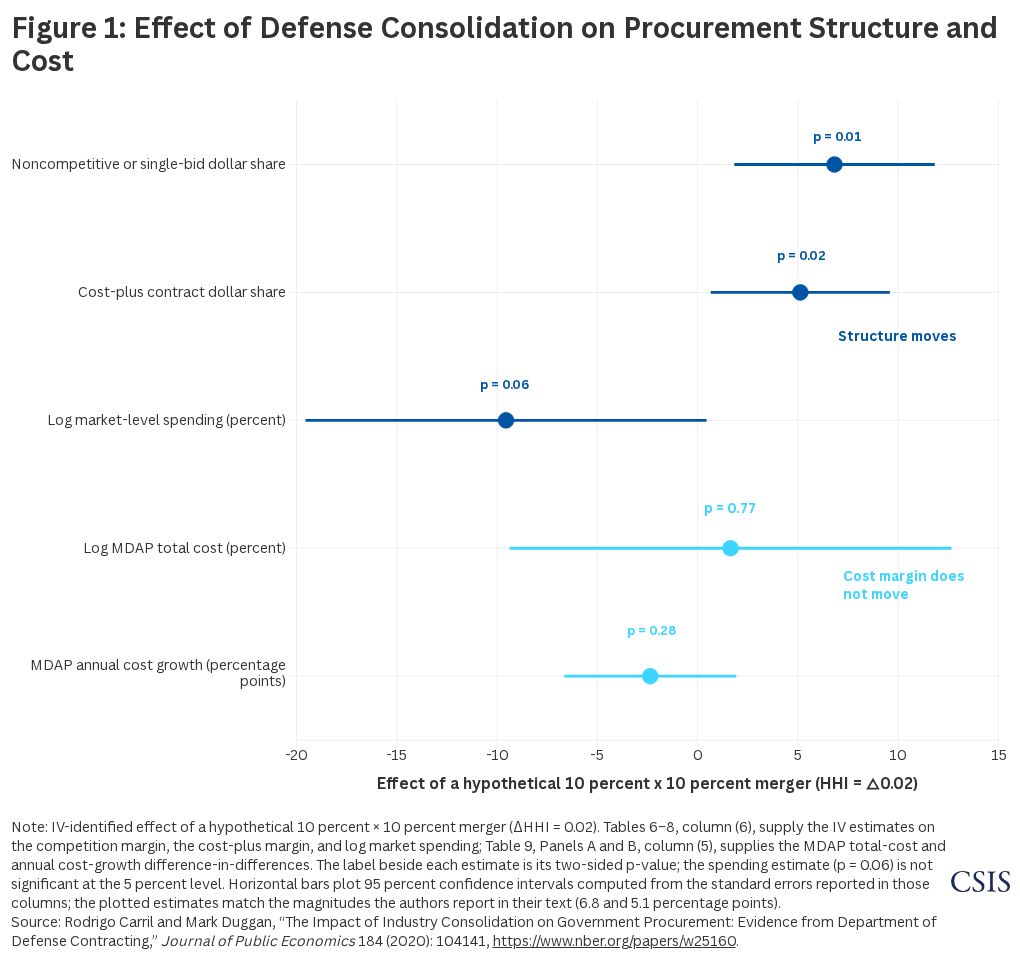
A 2020 study by Rodrigo Carril and Mark Duggan provides the most rigorous analysis of the 1990s wave of consolidation in the defense sector, using DOD contract microdata aggregated to 97 product markets across 17 fiscal years (FY 1985–FY 2001) to study defense contracting when large prime contractors merge.28 Their test case was the previously discussed wave of mergers in the 1990s—four that the government approved (Northrop and Grumman; Lockheed and Martin Marietta; Boeing and McDonnell Douglas; Raytheon and Hughes/TI) and one that it blocked (Lockheed Martin and Northrop Grumman).
To isolate concentration, the researchers treated the four approved mergers as a natural experiment: Each produced a jump in concentration that the authors argue is unrelated to market-specific trends, so outcomes that move with those mergers can be attributed to concentration rather than to coincidental factors.
Carril and Duggan found that mergers measurably reduced the share of contracts awarded competitively and shifted more contracts to cost-plus terms. They found no sign that spending in the affected markets rose (if anything, it fell) and no evidence that acquisition costs rose. These outcomes lend credence to the kind of scrutiny that led regulators to block the 1998 Lockheed Martin–Northrop Grumman deal.
The same logic can be applied to a newer wave of defense mergers: Northrop Grumman and Orbital ATK (2018); L3 and Harris (2019); Raytheon and United Technologies (2020); and L3Harris and Aerojet Rocketdyne (2023). In rebuilding market concentration measures from federal contract records for most years from 2016 to 2024 (FY 2020 and 2022 are missing), the pattern Carril and Duggan documented shows up again: In more concentrated defense markets, the government awards a larger share of contracts without genuine competition, and these contracts rely more on cost-plus terms. However, the modern deals are smaller, sub-tier mergers rather than the giant prime-contractor combinations of the 1990s, which makes them too weak for the isolation of a clean causal effect.
An argument against this view is that the 1990s consolidation was deliberate policy and kept the defense industrial base from collapsing after the Cold War ended. That argument is reasonable for the 1990s, when preserving the industrial base was a benefit, but it does not prove that bigger firms translate to more security today. While there is some evidence that consolidation can increase efficiency in scale and scope, evidence broadly suggests that approving more mergers now would not deliver any added security or efficiency but would instead hurt entrepreneurship and innovation incentives. The prime contractors’ own record points the same way. As 225 companies consolidated into 6 between 1976 and 2019, their share of defense contract dollars held at about 35 percent while their patents went from more cited than the average patent in their field to less cited.29 This is a descriptive trend, not a causal estimate.
Ukraine: A Fragmented Base Outpacing a Consolidated One
The strongest pro-concentration claim is that a fragmented industrial base cannot deliver strategic capability at the speed and scale conflict demands. Ukraine is a direct counterexample. Its drone sector is highly fragmented—more than 500 companies were producing drones by early 2025, in a sector built almost entirely since 2022, with open entry through the state Brave1 platform. By contrast, Russia’s is consolidated under Rostec, which controls about three-quarters of the country’s defense companies.[30] In terms of speed of iteration, the measure least distorted by differences in reporting, the fragmented system appears faster. Ukrainian units refresh drone software and radios quickly in response to frontline feedback, though the Royal United Services Institute notes this has made production harder to scale. Meanwhile, Russia’s consolidated industry has struggled to modernize its production lines under sanctions and surge demand, though drones are among its better-performing segments.[31] Ukraine’s Defense Ministry reports that domestic firms produced more than 1.5 million first-person-view drones in 2024, 96 percent of those its forces received.[32] First-person-view drones cost $200–$1,000 each.[33] This is one wartime case, with heavy external support, speaking to emergent, iterative systems rather than capital-intensive platforms such as submarines or fifth-generation fighters, so it does not prove fragmentation is generally superior. But this example illustrates how large size and concentration can potentially lead to inefficiencies regarding innovating modular or other discrete technologies. The closest U.S. counterpart to Brave1’s open entry is the Defense Innovation Unit, discussed in Section 5.
Takeaway: The record does not show that firms need monopoly scale to keep innovating. If anything, history shows that while larger firms can excel in process and incremental innovation, smaller firms excel in “radical” or disruptive innovation.
Another national security argument for relaxed antitrust action is that big domestic tech firms need their scale to keep innovating, and that breaking them up would weaken the United States’ ability to out-innovate China. However, there is a large body of evidence that directly refutes this claim.
The clearest evidence comes from AT&T. In 1956, the government forced AT&T’s Bell System to share its patents for free; In 1984, it broke up the company entirely. While both times critics warned that AT&T’s research scale was a national asset and that fragmenting it would hurt innovation, patenting increased.34 The AT&T case is not wholly exact to the argument being made here, as AT&T was a government-sanctioned monopoly with a research arm separated from the operating business. Still, those arguing that scale is necessary for companies to innovate today do need to explain why this current moment is different from that of 1956 and 1984.
Likewise, the broader economics literature does not show that innovation needs monopoly-sized firms. One major study finds an inverted-U relationship between competition and innovation: Where competition is weak, more of it raises innovation, and only where competition is already intense does more of it start to reduce innovation.35 Another study finds that research spending benefits spread widely to other firms working on similar technologies, with the social return to R&D worth at least twice the private return.36 A simple correlation showing that big firms hold more patents is thus not a reliable guide to what would actually happen if regulators changed course. The defense sector points the same way on the adjacent efficiency question: The 1990s merger wave, examined in Section 3 of this brief, did not deliver the cost savings its backers promised. While these effects of the merger wave are related to procurement efficiency and not innovation specifically, they still cut against the argument that greater company size leads to efficiency gains. Likewise, a study of 22 industries in 12 OECD countries finds stronger antitrust enforcement associated with faster productivity growth, though scholars acknowledge that overly aggressive antitrust enforcement can have a chilling effect on investment and growth.37
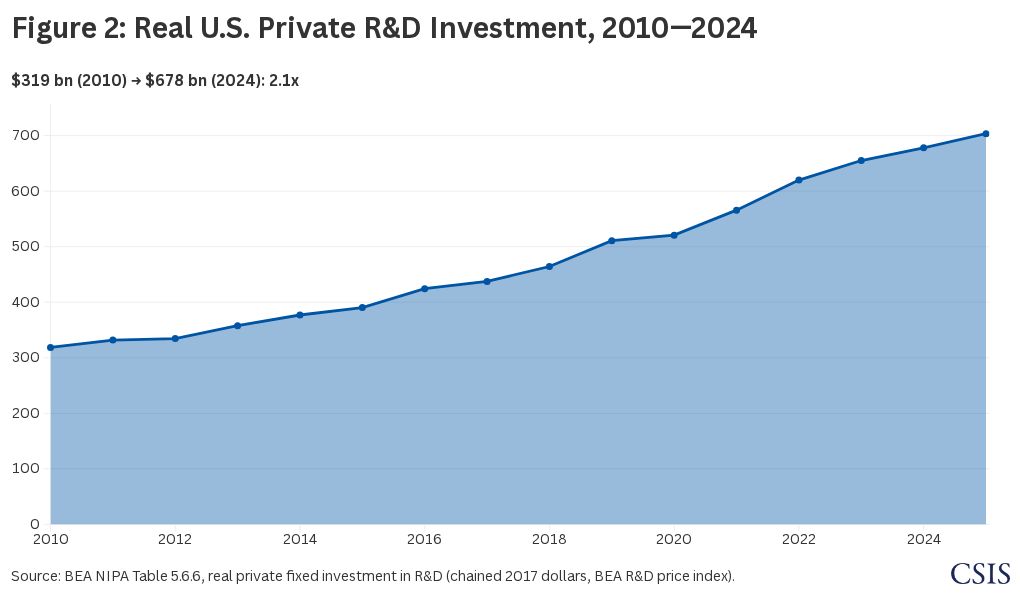
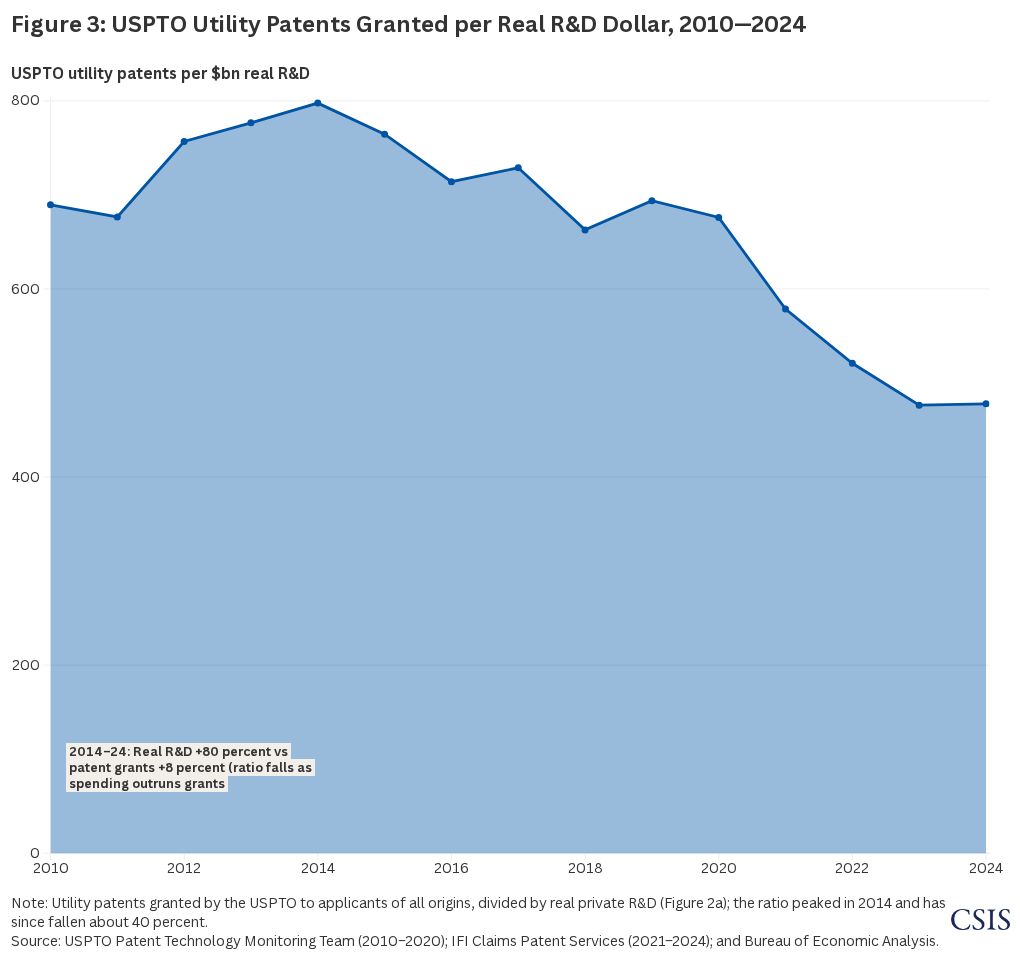
The aggregate picture fits: U.S. private R&D has more than doubled in real terms since 2010, and the combined R&D of the largest platform firms—Alphabet, Apple, Meta, and Microsoft—roughly quintupled in nominal terms between 2014 and 2024 (about fourfold after inflation). Yet utility patents granted by the U.S. Patent and Trademark Office per real R&D dollar have fallen about 40 percent from their 2014 peak; this is because real R&D rose about 80 percent over the decade while patent grants rose about 8 percent.38 More money, concentrated in a few very large firms, has coincided with less measured innovation per dollar. And while correlation does not mean causation, these facts on their face run opposite to what proponents of the scale-drives-innovation argument would predict.
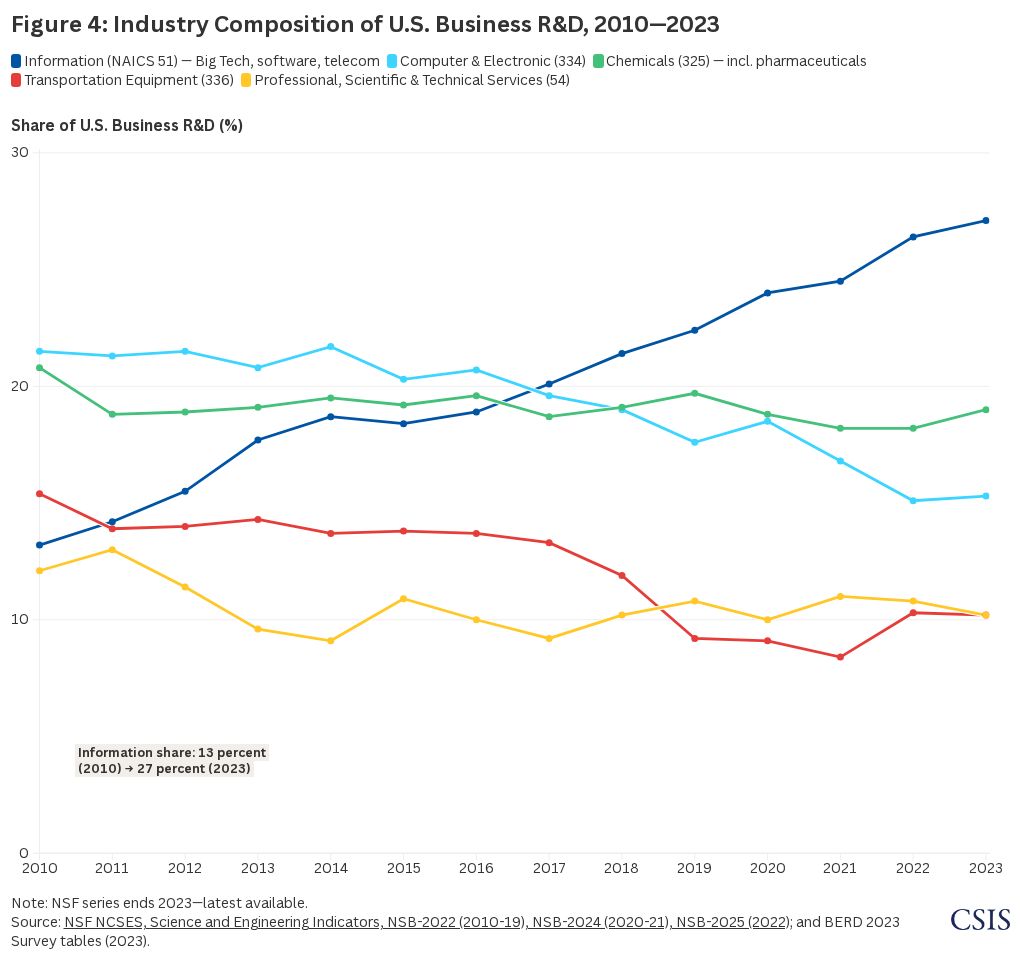
In short, neither major version of the national security argument has produced a rigorous, peer-reviewed study showing that domestic concentration improves security-relevant innovation. Various think tank reports have gestured at the connection without carrying the evidentiary weight of the studies above.39
Put simply, neither side has made the case for using antitrust as a national security lever. The costs of bending the consumer welfare standard are documented in 60 years of merger-review case law and in the empirical literature summarized in Sections 3 and 4 of this brief.
Any future antitrust decision that turns on national security considerations should meet an elevated evidentiary standard. The standard should include, at minimum, the following two tests.
Any national security–based argument, whether for or against antitrust action, must show that the industry in question generates a measurable effect—positive or negative—on the identified security interest that the antitrust decision would materially affect. Generic appeals to “critical infrastructure” or “strategic sector” do not discharge this burden; the externality must be specific and tied to the antitrust decision. The existing literature on network externalities (where each user’s value depends on the size of the connected base), knowledge spillovers (the dollar value of R&D produced by one firm accruing to other firms in the same technology space), and supply chain concentration provide templates for what this evidence looks like.40 Where the externality involves low-probability/high-consequence outcomes that conventional frequentist measurement cannot directly capture (wartime supply chain disruption, catastrophic technology transfer events), structured Bayesian or scenario-analytic evidence is admissible if methodologically defensible. The test is structurally similar to the existing antitrust burden on market-definition and anticompetitive-effect showings, and it should be held to a comparable standard of rigor.
The advocate must further show that the antitrust decision would materially affect the security outcome identified under Test 1. The evidence can draw on case studies from comparable industries, scenario analyses tied to real historical episodes, and existing peer-reviewed studies—whatever combination is strongest. A “scale-is-strength” argument must show that scale actually produces the strength; a “fragmentation-is-resilience” argument must show that fragmentation actually produces the resilience. The standard is not that the advocate produces a specific within-firm or within-sector regression—such evidence is rarely available ex ante for a particular transaction—but that the underlying causal claim be supported somewhere in the published empirical record on comparable cases. Where the available evidence is genuinely ambiguous, the presumption should favor the consumer welfare default, as consumer welfare is the only antitrust standard that is tested across 60 years of case law, while the proposed national security–extended standard is not yet operationalized at all.
Antitrust policy should consider national security without making that its primary focus or a first-resort tool when addressing international challenges. There are often alternative policy levers that are more precise, better tested, and more established than antitrust litigation.
While breaking up monopolies can encourage more innovation and competition in the defense industry, there are other ways to promote innovation and R&D, including research grants, subsidies for R&D and small and medium-size enterprises, investments in education, and improved government signaling for demand. To this end, the DOD, through its Defense Innovation Unit and Office of Strategic Capital, has made extensive efforts to incentivize venture capital and other private investment into defense tech startups to reduce reliance on single suppliers and promote competition.
There is direct evidence that these procurement tools work. In 2018, the Air Force began letting small firms propose their own projects for research grants rather than answer a specification written by the DOD. Firms that narrowly won under the open format were about 11 percentage points more likely to win later DOD contracts than firms that narrowly lost, and they were also more likely to raise venture capital and to patent. The traditional format produced none of these gains, only more repeat grants to the same firms.41 A newer study finds that firms listed in the Defense Innovation Unit’s catalog of tested commercial products became about 12 percentage points more likely to win a DOD contract.42 That study can follow firms for only a year or two after listing, and part of the gain may reflect follow-on awards for prototypes the unit had already tested. Both studies measure the margin the 1990s mergers moved: how many firms compete for Pentagon work. Procurement rules can widen that field directly, without a merger case.
On the other hand, some argue that the government must forgo antitrust action against national champions lest they be unable to compete with subsidized Chinese firms. However, in sectors relating to national security, the United States and allied governments have tools to prevent dangerous dependencies on China; they have investment screening tools, import regulations, and discretion in government acquisitions that can prevent Chinese products from dominating critical industries. In sum, there are alternative methods to promote innovation besides breaking up companies, as well as other ways of promoting the international competitiveness of U.S. firms besides shielding them from anti-monopoly laws.
The U.S. government already does this when it is serious about a strategic rivalry. When Washington moved to keep advanced chips and chip-making tools out of China’s hands, it reached for export controls and investment screening—the “small yard, high fence” approach—not for merger policy. The United Kingdom made the division of labor explicit in 2021, routing security reviews through a standalone National Security and Investment Act while leaving competition enforcement to its antitrust regulator. The tools built for the security problem are the ones already in use for it.
The proposals to bend antitrust policy toward national security—from the left and the right—share a premise the empirical record does not support. While the costs of departing from the consumer welfare standard are well documented in 60 years of merger-review case law, the security benefits are unproven. The asymmetry between known costs and unproven benefits should drive decisionmaking. Until a national security claim clears the two tests set out above, antitrust enforcement should run on its existing mandate.
The national security problem that the current debate references is reasonable; the instrument it suggests is not. Antitrust is a blunt instrument for a surgical security problem. Thus, antitrust policy should not be used as a substitute for other policies that directly address national security challenges, such as export controls, investment screening, or industrial policy. At the same time, when structural remedies in critical technology markets could affect capabilities relevant to national security, this brief argues that such risks are best evaluated through a disciplined remedy-stage consultation process that would enable meaningful input from departments and agencies with expertise about such capabilities.
Please consult the PDF for references.
Christopher Gundermann is a fellow with the Economics Program and Scholl Chair in International Business at the Center for Strategic and International Studies (CSIS) in Washington, D.C. Philip A. Luck is director of the Economics Program and Scholl Chair in International Business at CSIS. Taylar Rajic is an associate fellow for the Strategic Technologies Program at CSIS. Emma Surnow was an intern with the Economics Program and Scholl Chair in International Business at CSIS.
AI tools were used to clean, organize, or format data for this publication. CSIS analysts checked the results against the source data.
This brief is made possible by funding from Amazon.

Commentary by Matt Pearl — November 5, 2026


Podcast Episode by Matt Pearl and Lauryn Williams — October 28, 2026