Capital, Consolidation, and Leadership in the New Minerals Era
October 7, 2026 • 10:00 – 10:30 am EDT
Hosted by Critical Minerals Security Program

Photo: Costfoto/NurPhoto via Getty Images
At a People’s Liberation Army (PLA) center that runs trials pitting drone swarms against counter-drone defenses, one participant explained the logic to state media: “The errors we make in trials are detours the troops will not have to take.” China is running the most systematic effort by any outside power to convert the Ukraine war’s lessons into military advantage, absorbing the errors of both sides. Chinese analysts are explicit about the value of Russia’s war against Ukraine. They describe the conflict as a living textbook and call 2024 “year one of world drone war,” when the two sides fielded enough drones to show the contours of the new mechanized battlefield.
Examination of how this learning works finds three things:
The database for this analysis consists of more than 90 verified Chinese-language sources published between July 2022 and August 2026 across 45 outlets, including the Central Military Commission’s newspaper and peer-reviewed journals of China’s missile, shipbuilding, and aviation conglomerates. The database tracks two bodies of evidence: the literature itself and the implementation record that measures the speed of China’s learning.
The authors of the papers analyzed here are participants in the military learning system. They include researchers at the PLA’s universities and academies, engineers at the defense industrial design institutes, civilian academics working alongside numbered military units, and military acquisition organizations that turn battlefield lessons into requirements and procurement.
As shown in Figure 1, for five signature techniques of the drone war, this analysis records three milestones: first battlefield appearance, first Chinese analysis, and first evidence of PLA training or hardware manufacturing.
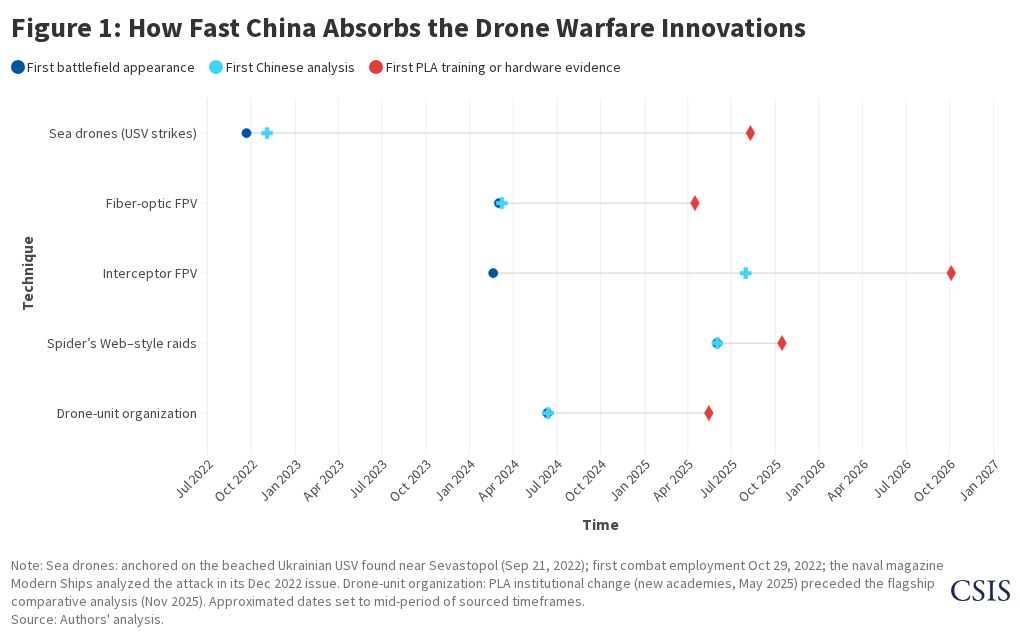
The intervals show a consistent pattern. Chinese analysts register new battlefield techniques quickly, with average of four months from front line to print. Absorption takes longer: Organizational and system-level lessons surface only after a year or more of internal digestion.
Figure 2 maps each outlet to its sponsoring institution: The learning effort feeds directly into military requirements and procurement channels. Nearly half of the sources appear in venues run by the defense industrial institutions—shipbuilding institutes that study naval countermeasures, missile academies that track strike and air-defense lessons, the aviation conglomerate whose own unmanned systems journal is the single deepest analytical platform, and the ordnance ecosystem serving the ground forces.
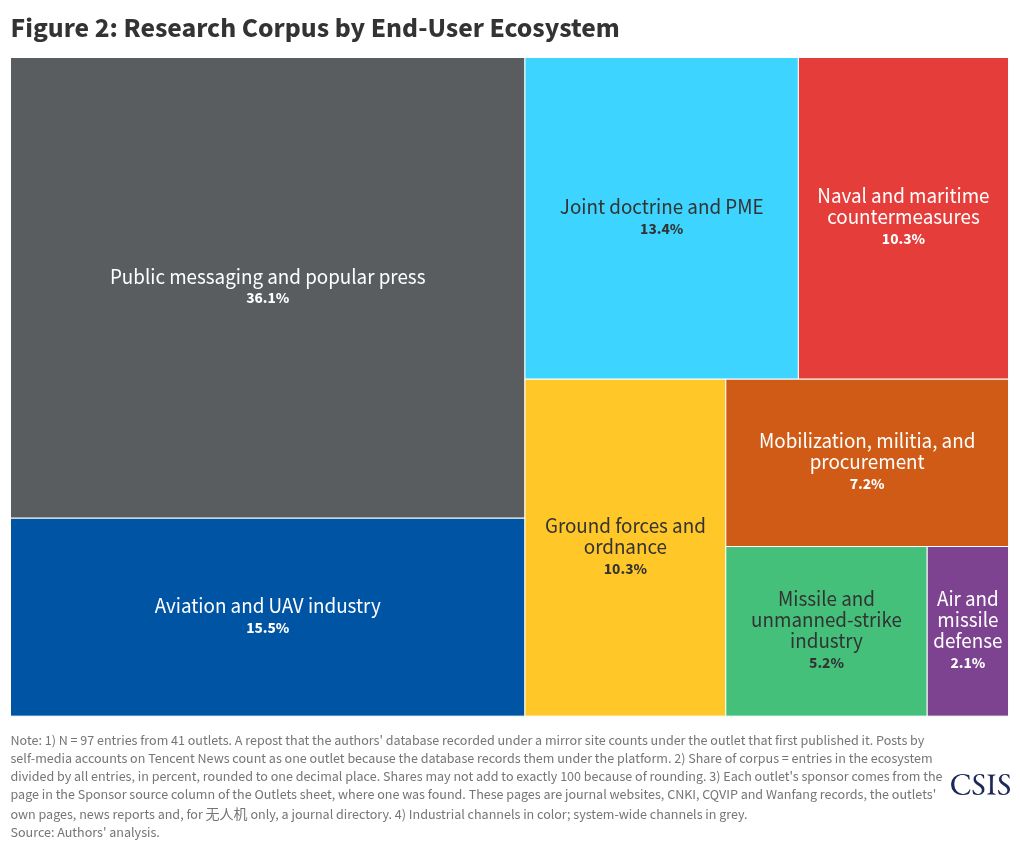
China’s study of the drone war runs through distributed channels. Each military structure feeds lessons from its journals through its design institutes and into its own service’s requirements, while the Central Military Commission’s press carries the doctrinal debate and state media broadcasts the conclusions.
This analysis sorts the lessons the way China does—offense, defense, organization, industry, and what the war failed to prove—because each category moves through a different channel at a different speed. Offensive technique is copied from Russia, whose army resembles the PLA’s and whose fixes have been tested in combat. Defensive requirements are derived from Ukraine’s attacks and built into hardware. Organizational conclusions are debated in the military press while institutions change around the debate. Industrial lessons flow into a manufacturing base that already leads the world, and unproven concepts stay open as a research agenda rather than purchases.
The first offensive lesson is economic. In March 2025, the PLA Daily treated as settled fact the claim that a single reconnaissance-strike drone costs less than 1 percent of a modern fighter while achieving more than 90 percent of its battlefield coverage. While these are rough figures, the Central Military Commission’s newspaper states them without qualification. The professional literature provides supporting evidence. More than one million small drones were purchased by Ukraine and Russia in 2024 alone, which a Chinese naval academy analyst depicted as an average of two drones hanging over every frontline soldier’s head. For Chinese planners, mass is not an ad hoc wartime improvisation, but the economic structure of drone war itself.
The second lesson is speed. According to the National Defense University’s Joint Operations College, Russian forces can strike a detected target within three to five minutes—compared to hours in earlier wars. A survey by researchers at a PLA unit attributes this to Russia’s reconnaissance-strike complex, in which a low-cost reconnaissance drone pushed deep into the enemy rear serves as the observer and guides another drone’s strike, with Orlan-10s cueing Kub and Lancet loitering munitions. The copying target is not any single platform but rather the connection between them: drones wired directly into artillery and command networks.
The third lesson is overcommunication and connectivity. Chinese analysts treat electronic warfare as the deciding factor of the drone war, recording heavy losses on both sides to jamming and countermeasures. They registered Russia’s answer—the fiber-optic first-person-view (FPV) drone steered through a thin cable that jamming cannot touch—almost immediately. The PLA Daily flagged the shift in May 2024 within weeks of the technique’s operational debut, and by April 2025, state media were weighing its trade-offs in detail. That April, China Central Television (CCTV) showed a People’s Armed Police unit in Yunnan training with FPV drones and researching fiber-optic models. PLA training footage of strikes and evasion released in 2024 was framed by Chinese outlets as drawing on Russia-Ukraine battlefield experience, down to the use of capture nets and jamming guns. About a year separated first battlefield use in Russia from Chinese unit training. The lesson pipeline worked at speed.
The analytical corpus runs deepest on defense, organizing lessons around two Ukrainian methods that Chinese analysts consider previews of potential attacks on China. The first is the sea drone. In the journal of the state shipbuilder’s underwater-warfare institute, a team from the Naval University of Engineering tallied repeated Ukrainian strikes on Russian ships, ports, and the Kerch Bridge and found more than 10 large naval vessels damaged. They concluded that a systematized sea drone offensive must be met by counter–sea drone equipment that also fights as a system. A researcher at a sister combat-systems institute proposed countering suicide boats with interceptor swarms, in skirmishes devoid of humans entirely.
The second preview is the airfield raid. After Ukraine’s Operation Spider’s Web reached Russian bomber bases on June 1, 2025, the Chinese foreign ministry’s magazine estimated Russian losses at 11 strategic bombers and identified the raid’s novelty in being launched from inside Russia, at close range. The PLA’s training system answered within four and a half months. In an October 2025 exercise, a brigade defended against a drone attack team of more than 20 operators, using detection gear that locates drones by their radio emissions and matches them against a catalog of more than 800 commercial models, paving a path for Chinese response to a Spider’s Web–style drone infiltration.
The economics of defense received the same treatment as the economics of attack. According to a Global Times analysis of Ukraine’s interceptor drones, “the cost of procuring one man-portable air-defense missile buys several hundred air-defense FPV drones.” Every missile the defender fires costs more than the drone cost the attacker, so the conclusion in the Chinese press is that the best weapon against a drone is another drone. Chinese analysts draw a second conclusion from the same numbers: Any enemy China fights will have cheap drones in mass, so China must learn to shoot them down.
China is taking its cues on this issue from Russia, which has been forced to make fixes under fire. A 2026 review from a Chinese state aerospace design institute recorded that Russia “has built in combat a counter-drone equipment system of electronic jamming first, firepower interception as the backstop, and self-defense interception as the supplement.” Chinese state radio commentary has cataloged Russia’s protective adjustments in the same spirit, from strategic bombers pulled back some 6,000 kilometers to the Chukotka Peninsula to retractable protective nets developed from the improvised cages on tanks in Ukraine. The PLA expects to defend the same kinds of targets, so it wants to copy a tested defense.
These studies have moved into hardware faster than any other category. At the Zhuhai air show in November 2024, the counter-drone systems of the state electronics, ordnance, and aerospace groups dominated Chinese coverage, led by CETC’s Tianqiong, NORINCO’s Hurricane 3000 microwave weapon, and CASIC’s LW-60 laser. The September 2025 military parade put counter-drone missile-gun systems, high-energy lasers, and high-power microwave weapons on state display. In late July 2026, CCTV aired footage of an army drone crew putting a missile into a fast boat maneuvering at sea, and in August the army flew armed KVD002 drones against sea drone targets in exercises. The navy had begun training against unmanned boats a year earlier. In August 2025, the PLA Daily reported a missile-boat drill with an “enemy unmanned boats closing” inject, 35 months after the first Ukrainian sea drone washed ashore near Sevastopol. In April 2026, an Eastern Theater frigate flotilla ran a live-fire drill against unmanned boats.
The war’s organizational lessons reached China through similar channels. When Russia created an independent unmanned systems branch in 2025, the PLA Daily noted it alongside Ukraine’s Unmanned Systems Forces, established in 2024, and Poland’s drone force of January 2025. A November 2025 analysis in the same newspaper praised Ukraine’s embedding of drone battalions and companies within traditional brigades to shorten the kill chain and cut duplicate strikes, weighed embedding against a separate drone service, and judged the two arrangements complementary.
Institutional change ran ahead of the published debate. The Central Military Commission had formed three new military universities out of existing academies six months beforehand, in May 2025. One of them, the Army’s new combat arms university in Hefei, merged the Army’s armored forces academy with its artillery and air defense academy. A Chongqing government enrollment notice lists unmanned systems command and control among its undergraduate majors, and unmanned equipment engineering among those of the new Joint Logistics Support Force Engineering University in Chongqing.
Militia drone detachments organized in Xinjiang and elsewhere extend the effort beyond the regular army under the party’s label for emerging capabilities it wants built into the force. By August 2026, CCTV was presenting the air force’s drones as a cross-service system feeding targeting data to the rocket force, situational awareness to the navy, and long-range strike support to the army. These actions show that China is adapting institutionally, during peacetime via schools, state industry, and the militia, what Ukraine and Russia improvised in war.
Despite the Chinese system’s advantages, there are limits to Chinese adaptation, centering on the frontline feedback loop. A military built on centralized approval, however, cannot create decentralized improvisation by command. This is the open question at the heart of China’s learning efforts: whether it can find a suitable substitute that facilitates improvisation within its centralized command structure.
The first industrial lesson Chinese analysts drew is that production wins. As early as November 2023, the youth press was explaining to its readers why Russia had overcome its early disadvantage in drones. The answer was the sheer scale of Russia’s defense industry, which gradually reversed the situation. For Chinese analysts, a drone war is won by the side that can build more, and no country builds more drones than China. This advantage extends to upstream components. Fiber-optic drones fly on spools of ordinary optical fiber, and a report carried by People’s Daily Online put China’s share of global fiber and cable shipments at 60 percent for 2025.
The war also generated new infrastructure requirements. The fullest Chinese study of Starlink’s battlefield role—written jointly by the state rocket academy, a satellite launch center, and a PLA unit in 2022—traced how Ukrainian firing units depended on intelligence moving through the constellation and concluded that China must develop and build its own low-orbit constellation. It also explains why Chinese writing on drone command keeps returning to satellite constellations, including how to cut an enemy off from them.
One industrial lesson China has learned but will not state officially concerns civilian drones. Beijing’s official position, restated in its 2023 drone export controls, is to oppose the use of civilian drones for military purposes. The PLA’s own procurement website, meanwhile, carries a military unit’s tender for docks and Matrice airframes made by DJI he Shenzhen-based manufacturer that dominates the global commercial drone market. The Matrice is DJI's enterprise-grade line of multirotor drones, built for industrial inspection, surveying, and public safety work rather than for military use, and the docks are automated ground stations that let the drones launch, land, and recharge without an operator present. The Ukraine war shows that commercial drones can survey or fight, and Chinese buyers act on that lesson, whatever the official ministry position.
Chinese literature also records what the Ukraine war did not settle. Drone swarms are the leading example. In October 2024, China National Defense News asked why swarm warfare had produced “all thunder and little rain.” Both sides committed huge numbers of drones, but a swarm mode of operations never appeared on the battlefield. The piece lists the reasons, including flight control, communications, onboard intelligence, energy, and payload. Publication in an official paper lays out how Chinese military commanders approach the issue—exploring each obstacle through a domestic research agenda, with the PLA running swarm experiments to provide information the war did not. This reveals China’s pragmatic approach: It buys what the war proved but experiments on what it left open. Because the defensive lessons provided the most robust evidence, they have made it the furthest and fastest into hardware.
The Russia-Ukraine battlefield has become a “live test site” for China’s military learning. The evidence shows a systematic process through which the PLA and the Chinese defense industry identify battlefield innovations and translate selected lessons into training, procurement, and force structure. The analysis phase, with an average of four months from battlefield appearance to Chinese print, is considerably faster than the institutional absorption that follows, but the process gives China a way to learn from a war without fighting one.
For Taiwan, this learning cuts in both directions. The PLA is studying how unmanned systems can support offensive operations while also examining how inexpensive drones can impose disproportionate costs on concentrated forces. Taiwan’s growing investment in unmanned and counter–unmanned systems will therefore feed into the same cycle of adaptation across the strait.
For the United States, the process also opens a window into emerging PLA priorities. Military journals, training footage, procurement activity, and new institutional programs can reveal which battlefield lessons China considers significant enough to test and institutionalize, often before they appear in doctrine.
But while China can observe combat, reproduce technologies, and institutionalize lessons, it cannot replicate the frontline feedback loop through which wartime forces adapt under pressure. Chinese analysts themselves acknowledge that many theoretical lessons have yet to be translated into mature combat guidance or regulations.
Lilly Min-Chen Lee is a nonresident fellow at the Research Institute for Democracy, Society and Emerging Technology (DSET) in Taiwan and a doctoral fellow at the Fletcher School at Tufts University. Kateryna Bondar is a senior fellow in the Wadhwani AI Center at the Center for Strategic and International Studies in Washington, D.C.