Digital Resilience in a Post-Mythos World: A Conversation with Greg Rattray
November 18, 2026 • 9:00 – 10:00 am EST

Photo: PM Images/Getty Images
On November 16, the Department of Commerce’s Bureau of Industry and Security (BIS) issued a consequential new regulation concerning the advanced hardware needed for super intelligence (SI). The rule also serves as the long-awaited formal rescission and replacement for the Biden administration’s AI Diffusion rule, which the Trump administration announced it would not enforce in May 2025. The new interim final rule (IFR) comes on the heels of revelations concerning former Nvidia CEO Jensen Huang’s involvement with an executive of a Singapore-based cloud computing provider under investigation for smuggling chips to China.
Instead of the AI Diffusion rule’s global license requirement for advanced SI chips and servers with a tiered system allowing set amounts of compute per country and controls on model weights, the new IFR requires a license for a group of countries considered a high risk for diversion or other proliferation concerns and a worldwide license requirement for remote access involving specified levels of compute to end users headquartered in China or other U.S. arms-embargoed countries. While the AI Diffusion rule had some limited provisions touching on remote access—whereby a customer in one country leases compute power from a data center in another—the IFR tackles the issue head-on.
Q1: What does the diversion part of the rule do?
A1: Previously, the item-based licensing requirement for advanced graphics processing units (GPUs) and servers applied only to the 45 countries in BIS country groups D:1, D:4, or D:5, as well as companies headquartered in (or with an ultimate parent headquartered in) D:5 countries. This included countries such as Saudi Arabia, Kazakhstan, and Vietnam, but not other Southeast Asian countries frequently used as transshipment points for advanced compute to China.
The IFR extends the license requirement to five additional countries due to the risk of diversion: Indonesia, Malaysia, Singapore, Thailand, and Brazil. This is not an export ban; the licenses will be reviewed on a case-by-case basis to root out diversion schemes. Licenses are not required for U.S.-headquartered companies in the five new countries as long as they submit monthly reports to BIS.

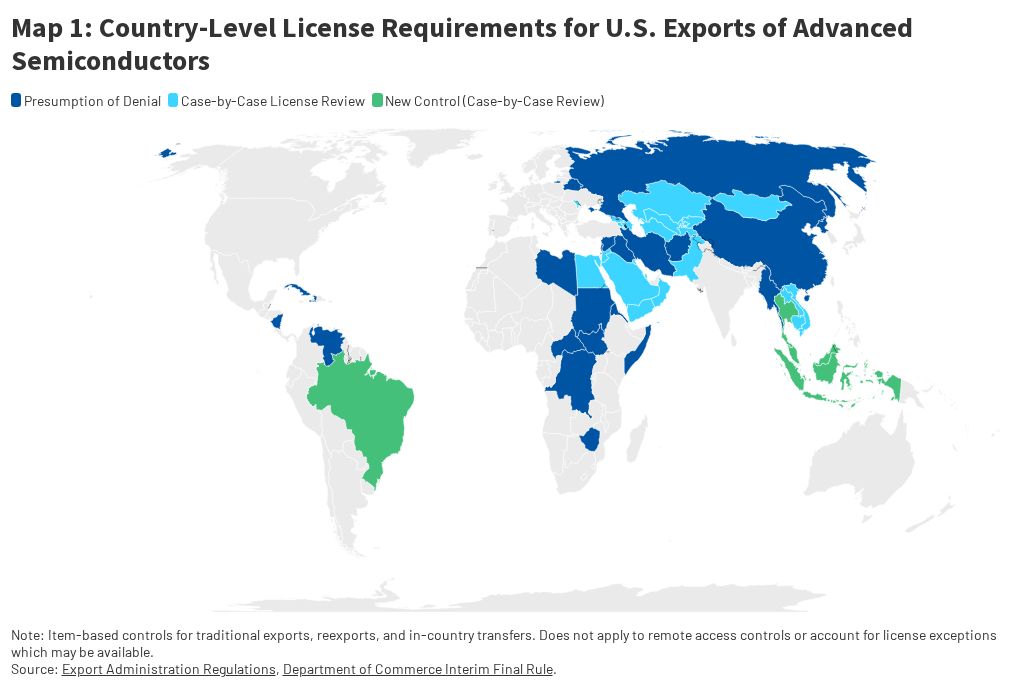
Part of the license review criteria is the effectiveness of the export control regime of the destination country, which may encourage the targets to build out their regulatory systems and improve enforcement coordination with BIS. Singapore stands out on the list as it already has advanced strategic goods controls and a track record of enforcement.
Q2: What does the remote access part of the rule do?
A2: Past BIS advisory opinions held that the provision of cloud services is not an “export,” and therefore not subject to the Export Administration Regulations. The IFR solves this by controlling the end use of exported hardware. If an exporter has knowledge that the items will be used by a data center anywhere in the world to provide more than a specified amount of compute to China or other U.S. arms-embargoed countries, they must obtain a license. The threshold amount of compute is low by data center numbers; 12 million total processing performance equates to around 750 H200 GPUs, or around 42 Vera Rubins.
By controlling the end use, the rule also applies to previously exported hardware. Data centers that were previously leasing compute to China or other countries of concern have 90 days to cease those activities or obtain a license to continue them. If a data center changes how it allocates compute from previously exported hardware in a manner that exceeds the allowed threshold to restricted end users without first obtaining a license, that is considered an export violation.
Q3: What are the implications for industry?
A3: Companies exporting advanced GPUs and servers containing them face a large new compliance and licensing burden, for both future and past sales. For new shipments, exporters are responsible for obtaining sufficient information from foreign data centers to ensure they performed adequate “know your customer” due diligence checks to determine whether a license is required for remote access purposes. The rule does not provide details on what sufficient information means in this context, which may lead to overcompliance, with companies restricting sales to avoid risk. The compute threshold triggering a license requirement for remote access is very low, potentially significantly delaying new and existing data center buildouts until license applications are adjudicated by an already overburdened system.
Moreover, companies that previously exported chips that did not explicitly require a license may find themselves in the crosshairs of enforcement. The rule states that license requirements have always applied if the sale was “on behalf of” companies headquartered in restricted destinations. So, if the exporter sent chips to a data center in Southeast Asia knowing that they were purchased by or their primary use was for customers in China, they need a license to continue such activity and are directed to submit a voluntary self-disclosure to BIS Export Enforcement.
Q4: Will the rule be effective at slowing Chinese SI development?
A4: Likely yes, at least in the short term. The new license requirement for high-diversion countries will add time, cost, and friction to diversion networks, and the remote access end-use control will probably cut off a significant amount of compute. Because the restriction applies retroactively to previously exported computer hardware, third-country data centers currently providing significant amounts of compute to China will either need to obtain a license from BIS, cut off their Chinese customers, or risk consequences from committing an export violation.
However, procurement networks, especially those funded by state actors, will reroute. Continued diligence and willingness to impose controls on new hot spots—and flexibility to remove countries that take appropriate measures to prevent diversion—will be necessary to maintain effectiveness.
Additionally, the exception for “commercial recommender systems”—SI tools used by online retailers and social media companies to rank, filter, or suggest content to users—may emerge as a loophole. The exception only applies if computing power is supplied exclusively for these use cases, but in practice a data center is unlikely to be able to differentiate between this and other nonallowed forms of SI development. The rule does not reference the Pentagon’s list of Chinese military companies (also known as the 1260H list), and therefore exporters and data centers could presumably use the commercial recommender exception for listed entities such as Alibaba. Use of the exception does not require companies to gain prior approval, only to document it.
Furthermore, the IFR leaves room for BIS to modulate how strictly it implements the controls. License applications for remote access will be reviewed on a case-by-case basis, which will almost certainly lead to complex debates among the interagency on which to approve and which to deny.
Finally, the rule was issued just days before Presidents Donald Trump and Xi Jinping are due to meet in Shenzhen. The rule is likely to spark a reaction from China, and President Trump has been willing to negotiate export controls in past bilateral meetings. Though momentum around tighter controls grew swiftly from the Departments of the Treasury and State and from Congress as the Megaspeed case unfolded, President Trump is thus far standing by Secretary of Commerce Howard Lutnick and his previous conservative stance on restricting technology to China. Secretary Lutnick is joining President Trump at the meeting with China on November 19, the same day the rule goes into effect.
Kate Koren is deputy director of the Economics Program and Scholl Chair in International Business at the Center for Strategic and International Studies (CSIS) in Washington, D.C. Kevin Kurland is a senior technical expert (non-resident) with the CSIS Economics Program and Scholl Chair in International Business.

Critical Questions by Kate Koren, Kevin Kurland, and Aalok Mehta — June 16, 2026

Brief by Kate Koren and Philip Luck — April 21, 2026