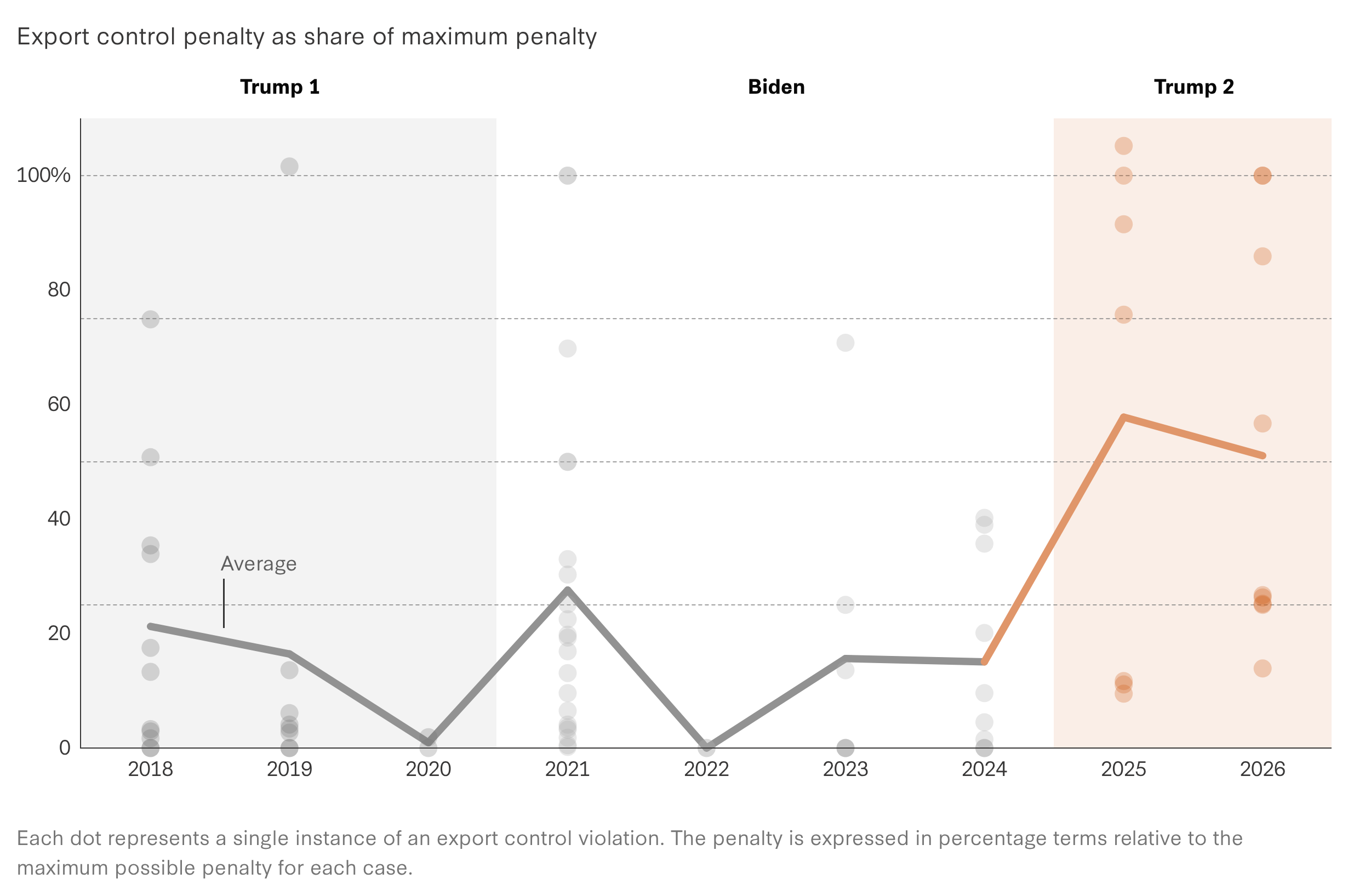
Trump Administration Ratchets Up Export Control Penalties

Remote Visualization

Penalties for export control violations are rising, while government-led training and outreach has slowed, making effective compliance programs more critical than ever. Pending legislation could raise fines even higher. 

  1. Making good on Commerce Secretary Lutnick’s remarks in March 2025 promising a “dramatic increase,” a growing share of fines for export control violations approached the statutory maximum in 2025 and 2026. The Export Control Reform Act of 2018 gives the Bureau of Industry and Security (BIS) the authority to impose a maximum penalty amount per violation or twice the value of the transaction, whichever is greater. As of September 2026, BIS has issued fines totaling over $297 million, more than triple the average total for the past five years.  
  2. BIS is able to impose higher penalties due to a Biden administration regulation change that removed mandatory 25 percent penalty reductions for first-time offenders and other mitigating scenarios as well as raised the penalty cap for cases deemed non-egregious. BIS is also leveraging aggravating factors, such as acting with knowledge of a violation, more aggressively in order to raise penalties. 
  3. These trends make it more critical than ever for companies and universities to resource and implement effective export compliance programs and to file voluntary self-disclosures (VSDs) when violations occur. By regulation, penalties for cases with a VSD must be reduced by at least 50 percent, and according to BIS statistics, no charges are brought for 99 percent of VSDs that are filed.  
Image
Kevin Kurland
Senior Technical Expert (Non-resident), Economics Program and Scholl Chair in International Business
Image
Kate Koren
Deputy Director, Economics Program and Scholl Chair in International Business