Trump-Xi-Putin Summit: What Happened? | The Capital Cable #147
November 19, 2026 • 8:45 – 9:30 am EST
Hosted by Korea Chair

Photo: UAE Presidential Court / Mohamed Al Hammadi / Handout /Anadolu Agency via Getty Images
Less than two weeks into the war with Iran, the Nigerian government sensed an opportunity. On March 11, 2026, then–Minister of Foreign Affairs Yusuf Tuggar appealed to Arab Gulf states to invest in Nigeria’s energy sector, casting Nigeria not as a rival hydrocarbon producer but as a partner that could help them diversify markets and build resilience. Just two months earlier, the UAE and Nigeria had signed a comprehensive economic partnership agreement (CEPA), signaling their intention to deepen trade and investment ties and expand economic cooperation across a range of sectors.
These developments show how the war with Iran has created an opportunity for middle powers in the Gulf and Africa to build on relationships they have steadily developed in order to achieve greater strategic gains. “Middle powers” possess significant economic, diplomatic, demographic, or technological weight but lack the military capabilities of superpowers to project global dominance. They exhibit a growing desire and capacity to shape events within their regions while also balancing and at times limiting the ambitions of outside powers. Many middle and emerging powers are refusing bloc alignment and using this ambiguity as leverage against great powers while continuing to hedge by forging new ties. These countries often seek to exploit geopolitical openings to influence the international system. As the global order shifts toward multipolarity and creates opportunities for middle powers to assert greater agency, states in Africa and the Gulf have worked to diversify their international ties.
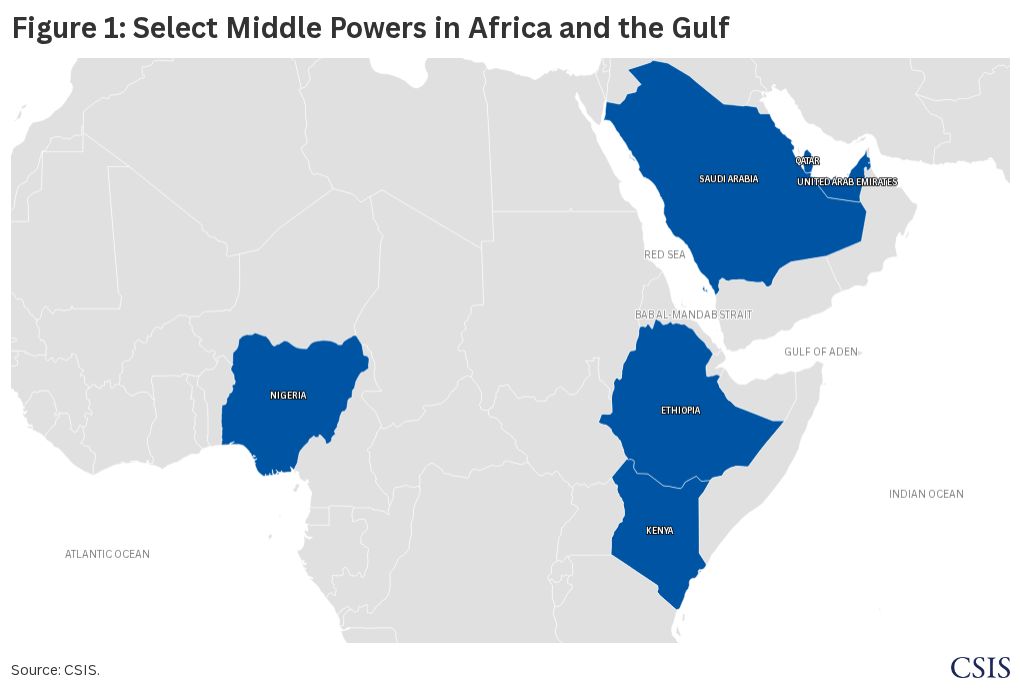
This brief examines relations between three key Gulf middle powers—Saudi Arabia, the UAE, and Qatar—and three key African middle powers—Nigeria, Kenya, and Ethiopia. These countries pursue distinct strategies. However, overall, Gulf powers leverage their partnerships with African powers to strengthen economic resilience by advancing economic diversification. The UAE has the most developed ties, Saudi Arabia is expanding its ties, and Qatar has smaller and more targeted ties to African middle powers. For their part, Nigeria, Kenya, and Ethiopia have actively increased engagement with Gulf countries to attract investment and diversify their partnerships and options, even as they remain far more economically dependent on their Gulf partners than those partners are on them.
Recent opportunities to assert agency and further diversify international relationships build on more than a decade of deeper economic engagement that is spreading into security and political spheres. As Gulf-African partnerships grow, they at times complement and at times compete with ties to great powers, including the United States and China. The war with Iran demonstrates both the opportunities and potential fragility of the expanded relationships between the two regions. It has validated strategies of diversifying ties but also caused disruptions and new uncertainty. As the war continues without a clear resolution, diversifying the economic, political, and security relationships between African and Gulf countries offers opportunities to build strategic resilience. However, it also risks the spillover of regional contests and conflict. In particular, the UAE’s and Saudi Arabia’s entanglement in conflicts in the Horn of Africa, as well as bilateral competition between Riyadh and Abu Dhabi, complicates relations with African middle powers.
The partnerships between African and Gulf middle powers serve complementary strategic aims. Gulf states gain access to fast-growing markets, strategic resources, labor, food supplies, and alternative shipping networks, while African powers gain new sources of capital and greater bargaining power among competing external partners. This section reviews the result: denser, more diversified networks of economic, political, and security relationships through which both sides seek greater autonomy and enhanced resilience in an increasingly fragmented global system.
As relations between African and Gulf middle powers have diversified and expanded, commerce and finance have remained the core pillar. Economic ties between these middle powers have evolved over the past decade from largely transactional trade relationships to broader strategic partnerships encompassing investment, infrastructure, energy, logistics, and food security. The shocks of the Covid-19 pandemic in 2020, Russia’s full-scale invasion of Ukraine in 2022, and now the war with Iran have further reinforced both regions’ imperative to diversify international partnerships and build greater economic resilience. Through this lens, Gulf governments increasingly view African markets, infrastructure, energy resources, and agricultural production as assets that can support their own economic diversification and reduce exposure to geopolitical shocks. Meanwhile, African governments see Gulf capital as a means to close infrastructure and financing gaps while diversifying away from traditional partners.
The shocks of the Covid-19 pandemic in 2020, Russia’s full-scale invasion of Ukraine in 2022, and now the war with Iran have further reinforced both regions’ imperative to diversify international partnerships and build greater economic resilience.
Over the past decade, the United States and China have reduced investment in and lending to African countries. U.S. direct investment in Africa fell from a high of $69.0 billion in 2014 to $37.9 billion in 2025, while Chinese lending to the African continent declined from a peak of $28.8 billion in 2016 to just $2.1 billion in 2024, forcing African states to find new partners. While European Union countries continue to play a significant financial role, Western financial institutions have been accused of being slow and unresponsive and of charging high interest premiums. African countries consider Gulf capital to be a faster, more direct, and less conditional alternative. Across the continent, total Gulf-Africa trade exceeded $121 billion by 2023, while Gulf states have invested more than $100 billion in Africa over the past decade.
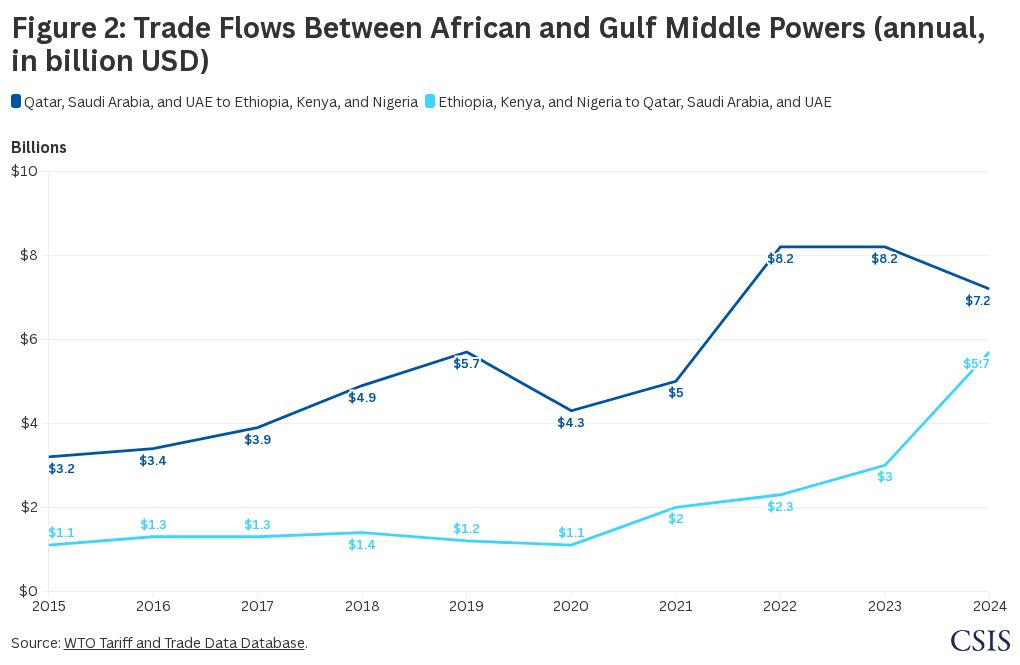
However, the economic relationship extends beyond investment flows. Gulf states rely heavily on African labor, while African states benefit from remittances and capital transfers, creating what may be the early foundations of deeper economic interdependence between the two regions. Despite Gulf states’ recent efforts to reduce dependence on foreign workers as part of their nationalization agendas, they continue to turn to workers from Africa. In 2023, an estimated 750,000 Ethiopians were living in Saudi Arabia, for instance. Ethiopia has signed bilateral labor agreements with Qatar (2012), Saudi Arabia (2017), and the UAE (2018) to formalize opportunities to recruit Ethiopians. However, these agreements primarily focus on domestic labor and do not cover other sectors that use African migrant labor, such as agriculture and livestock, construction, and hospitality. While labor migration is a significant part of the economic relationship, it has also been a source of friction. Between 2017 and 2021, Saudi Arabia expelled more than 425,000 Ethiopians in an effort to increase local employment and tighten immigration enforcement on undocumented workers. For its part, Ethiopia has at times restricted travel to Gulf states because of concerns about Ethiopian workers’ welfare.
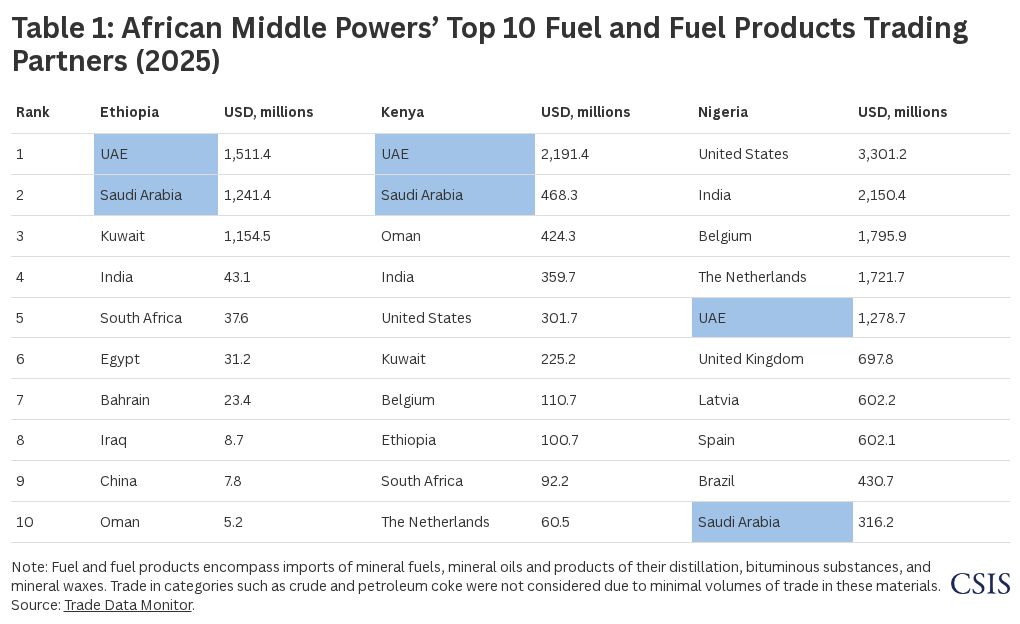
The UAE has pursued the most ambitious economic engagement strategy with African middle powers and has become the leading fuel trading partner for both Ethiopia and Kenya. Saudi Arabia is the second-largest trading partner for both states in this sector, while Qatar lags behind, not ranking among the top 10 fuel trading partners of Ethiopia, Kenya, or Nigeria. Yet these relationships are imbalanced, and Gulf middle powers account for a larger share of African middle powers’ trade than vice versa. Ethiopia, Kenya, and Nigeria do not feature at all among Gulf middle powers’ top 10 trading partners across sectors.
The UAE’s investments in ports, logistics, energy, and infrastructure aim not only to generate returns but also to embed the UAE at the center of trade routes connecting Africa to Asia and Europe as part of its economic corridor strategy. For instance, Emirati port investments across the continent link African shipping to Dubai’s Jebel Ali hub. On September 9, 2026, Dubai logistics company DP World and Kenyan conglomerate GulfCap Group signed a deal to develop a major special economic zone in Mombasa valued at more than $100 million. These investments also create stakes in African countries’ trade hubs to direct and increase trade.
Similarly, the UAE prioritizes agriculture as a strategic investment to bolster food security, as it relies on imports for 85–90 percent of its food. Abu Dhabi signed 17 agreements with Ethiopia in 2023 covering agriculture, industry, investment, and finance. This was followed by a currency-swap agreement in 2024, which eases trade and investment flows, supports the UAE’s broader push to de-dollarize bilateral trade, and extends the relationship into monetary policy.
Meanwhile, Kenya became the third African state (after Mauritius and Morocco) to sign a CEPA with the UAE in January 2025. Not long after, Nigeria signed its own CEPA with the UAE in 2026. Both agreements are intended to expand market access, reduce tariff barriers, and support increased investment flows from the UAE—though they were not yet in force as of October 2026.
Saudi Arabia’s engagement is narrower but has accelerated rapidly—marked by increased trade and engagement with the continent—in line with its diversification strategies under Vision 2030 and efforts to build economic resilience. Its priorities center on food security, securing maritime trade through the Red Sea, investing in infrastructure, and accessing new and growing markets. Since 2024, Riyadh has created joint business councils with Ethiopia, Kenya, and Nigeria, signaling these countries’ growing economic importance to the kingdom. In Kenya, agreements signed in 2026 paved the way for direct cooperation between the Saudi Export−Import Bank and the Kenya Development Corporation and created mechanisms to steer Saudi capital toward Kenyan infrastructure, logistics, and industrial projects.
Qatar lags behind the UAE and Saudi Arabia in its economic engagement with African middle powers. It has adopted a more selective model, concentrating on sectors where it possesses comparative advantages, such as aviation and energy. For example, Qatar Airways expanded its partnership with Kenya Airways in 2025, while Qatari and Nigerian companies agreed in 2026 to pursue four joint energy projects, including a roughly $2 billion natural gas exploration venture.
The growing relationship over the past decade stems from sustained diplomatic engagement. Gulf state summits have increasingly connected these countries’ leaders and created opportunities for additional high-level cooperation. For example, the 2023 Saudi-Africa Summit brought Nigerian President Bola Tinubu, Ethiopian Prime Minister Abiy Ahmed, and Kenyan President William Ruto to Riyadh. Other Gulf-hosted gatherings, such as Saudi Arabia’s Future Investment Initiative conference, Abu Dhabi Sustainability Week, and Dubai’s Expo 2020, have also served as forums for leader-led engagement between the countries. In this way, Gulf political outreach to African middle powers can be seen as part of efforts to assert global leadership and diversify partnerships. Notably, Nigeria and the UAE signed their CEPA on the sidelines of the 2026 Abu Dhabi Sustainability Week.
Expanded leader-to-leader relationships have created new diplomatic opportunities. For instance, Saudi Arabia played a role in mediating between Ethiopia and Eritrea, which led to the 2018 Jeddah Peace Agreement that officially ended the 1998–2000 border war. Similarly, Qatari mediation helped restore diplomatic relations between Kenya and Somalia in 2021 after almost six months of severed ties. Although high-level engagement focuses mainly on economic cooperation, there is growing emphasis on defense and security as well.
Security and defense cooperation has increased since 2020, advancing through structured defense agreements, joint training exercises, and arms transfers from Gulf to African middle powers. As in the economic sphere, the UAE is leading Gulf countries’ engagement, largely through arms sales and military-to-military ties. However, over the past two to three years, Saudi Arabia has increasingly collaborated with African middle powers on various security initiatives. In December 2025, Nigeria and Saudi Arabia signed a memorandum of understanding on defense and military cooperation covering training, intelligence sharing, joint exercises, and counterterrorism cooperation. Similarly, Kenya has recently signed defense cooperation agreements with both the UAE and Saudi Arabia; joint training exercises have been an important component of these agreements. For Saudi Arabia’s part, the Islamic Military Counter Terrorism Coalition, an intergovernmental alliance headquartered in Riyadh, has hosted Nigerian military personnel for training and held multiple courses in Nairobi.
Increased arms deals and transfers between Gulf states and African middle powers have been reported, yet they remain among the least transparent aspects of these bilateral relationships. Verified arms shipments increased around 2020, driven largely by policy changes in the UAE. In 2019, Abu Dhabi formed Edge Group by merging over 20 domestic defense firms to reduce its reliance on Western arms and become a net defense and security exporter. The UAE has complemented this policy shift by leveraging its broad diplomatic partnerships to build out a multi-country logistics network. The consequences are largely documented through the use of UAE-made arms in conflicts such as those in Sudan and Ethiopia. For example, during the 2020–2022 Tigray war in Ethiopia, the UAE was reported to have delivered precision-guided munitions and small arms to the Ethiopian National Defense Force.
The proliferation of military-capable drones, or unmanned aerial vehicles, across Africa has exacerbated tensions between Gulf states and made it more difficult for African middle powers to balance their ties with them. The UAE’s alleged ongoingmilitarybacking of the Rapid Support Forces (RSF) militia and Saudi Arabia’s strategic partnership with the Sudanese Armed Forces (SAF) put the two Gulf states on opposite sides of the conflict in Sudan. Their roles in this conflict have created a difficult balancing act for Kenya and Ethiopia in particular, as both countries have been accused of supporting the RSF even as they seek to maintain close economic ties with Saudi Arabia.
The war with Iran has forced dramatic shifts in Gulf states’ economic strategies. The closure of the Strait of Hormuz disrupted their exports and imports, raised shipping costs, and exposed their dependence on external markets and suppliers for food and other essential goods. More broadly, the conflict threatens to undermine Gulf states’ economic diversification strategies, a shared cornerstone of their ambitious visions centered on significant non-hydrocarbon economic growth and global connectivity.
Rising insecurity in the Red Sea, combined with uncertainty surrounding the extent of U.S. participation in regional security operations, has reinforced Gulf states’ efforts to develop and lead their own security initiatives.
The UAE’s role as a major re-export hub and its focus on supply chains and logistics have made it acutely vulnerable to the war’s disruptions. The closure of the Strait of Hormuz forced it to reroute trade from the Jebel Ali and Khalifa ports in the Persian Gulf to Fujairah on the Gulf of Oman. At the same time, the conflict demonstrated and reinforced the strategic value of the UAE’s extensive network of ports and infrastructure investments in Africa. The country appears to be doubling down on these economic partnerships in response. In May 2026, for example, the Dubai Chamber of Commerce held the Dubai-Ethiopia Business Connect forum in Addis Ababa, which sought to strengthen bilateral trade and investment by facilitating 510 business-to-business meetings between Emirati and Ethiopian companies.
Like the UAE, Saudi Arabia rerouted trade to alternative ports to circumvent the Strait of Hormuz closure. This mitigation strategy has heightened the strategic importance of the Red Sea, with a greater share of oil exported from, and more imports entering through, Saudi Arabia’s west coast ports. However, Houthi attacks on Saudi shipping through the Bab al-Mandab Strait and the group’s subsequent seizure of the western coast of Yemen in September 2026 threaten much more dire economic consequences.
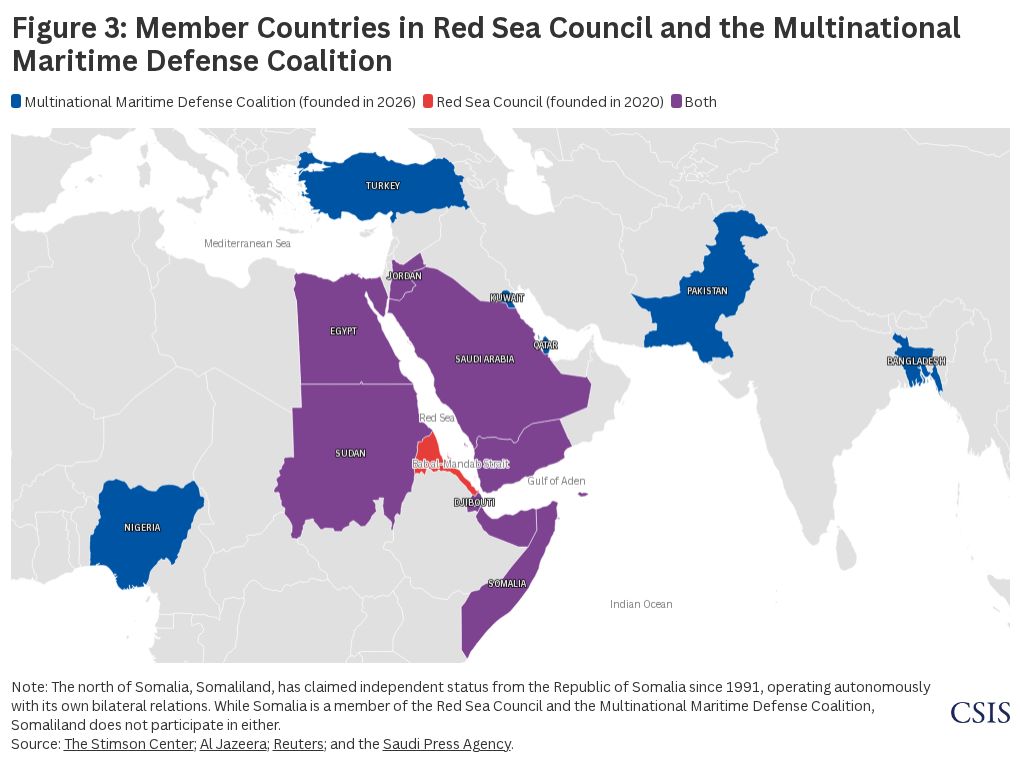
Rising insecurity in the Red Sea, combined with uncertainty surrounding the extent of U.S. participation in regional security operations, has reinforced Gulf states’ efforts to develop and lead their own security initiatives. Although Gulf states were already establishing Red Sea security initiatives before the Iran war, including the 2020 Council of Arab and African Coastal States of the Red Sea and the Gulf of Aden, these efforts have taken on greater urgency since Houthi attacks intensified in July 2026. In August 2026, for instance, Nigeria joined the Riyadh-led Multinational Maritime Defense Coalition, aimed at enhancing security in the Bab al-Mandab Strait, the Red Sea, and the Gulf of Aden. Coalition members cooperate on joint military exercises, intelligence sharing, operational planning, and capacity building. For Nigeria, which has traditionally focused its maritime security efforts on West Africa and the Gulf of Guinea, participation represents a significant expansion of its security engagement and highlights the Red Sea’s strategic salience in the shadow of the Iran war.
Saudi Arabia has not invested in ports and logistics infrastructure in Africa to the same degree as the UAE, but it now faces a strategic imperative to do so. In particular, Saudi Arabia’s relationship with Kenya has grown more important as Riyadh seeks to expand ties with trade partners less exposed to Strait of Hormuz closures. In July 2026, Saudi Arabia and Kenya signed three financial memorandums of understanding during the inaugural meeting of the Saudi-Kenya Political Consultations Committee. At the same time, the two countries signed a new formal recruitment and employment agreement that aims to regulate flows of domestic workers to Saudi Arabia and safeguard Kenyan workers’ rights. Additionally, the Kenyan government is pursuing opportunities that also help to bolster Saudi Arabia’s food security goals. During a July 2026 meeting, Kenyan Prime Cabinet Secretary Musalia Mudavadi joined Saudi officials to explore opportunities in agriculture and food security, among other issues.
Qatar faces the gravest economic consequences of the war, as it lacks alternative ports through which it can export fuel, fertilizers, helium, and other key goods or import food and other necessities. In October 2026, the International Monetary Fund (IMF) predicted that Qatar’s GDP would contract by 15.6 percent in 2026. The war has also threatened Qatar’s food supply, nearly 90 percent of which was imported in 2023, mostly through seaports. However, Qatar had weaker economic ties with African states before the war and appears to have made a less concerted effort than Saudi Arabia or the UAE to turn to African countries to mitigate the war’s effects.
As in many other regions, the war with Iran has acted as a shock to African economies. Governments have been focusing on the immediate rise in fuel costs and the impact on agricultural inputs such as fertilizer. In the aggregate, these effects are being felt across the continent, particularly because of the precarity of many economies and their dependence on agricultural exports.
However, a closer look shows distinct variation. While Kenya and Ethiopia have implemented fuel tax cuts and subsidies to lower citizens’ costs, Nigeria, a member of the Organization of the Petroleum Exporting Countries (OPEC), has benefited from windfall revenues from rising oil prices. According to the World Bank, the price jump drove the country’s significantly increased export revenues in the first half of 2026. The continued expansion of operations at Nigeria’s $1.63-billion Dangote Petroleum Refinery has also highlighted the potential value of domestic energy investment and refining capacity. Even so, rising fuel prices have still hit ordinary citizens, as the Nigerian government has rejected calls to reinstate fuel subsidies.
Similarly, the war’s impact on fertilizer access and markets varies by country, depending on production and planting seasons. Nigeria is a producer and exporter of fertilizer. By contrast, East African countries are fertilizer importers. For Ethiopia and Kenya, the war with Iran began after the general fertilizer procurement window. In Kenya, the “long rain” planting season begins in March, with fertilizer procurement typically occurring between December and March. Ethiopia follows a similar procurement timeline. Therefore, the length of the war and its impact on global fertilizer prices will most likely be visible in the next procurement cycle.
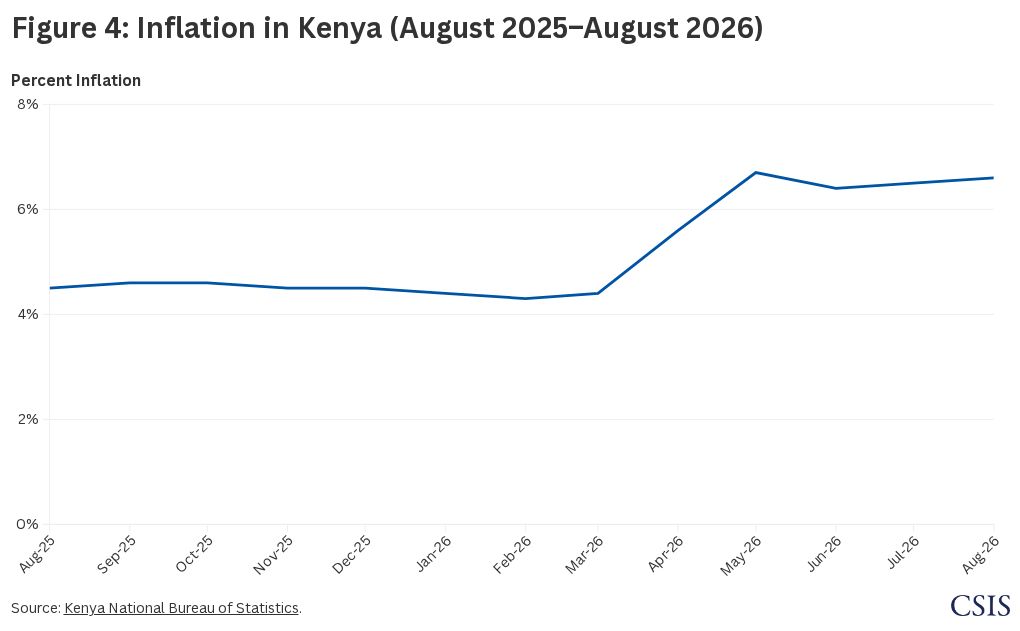
As African countries manage the shock of rising prices, subsidies and tax breaks have become key policy tools to lessen the daily impact on citizens. At the same time, global price increases have accelerated inflation in places such as Kenya. Together, these factors have longer-term implications for countries’ budgets and future spending potential. As of June 2026, the Kenyan government had reportedly lost 9.1 billion Kenyan shillings ($70 million) in revenue due to the April 2026 fuel tax cut. This budgetary pressure is further exacerbating Kenya’s fiscal challenges, where increased taxes—part of an IMF-supported fiscal program designed to raise revenue and reduce debt vulnerability—have triggered regular protests and shifted the political landscape.
Longer-term responses are already being selectively implemented to reduce vulnerability to external shocks and exploit geopolitical energy opportunities. For example, Kenya is constructing an oil-refining plant in partnership with the Nigerian Dangote Group; Nigeria is opening opportunities for greater offshore oil exploration; and Ethiopia continues to expand sectors that rely on its hydro-driven power network, such as an electric vehicle strategy. These approaches further complement African middle powers’ expanded relationships with Gulf states, including by soliciting new investment and advancing existing energy partnerships.
Finally, the war is bringing increased attention to security and defense in the Horn of Africa. Additional attacks by Iran and the Houthis in the Red Sea and the Bab al-Mandab Strait are heightening security concerns about potential spillover effects for coastal states—particularly in Somalia, Djibouti, Sudan, and Eritrea. At the same time, Ethiopia has reiterated its demand for greater maritime access, an objective that has fueled tensions with neighboring states and renewed concerns about stability in the Horn of Africa.
Global shocks, particularly the war with Iran, have reinforced the conviction among African and Gulf middle powers that diversifying their partnerships is increasingly necessary and effective.
Multiple factors will shape the future of Gulf-African relations, including evolving security dynamics in the Red Sea and Horn of Africa, the emerging economic models in Gulf states, and rising competition between Saudi Arabia and the UAE.
However, the war with Iran has caused unprecedented economic damage to Qatar, Saudi Arabia, and the UAE, far surpassing the impact of past geopolitical shocks, such as the Covid-19 pandemic and Russia’s full-scale invasion of Ukraine. As Nigeria’s appeal to Gulf states for investment shows, many players in both regions are approaching this moment as an opportunity to deepen existing relationships. Despite this, the longer the war goes on, the more political, economic, and security realities may override these ambitions.
Ultimately, the ongoing direct and indirect implications of the Iran war create an uncertain environment. Multiple factors will shape the future of Gulf-African relations, including evolving security dynamics in the Red Sea and Horn of Africa, the emerging economic models in Gulf states, and rising competition between Saudi Arabia and the UAE. The strategic relevance of new security ties remains in question. Nigeria’s participation in the Saudi-led Multinational Maritime Defense Coalition signals deepening ties between Abuja and Riyadh. However, the coalition is not yet fully operational, and it is unclear whether Nigeria’s membership is simply a diplomatic show of support for Saudi Arabia or a more serious commitment to Red Sea security.
In response to the war with Iran, Gulf states are beginning to reassess their economic priorities as their budgets become more strained. To date, trade and investment have driven the relationship between African and Gulf states. However, large project announcements can be misleading, giving the impression of greater investment than actually materializes. Projects can fail at various stages for different reasons. For example, a high-profile data center agreement between the UAE, Kenya, and Microsoft was indefinitely delayed as investment gaps emerged and stakeholders raised questions about integration with existing infrastructure. As Gulf states rebalance their portfolios, they will face critical decisions about whether to continue to prioritize investments in Nigeria, Kenya, and Ethiopia or to seek more profitable investments elsewhere. They will likely double down on the partnerships that generate the most strategic and economic benefit domestically, such as those that enhance food security.
Rising competition between Gulf middle powers, particularly the UAE and Saudi Arabia, could also present a challenge to African countries’ investment and partner diversification strategies. The UAE and Saudi Arabia are key international actors in Sudan’s civil war given their respective support for the RSF and SAF. This conflict risks jeopardizing Ethiopia’s (and to a lesser extent, Kenya’s) ability to balance ties with the two Gulf powers, given that Addis Ababa has increasingly been seen as siding with the RSF.
Broader Red Sea dynamics are also intertwined with competing alignments across the Horn of Africa. The UAE and Ethiopia are widely seen as supporting Somaliland’s pursuit of greater international recognition, a position strongly opposed by Mogadishu, while Qatar is generally viewed as aligned with Somalia. Kenya and Ethiopia both provide troops to the African Union mission to help the government in Mogadishu stabilize Somalia, and both have security and economic interests in Sudan as well.
Regularizing Saudi Arabia’s dependence on the Red Sea to maintain export levels would necessitate increased engagement with African partners, at least in the security sector. However, given these overlapping security partnerships and rivalries, Saudi Arabia’s expanded security role in Horn of Africa nations may strain certain relationships as much as it strengthens others. Despite growing Ethiopian-Saudi economic cooperation and Saudi Arabia’s trusted role in the Ethiopia-Eritrea peace agreement, Addis Ababa’s close security partnership with the UAE could create points of friction. These relationships are built on foundations that have thus far proven durable, with current evidence pointing to continued and deepened engagement despite a more complex geopolitical environment. Yet while such relationships have so far weathered multiple global and regional shocks, strategic considerations point to an uncertain future.
While the Iran war has accelerated a decade-plus push by Gulf and African middle powers to diversify their strategic partnerships, potential gains will also depend in part on the pressures a longer conflict could bring. So far, Gulf and African states appear to be leaning further into their relationships as a hedge against war-driven disruption, yet the way regional rivalries evolve in an increasingly strained security environment will influence the trajectory of economic, security, and political cooperation.
For the United States, these developments present both opportunities and constraints. On the one hand, deeper Gulf-African engagement can advance longstanding U.S. objectives, including greater regional stability, increased investment, and burden sharing in critical maritime corridors such as the Red Sea. On the other hand, the growing autonomy of Gulf and African middle powers may leave Washington less able to shape regional outcomes directly. As these states diversify their partnerships and pursue more independent foreign policies, the United States will increasingly need to engage them as strategic actors in their own right rather than simply as partners within a U.S.-led framework.
Will Todman is the chief of staff for the Geopolitics and Foreign Policy Department and senior fellow for the Middle East Program at the Center for Strategic and International Studies (CSIS) in Washington, D.C. Aaron Stanley is deputy director and fellow of the Africa Program at CSIS. Josiane Atallah is associate director of the Middle East Program at CSIS. Catherine Nzuki is an associate fellow with the Africa Program at CSIS.
This brief is made possible with support from the CSIS Strategic Initiatives Fund.
The authors would like to thank Oge Onubogu, Mona Yacoubian, and Allison Minor for their helpful feedback. They would also like to thank Ninar Fawal, Dylan Herman, Khasai Makhulo, Kira Nygren, Mohamed Shukri, and Lilya Yatim for their invaluable research support. Thanks too to Kelsey Hartman, Julia Huh, and Hunter Macdonald for their design and editorial support.