Trump-Xi-Putin Summit: What Happened? | The Capital Cable #147
November 19, 2026 • 8:45 – 9:30 am EST
Hosted by Korea Chair

Photo: iLab/CSIS
For the war in the Gulf, the answer is not yet clear—rather, it is shifting, and not reliably in America's favor. The blockade and counter-blockade are imposing real costs, not just on Iran, but on the United States, its allies, and the global economy. Gulf producers have cut more than 10 million barrels per day, stockpiles are tightening, and Refined product shortages are already hitting a number of countries especially, across the Indo-Pacific. The UAE's exit from OPEC compounds the problem: it potentially weakens the coordination mechanism that made more than three million barrels per day in spare capacity a reliable market stabilizer.
What makes this moment particularly risky for the global economy is not the week-to-week disruptions to oil markets; it is the compounding effects of these disruptions. As buffers erode across crude, diesel, and shipping, each shock amplifies the next. These are the substrates of global trade and manufacturing. When they tighten simultaneously, localized disruptions cascade into systemic risk. Market signals, for now muted oil futures and resilient equities, are masking the underlying stress. But alliances built over decades of shared investment and security guarantees are being tested in real time. Under pressure, they can shift quickly.
The United States has some leverage. It is attracting rerouted shipments now making it a net crude exporter for the first time since WWII, and the war provides impetus for long-overdue investment in shipbuilding, energy infrastructure, and reindustrialization. But these gains can be fragile and fleeting. Without a credible endgame in the Gulf, uncertainty will continue to move through supply chains, undermining the macroeconomic stability and investment climate required for U.S. technology competitiveness and growth.
Washington is betting that pressure on Iran yields a transformed regional order that stabilizes the Middle East while securing U.S. control over a critical global chokepoint. It is an ambitious wager with no clear strategy to back it. In the meantime, poor execution risks the opposite: a more entrenched Iran with greater leverage over Gulf energy flows, posing a sustained challenge to the United States, its partners, and the global economy.
America was already fighting against time in the global technology race, and the Gulf war has made it worse. China is methodically building semiconductor capacity, scaling AI, and deepening industrial strength while Washington manages the crisis of the moment. Allies are watching, recalculating, and quietly hedging. Export controls may buy time — but only if used with discipline. Overextended, they accelerate Chinese indigenization and invite countervailing controls that erode the very advantages they were meant to protect. With a Summit with President Xi Jinping on the horizon, Beijing will press its own leverage accordingly. The harder question, and the one this department keeps returning to, is whether Washington can execute a long-term economic competition strategy that is predictable enough for allies to build around and durable enough to outlast a single administration. That capability has been quietly eroding. Rebuilding it is as urgent as anything happening in the Gulf.
That is the backdrop for the research insights and engagements EST has shared this past month. More to come.

Photo: Marcelo del Pozo/Bloomberg/Getty Images
What’s Next for Oil Markets After the Ceasefire Agreement?
April 8, 2026
Clayton Seigle writes that the ceasefire announcement leaves more questions than answers for Gulf oil and gas exports. Iran is still in control of whether and when ships can pass—and how much that might cost under a new tolling requirement.
Iran Conflict Heightens Cyber Threats to U.S. Energy Infrastructure
April 2, 2026
Leslie Abrahams and Lauryn Williams analyze that, as the Iran conflict intensifies, U.S. energy infrastructure faces escalating cyber threats from nation-state actors. Scale, age, and regulatory fragmentation leave the sector uniquely exposed.
Reining in the Export Control Arms Race
April 10, 2026
Kate Koren, Scott Kennedy, Philip Luck, and Ilaria Mazzocco write that export controls are evolving to an instrument of economic coercion. They argue that when Trump and Xi meet next in May, reining in the arms race should be at the top of the agenda.
How Russia Is Building a Sovereign Drone Ecosystem for AI-Driven Autonomy
April 13, 2026
Kateryna Bondar analyzes how Russia is leveraging applied AI and building a drone ecosystem, combining decentralized innovation, commercial tech, and state coordination to accelerate battlefield autonomy.
Expanding India’s Role in the International Semiconductor Ecosystem
April 15, 2026
Sujai Shivakumar, Hideki Tomoshige and Jeffrey D. Bean write that India is emerging as a critical player in the global semiconductor ecosystem, leveraging its design strengths and talent base while scaling manufacturing.
NATO’S Hidden Dividend and the Avoidable Cost of U.S. Withdrawal
April 22, 2026
Philip Luck, Karen Jackson and Oleksandr Shepotylo write that NATO was designed to do more than provide security, it built deep economic integration that has become one of its least appreciated strengths.
The Texas Energy Reference Design: Stress-Testing Load Growth Challenges for an AI Century
April 7, 2026
Arushi Sharma Frank analyzes that Texas has become the high-stakes laboratory for the national AI race.

Photo: iLab/CSIS
Solidarity in an Era of Economic Competition: Featuring Congressman Ami Bera (D-CA)
April 29, 2026
Congressman Ami Bera joins Navin Girishankar to discuss the importance of reviving economic alliances amid rising global threats. He explains the roots of today’s economic security challenges, as well as the dual goal of achieving balanced economic integration with countries like Japan, Korea, and India while rebuilding the U.S. domestic industrial base.
Talking Export Control Alignment, New 232s, and Trump's Budget Request with Kate Koren
April 13, 2026
On this episode, Bill and Scott talk with Kate Koren, Deputy Director of the Economics Program at CSIS. She discusses the latest efforts in Congress to align U.S. export controls with partners, including the MATCH Act bill. They also cover new Section 232 tariffs on pharmaceuticals and metals and the White House's budget request for Fiscal Year 2027.
Can AI Accelerate Scientific Discovery? Featuring Under Secretary Darío Gil – Betting on America
April 8, 2026
Under Secretary Darío Gil joins Navin Girishankar to discuss the Genesis Mission—a Department of Energy–led initiative to build an AI-driven platform for accelerating scientific discovery.
One Year After Liberation Day, Plus the E-Commerce Moratorium and New Chinese Investigations
April 6, 2026
On this episode of the Trade Guys, Bill and Scott reflect on the anniversary of Liberation Day and how President Trump has reshaped the global economic landscape. They also react to the failure to renew the global moratorium on e-commerce taxation at the 14th WTO Ministerial and new Chinese investigations into U.S. trade practices.
Unpacking Russian Military AI with Kateryna Bondar
April 14, 2026
On this episode, Wadhwani AI Center fellow Kateryna Bondar discusses her recent reports on Russia's military AI, "How Russia Is Building a Sovereign Drone Ecosystem for AI-Driven Autonomy" and "How Russia Is Reshaping Command and Control for AI-Enabled Warfare."
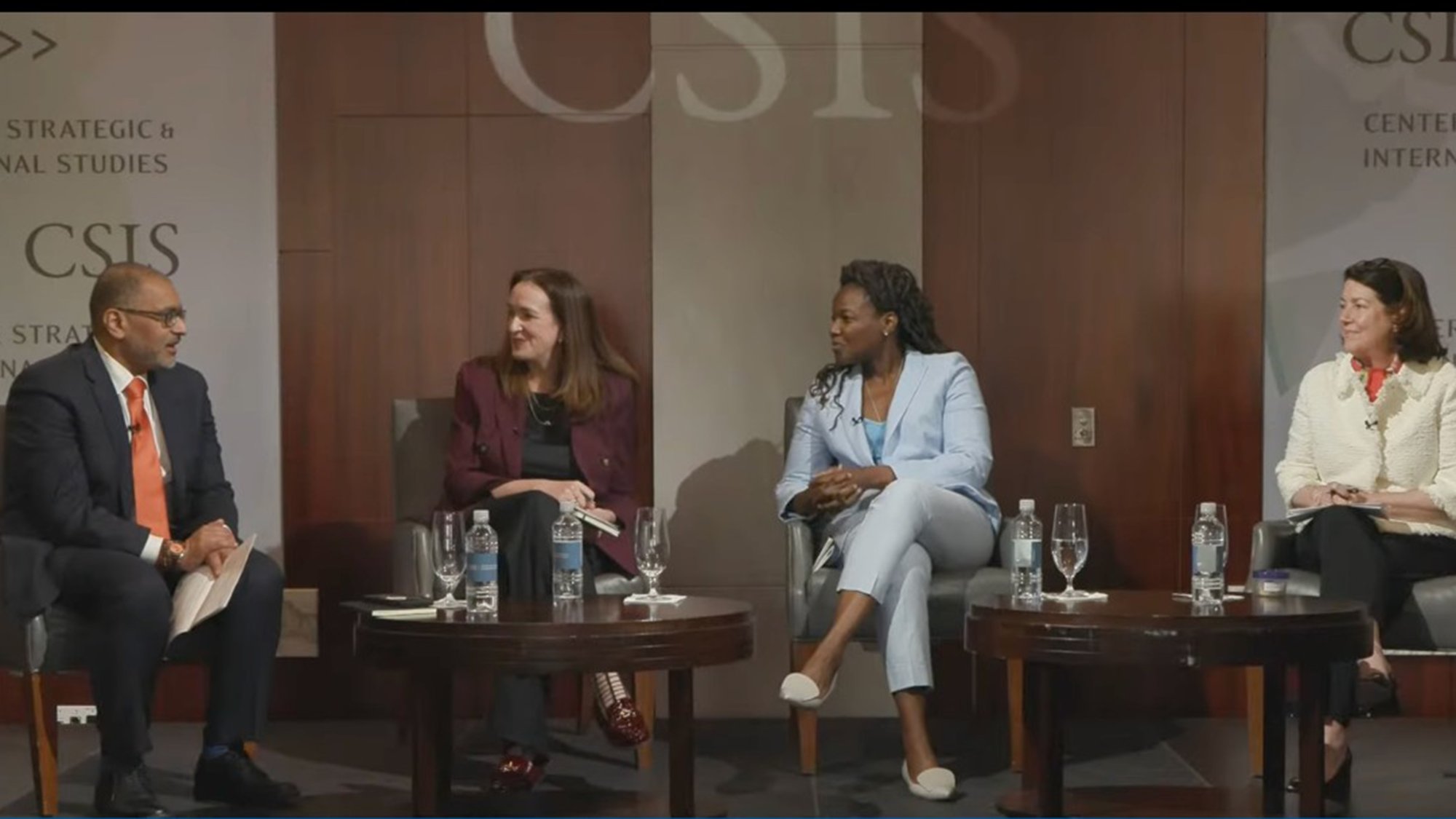
Photo: CSIS
U.S. Commercial Diplomacy Through the Lens of the Private Sector | The Futures Summit
April 10, 2026
This panel examined what is needed to effectively operate at greater scale and through deeper partnerships in the Global South with support from commercial diplomatic initiatives that work for the U.S. and emerging economies in ways that are durable and strategic over time.
NSF's National Security Mission for the Twenty-First Century
April 3, 2026
Catch the Recap: CSIS Renewing American Innovation, together with NSF acting director Brian Stone and key scholars and NSF stakeholders, hosted a half-day multi-panel event on NSF's national security mission and how it can address the unique challenges of the twenty-first century and the rise of China as a technological and military competitor.
Adapting Under Fire: Ukraine's Race to Reinvent Modern Defense
April 3, 2026
Catch the Recap: The CSIS Wadhwani AI Center hosted Viktoriia Honcharuk, Senior Lieutenant Oleksandr “Zhan” Vorobiov, and Captain Max Maslii for a conversation with Wadhwani AI Center fellow Kateryna Bondar on how Ukraine’s military has adapted across air defense, training, and tech development.
EST Rapid Roundup: Unpacking the National AI Framework
March 30, 2026
Catch The Recap: Navin Girishankar and Aalok Mehta unpack why the Trump Administration released this framework now, how it addresses federal vs. state tensions over AI regulation, its implications for local concerns surrounding data centers, and what's missing in the context of U.S.-China competition.
EST Rapid Roundup: Is the WTO at a Turning Point?
March 25, 2026
Catch the Recap: Navin Girishankar, Angela Ellard, Bill Reinsch, and Phil Luck examine the countries and issues that will shape the reform agenda at the 14th WTO ministerial, surrounding decision-making, the level playing field, special and differential treatment provisions for developing countries, and more.
