Capital, Consolidation, and Leadership in the New Minerals Era
October 7, 2026 • 10:00 – 10:30 am EDT
Hosted by Critical Minerals Security Program

Photo: Cheng Xin/Getty Images
Export controls are a critical instrument of U.S. national security policy, designed to prevent adversaries from acquiring technologies that could enhance military capabilities or undermine global stability. Historically, these measures were narrowly focused and predominantly multilateral, coordinated through regimes like the Wassenaar Arrangement. However, in recent years and amid escalating U.S.-China tensions, export controls have evolved into a broader tool of economic statecraft. They are increasingly deployed unilaterally and even negotiated as part of trade deals.
This shift places export controls at the forefront of an ongoing trade war, risking their long-term credibility and effectiveness. Moreover, as China mobilizes its own export control regime, the world is in danger of an export control and economic statecraft arms race that, if unchecked, could severely undermine our security and economic prosperity.
The Department of Commerce’s authority to restrict the transfer of goods and technology derives from the Export Control Reform Act of 2018 (ECRA). This statute and its predecessors limit the imposition of export controls to genuine national security concerns, such as controlling items with military applications or specific foreign policy objectives, including human rights protections.
Historically, these controls were rarely unilateral; instead, they relied on multilateral coordination through mechanisms like the Wassenaar Arrangement, established in 1996 as a successor to Cold War–era regimes. Wassenaar and similar fora maintain consensus-based lists of controlled dual-use items across members, creating a level playing field and reducing the risk of circumvention.
Critically, export controls were never treated as bargaining chips. As a national security instrument, adjustments occurred only in response to changes in an adversary’s behavior, technological developments that mitigated risks, or the emergence of new threats—not as leverage in negotiations.
The paradigm began to shift under the Biden administration, which viewed export controls as a powerful, underutilized tool to slow China’s development of advanced AI. In October 2022, the Bureau of Industry and Security (BIS) imposed unilateral controls on high-performance computing chips, advanced semiconductors, and related manufacturing equipment destined for China. These measures, which were refined and expanded in 2023 and 2024, use foreign direct product (FDP) rules to make foreign-produced items subject to U.S. jurisdiction when their production involves certain U.S. technology, software, or equipment. For example, BIS asserted regulatory authority over Dutch lithography equipment (from the firm ASML) until the Dutch government implemented comparable controls.
Policymakers framed these actions strictly as national security necessities to curb China’s military modernization and supercomputing advances, stating that “these items and capabilities are used by the PRC to produce advanced military systems including weapons of mass destruction; improve the speed and accuracy of its military decision making, planning, and logistics, as well as of its autonomous military systems; and commit human rights abuses.” Beijing predictably viewed them as economic coercion aimed at hobbling China’s technological rise rather than addressing imminent military threats. Critics in the United States and among allies, by contrast, were worried that these measures stretched the definition of national security to a degree that would put U.S. policy on a slippery slope where the “small yard” would inevitably expand as a result of China’s changing technological capabilities, the widening of goals, or through a tit-for-tat dynamic indefinitely.
The Biden-era controls also stand out for the sheer number of Chinese companies that were affected. For context, an average of 10 Chinese companies per year were added to the Entity List from 2014–2018, and an average of 50 per year from 2019–2022. Chinese company additions jumped to 154 in 2023 and to 264 in 2024. This doesn’t include the Pentagon’s list of “Chinese Military Companies” (the “H1260” list) or the Department of the Treasury’s “Non-SDN Chinese-Military Industrial Complex Companies List,” each with more than 100 Chinese companies. Although the United States added many of these companies for circumventing export controls to Russia, in practice the government began to signal that it increasingly viewed broad swaths of Chinese industry as untrustworthy.
China has long been on a mission to pursue “indigenous innovation” and reduce its dependence on American technology. The increased use of export controls and other restrictions, including tariffs and investment barriers, led China to significantly accelerate these initiatives, and the reduction in availability of U.S. technology incentivized Chinese research organizations and companies to invest in substitutes at an unprecedented pace. In practice, the controls helped align various actors within China that were previously not as fully committed to reducing reliance on U.S. technology.
Equally important, China has also studiously developed its own export control regime. It adopted an Export Control Law in 2020 modeled heavily on the U.S. system, creating lists of controlled items and restricted entities. In 2023, it began creating licensing regimes for specific raw materials, including gallium, germanium, graphite, tungsten, and tellurium. All of this was a preface to the escalatory spiral that has emerged over the last year. In reaction to the Trump administration’s imposition of unprecedentedly high tariffs on April 2, 2025, also known as “Liberation Day,” the Chinese government responded by adding multiple medium-to-heavy rare earths to its control list. The measure immediately slowed the export of rare earths. In mid-May, following the Department of Commerce’s clarification of rules around the Huawei Ascend chip, China stopped rare earth exports entirely. Importantly, the Chinese controls affected exports to all countries, not just the United States, triggering global concerns.
With China having explicitly weaponized its export-control regime to push back against American tariffs and export controls, the Trump administration followed suit, using “Is Informed Letters” (typically narrow stop-gap notifications of a license requirement) to impose export controls on electronic design automation (EDA) software used for semiconductor design, and ethane, a feedstock used to make plastics, a product with no clear national security relevance. Export licenses for machine tools and aviation equipment that had been issued previously were also suspended.
The measures adopted by both sides were outside the scope of how export controls should be used. Instead, they were merely bargaining chips intended to impose costs and gain leverage on the other side (see Figure 1). In June, the two sides agreed to deescalate, with China committing to issuing licenses for rare earths in exchange for the U.S. lifting its new controls, allowing licensed exports of Nvidia H20 GPUs, and at least implicitly committing to withholding issuing new export controls on China.
Three months later, though, tensions flared again; in late September 2025, the U.S. issued an “affiliates” rule, expanding coverage of U.S. export controls to subsidiaries of Chinese companies already listed. In response, two weeks later, China rolled out a comprehensive export-control regime on rare earths. Consistent with the FDP rule, China’s regime would give it extraterritorial authority to regulate exports of items from other countries that included China-origin rare earths.
As in the summer, the two sides again quickly agreed to a ceasefire, with the U.S. suspending its affiliate rule and China suspending its de minimis, FDP rule, and 50 percent rule for one year. Yet, this ceasefire does not solve the underlying issues, which are likely to flare up again, leading to renewed escalation. It also leaves unanswered questions about how the two countries will manage the bilateral relationship after the agreed ceasefire ends.

The effects of this evolution are far-reaching and detrimental. Foremost, the credibility of U.S. export controls has eroded. When measures once deemed nonnegotiable for national security reasons are traded away for economic concessions, adversaries and allies alike have rational cause to question the legitimacy of the system. This makes it harder to rally allies for multilateral or plurilateral controls, which are the most effective way to deny sensitive technologies to adversaries, including China. Not only are allies concerned they will be left holding the bag if the U.S. reverses course, but the true purpose of any proposed shared controls is put into question. Future U.S. initiatives now appear ephemeral and focused on U.S. economic gains rather than enduring shared security needs.
As described above, the United States’ broadened, unilaterally implemented export control system, which has evolved from an aggressive stance on semiconductors and AI into an explicit tool in bilateral negotiations, has generated unanticipated responses from China. China has accelerated its efforts to eliminate dependence on U.S. technology, which threatens the United States’ technology leadership. For example, when the United States temporarily restricted exports of all EDA software to China last year, Beijing pivoted funding to local EDA companies to accelerate development of domestic alternatives. The increased urgency from Beijing to end its reliance on U.S. EDA software did not end when the controls were rolled back just a few weeks later. And China’s adoption and expansion of its own export-control regime has translated into a series of escalatory spirals, threatening restrictions on items without sufficient justification and then removing them just as quickly as part of a high-stakes negotiation.
Licensing delays in 2025 compounded the impact of export controls on industry. A March 2026 CSIS survey of semiconductor and information technology companies found that more than half (56 percent) experienced license review times averaging over 180 days, with over a third (33 percent) reporting waits of over 300 days.
More than half (54 percent) reported losing business due to these delays: 62 percent said delays had damaged relationships with existing customers, 58 percent said they had lost customers to foreign competitors, and 42 percent said they had over $10 million in exports delayed by pending license reviews.
By bartering with export controls, the United States lost its ability to use the tool as intended—to protect national security. The trade war entered a cold phase at the end of October, reaching a détente after talks in Busan. Because export controls were part of the negotiations, all export control actions that could be seen to impact China have effectively been paused since.
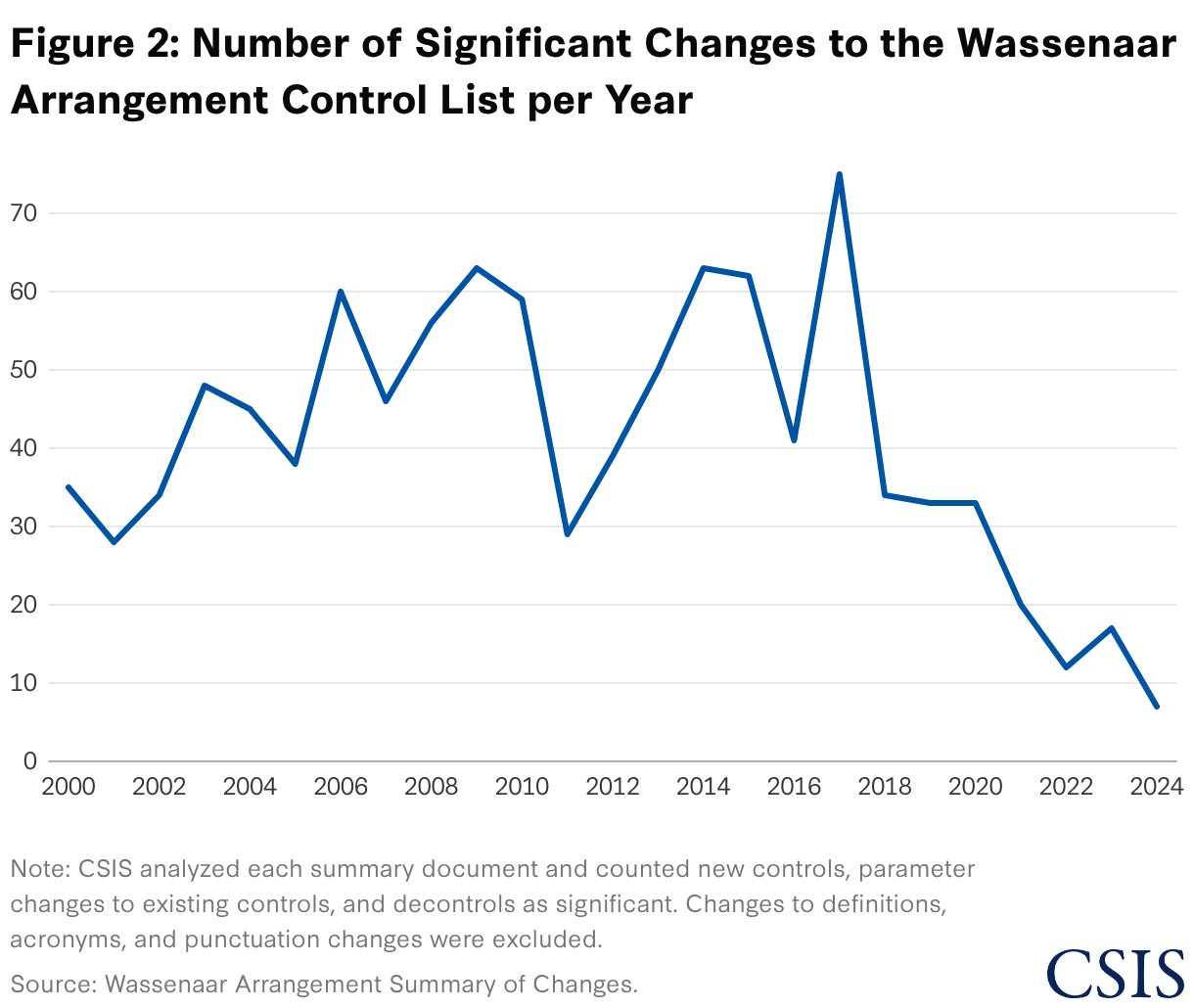
Policymakers’ dissatisfaction with the outdated multilateral regimes is understandable. Wassenaar's consensus-driven process takes an average of three years to result in new or revised controls, rendering it ill-suited to fast-evolving technologies like advanced semiconductors and AI. Interestingly, output from the Wassenaar Arrangement dropped precipitously after the passage of ECRA in 2018 (see Figure 2). BIS has always had the authority to impose unilateral controls for national security or foreign policy reasons, but ECRA gave BIS a mandate to take swift, unilateral action to control emerging and foundational technologies. Wassenaar’s effectiveness eroded even further following Russia’s full-scale invasion of Ukraine in 2022, since Russia is a member and can singlehandedly block proposals.
A reformed plurilateral system involving smaller coalitions of like-minded partners could enable controls to be implemented and recalibrated at a faster pace. The United States and allies started down this path with the “Wassenaar Minus One” group controls in 2024, but could go further by building a more flexible system that allows for fast decisions when needed across different blocks of partners.
Ultimately, policymakers need to stop using export controls as offensive economic tools, or they will lose the ability to use them when needed for critical national security purposes. Self-restraint in the use of these tools can achieve multiple goals, creating the conditions for de-escalation and setting the basis for a more rational global regime, as well as helping improve the effectiveness of export controls by focusing U.S. resources and resolve. Targeted controls remain essential to protect military advantages and keep dual-use items out of the hands of bad actors. For example, targeted plurilateral export controls are vital to keep Iran from procuring the foreign technologies it needs to rebuild its military platforms and weapons production.
Enacting controls for leverage in negotiations undermines their legitimacy and weakens the ability to use them effectively when needed. The appearance that U.S. goods could be capriciously cut off also creates incentives for other countries to design them out of their supply chains, harming U.S. businesses without a proportional strategic gain. A return to national security-focused use of export controls, informed by rigorous economic analysis of the costs and benefits, offers the best path to safeguarding U.S. interests in the long-term.
A return to a national security focus would serve not only long-term U.S. interests but also address immediate vulnerabilities that the current approach leaves exposed. Consider the consequences already unfolding: In January 2026, China imposed targeted export controls on Japan—a critical U.S. ally and intermediate processor of Chinese rare earths and specialty metals destined for U.S. defense, automotive, and semiconductor supply chains. Public data suggests that in the first two months of these restrictions, Chinese exports of controlled products to Japan fell 43 percent, with rare earth shipments down 78 percent. Should these disruptions persist, it is only a matter of time before they are likely to significantly impact U.S. supply chains.
The disruptions to Japanese supply chains illustrate a broader trajectory: China is not standing still. Its technological capabilities are gaining momentum. Today, the discussion centers on rare earths and other raw materials, but as China inevitably gains advantages in more technologies, it will be able to expand its own use of export controls against the United States and others. The United States’ undisciplined use of export controls and other measures essentially gives China license to do the same. This makes developing a more disciplined and collaborative approach with allies not just preferable but urgent, for both the legitimacy and effectiveness of such measures and for preparedness against an increasingly capable competitor.
This trajectory, in which both sides escalate controls while multiplying vulnerabilities, should provide a strong incentive for both Washington and Beijing to shift the bilateral conversation from rare earths and semiconductors to developing mutually acceptable guardrails for export controls in general. Important topics could include standards for adding items to the control list, the listing (and de-listing) of entities, end-user verification procedures, and extraterritorial reach. Such discussions may be arduous and frustrating, but a lack of dialogue almost guarantees that the ongoing arms race is unlikely to end soon.
Kate Koren is deputy director of the Economics Program and Scholl Chair in International Business at the Center for Strategic and International Studies (CSIS) in Washington, D.C. Scott Kennedy is senior adviser and Trustee Chair in Chinese Business and Economics at CSIS. Philip A. Luck is director of the CSIS Economics Program and Scholl Chair in International Business at CSIS. Ilaria Mazzocco is deputy director and senior fellow with the Trustee Chair in Chinese Business and Economics at CSIS.