Proportional to the Mischief: International Law and U.S. Grand Strategy
October 26, 2026 • 3:30 – 4:30 pm EDT
Hosted by Defense and Security

Photo: ©2026 by Satellogic
On July 21, President Trump signaled that the United States was escalating strikes against Iran and that the conflict was entering a new phase. Speaking from the Oval Office, the president noted that the United States might soon strike Pickaxe Mountain, one of the last remaining vestiges of Iran’s nuclear program.
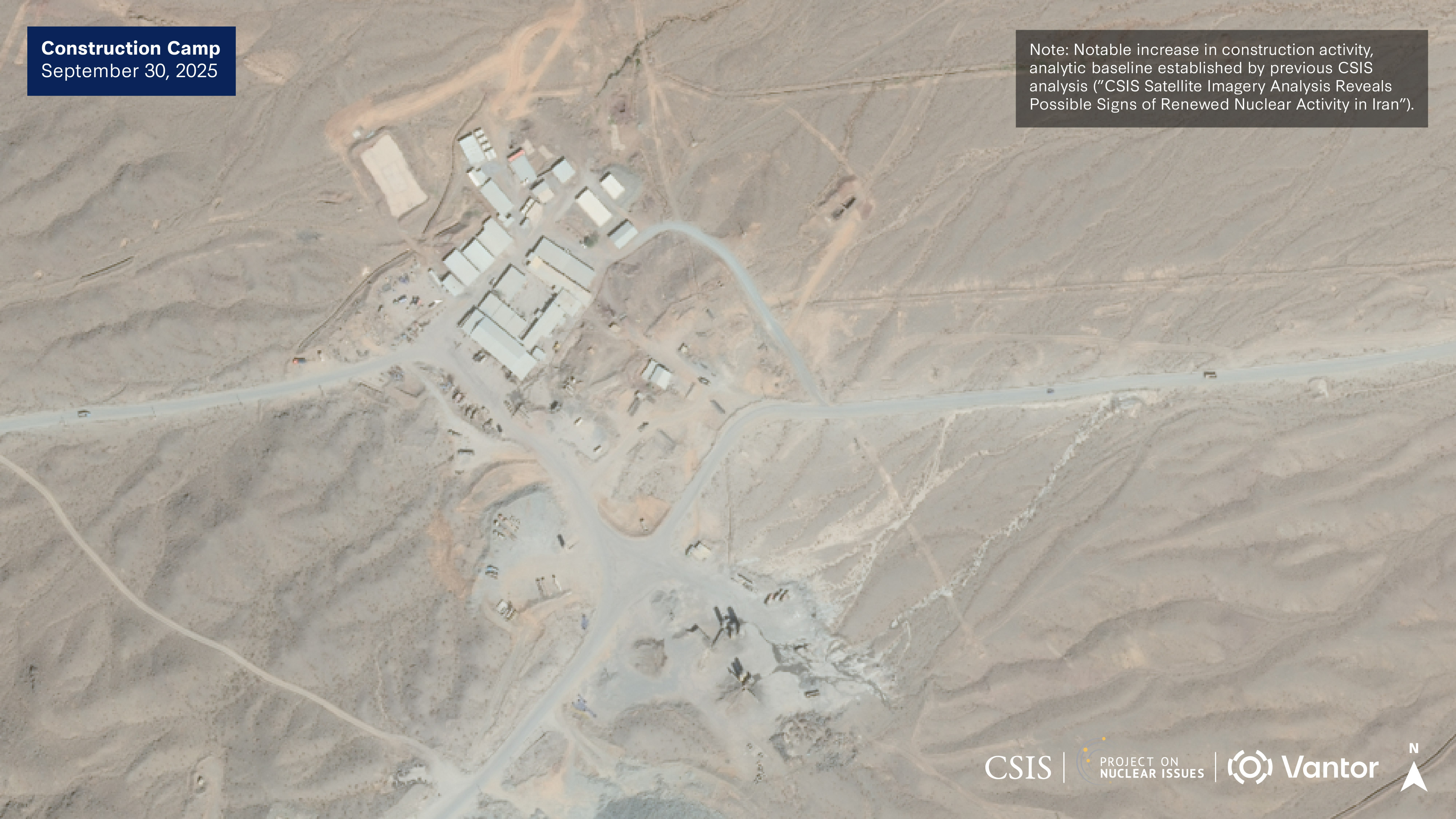
In the lead-up to President Trump’s statements, Israeli intelligence reportedly released information to the U.S. Intelligence Community claiming that Iran moved uranium centrifuges and centrifuge parts into Pickaxe Mountain last fall. In October 2025, previous CSIS satellite imagery analysis of construction activities at Pickaxe Mountain noted that the construction pace increased and that Iran erected a security perimeter around the facility.
Multisource imagery analysis of Pickaxe Mountain and the Natanz Nuclear Facility from 2020 to the present reveals a clear three-phase activity signature across the five key points of interest and the roads connecting them, indicating a site that has shifted from active excavation toward probable internal construction and continued exterior reinforcement. This analysis utilizes six years of synthetic aperture radar (SAR) change detection with Sentinel-2 optical change detection and very-high-resolution (VHR) Airbus imagery from July 9, 2026, as well as a Satellogic image from August 9, 2026.
Together, these images reveal more road activity at Pickaxe Mountain in 2026 than at any point in the site’s history. There is a clear surge in construction activity in 2026 that corresponds to the raising and hardening of the portal accesses, paving of the internal road network, reinforcement around access areas, and the flattening and removal of excavation spoil.
This assessment can neither refute nor substantiate the Israeli intelligence claim that Iran moved centrifuges into Pickaxe Mountain. The continuous construction, the absence of an increased internal security posture, and the lack of observed nonconstruction vehicles and equipment suggest the underground facility is not yet capable of enrichment work, if that is the intended purpose. Further analysis of daily activity would be needed to establish the site’s pattern of life beyond its current construction footprint.
Pickaxe Mountain is a deeply buried granite fortification, and it will be difficult to destroy the facility even with the heaviest non-nuclear U.S. munitions, such as the GBU-57 Massive Ordinance Penetrator. While military strikes may degrade or temporarily disable Pickaxe Mountain, continuously bombing Iranian nuclear infrastructure is unsustainable, illustrating the need for a verifiable diplomatic solution to the Iranian nuclear challenge.
Pickaxe Mountain, or Kuh-e Kolang Gaz La in Farsi, is a large underground tunnel complex 2 kilometers south of the Natanz uranium enrichment facility in Iran. In 2020, the head of Iran’s nuclear program, Ali Akbar Salehi, announced the groundbreaking of an underground centrifuge assembly facility near Natanz following suspected Israeli sabotage of an aboveground workshop at the Natanz complex.
The International Atomic Energy Agency (IAEA), a UN nuclear watchdog, has requested information about Pickaxe Mountain and access to the facility. Iran has reportedly never responded to the IAEA requests. When asked about construction activities at Pickaxe Mountain on September 26, 2025, Iranian President Masoud Pezeshkian said that satellite imagery was insufficient to determine what was happening at the site and called for IAEA inspectors on the ground to verify the site’s purpose. Unfortunately, Tehran has demanded transparency and simultaneously banned the very inspectors who could provide it.
There are at least three likely explanations for what is contained at Pickaxe Mountain:
While open-source evidence is not enough to fully reveal what is happening at Pickaxe Mountain, Iranian construction of a facility just 2 kilometers away from their old uranium enrichment facility at Natanz is suspicious.
Previous CSIS analyses have noted that Iran continued construction activities at Pickaxe Mountain in the aftermath of Operation Midnight Hammer in June 2025. Between June and September 2025, Iran completed the security perimeter fence around the entire facility, reinforced and extended several tunnel entrances with portal doors, and increased the pace of excavation at the facility. Notably, the tunnel portal entrances at Pickaxe are shaped in a U-bend, which could prevent missiles from flying straight down the tunnel corridor and reduces shock waves created by explosions channeling energy into the underground facility.
This analysis of multisource imagery of Pickaxe Mountain and the Natanz Nuclear Facility from 2020 to the present reveals a clear three-phase activity signature across the five key points of interest as well as the roads connecting them. The analysis utilized Sentinel-1 SAR, a day-night and all-weather active radar imaging system, to conduct six years of continuous monitoring of the entire site. SAR registers how strongly the ground reflects those pulses: Flat, undisturbed desert appears dark, while hard, manmade features such as buildings, walls, and graded roads bounce the signal back brightly. Comparing radar images over time reveals where new activity is occurring. Pairing this methodology with Sentinel-2 optical change detection analysis over the same period revealed a clear three-phase activity signature across the five key points of interest and road corridors within Pickaxe Mountain.

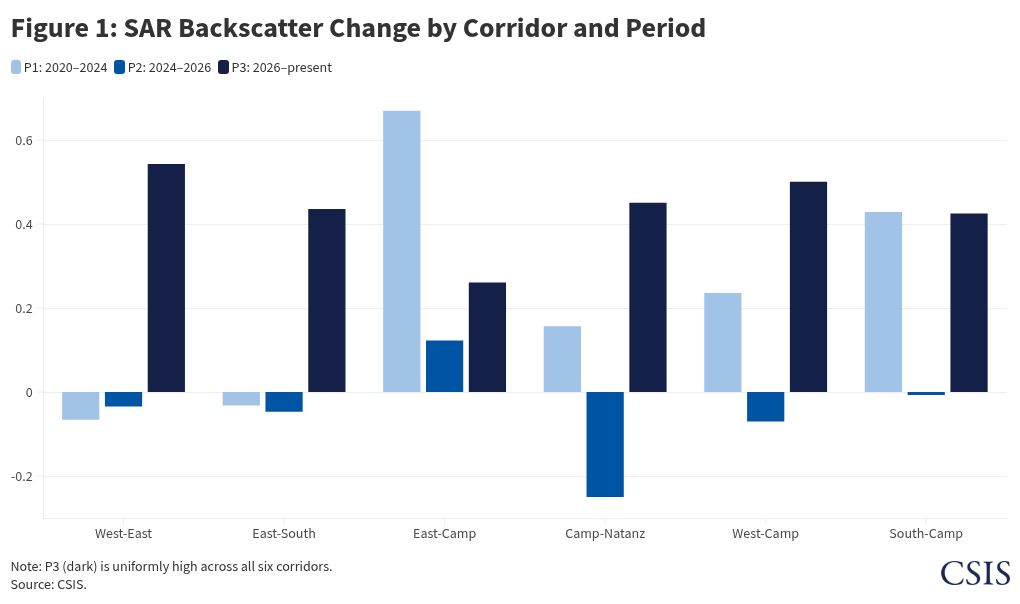
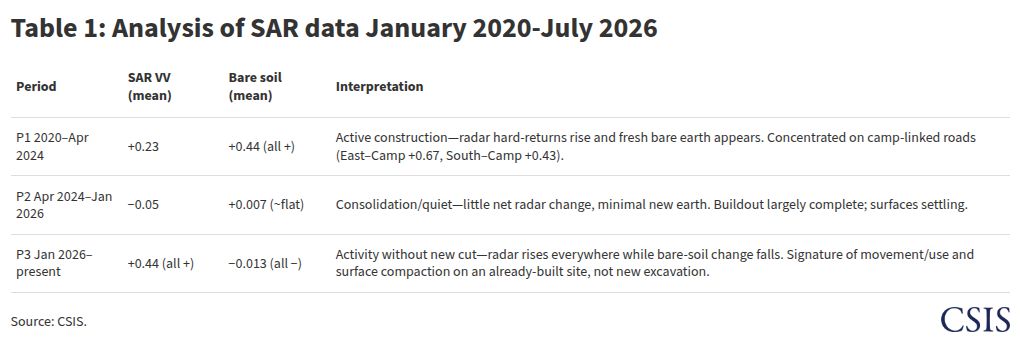
As depicted in Figure 1, Phase 1 (2020–April 2024) was marked by heavy construction and initial site buildout. Phase 2 (April 2024–January 2026) was relatively consolidated, with less change detected across the facility aside from the changes noted in late 2025. However, SAR change detection analysis during Phase 3 (January 2026–present) registered heavy usage across every road corridor simultaneously and increased hardened surface returns near portal accesses and road corridors. Phase 3 represented the most activity of this kind since the initial construction of the facility and is indicative of increased utilization of the site rather than new excavation.
This analysis was supplemented by VHR imagery acquired from Airbus of Pickaxe Mountain from July 9, 2026, and Satellogic Imagery from August 9, 2026, which corroborates the previous findings: The surge corresponds to the raising and hardening of the portal accesses, hardening of the internal road network, reinforcement around access areas, and the flattening and removal of excavation spoil piles. Together, these signals indicate a transition from excavation toward probable internal construction and continued exterior reinforcement.
The first campaign returned significant change in the detection of bare soil, likely because roads were being constructed during this phase. The rising radar signatures with falling amounts of bare soil across every corridor in Phase 3 indicate hard-surface returns—such as vehicles, materiel, compaction, or traffic—over ground that is no longer being freshly exposed. Overlaying Sentinel-1 SAR with 10-meter optical imagery from Sentinel-2 reveals these changes across the road networks at Pickaxe Mountain in the graphic below.
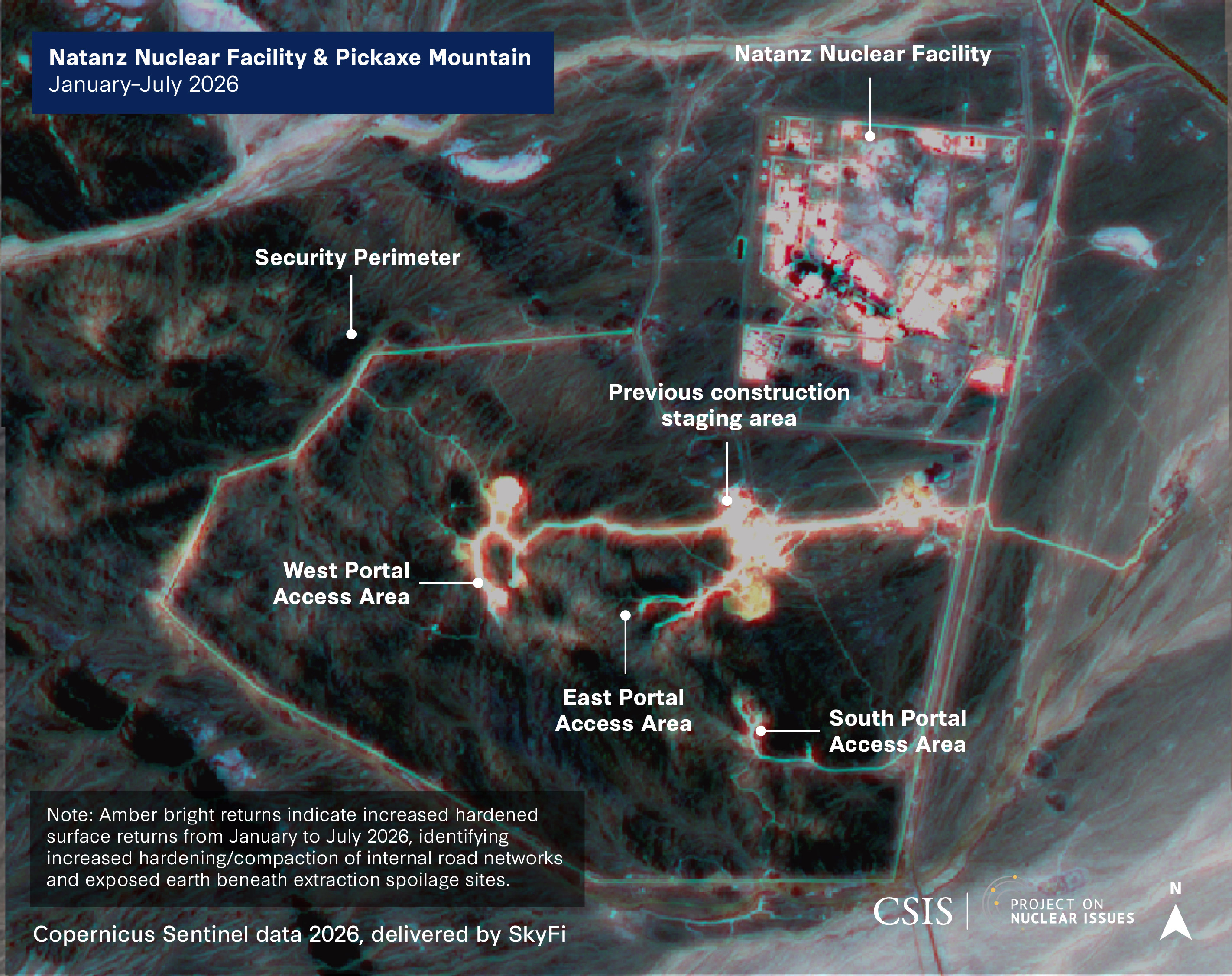
Contains modified Copernicus Sentinel data 2026, delivered by SkyFi. Image may not be republished without permission. Please contact [email protected].
Analysis of VHR Airbus optical imagery (below) resolves what the SAR change detection indicated: new concrete surfacing over roads and exterior portal accesses, a noted decrease in spoilage piling and evidence of removal, and continued construction activity. The south and east portal entrances are more heavily hardened in July 2026 than they were in September 2025. There is site-wide evidence of the removal of excavation spoilage, which is typical of a construction site transitioning from a cut to a buildout phase and is a probable indication that construction shifted toward the internal construction of the underground facility, though external reinforcement of east and west portal access is still ongoing. No change was observed at the Natanz Nuclear Facility itself, consistent with the surge in activity observed via Sentinel data being specific to the Pickaxe underground complex.
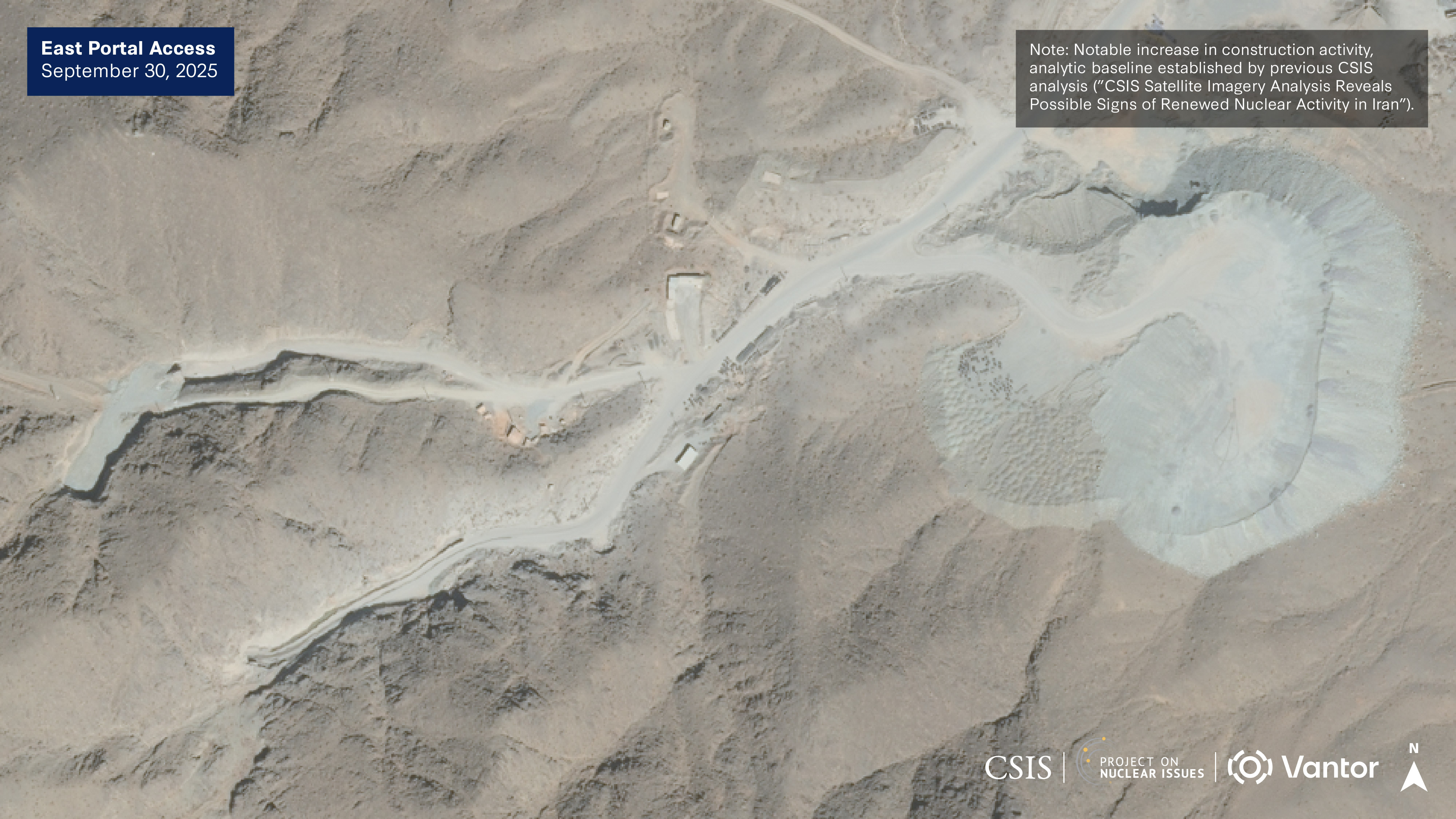
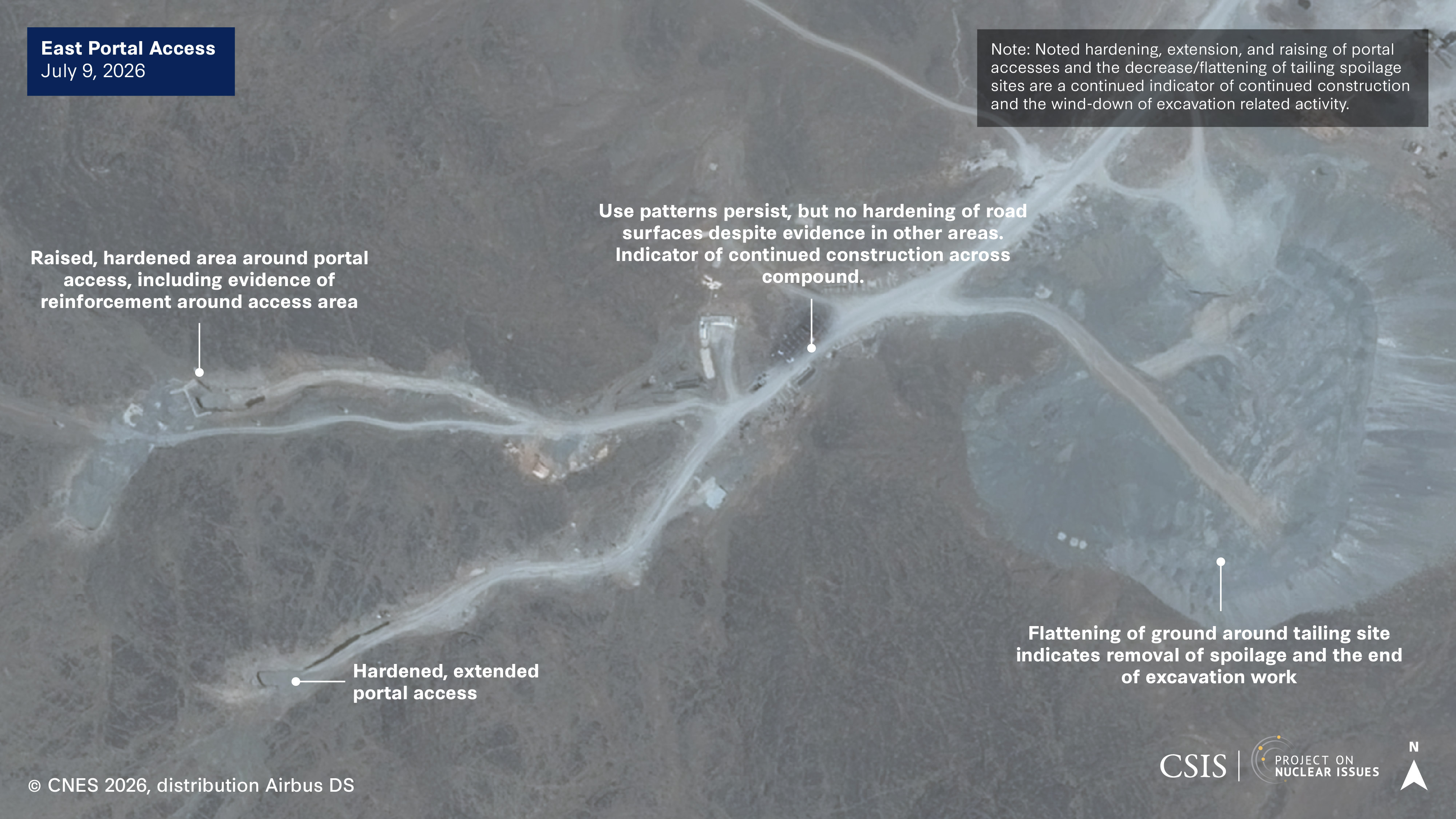
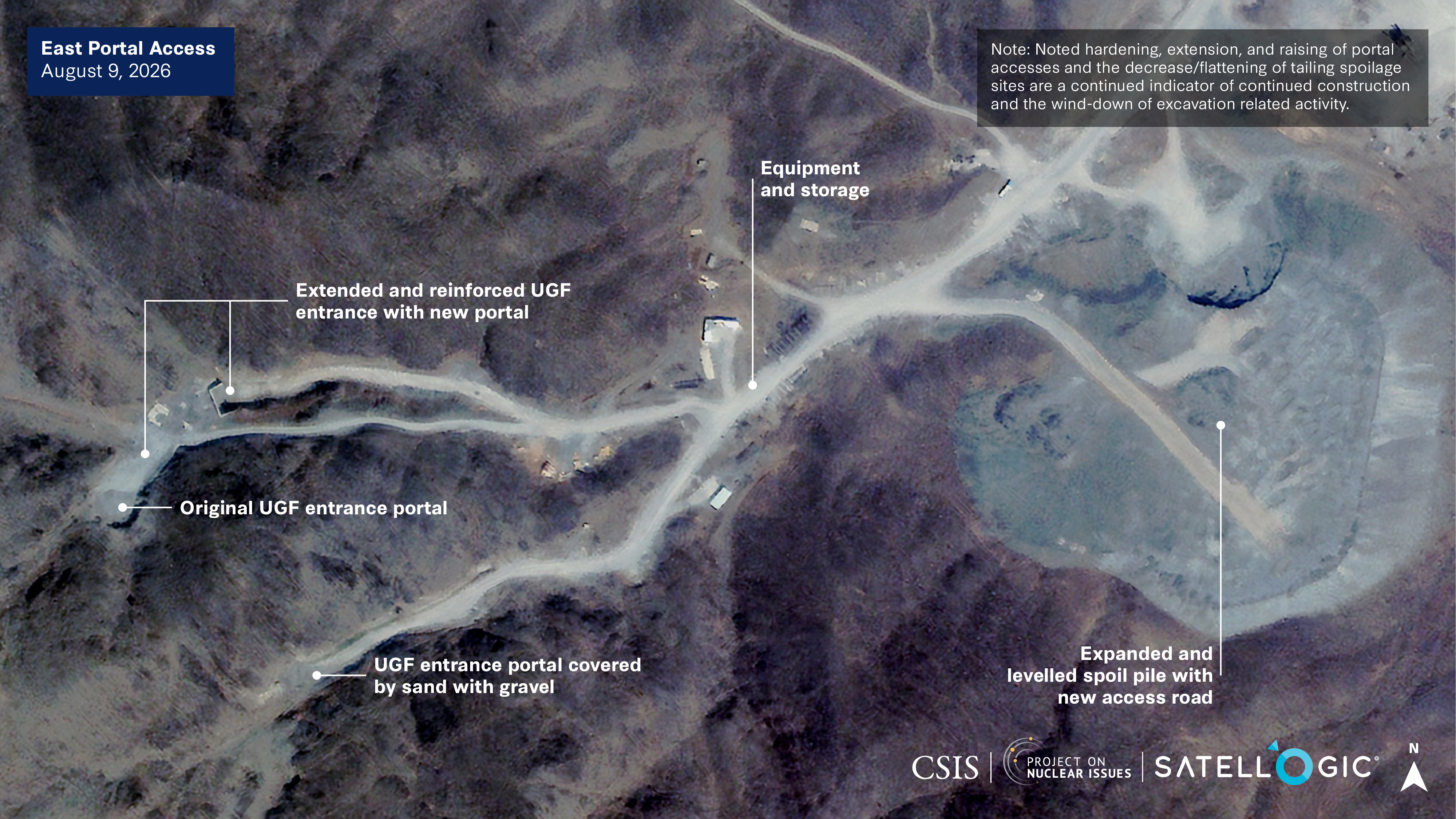
Image may not be republished without permission. Please contact [email protected].
Click arrows to view the full sequence of satellite images.
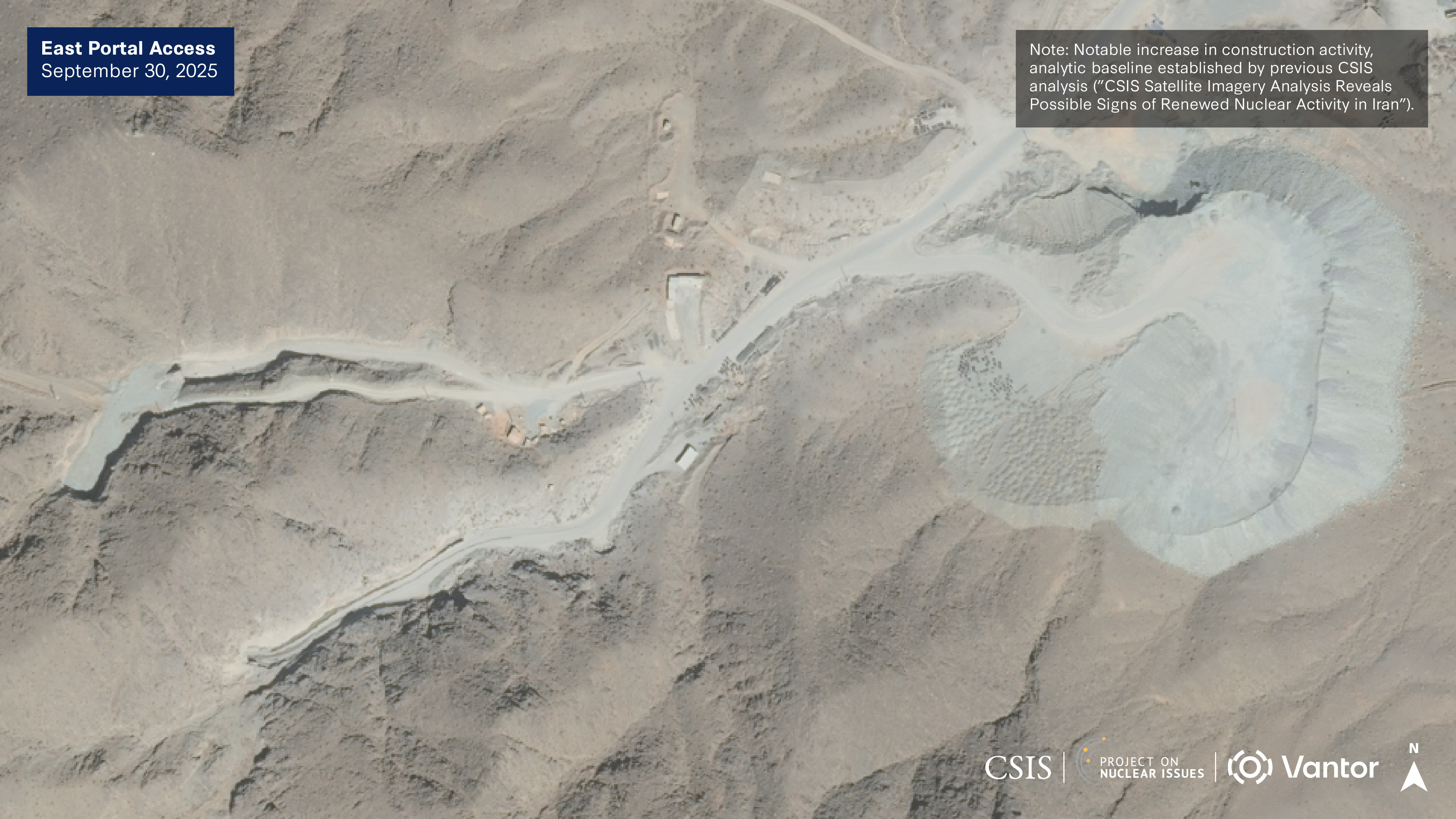
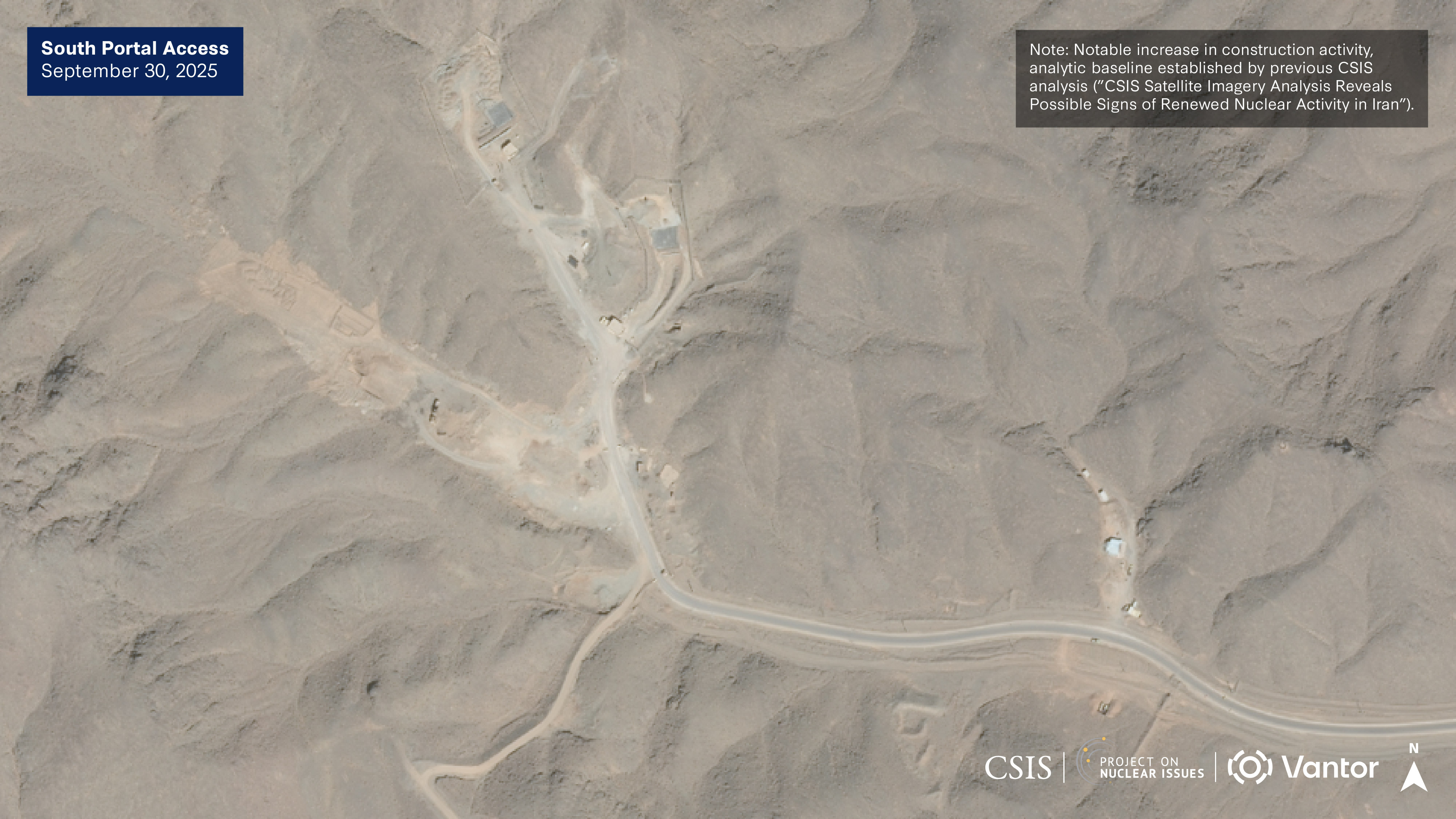
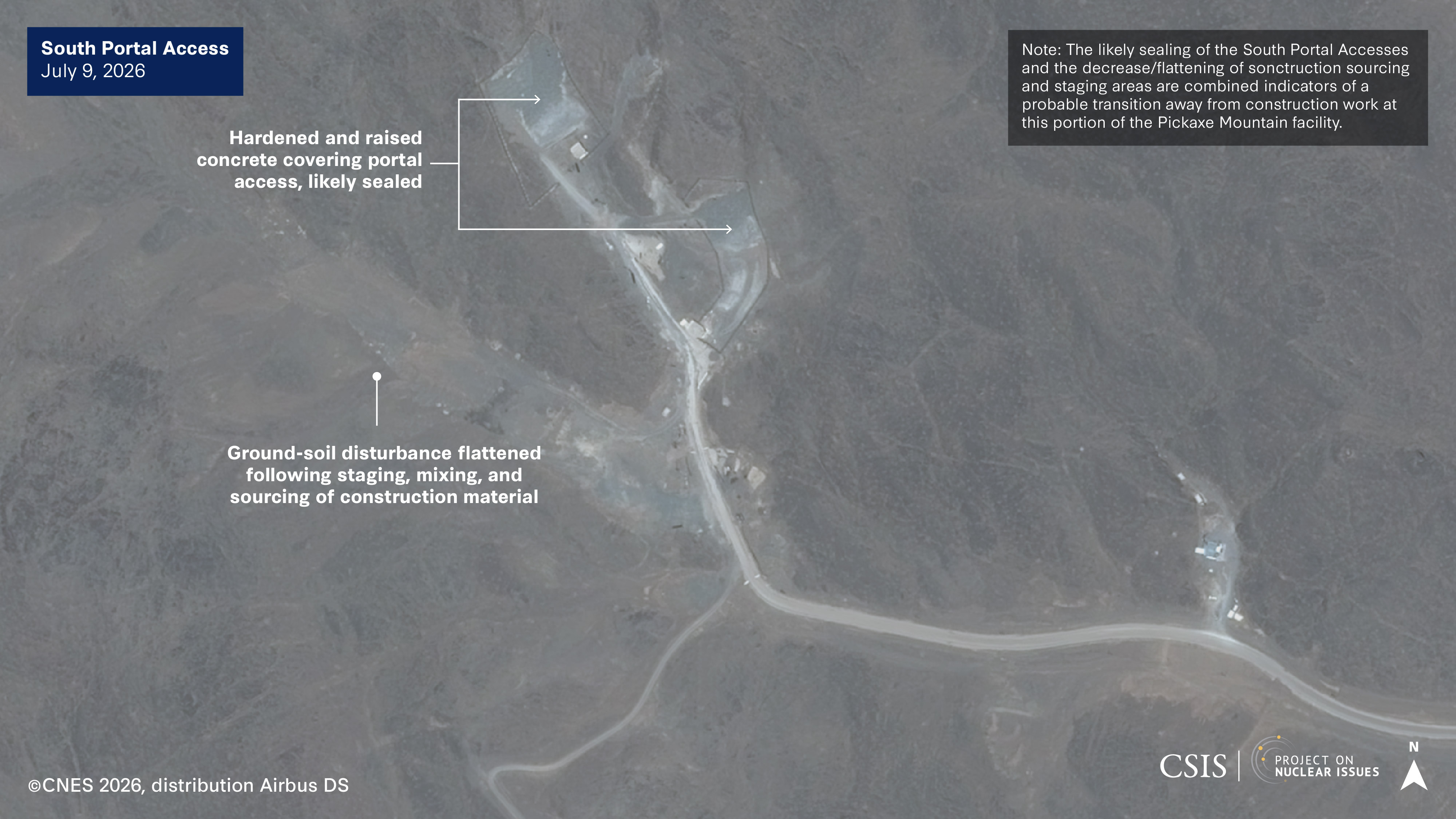
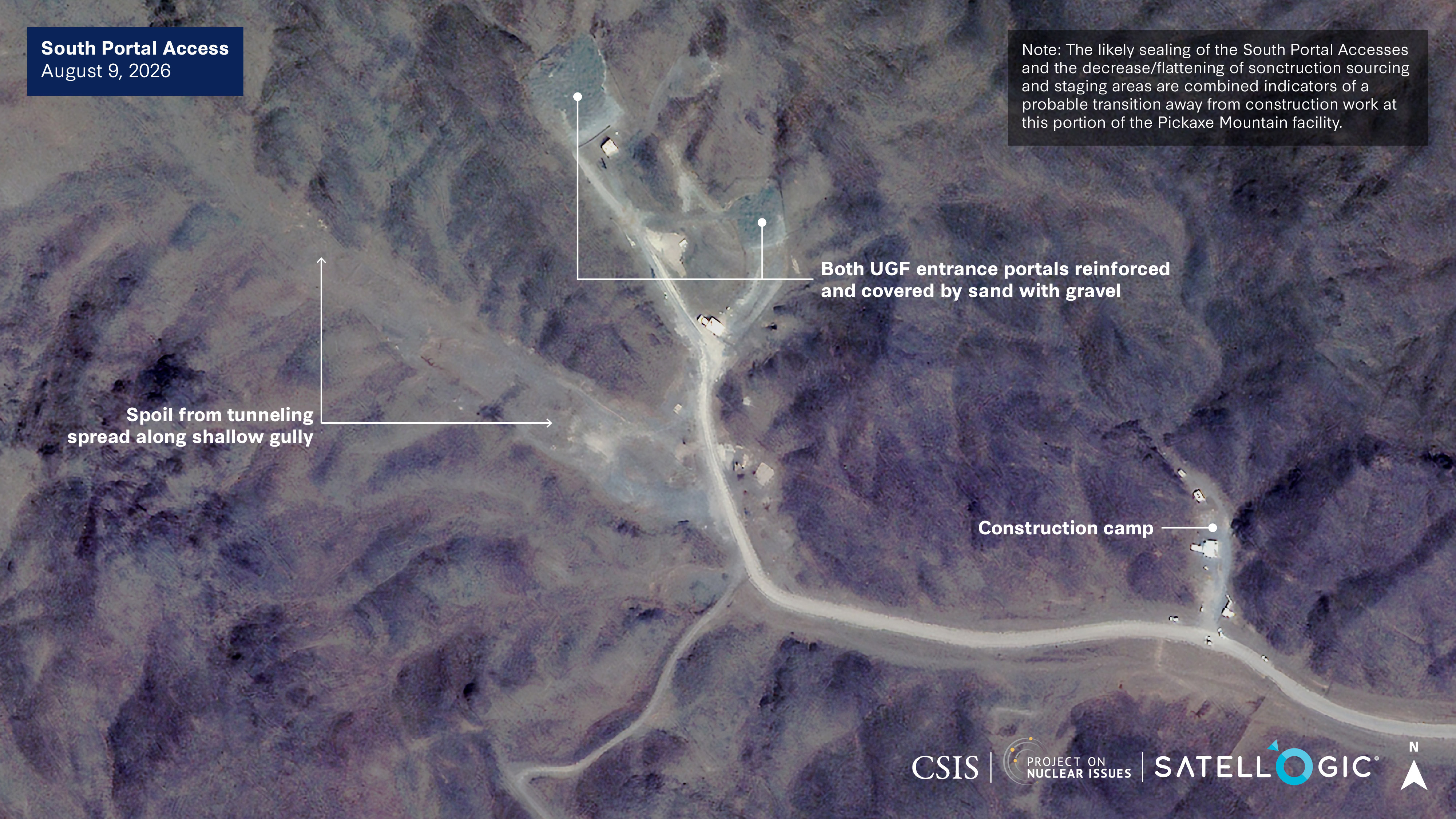
Image may not be republished without permission. Please contact [email protected].
Click arrows to view the full sequence of satellite images.
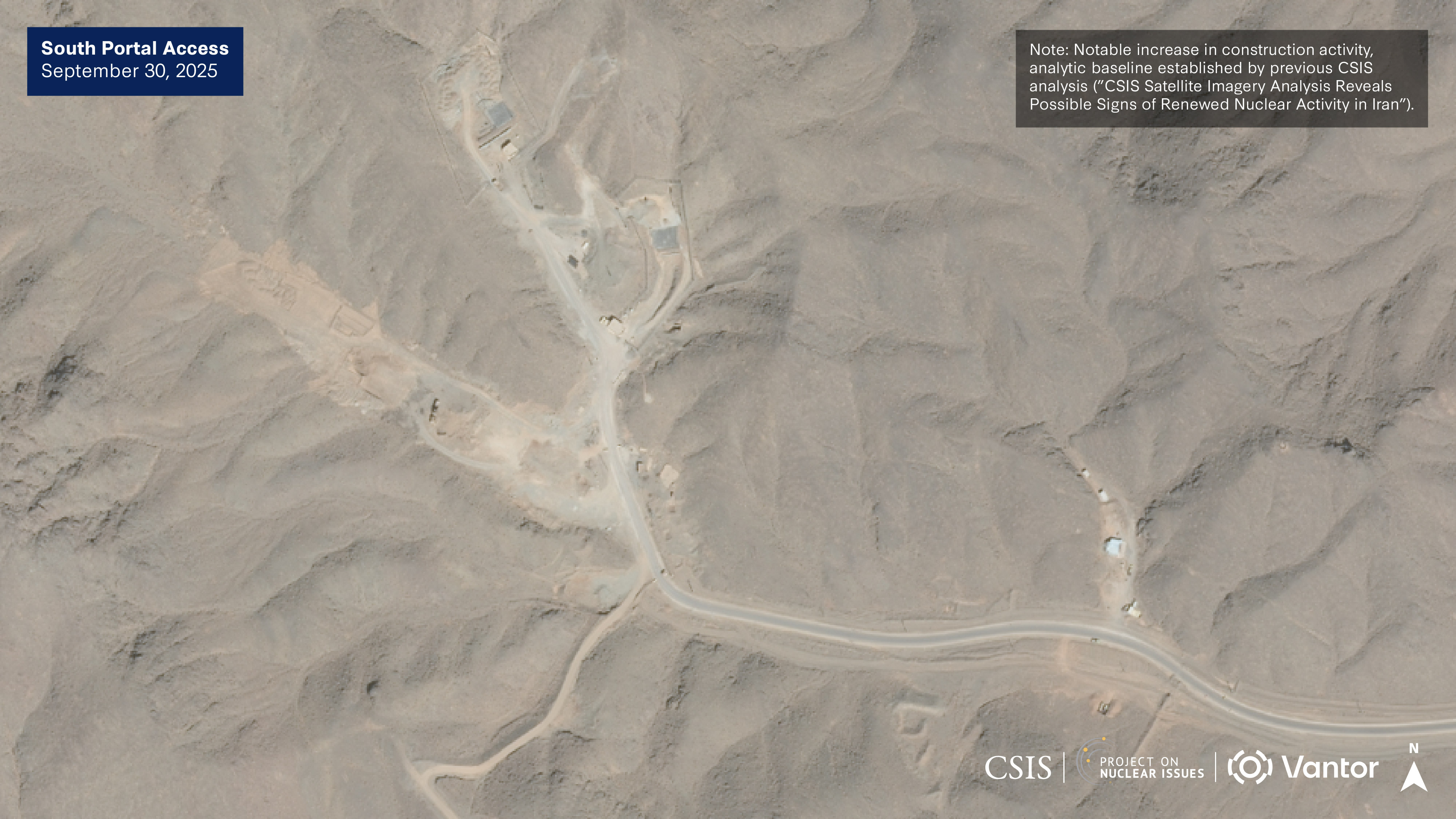
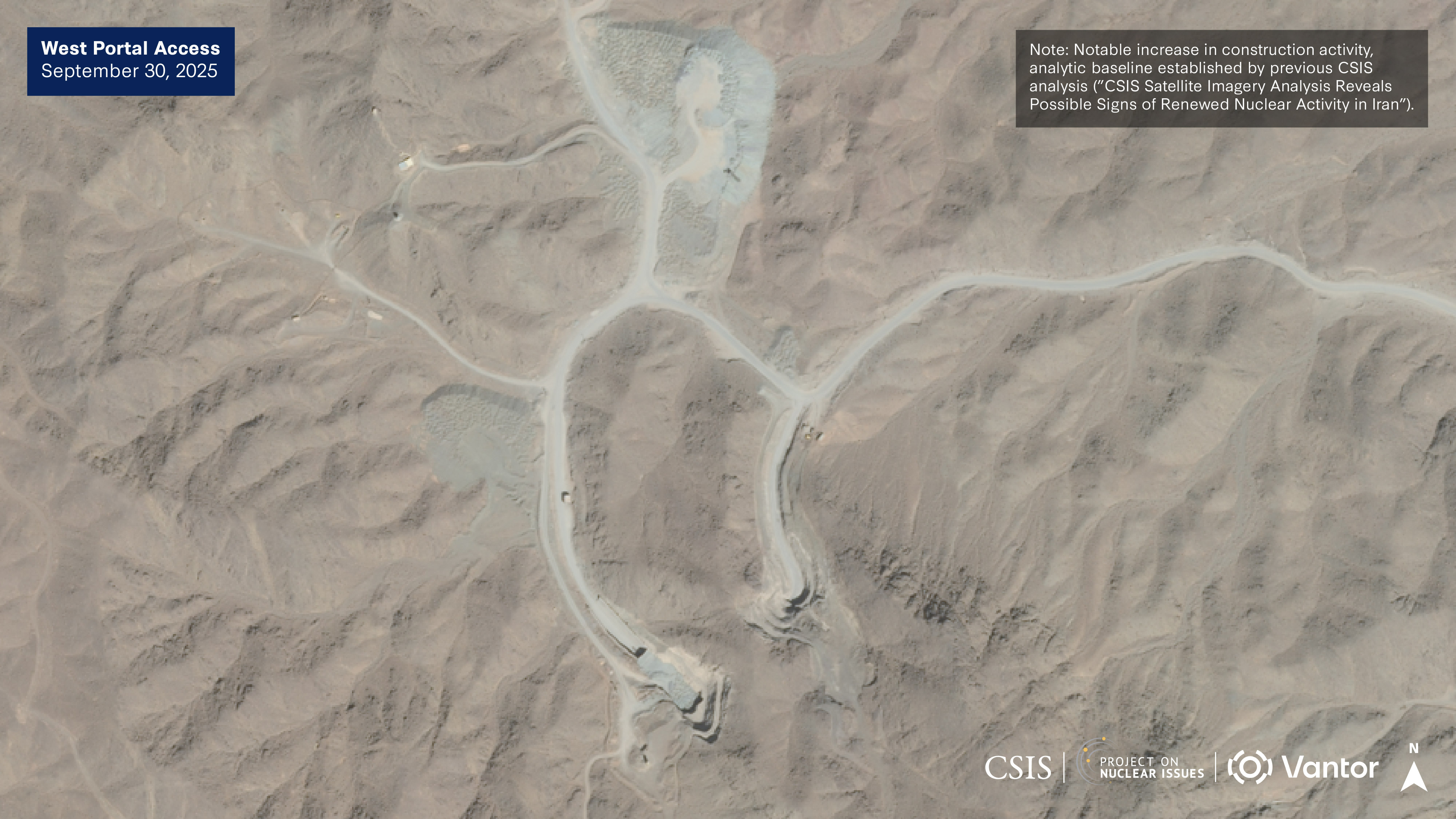
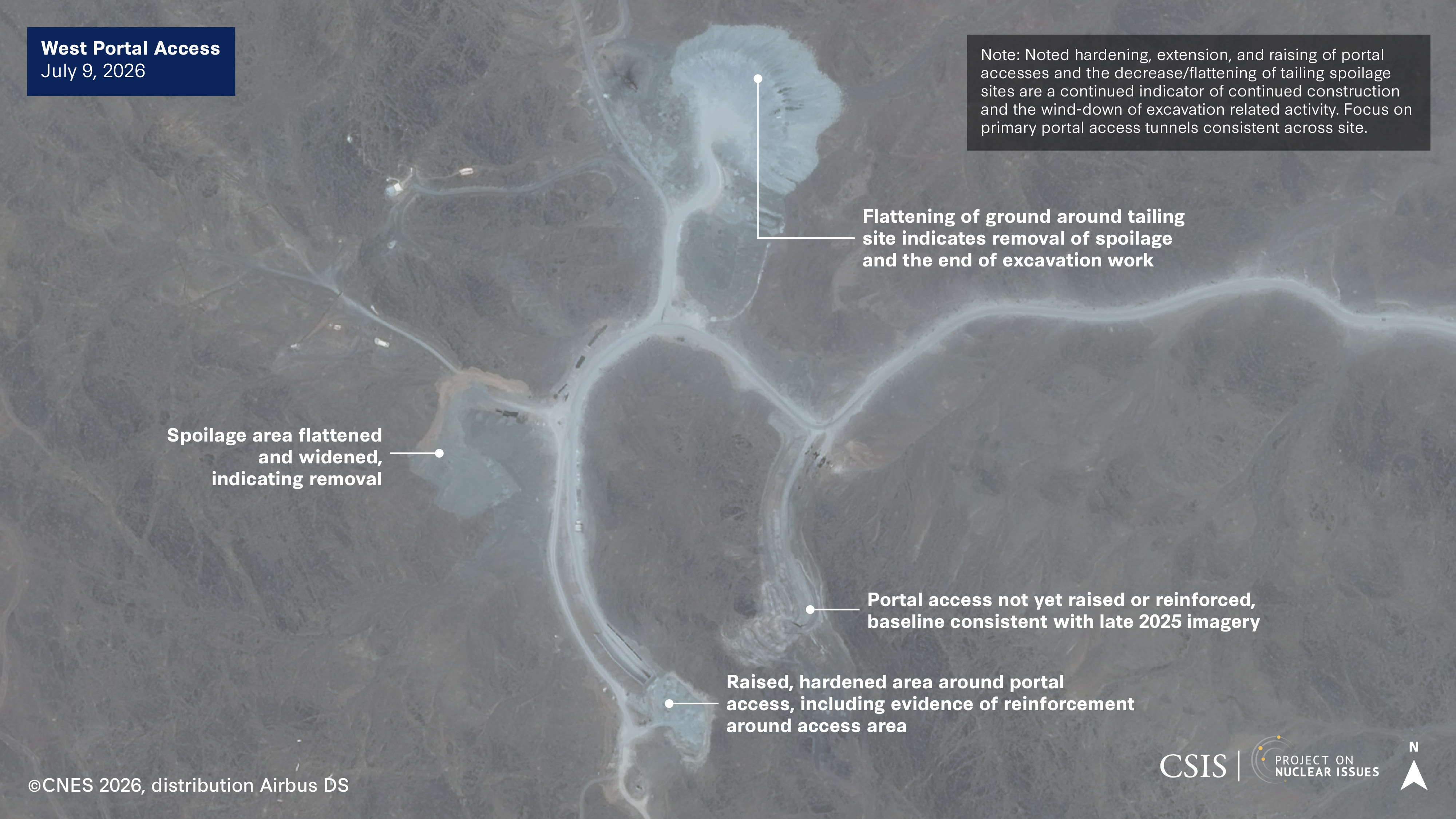
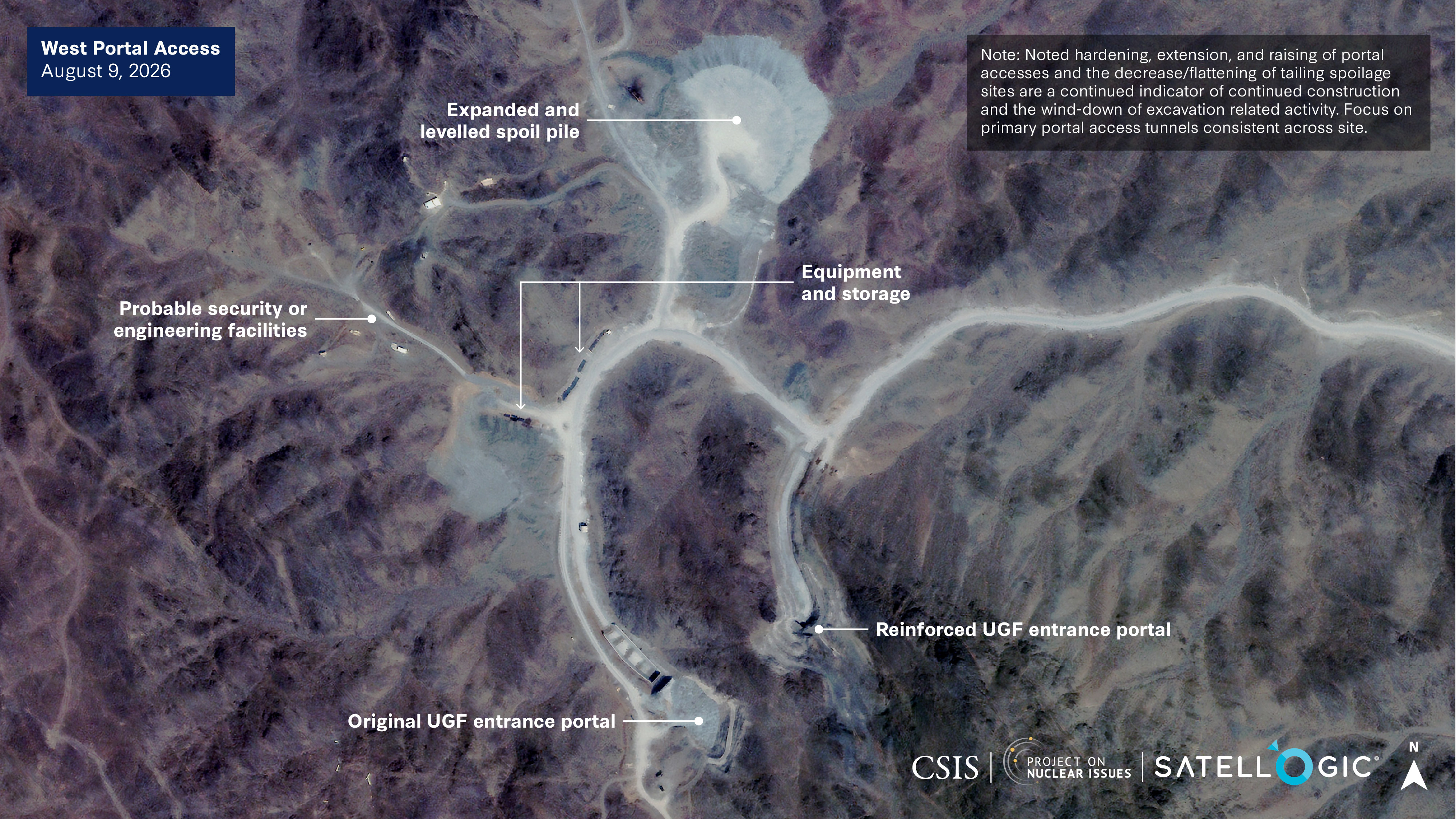
Image may not be republished without permission. Please contact [email protected].
Click arrows to view the full sequence of satellite images.
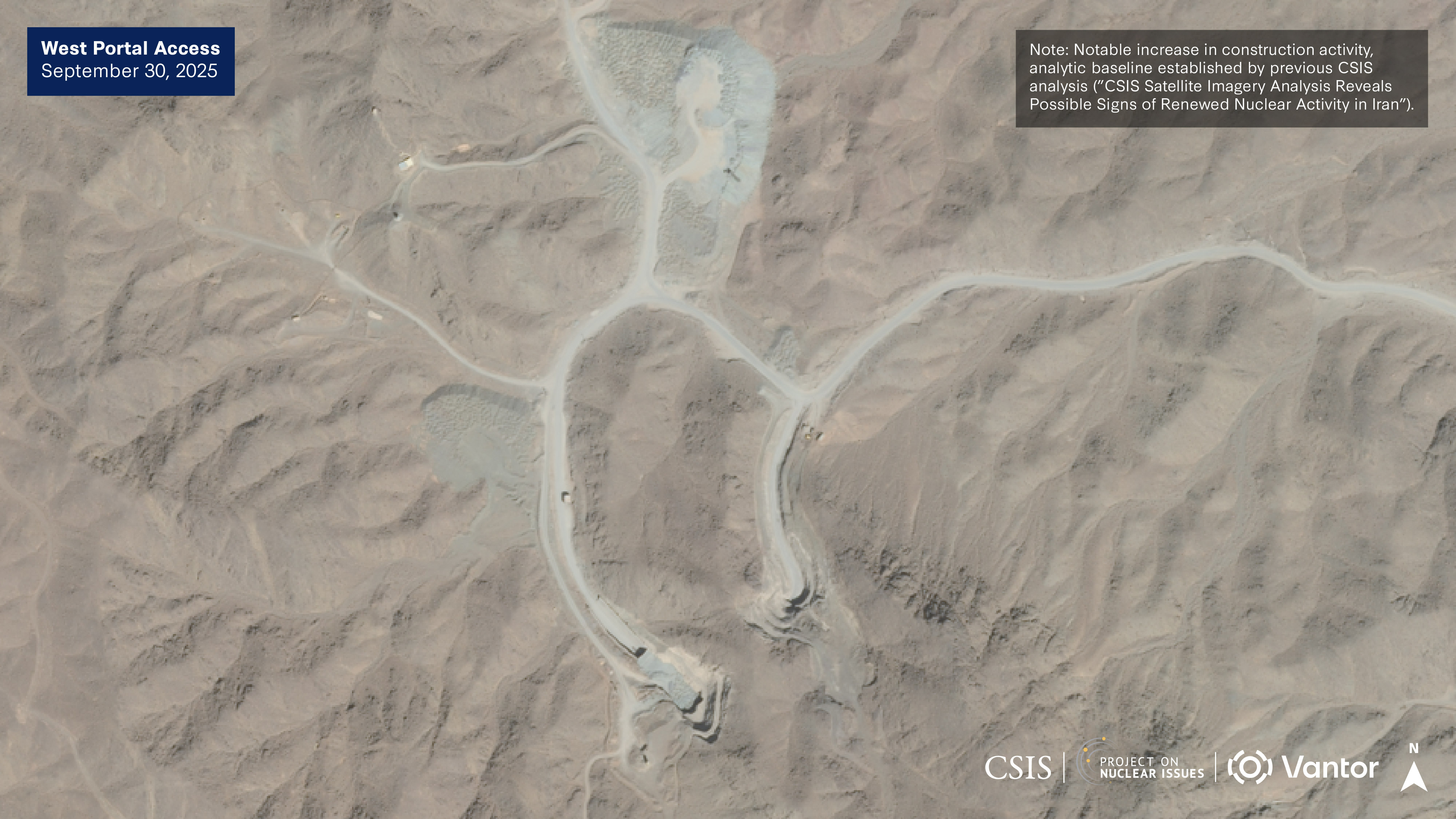
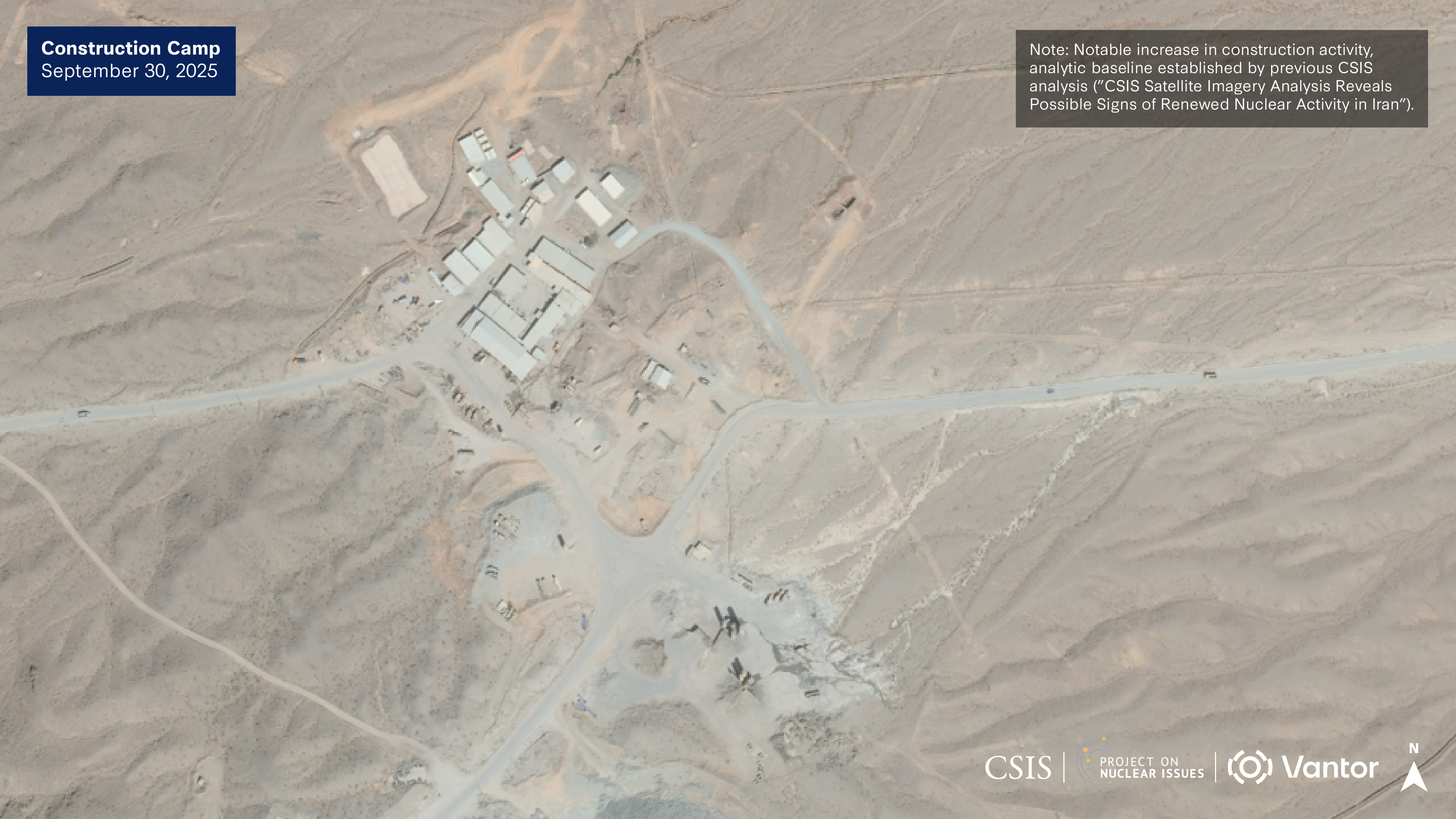
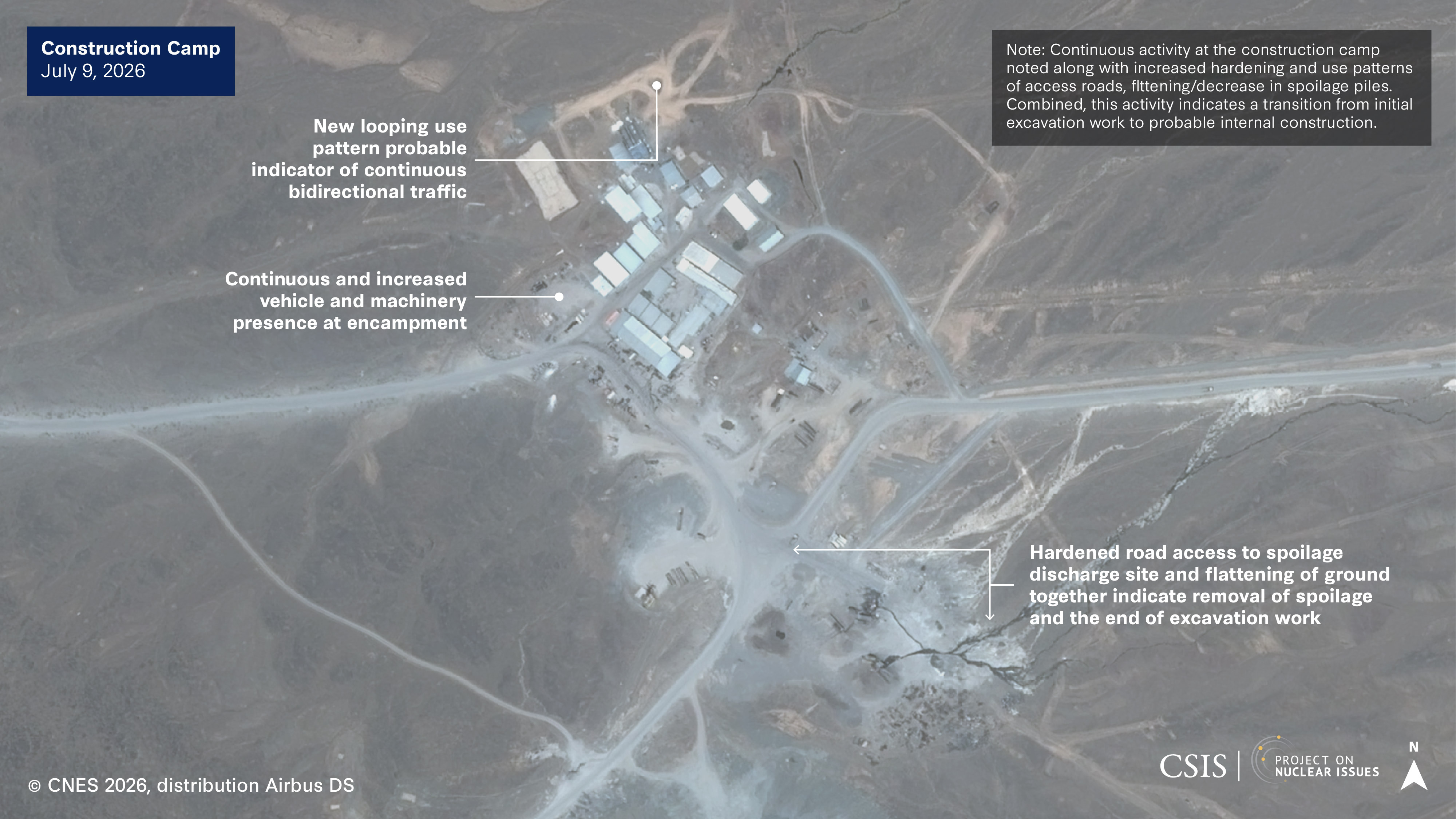
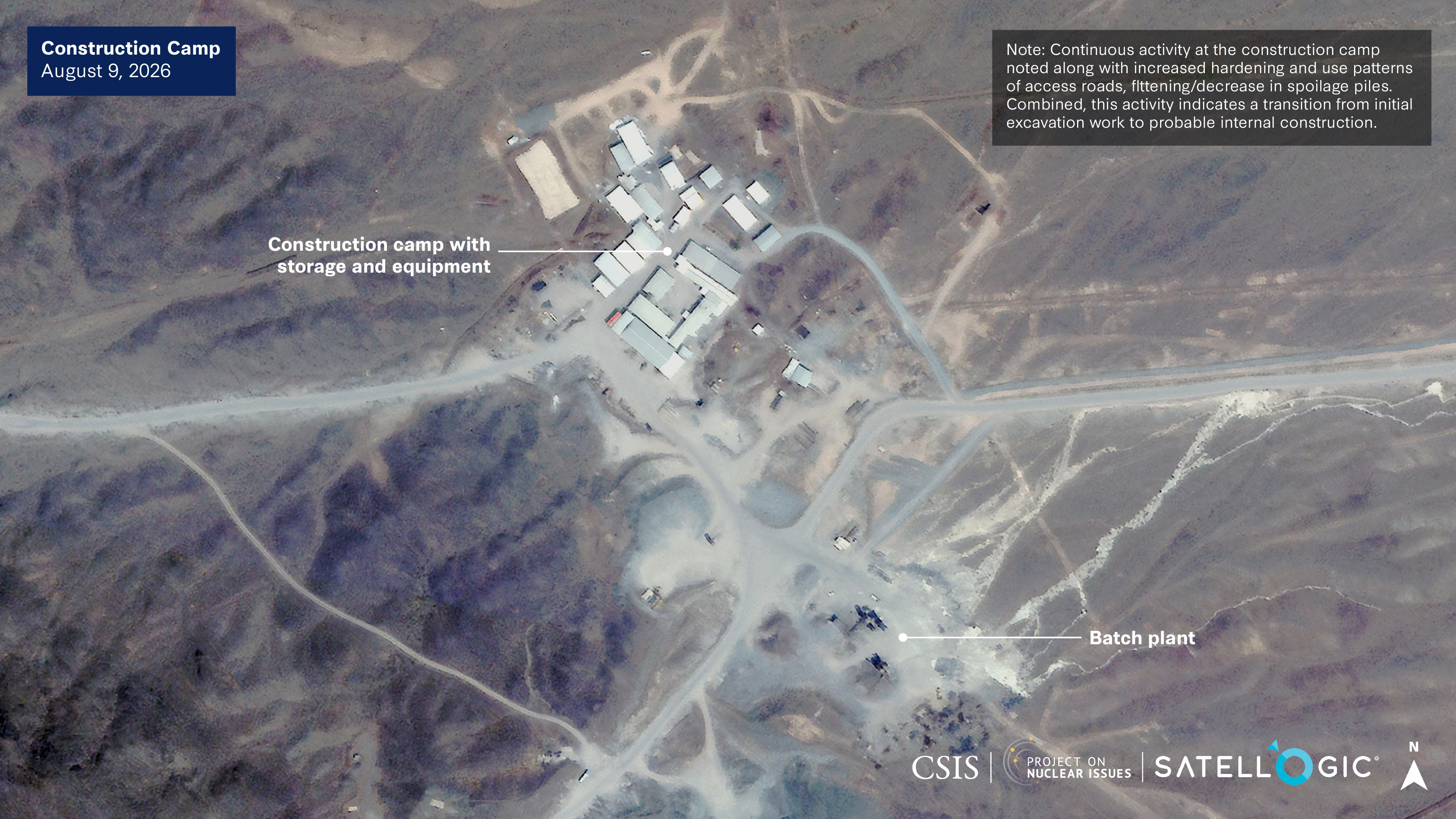
Image may not be republished without permission. Please contact [email protected].
Click arrows to view the full sequence of satellite images.
Other analysts have concluded Iranian construction activity continued at Pickaxe Mountain during the June 17 memorandum of understanding (MOU) between Iran and the United States. That MOU stated that “the Islamic Republic of Iran will maintain the current status quo of its nuclear program.” CSIS imagery analysis confirms that construction activity continued at a high rate during the period covered by the MOU.
It is difficult to assess with a high degree of accuracy the depth of the underground facility at Pickaxe Mountain Some open-source estimates claim that the facility is between 80 and 100 meters deep. However, these estimates rely on measuring the amount of spoil, or dirt removed from the underground tunnel. While satellite imagery can provide some insights into the volume of dirt removed by measuring spoil piles, it does not provide insight into the internal design of the facility as tunnels drilled horizontally, upward, or downward would likely accumulate the same volume of spoilage. Despite these limitations to internal analysis, detailed analysis of the external facility at Pickaxe Mountain reveals an extensive and heavily fortified underground facility buried deep into a granite mountain.
It is incredibly difficult to destroy a facility such as Pickaxe Mountain through conventional external kinetic force. While the United States possesses large munitions, even the heaviest “bunker buster” bombs have limits. The largest conventional bunker buster in the United States arsenal is the GBU-57 Massive Ordnance Penetrator, which can only be operationally delivered by the B2 stealth bomber. This 30,000-pound precision-guided munition, which carries a 5,000-pound explosive warhead, can reportedly penetrate 60 meters into the ground before it detonates with a delayed fuse.
During Operation Midnight Hammer, the United States Air Force dropped 12 Massive Ordnance Penetrators at Fordow, creating six craters on top of a ventilation shaft that led into the underground centrifuge hall. This strategy, which is called “double tapping,” begins with dropping one bomb on the ground to create a hole. The second Massive Ordnance Penetrator then falls directly into the crater of the first bomb, coupling the blast more deeply underground to channel the shock wave into the earth.
The nuclear facility at Fordow was reportedly buried at least 80 meters deep, beyond the upper limits of the Massive Ordnance Penetrator’s capabilities. However, Fordow contained a structural weak point: ventilation shafts that allowed blast waves to channel directly into the underground facility. Additionally, it is clear from the precision of the attack on Fordow that the United States and Israel had a significant amount of intelligence about their target, possibly including schematics and blueprints of the facility. While ventilation is a requirement of any underground facility, it is unclear from open sources if ventilation shafts at Pickaxe Mountain are similar structural weak points, as Iran would likely seek to apply lessons learned from Operation Midnight Hammer.
If the United States decides to attack Pickaxe Mountain, dropping Massive Ordnance Penetrators with B2 bombers may not actually complete the job. Furthermore, the United States possesses a limited inventory of Massive Ordnance Penetrators and is currently trying to restock that inventory after Operation Midnight Hammer. The Pentagon may decide that a more effective attack on Pickaxe Mountain involves targeting and collapsing tunnel entrances with cruise missiles, rather than attempting to cause structural damage to the underground facility itself. This is the same approach that the United States took for the Isfahan underground nuclear facility in June 2025, when the tunnel entrances were struck with multiple Tomahawk cruise missiles. As a result, Iran may seek to further fortify the tunnel entrances at Pickaxe Mountain. Optical satellite imagery from after President Trump’s statements is not commercially available at the time of publication.
Destroying Pickaxe Mountain will be a scientific and targeting challenge. It is an underground fortress buttressed by granite. It is one of the only facilities in Iran’s nuclear program that the United States has not yet struck. Structurally degrading Pickaxe Mountain requires more than just kinetic force—it takes actionable high-confidence intelligence and sophisticated mathematical modeling. The U.S. hesitation to strike Pickaxe Mountain and Isfahan with bunker busters likely reflects operational caution. Nevertheless, the United States appears poised to target Pickaxe Mountain, with President Trump claiming “we’ll be hitting that area pretty soon. And very heavily.”
This multisource imagery analysis of Pickaxe Mountain reveals more road activity in 2026 than the last six years. The imagery analyzed here can not substantiate nor refute claims that Iran moved uranium enrichment centrifuges into Pickaxe Mountain. Given the level of construction activity at the site, there is reason to doubt that Iran is conducting uranium enrichment at the facility right now.
Ultimately, Pickaxe Mountain is just one of many challenges that the United States faces in Iran. Tehran has many underground facilities that are difficult to strike, including the underground facility at the Isfahan nuclear complex. Prior to Operation Midnight Hammer, IAEA Director General Rafael Grossi was scheduled to visit the underground facility at Isfahan to view a third uranium enrichment site that Iran was allegedly constructing.
Iran operates numerous other underground facilities across the country. Even if the United States can destroy or disable Pickaxe Mountain, Tehran’s nuclear aspirations are unlikely to change any time soon. Military operations in Iran must ultimately serve U.S. political and security objectives. If the United States’ goal is to prevent Iran from ever developing a nuclear weapon, repeatedly bombing Iran every few months is insufficient and unsustainable. Ultimately, a verifiable diplomatic solution is likely the only lasting resolution to restrict Tehran’s nuclear ambitions.
Joseph Rodgers is deputy director and fellow in the Project on Nuclear Issues at the Center for Strategic and International Studies (CSIS) in Washington, D.C. Douglas Comstock is fellow for satellite imagery analysis and open-source intelligence at CSIS.

Commentary by Joseph Rodgers and Joseph S. Bermudez Jr. — October 27, 2025

Critical Questions by Heather Williams, Doreen Horschig, and Bailey Schiff — June 13, 2025

Transcript — August 24, 2026

