The Eurofile Live: Are Europe and China on an Economic Collision Course?
October 22, 2026 • 9:00 – 10:00 am EDT
Hosted by Europe, Russia, and Eurasia Program

Photo: Sally Hayden/SOPA Images/LightRocket via Getty Images

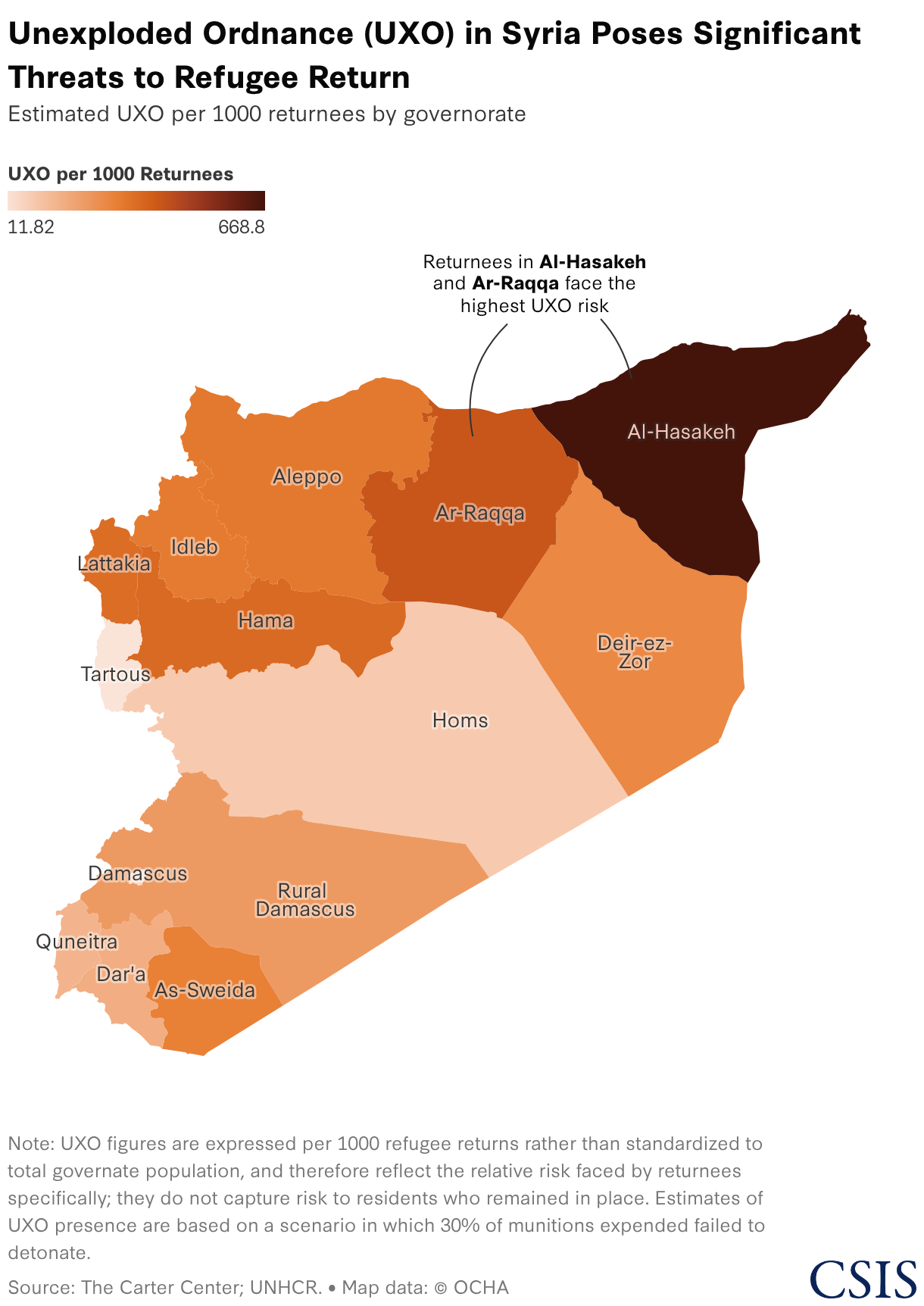
More than 1.7 million Syrian refugees have returned to Syria following the fall of the Bashar al-Assad regime in December 2024, with explosive remnants of war now posing a significant obstacle to safe resettlement. This installment of Charting the Middle East highlights how the scale of unexploded ordnance (UXO) contamination, relative to returning populations, varies across Syria. These disparities underscore the importance of prioritizing mine clearance and risk awareness efforts in areas of particular concern.
In 2025, Syria was the second-largest recipient of returned refugees worldwide while also reporting the highest number of UXO-related casualties globally. By measuring estimated UXO presence per 1,000 returnees, this analysis identifies a particular challenge in the northeastern governorates of Al-Hasakeh and Ar-Raqqa, which record the highest ratios of refugee return amid UXO presence nationwide. Both governorates form part of Syria’s agricultural breadbasket, where activities such as farming can require turning over soil contaminated with explosive ordnance. The HALO Trust estimates that more than 60 percent of detonation incidents in 2025 have taken place on agricultural or grazing lands, underscoring the particular dangers facing returnees whose livelihoods depend on agriculture.
De-mining activities and awareness-raising initiatives, such as the Syria Mine Action Partner Conference in Geneva held in June 2026, have accelerated in recent months. However, establishing a national baseline of contamination and building trust with affected communities remain significant challenges. As returns continue, considering contamination levels and patterns of refugee return together will be critical to informing mine clearance priorities and supporting safe resettlement.
