U.S. Carrier to the Caribbean: A Step Closer to War
Photo: Mass Communication Specialist 3rd Class Maxwell Orlosky
This commentary was updated on Monday, October 27 with an extended discussion of latest U.S. military activities.
The Trump administration announced that the Gerald R. Ford carrier strike group (CSG) will deploy to the Caribbean to help “dismantle Transnational Criminal Organizations and counter narco-terrorism in defense of the Homeland.” The CSG had been in the Mediterranean for exercises with allies and to respond to potential hostilities around Israel, Gaza, and the Red Sea.
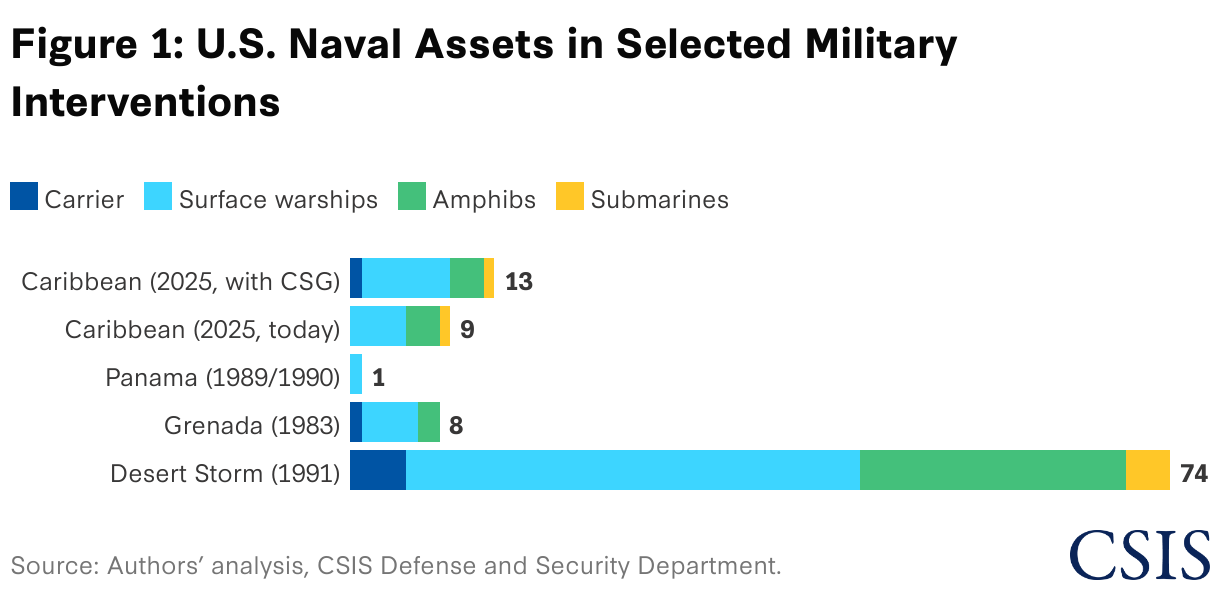
An earlier update on the Caribbean from CSIS wondered whether the forces in the region would decline, stay even, or increase. For a while it looked like they were staying even, as new arrivals replaced departing ships. Now, it looks like the naval presence is expanding.
Moving such a major element of U.S. combat power is highly significant because of the strategic trade-off it represents. The Navy has only 11 aircraft carriers. In general, only three are at sea at any one time because of the need for maintenance and training. All the regional commanders want them. U.S. Indo-Pacific Command always wants one—as a supplement to the carrier permanently stationed in Japan to counter the Chinese navy and conduct exercises with regional allies and partners. Central Command wants one for the Indian Ocean for use against Iran and the Houthis or in the Eastern Mediterranean to provide air defense for Israel. European Command wants one for operations around Europe to deter Russia. By contrast, the Caribbean has been a low-visibility region for decades, with carriers rarely visiting.
The administration attributes the aircraft carrier’s deployment to the counterdrug mission, and a few of its wide range of capabilities can help with ongoing operations. Overall, however, carriers are poorly suited for the surveillance tasks entailed with stopping drug smugglers. On the other hand, they are superbly suited for conducting air attacks and supporting amphibious landings.
Carriers are immensely powerful because of their air wing. Their striking power comes primarily from the fighter/attack aircraft, typically 24 F/A-18E/Fs and 24 F-35Cs. However, these aircraft are not well suited for counterdrug search because they move too fast. In addition to the fighters, carriers have support aircraft like E-2Ds for aerial surveillance (four, typically) and SH-60R/S helicopters (19) for antisubmarine warfare. The helicopters could help with search and can fire antiship missiles, like Penguins, which are designed to attack fast boats.
Three destroyers will reportedly escort the USS General R. Ford to the Caribbean. (Five deployed with the Ford to the Mediterranean, but two are apparently remaining in the European theater.) Each destroyer has one SH-60R helicopter for antisubmarine warfare, which could help with the search.
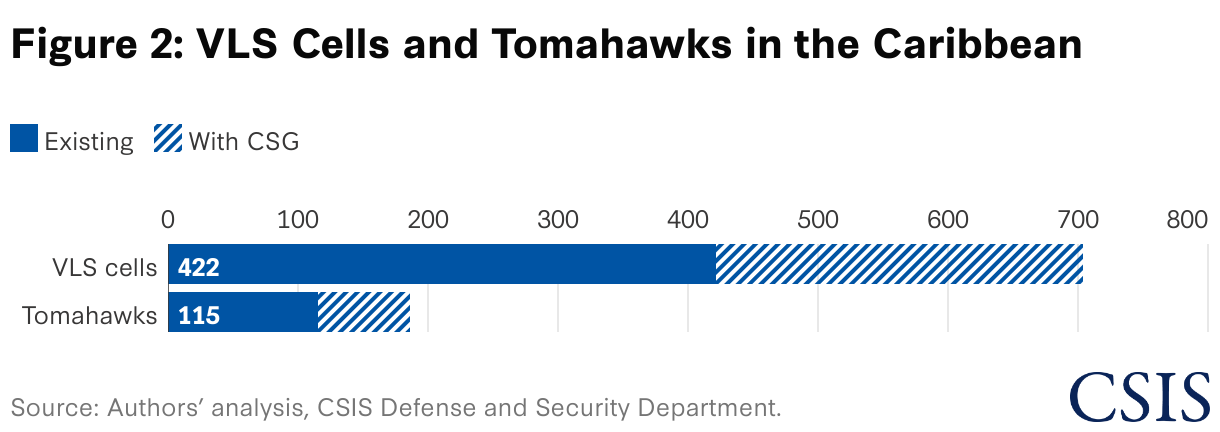
With the addition of these three ships, U.S. naval forces in the region will have over 700 Vertical Launch System (VLS) cells. Those launchers carry a variety of missiles, including Tomahawk missiles for land attack, SM-2/SM-6 missiles for air defense, and SM-3 for ballistic missile defense. With an average loadout across the force of 25 percent land attack missiles, roughly 180 Tomahawks would be available for strikes against the Maduro regime or cartel facilities.
The Ford is currently in the Mediterranean and will take about 10 days to get to the Caribbean (at 20 kts speed of advance), so nothing is imminent. However, it is such a scarce and powerful warfighting resource that the Pentagon will be reluctant to keep it on station for an extended period. Other world events will spring up, and regional commanders clamor for the CSG’s presence. For U.S. Southern Command (SOUTHCOM)’s regional commander, it’s a use or lose asset: strike or give it up.
Redeployment of the Ford has not been the only recent event. Three others—the establishment of a new headquarters, the intensification of interdiction, and an expansion to the Pacific—signal a broadening campaign and possibly operations ashore.
- New Headquarters: On October 10, the Department of Defense established a new headquarters around II Marine Expeditionary Force at Camp Lejeune, NC. The stated purpose is “to synchronize and augment counter-narcotics efforts across the Western Hemisphere.” Previous CSIS analysis on this headquarters noted its distinct mission from the law enforcement–focused Joint Interagency Task Force-South.
Unclear is why a new headquarters was needed. Operations to date may have strained SOUTHCOM, a smaller headquarters unaccustomed to managing large operations. Establishing a joint task force is common in these situations. On the other hand, it may signal an expansion of operations.
Although the headquarters will be built around a Marine Corps nucleus, it will include staff members from other services and—in this case—representatives from other government agencies. Nevertheless, choosing a Marine Corps nucleus may be significant. If the administration’s anticipated military campaign will focus on naval interdiction, it would make more sense to establish the headquarters at a Navy base, for example, in Jacksonville, FL. If the focus will be an air campaign, it would make sense to establish it at an Air Force base in Florida, such as Tyndall or Homestead. A lead Marine Corps role implies an amphibious operation, not counterdrug. - Intensification of interdiction: Earlier CSIS analysis anticipated a continuing interdiction campaign, and that has occurred. Significantly, that campaign has intensified. As data from the Washington Postshows, there were three interdictions in September, two in the first two weeks of October, and four in the 10 days between October 15 and October 25.
- Expansion to the Pacific: Two interceptions have now occurred in the Pacific, which is unsurprising since many drug trade analyses show smuggling routes to the United States pass through it. It is unclear how the United States is conducting these Pacific interceptions. There are no major surface groups in the area, and it is far from deployed special operations forces. The primary military asset may be the P-8 maritime patrol aircraft. It has a long patrol range, ocean-search sensors, and antiship attack capabilities.
The movement of an aircraft carrier into the Caribbean is one of two indicators that CSIS has previously flagged for attack and invasion. The other is the establishment of tent cities in Puerto Rico, which would indicate preparations for a major troop movement into the region. So far, the latter has not happened. U.S. forces are increasingly well positioned to conduct an air campaign against either the cartels or Venezuela—but they do not yet have the combat power for a ground invasion.
Mark F. Cancian (Colonel, U.S. Marine Corps Reserve, ret.) is a senior adviser with the Defense and Security Department at the Center for Strategic and International Studies in Washington, D.C. Chris H. Park is a research associate for the Arleigh A. Burke Chair at CSIS.