Ukraine Has Problems With Both Koreas? | The Capital Cable #144
October 15, 2026 • 9:30 – 10:15 am EDT
Hosted by Korea Chair

Photo: J Studios/Getty Images
Trustee Chair in Chinese Business and Economics > Trustee China Hand
In December 2020, the Trustee Chair published the first iteration of “Not Number One,” which provided global rankings of the United States and China covering a wide array of metrics, including the military, the macroeconomy, health, quality of life, technology, social stratification, and other issues. The conclusion was clear: While the United States and China are widely assumed to be engaged in a battle of the best, across most indicators—especially those pertaining to the quality of life—neither country were anywhere near number one.
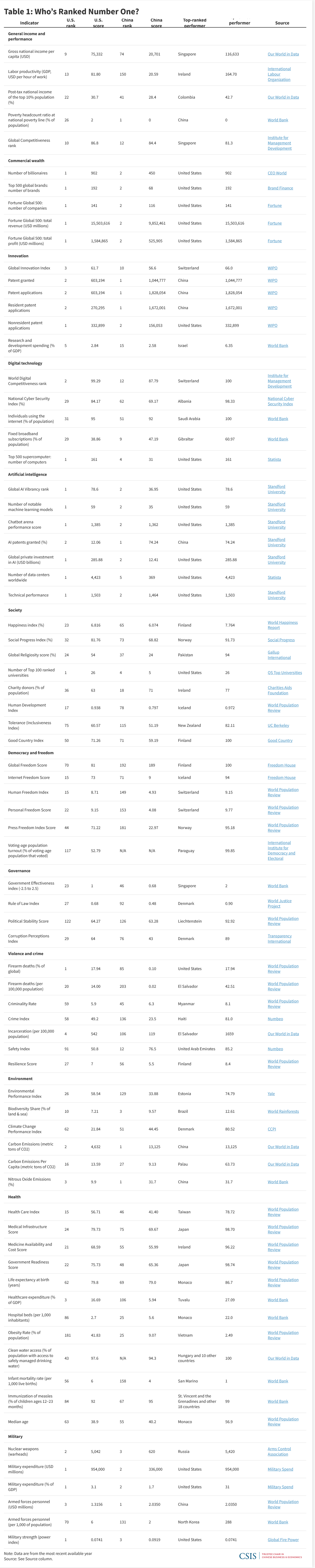
Nearly six years later, the Trustee Chair has updated the analysis to see if any of the tables have turned. Spoiler alert: They have not, as summarized in Table 1.
The United States still leads the globe in military spending and commercial wealth, with a $954 billion defense budget and 902 billionaires. It is also the unenviable leader in firearm deaths, accounting for 17.9 percent of the world’s annual total. Meanwhile, China takes the cake for patent applications and patents granted, filing over a million more than any other nation. China also holds lowest poverty headcount ratio, having claimed “complete victory” over poverty in 2021. As a reminder, China’s national poverty line, established in 2011, is roughly $340 (¥2,300) per year, which equates to $0.93 (¥6.3) per day. In tier 1 cities this tends to support no more than a packet of instant noodles or bag of chips, if that.
Understandably, none of this cashes out for everyday well-being. For the average person, a defense budget does not lower a hospital bill, and a patent portfolio does not put dinner on the table. Simply put, when it comes to measuring a society’s happiness, social progress, and freedom, both nations are caught lacking.
The United Nations has created the Human Development Index “to assess countries’ development based on life expectancy, education, and gross national income per capita.” The index ranks the United States 17th and China 78th, both nations punching well below their economic weight and outranked by less-powerful countries such as Iceland and Sweden.
Moreover, since the last edition in 2020, the United States and China have gotten worse in the eyes of the Good Country Index, which measures “what each country on earth contributes to the common good of humanity, and what it takes away, relative to its size.” The United States now ranks 50th and China 71st, down from 40th and 61st, respectively. This means that relative to their size and resources, the world’s two most powerful nations give less to humanity than they take; both perform especially poorly concerning contributions to global culture and prosperity and equality.
In terms of Social Progress Index, the United States has fallen from 18th place to 32nd, while China has risen from 86th to 73rd. From a pure numbers standpoint, fourteen places lost for one and thirteen gained for the other reflects an evident image of decline and ascent.
This pattern repeats for quality-of-life measures. The 2026 World Happiness Report ranks the United States 23rd (declining from 18th in 2025) and China 65th (climbing from 94th). At present, Finland remains joyfully in first, where it has sat for the past nine years.
The U.S.’s downward trend continues for measures of freedom. While it is evident that American advantage is real, it is also shrinking. Freedom House’s Global Freedom Index dropped the United States from 52nd to 70th, keeping it well behind the Nordic bloc that anchors the top of the table.
Likewise, on Freedom House’s Internet Freedom Score, the U.S. has slipped from 5th to 15th. On metrics of democracy that America once used to define itself against its rivals, its rankings are headed in the wrong direction.
Understandably, it is needless to keep going for one to get the point. Although the rankings have shifted by a few places in either direction, the underlying truth holds: On issues pertaining to governance, society, and human development, both the United States and China remain neatly positioned in the middle of the pack, or worse.
While these indicators are only part of the picture, what remains significant about the data is not just that each country lags, but also that competition between both nations is almost entirely absent. Neither Washington nor Beijing sufficiently treats tolerance, environmental performance, or life expectancy as a matter of national prestige. Nations such as New Zealand, Estonia, and Monaco, on the other hand, pride themselves on precisely that.
In other words, the rivalry between the United States and China is typically framed in a highly selective way. It is intense where indicators translate into power and largely absent where they translate into welfare.
That said, one arena has become blazingly hot: artificial intelligence, the field where both countries are most actively striving to be the global leader. The landscape is complex and ever-changing, with new frontier models emerging from both sides and export controls rushing to tighten around them daily. The landscape is complex and ever-changing, with new frontier models emerging from both sides and export controls rushing to tighten around them daily.
To encapsulate just how fast things can change, Stanford University reported that “in 2024, U.S.-based institutions produced 40 notable AI models, significantly outpacing China’s 15 and Europe’s three.” After a mere 2 years, Stanford’s 2026 AI Index puts the performance gap between the top American and Chinese models at 2.7 percent.
Washington has also grown concerned about the near-overnight arrival of Kimi K3. Released by Beijing-based Moonshot AI in July 2026, K3 is the most capable open-weight Chinese model. Notably, it reportedly runs at a fraction of the cost of its U.S. counterparts.
Ultimately, it is too early to say who will come out on top. “The AI race is many marathons, not one sprint”; and while the United States seems confident in its lead—particularly with regard to computing power—China is heavily focused on diffusion and adoption across its economy.
Overall, winning the AI race may carry major consequences in itself: The victor may capture outsized economic gains and set standards for the rest of the world to follow. That having been said, true global leadership consists of responsibility alongside advantage. It is with that in mind that we should look beyond first place; the real winner should not be who tops the leaderboard, but who uses AI to move the needle on some of the other metrics highlighted in this analysis, including education, health, and the environment.
For the full in Flourish version and a PDF copy.
Related Trustee Chair Activity
Ryan Featherston, “Location Is Everything: The Promises and Limits of China’s Development Zones,” CSIS, Trustee China Hand (blog), June 2, 2026, Location Is Everything: The Promises and Limits of China’s Development Zones | Trustee China Hand | CSIS.
Qin (Maya) Mei, “Why China’s Long-Awaited “Revenge Spending” Boom Has Not Arrived,” CSIS, Trustee China Hand, June 1, 2023, Why China’s Long-Awaited “Revenge Spending” Boom Has Not Arrived | Trustee China Hand | CSIS.
Scott Kennedy, “Pursuing Strategic Competition: Relative Competitive Position Matters,” CSIS, Trustee China Hand (blog), May 31, 2023, Pursuing Strategic Competition: Relative Competitive Position Matters | Trustee China Hand | CSIS.
Shining Tan, Michael Zhang, Qihan Zou, and Scott Kennedy, “The US and China: Not Number One,” CSIS, Trustee China Hand (blog), December 21, 2020, The US and China: Not Number One | Trustee China Hand | CSIS.