Civil Society Perspectives on Lebanon’s Reform Agenda
October 28, 2026 • 9:00 – 10:00 am EDT
Hosted by Middle East Program

Photo: Chip Somodevilla/Getty Images
The U.S. Department of Defense (DOD) and the rest of the federal government are currently operating under a continuing resolution (CR) through December 11 to start fiscal year (FY) 2027. With Congress punting on taking action on full-year appropriations and reconciliation in response to the Trump administration’s $1.5 trillion budget request, the outcome of the midterm elections will have a significant impact on both the level of defense funding legislators ultimately provide and the time frame for doing so.
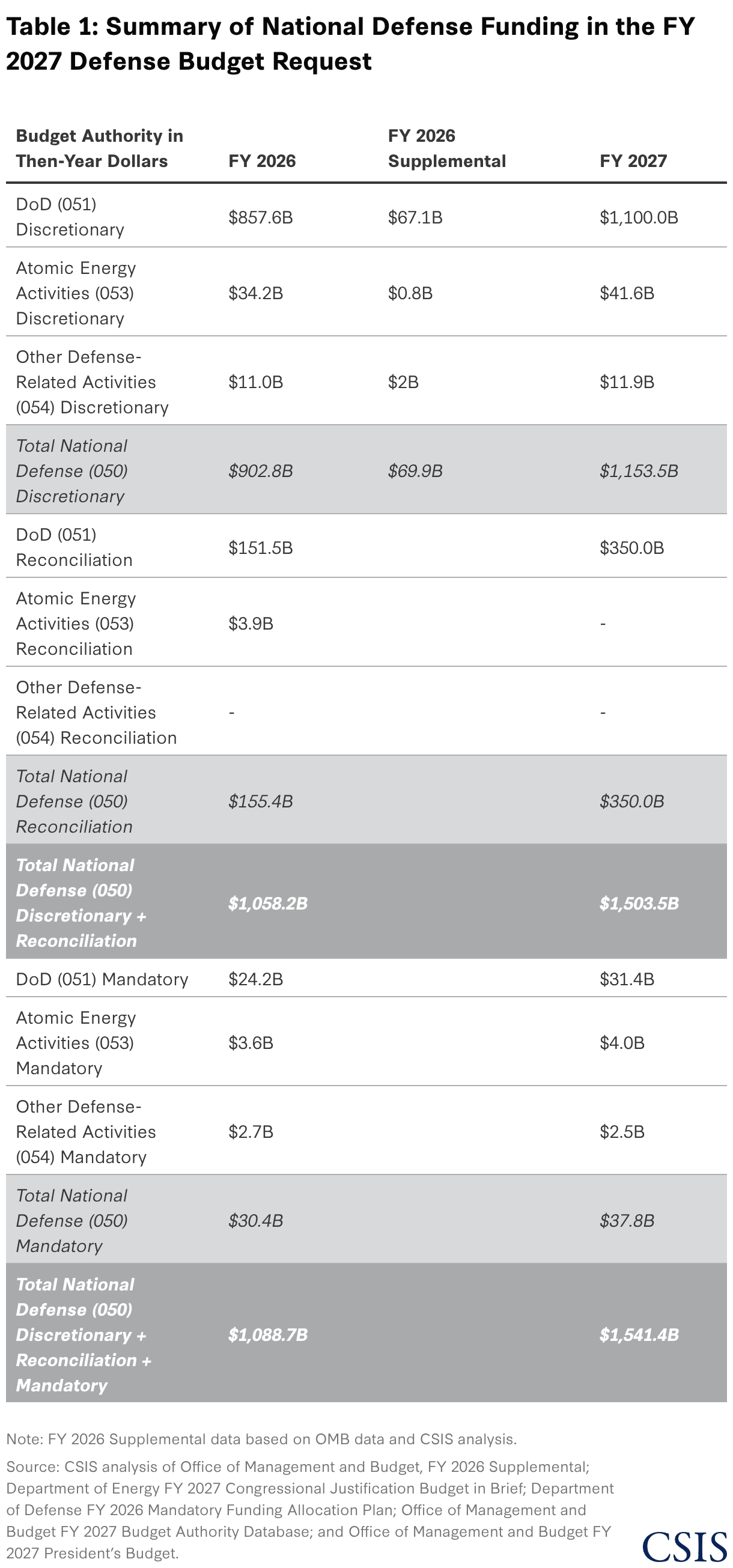
For national defense in FY 2027, the Trump administration requested $1.15 trillion in base discretionary appropriations plus an additional $350 billion in reconciliation funding, as Table 1 shows. In June, the administration submitted a supplemental request for nearly $70 billion to cover some of the costs of the war with Iran and other defense activities.
Following the November 3 elections, lawmakers must decide how they will fund the government by the expiration of the current CR in December—either by passing full-year appropriations or punting again with another CR—and whether to attempt passing reconciliation or supplemental appropriations during the lame-duck session. The decisions made by legislators in both parties will be shaped not only by the election results and control of the House and Senate in the next Congress, but also by the relatively few remaining days in session for the two chambers (22 days scheduled in the Senate and 20 days in the House). The analysis below explores the factors that may influence FY 2027 defense funding legislation after the midterms.
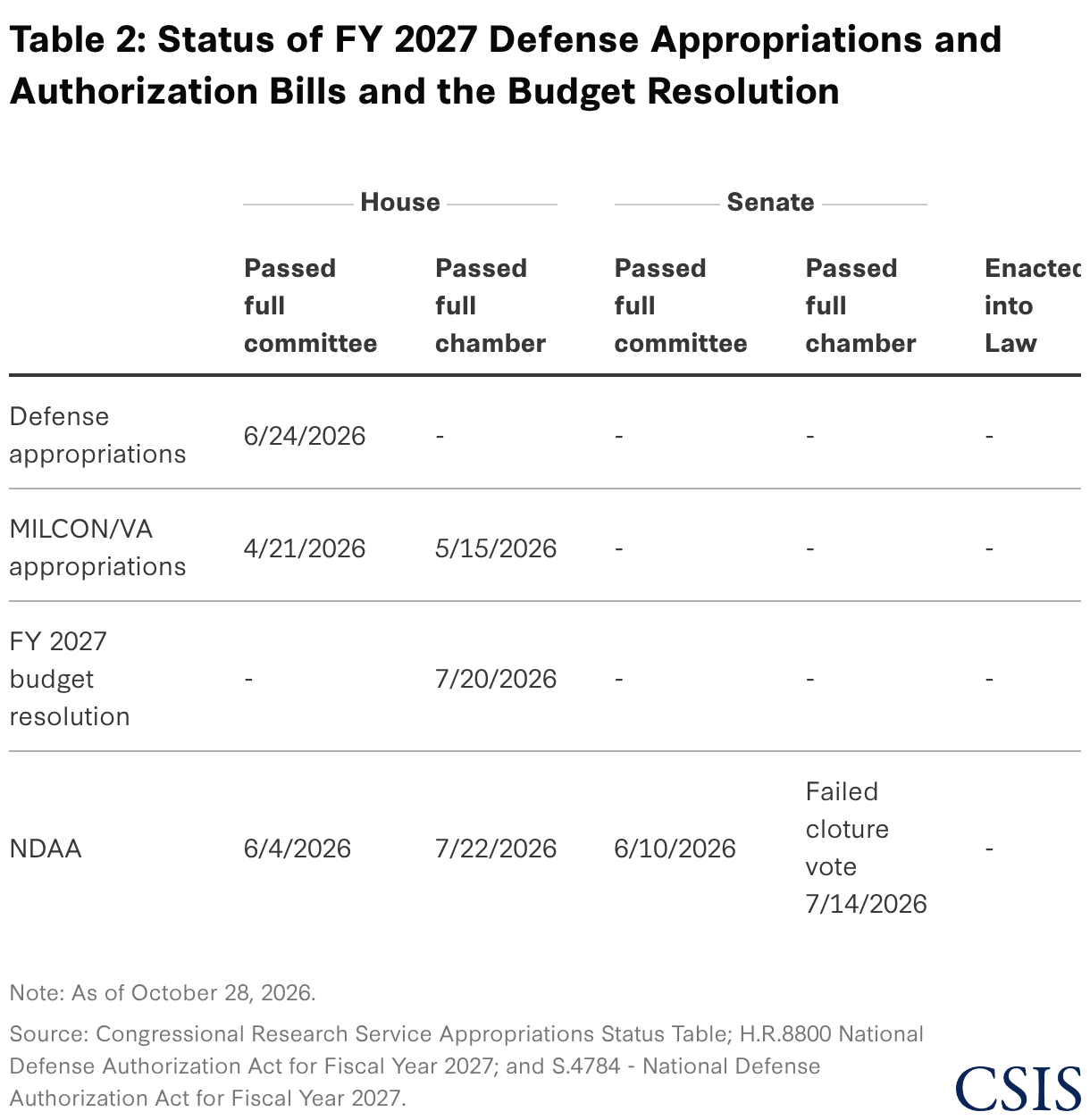
Lawmakers in both chambers still have considerable work to do to pass regular appropriations for FY 2027. As Table 2 shows, in the House, the Military Construction (MILCON)/Veterans Affairs (VA) appropriations bill (H.R. 8469) has passed, while the defense appropriations bill (H.R. 9495) must still pass the full chamber after being reported out of committee. Neither bill has been passed by the Senate Appropriations Committee.
With limited days in session before Congress adjourns, passing full-year appropriations by the expiration of the current CR will be challenging. Moreover, if Democrats take control of one or both chambers, they may be incentivized to wait to negotiate FY 2027 funding levels until the new Congress is seated. Passing a CR that extends into the new calendar year could provide them with more leverage in budget negotiations to secure funding for nondefense priorities.
During the last three midterm election years (2014, 2018, and 2022), full-year defense appropriations for the relevant fiscal years (FY 2015, FY 2019, and FY 2023) were passed prior to the end of the respective calendar year and the adjournment of each respective Congress—despite control of one chamber flipping in each instance. Defense appropriations for FY 2015 and FY 2023 were passed during the lame-duck sessions after the elections, while FY 2019 appropriations were enacted in September prior to the start of the fiscal year.
However, the relatively few remaining days in session coupled with the Trump administration’s budget request to increase defense spending through reconciliation while cutting nondefense spending—as well as its “pocket rescission” in September—will likely push Democrats to seek greater leverage in FY 2027 funding negotiations in the next Congress. Pushing government funding decisions into the new year could intertwine appropriations with negotiations over the debt ceiling, with projections estimating the debt could reach the limit in early- to mid-2027—although some Democrats and Republicans have suggested they may address the issue in the lame-duck session.
Beyond the political dimension of the midterms, uncertainty over the fate—and overall amount—of defense funding in a reconciliation bill could also influence full-year appropriations. If Republicans do not pass a reconciliation bill or provide funding significantly below the requested $350 billion level (see below), lawmakers may seek to adjust the topline in the full-year appropriations and incorporate reconciliation priorities in the annual funding bills. The defense appropriations bill under consideration in the House has a topline of approximately $1.072 trillion that is in line with the administration’s FY 2027 discretionary request, while funding for MILCON and family housing is approximately $9 billion below the requested level. Adding reconciliation priorities to the appropriations bills would require additional time and negotiations between both parties.
Significant uncertainty surrounds the fate of reconciliation after the midterms. If Democrats flip one or both chambers, the lame-duck session will likely be the last opportunity for Republicans to pass reconciliation legislation, and the party could be motivated to take action to pass additional defense funding.
For that to happen, lawmakers in both chambers must first agree to a budget resolution for FY 2027. The House passed its version of the budget resolution (H. Con. Res. 113) in July, but the Senate punted on voting on its version. The relatively few days in session could pose a challenge to passing a reconciliation bill, as Congress must compile and consider the bill after a budget resolution is adopted. The relevant committees included in the budget resolution must develop legislation responding to the resolution’s directives. In the case of providing reconciliation defense funding, the Armed Services Committees must outline how to allocate the additional funding. The reconciliation bill must then be considered in the full chamber, have its differences resolved between the House and Senate versions, and be enacted into law.
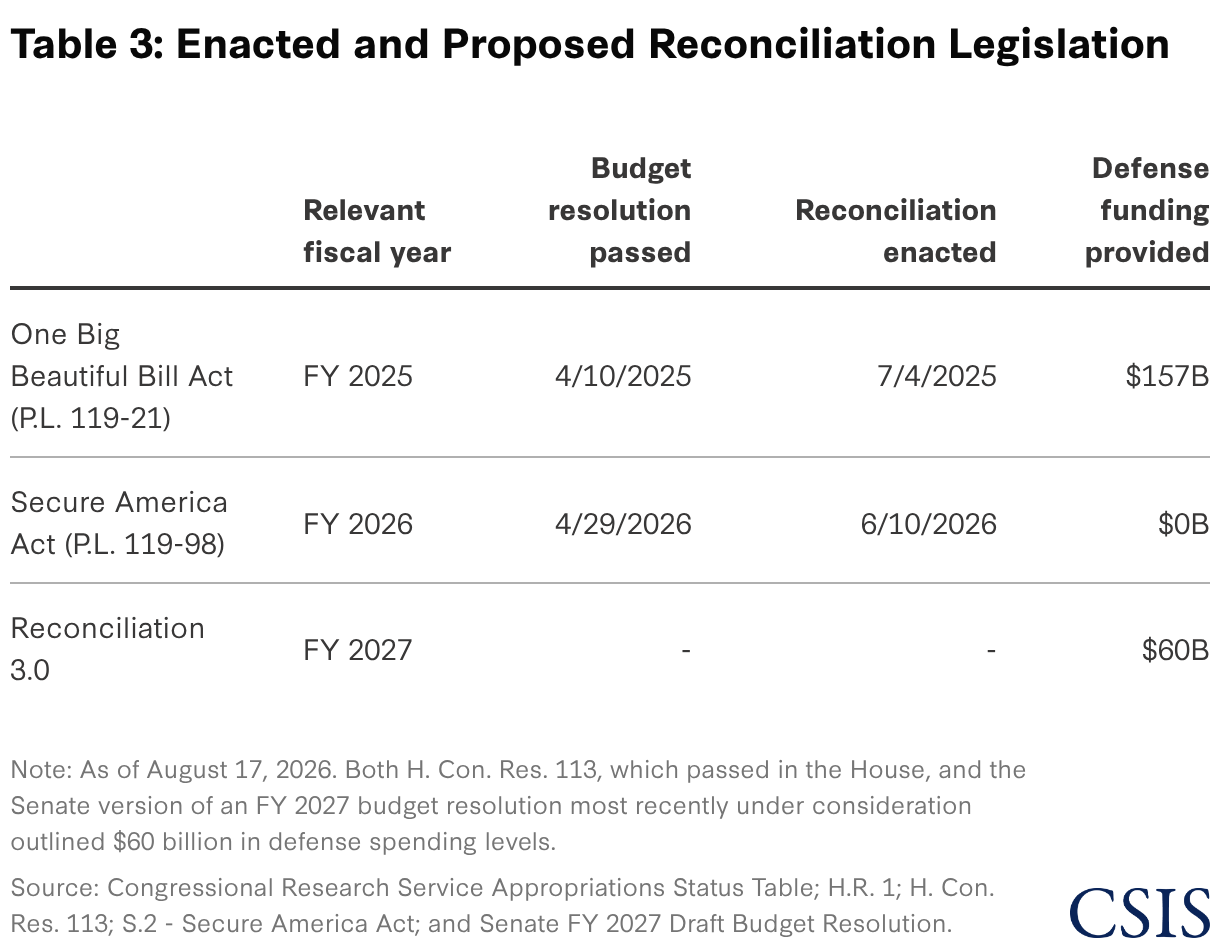
For the first reconciliation bill passed during the Trump administration, the One Big Beautiful Bill Act (P.L. 119-21), 85 days elapsed between the adoption of the FY 2025 budget resolution on April 10, 2025, and the date the reconciliation bill was signed into law on July 4, 2025. For the second reconciliation bill, the Secure America Act (P.L. 119-98), 42 days passed between the adoption of the FY 2026 budget resolution and the signing of the reconciliation bill.
However, passing another reconciliation bill could face challenges within the Republican Party beyond the short post-midterm schedule, and any legislation could fall well short of the Trump administration’s $350 billion request. Senate Majority Leader John Thune (R-SD) has expressed that securing the votes—with Republicans holding only slim majorities in both chambers—to pass reconciliation after the midterms would be “difficult.” Some Republican fiscal hawks want offsettingcuts in exchange for additional spending increases, and adding a debt limit increase to reconciliation legislation, as some in the party have suggested, could engender further pushback. Other Republican lawmakers warn that the Trump administration’s post-election agenda, including reconciliation, could face opposition because of its actions relating to the war in Ukraine. Moreover, questions over members’ attendance after the midterms, particularly those who are voted out of office, could imperil legislation.
The budget resolution that passed the House would provide only $60 billion in reconciliation funds for defense, and the Senate version would provide the same. If Republicans succeed in passing this level of funding, it would still leave programs within the administration’s $350 billion reconciliation request at risk of not being funded unless they are included in discretionary appropriations for FY 2027—which would require bipartisan negotiations and agreement.
The Trump administration remains bullish on securing $350 billion in reconciliation funding for defense, with Secretary of Defense Pete Hegseth saying at the Association of the U.S. Army annual meeting in October that DOD is working with congressional committees “to ensure . . . that reconciliation bill at a minimum of 350 [billion dollars], potentially more.” Some Senate defense hawks are still backing the push for the entire reconciliation request as well. However, DOD Comptroller Jules Hurst stated in September that the department would work with Congress to incorporate reconciliation priorities in discretionary appropriations should lawmakers not pass the full request.
Given the short legislative timeline and other priorities for the lame-duck session, Congress is unlikely to take up the administration’s supplemental request for nearly $70 billion in national defense funding—including $67.1 billion specifically for DOD—as a separate appropriations package. However, some Republicans, including Representative Rob Wittman (R-VA), have suggested using the smaller reconciliation package of $60 billion currently in the House’s budget resolution to address the supplemental request, which called for $21 billion to accelerate munitions acquisition and expand production lines.
Congress faces a busy lame-duck session after November’s midterm elections to shape defense funding decisions. If Democrats win control of one or both chambers, lawmakers may pass another CR to fund the government and punt full-year appropriations for FY 2027 until the new Congress takes office. The relatively few remaining days in session, coupled with the lack of a unified approach within the Republican Party, pose challenges to passing another reconciliation bill that provides additional funds for defense. Should those challenges be overcome, it is more likely that Congress passes reconciliation funding closer to the $60 billion under consideration in the House’s budget resolution than the $350 billion requested by the Trump administration. Beyond those funding issues, Congress must also consider the National Defense Authorization Act for FY 2027 and a potential debt ceiling agreement, among other pieces of legislation, ensuring a packed agenda for the remainder of the 119th Congress.
Seamus P. Daniels is a fellow for Defense Budget Analysis in the Defense and Security Department at the Center for Strategic and International Studies in Washington, D.C.

Critical Questions by Seamus P. Daniels — April 10, 2026

Critical Questions by Seamus P. Daniels — August 18, 2026
