The Implications of the Hormuz Energy Crisis in China
September 1, 2026 • 9:00 – 10:00 am EDT

Photo: Kevin Dietsch/Getty Images
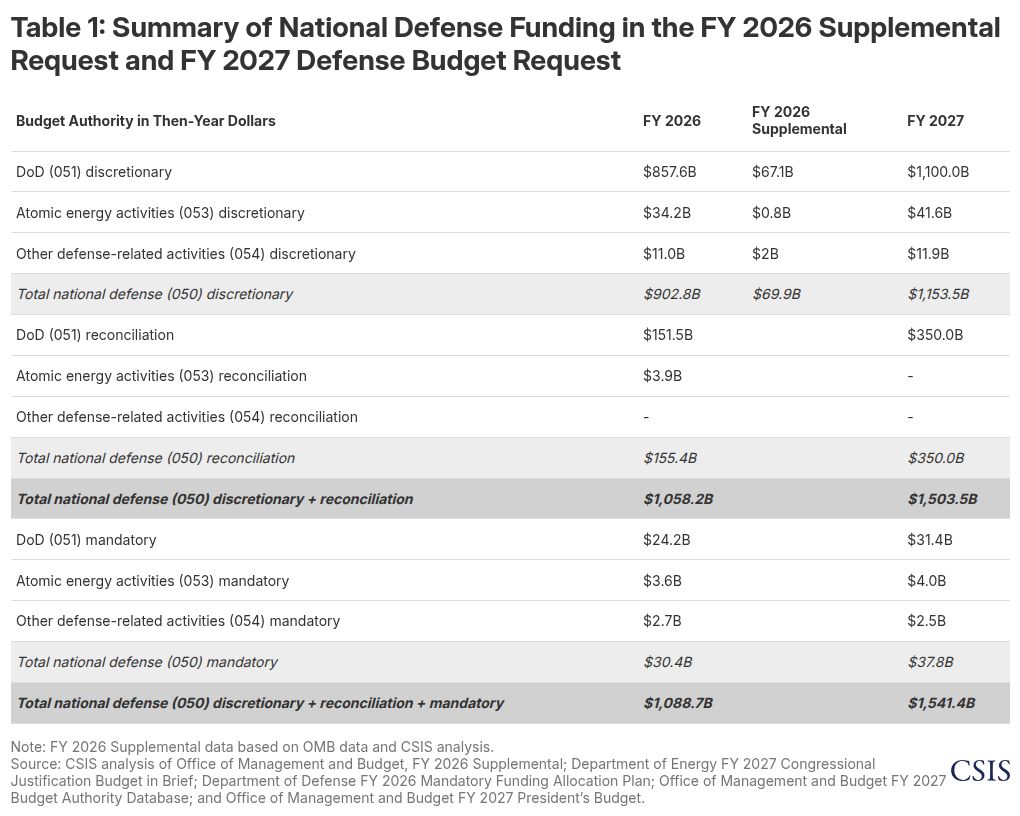
With just over one month until the October 1 start of fiscal year (FY) 2027, Congress has yet to enact legislation to fund the Trump administration’s defense budget for $1.5 trillion (see Table 1). Full-year discretionary appropriations appear unlikely to be enacted until after the beginning of December with both the House and Senate passing respective continuing resolutions (CRs), while the fate—and overall amount—of the administration’s $350 billion in requested reconciliation funding for defense looks uncertain. The White House additionally submitted a supplemental budget request in June to cover some of the costs of the war with Iran and other defense activities. Below are six questions on the status of defense funding for FY 2027.
Q1: What is the status of regular defense appropriations for FY 2027?
A1: Discretionary appropriations for the Department of Defense (DOD) are divided between two appropriations bills, the Defense appropriations bill and the Military Construction (MILCON)/Veterans Affairs (VA) appropriations bill. The former funds the vast majority of DOD activities, while the latter provides resources for the MILCON and family housing titles of DOD’s budget.
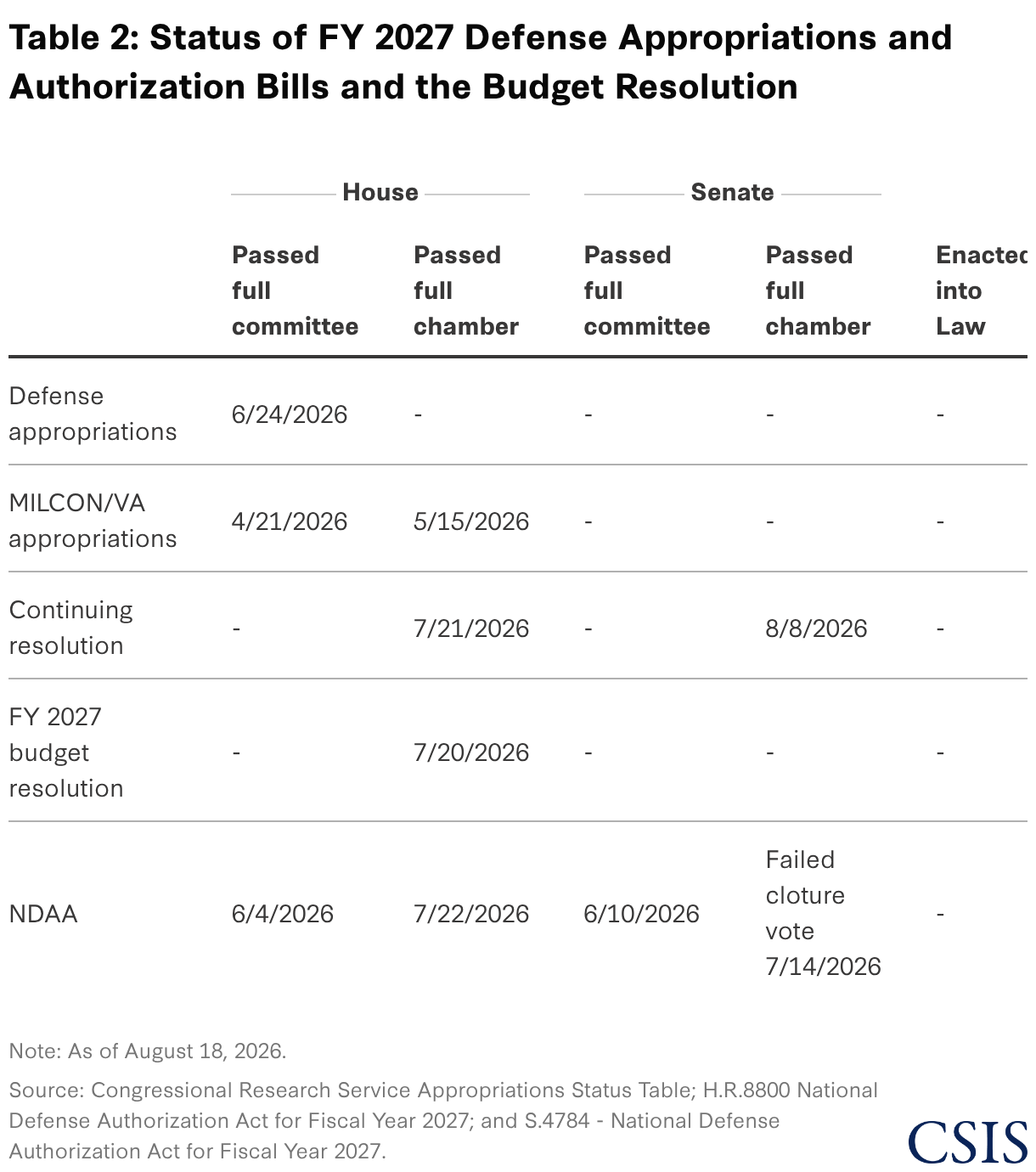
Table 2 shows the status of the appropriations bills as well as the CR, FY 2027 budget resolution, and National Defense Authorization Act (NDAA) legislation. Neither appropriations bill has been enacted into law. The House passed its version of the MILCON/VA bill (H.R. 8469) in May, and the House Appropriations Committee passed its Defense appropriations bill (H.R. 9495) in June. The House’s Defense appropriations topline of approximately $1.072 trillion is in line with the administration’s FY 2027 discretionary budget, while funding for MILCON and family housing activities falls approximately $9 billion below the requested level.
Both Senate appropriations bills have yet to be passed by the full Senate Appropriations Committee. Each chamber’s lack of progress to pass the appropriations bills has led them to consider CR legislation to provide government funding to start the fiscal year.

Q2: Will Congress pass a CR to begin FY 2027, and how long could it last?
A2: Both the House and Senate have passed respective CR bills to fund the government at FY 2026 levels to start the fiscal year. The House bill (H.R. 9970), passed on July 21, provides funding through December 4, while the Senate version (H.R. 6500), passed on August 8, extends funding levels through December 11. The House and Senate must reconcile the differences between their two bills prior to October 1 to prevent a government shutdown.
During a CR, DOD cannot fund “new start” programs or increase production rates unless Congress includes an “anomaly” in the legislation that grants an exception. Notably, the CR would only provide funding for programs that received discretionary appropriations for FY 2026—not mandatory funds provided through reconciliation under the One Big Beautiful Bill Act.
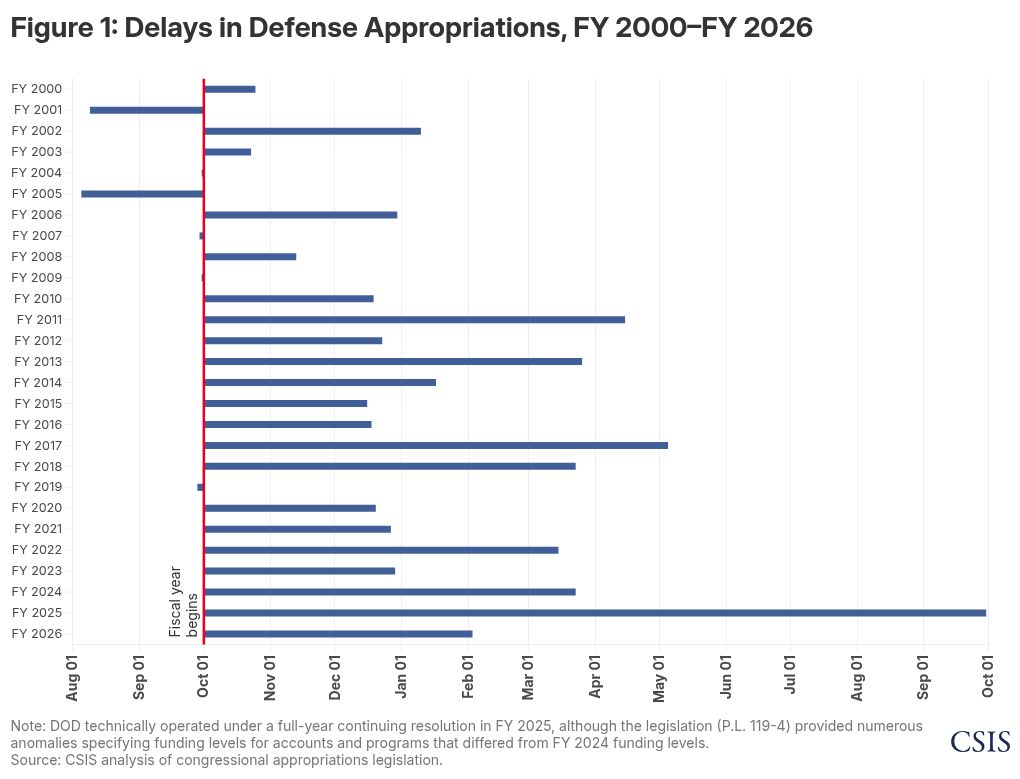
Since FY 2000, DOD has started 21 out of the 27 fiscal years under a CR or government shutdown. DOD last began a fiscal year with full-year appropriations in FY 2019. In FY 2025, DOD technically operated for the entire fiscal year under a CR—although the bill (P.L. 119-4) provided numerous anomalies that specified different funding levels from the FY 2024 funding levels.
Last fiscal year, Congress failed to pass full-year appropriations or a CR by the start of the fiscal year, leading to a government shutdown lasting 43 days, until some appropriations for FY 2026 (including MILCON/VA funding) and a CR (P.L. 119-37) was enacted on November 12, 2025. Congress passed some additional appropriations bills (P.L. 119-74) in January, but a second shutdown began on January 31 for those departments and agencies that remained unfunded (including parts of DOD) until President Trump signed full-year appropriations (P.L. 119-75) on February 3 (although the law did not provide full-year appropriations for the Department of Homeland Security).
Q3: How will Congress respond to the administration’s supplemental request for defense funds?
A3: In June, the White House submitted a supplemental funding request for $87.6 billion, including approximately $70 billion for national defense priorities. Of that, the request detailed $67.1 billion for DOD. While the transmittal letter notes that “Most of this request will address urgent needs related to Operation Epic Fury,” it also seeks funding for other priorities seemingly not directly related to the Iran war, as noted in a previous CSIS analysis of the supplemental.
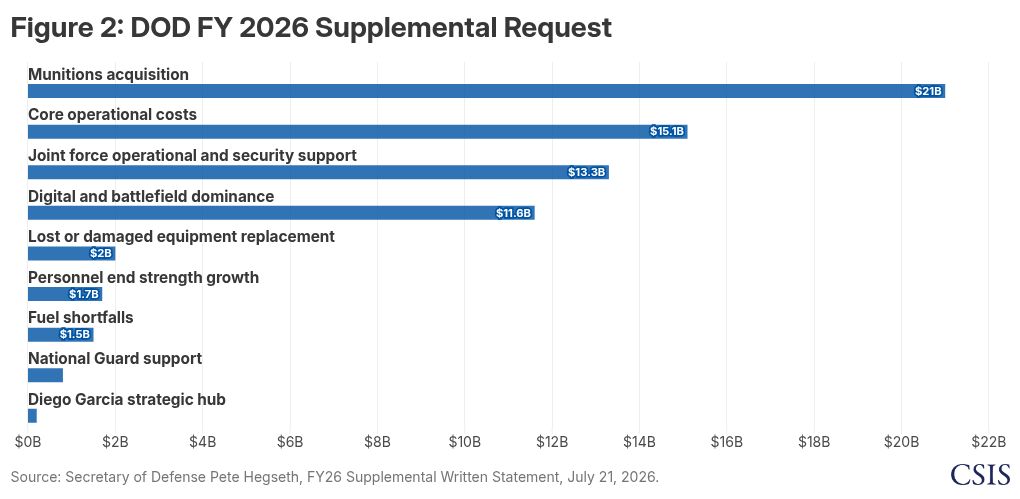
Written testimony submitted by Defense Secretary Pete Hegseth ahead of a hearing with the Senate Appropriations Committee provided further detail, as shown in Figure 2, denoting that over $17 billion would go toward core operational costs, training and readiness accounts, the cost of replacing equipment lost or damaged in combat, and other mission-related costs. Approximately $46 billion would go toward “accelerating critical capabilities,” including $21 billion to accelerate munitions acquisition and expand production lines and almost $12 billion for drones, space-based target tracking and resilient satellite networks, advanced computing, and other priorities. During the same hearing on July 21, Secretary Hegseth stated that the current cost of the war then stood at $37.5 billion.
The supplemental faces Democratic opposition over the unpopularity of the war, while Democratic senators also questioned necessity of additional defense funding while resources provided by last year’s reconciliation bill remain unobligated. Given the unlikely passage of additional appropriations in response to the June request, Republicans have sought to use reconciliation to address most of the priorities in the supplemental.
Q4: Will Congress pass a Reconciliation 3.0 bill with defense funding for FY 2027?
A4: The Trump administration requested $350 billion in reconciliation funding for DOD for FY 2027 in order to “[decouple] funding for Republican priorities from Democrat waste,” and to avoid corresponding increases for nondefense programs, according to Office of Management and Budget documents. The request followed the passage of approximately $157 billion in reconciliation funds defense in the One Big Beautiful Bill Act (P.L. 119-21) in July 2025 that are available for obligation between FY 2025 and FY 2029. While the reconciliation process allows for “fast-track consideration” of spending legislation in the Senate, requiring only a simple majority rather than the standard 60 votes—hence necessitating only Republican votes in this case in both chambers—the House and Senate must first agree on and pass a budget resolution for the relevant fiscal year.
In April, congressional Republicans passed a budget resolution for FY 2026 and, in June, subsequently passed a second reconciliation bill (P.L. 119-98) that provided $70 billion for immigration enforcement and border security—but did not provide any resources for defense.
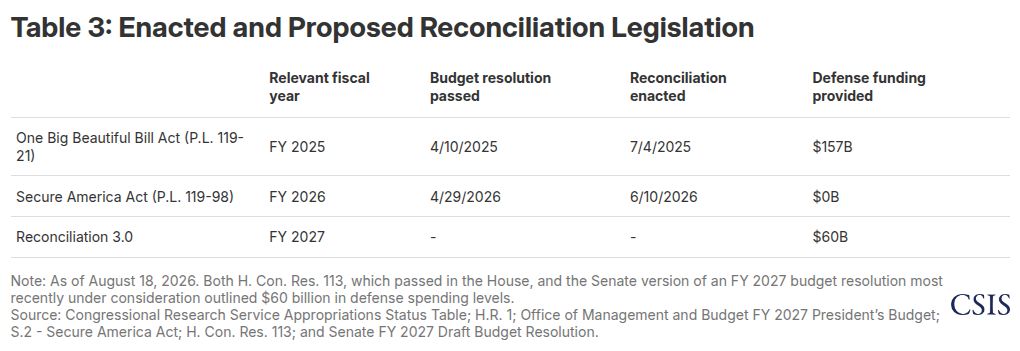
In order to provide additional defense funding in a third reconciliation bill, Republicans must first pass a budget resolution for FY 2027. The House passed its version of a budget resolution (H. Con. Res. 113) in July, which provided $60 billion in mandatory funds for defense, well below the administration’s $350 billion request, in addition to $13 billion for intelligence, $12 billion in farm aid, and $10 billion for Republican efforts to bolster stricter voter ID measures in line with the SAVE America Act.
However, the fate of Reconciliation 3.0 is uncertain following the Senate’s decision last week to punt on voting on its version of a FY 2027 budget resolution—which also included $60 billion for defense—until after the August recess. Senate Majority Leader John Thune (R-SD) and other senators have consistently expressed skepticism over attempting to pass a third reconciliation bill ahead of the midterm elections. The bill faces concerns from senators concerned over increasing Republican vulnerability prior to the elections, defense hawks pushing for defense spending funding above $60 billion, and some opposed to the voter ID measures. However, efforts to increase defense spending in a Reconciliation 3.0 bill could pose challenges from budget hawks already concerned over a lack of offsetting cuts. Moreover, the Senate faces a busy legislative schedule when it returns in September with the need to agree to a continuing resolution with the House and other votes.
Some congressional Republicans as well as the Trump administration have already raised the prospect of a Reconciliation 4.0 bill to pursue spending cuts, increase defense spending, and raise the debt ceiling following the midterms. However, if the third reconciliation bill passes, Congress would need to pass a budget resolution for FY 2028 in order to set the stage for a fourth reconciliation bill.
Q5: Which programs risk not being funded as part of DOD’s reconciliation request?
A5: The Trump administration’s decision to request $350 billion in reconciliation funding for DOD could place some programs at risk in the event that Congress does not pass another reconciliation bill or provides significantly fewer mandatory resources for defense—as evidenced by the $60 billion funding level in the current House and Senate budget resolutions for FY 2027. Legislators could still appropriate discretionary funding for programs that were included as part of DOD’s $350 billion reconciliation request; however, this would rely on bipartisan compromise between Democrats and Republicans.
The reconciliation request includes funding for several priorities for the Trump administration, as shown in Figure 3. It calls for $113 billion for investments in the defense industrial base, including over $48 billion for critical minerals. Approximately $103 billion for next-generation technology and autonomy includes funding for low-cost autonomous systems, AI, and counter-unmanned systems. The request provides $47 billion for a range of munitions. DOD also called for $36 billion for a “Warrior Ethos” category that includes investments in housing and facilities.
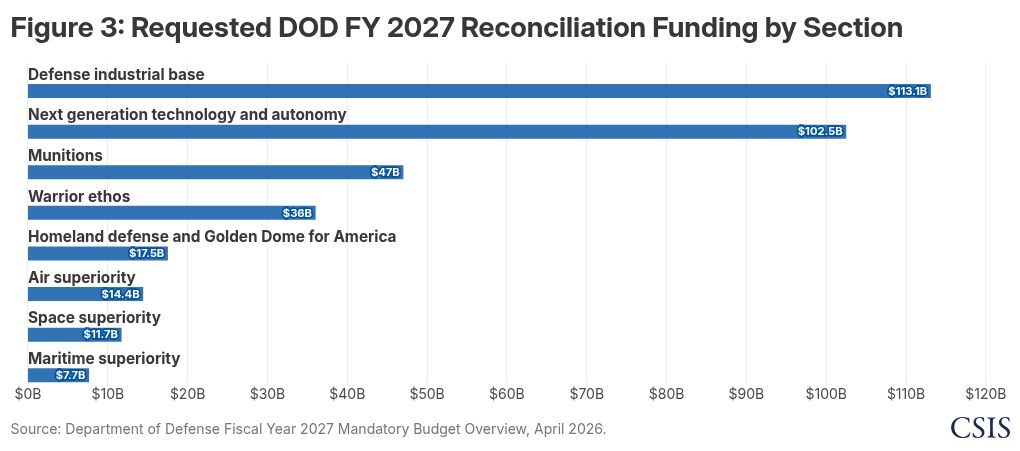
Notably, the vast majority of funding for the Golden Dome missile defense portfolio falls under the reconciliation request. DOD requested $17.1 billion of the total $17.9 billion for Golden Dome in reconciliation rather than discretionary funding. Space Force General Michael Guetlein, the direct reporting manager leading the Golden Dome effort, warned that a lack of funding in FY 2027 would prevent further development of the system.
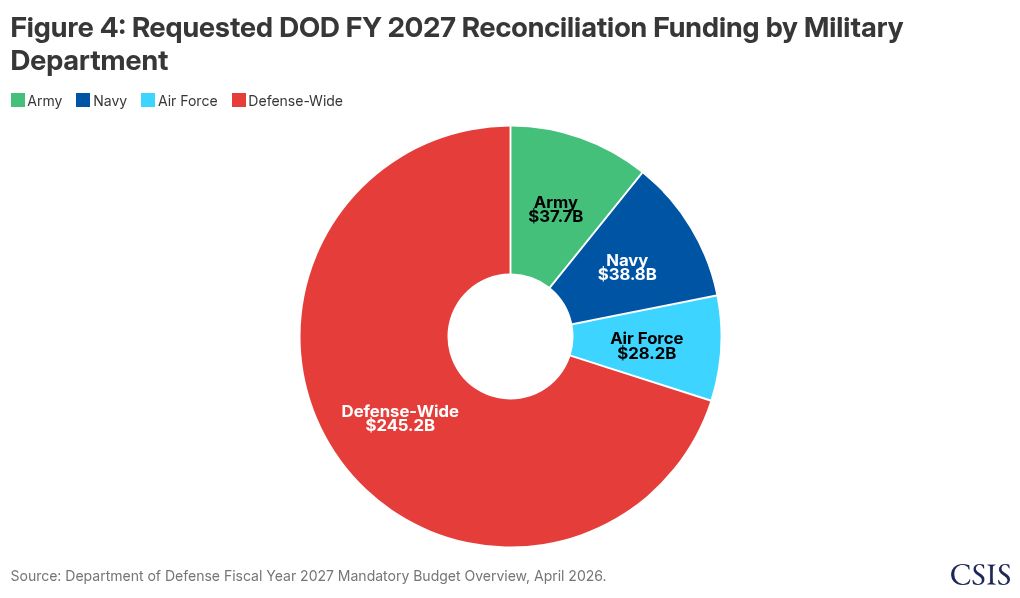
Broken down by military department, as shown in Figure 4, approximately 70 percent of the total reconciliation request would go to defense-wide accounts, including the entirety of funding for the defense industrial base, next-generation technology and autonomy, and homeland defense and Golden Dome for America categories. The Navy and Army requests account for approximately 11 percent each while the Air Force would receive approximately 8 percent of the requested reconciliation funds. This “concentration” of resources in defense-wide funding lines managed by the Office of the Secretary of Defense (OSD)—with limited information on the activities that funding will support in public budget justification materials—provides OSD with significant flexibility, but limits the ability of Congress to conduct oversight.
Q6: What is the status of the FY 2027 NDAA?
A6: While the NDAA does not actually provide funding for defense activities and merely “implies a level of funding,” it still significantly sets policies and imposes restrictions on the execution of DOD’s budget and programs. The House version of the NDAA (H.R. 8800) was passed by the House Armed Services Committee in June and then approved by the entire chamber on July 26 in a 216–212 vote. The bill authorizes $1.15 trillion in discretionary national defense funding in line with the Trump administration’s budget request.
The Senate version similarly authorized $1.14 trillion in discretionary funding for activities within its jurisdiction in its version (S. 4784). The Senate Armed Services Committee passed the bill in June, but a cloture vote in the full chamber failed (50–46) on July 14. Democrats blocked the bill from moving to the Senate floor over their opposition to the Iran war and concerns about the size of the defense budget topline while the administration has proposed cuts to nondefense programs.
Seamus P. Daniels is a fellow for Defense Budget Analysis in the Defense and Security Department at the Center for Strategic and International Studies (CSIS) in Washington, D.C.
