Without Parallel: North Korean Human Rights and the Russia Axis
October 14, 2026 • 9:15 – 11:00 am EDT
Hosted by Korea Chair

Photo: Giuseppe Cacace/AFP/Getty Images; AFP/Getty Images
Part of the Middle East Program’s Middle East Futures Project, this Commentary series will analyze the Middle East’s current period of disequilibrium, explore future scenarios for the region, and identify potential pathways forward.
The old is dying and the new cannot be born; in this interregnum a great variety of morbid symptoms appear. –Antonio Gramsci, Italian philosopher, 1930
The Middle East is at a “hinge moment.” It is entering a period of disequilibrium with the old order collapsing and a new one yet to emerge. The Iran war is the most consequential development in this chaotic interregnum, and its outcome will be definitive for the region. But for now, the region remains mired in enormous uncertainty. As regional and external stakeholders compete to shape the contours of an emerging Middle East order, this “messy middle” era could evolve along several trajectories, yielding not one, but many potential Middle East futures. For the United States and the region, a dual challenge defines this period of transformative change: navigating the inherent peril in this flux, while also anticipating—or, even better, creating—opportunities for a stable and prosperous Middle East to emerge.
Well before the outbreak of the Iran war, the Middle East had entered a period of disruption—a break with the decades-old order dominated by the United States. This dissolution began gradually, starting around 2019, then accelerated after the October 7, 2023, Hamas attack on Israel and the ensuing conflict in Gaza.
In hindsight, the U.S. nonresponse to the September 2019 Iran-backed Houthi attack on Saudi Aramco oil facilities at Abqaiq and Khurais—which temporarily knocked out nearly half of Saudi oil production and 5 percent of global supply—marked a watershed for the region and a prelude to an unraveling order. In the aftermath of the attack, Gulf leaders began to take stock of U.S. reliability and reassess how best to address the Iranian threat. The United States appeared bent on confrontation with Iran. It placed the Gulf squarely in Iran’s crosshairs, without stepping up to defend it when Iran inevitably lashed out. Marking a distinct regional shift on Iran, a Chinese-brokered (but region-led) process of détente with Iran culminated in a March 2023 Saudi Arabia-Iran normalization agreement. The United States was conspicuously absent.
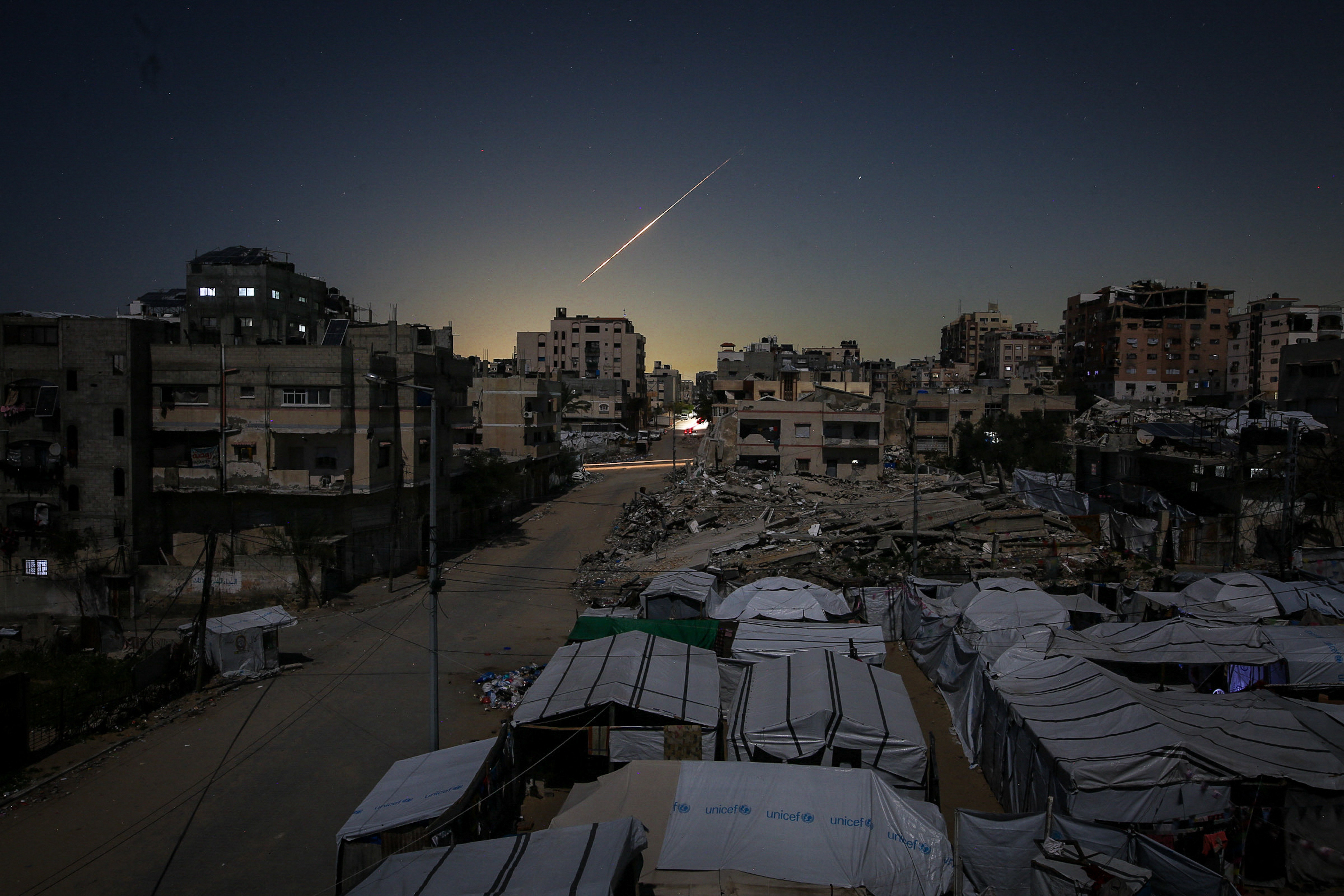
Iranian rockets heading toward Israel cross the sky over Gaza City on March 3, 2026.
Photo: Saeed Jaras / Middle East Images / AFP via Getty Images
Hamas’s October 7 terror attack on Israel and the resulting Gaza war marked another turning point in the region’s spiral. The Gaza conflict has served as a crucible for the emerging Middle East. Its many reverberations—the Assad regime collapse in Syria, the degradation of the Lebanese terrorist group Hezbollah, the growing prominence of Yemen’s Houthi militia, and the Rubicon-crossing direct military confrontation between Israel and Iran—have forged some of the region’s most significant transformations.
Just a few days after the October 7 attack that killed 1,200 Israelis—the largest number of Jews killed in a single day since the Holocaust—Israeli Prime Minister Netanyahu vowed to “change the Middle East.” Israel was subject to attacks from Hezbollah in the north and sporadic rocket volleys from the east launched by Iran-backed groups in Syria. In response, Israel embarked on a military strategy anchored in the principle of preemption at all costs. The doctrine aims to ensure that threats beyond Israel’s borders never materialize into a repeat of an October 7–style attack inside Israel. This aggressive posturing has led to Israeli incursions and occupation of portions of both Lebanon and Syria.
Against this backdrop, the Iran war stands as the most significant example of the region’s dissolving order. The conflict is already redefining the region’s power dynamics, its geoeconomics, and its military and security arrangements.
In the war’s opening days, Iran deployed an escalation strategy—powered by drones and missiles—that led to its de facto control over the Strait of Hormuz. Tehran’s disruption of the strategic chokepoint has translated into a source of deterrence, leverage, and power projection that it is unlikely to relinquish. This disruption has in turn spurred various workarounds. Vulnerable countries are pursuing multiple plans for new pipelines and energy corridors, potentially reconfiguring the region’s energy and economic ties. Meanwhile, the question of nuclear ambitions stands unresolved: Tehran could yet seek to build a nuclear weapon—a development that could provoke a wave of proliferation across the Middle East.
Prior to the Iran war, the Gulf was emerging as the center of gravity in the Middle East’s turbulent churn. The region’s massive wealth; diversifying economies, including nascent AI sectors; and influential mediation prowess positioned it to play an outsized role in shaping the new Middle East. Now, in the face of a war they counseled against, the Gulf states find themselves in a nightmare scenario. Vulnerabilities and war damage vary significantly across the Gulf, but all the states in the region have staked their futures on economic diversification and regional and global economic connectivity that demands stability. The Iran war has shattered that vision, as well as any shred of trust between the Islamic Republic and its Arab neighbors.
The conflict has also prompted Gulf countries to accelerate a push to diversify security partners and develop new relationships. While the United States will remain a key partner for the region, its reliability as a security guarantor has come under increased scrutiny. The future of a vast network of U.S. bases and military installations is now uncertain as both U.S. and Gulf stakeholders contemplate their future viability, albeit for different reasons. Meanwhile, countries such as Saudi Arabia are developing new security arrangements, including the Mecca Joint Defense Agreement, which groups Saudi Arabia, Pakistan, and Turkey, and a Saudi-led Red Sea maritime security coalition comprised of 15 countries, including several African states.
The Iran war is also reshaping the region’s geoeconomics. Hormuz’s closure has prompted Gulf countries to create bypasses, via both existing and new energy and economic corridors. Saudi Arabia has turned to its East-West pipeline and Red Sea transport as a key alternative, while the United Arab Emirates (UAE) has vowed to diminish entirely its use of the strait. Syria is poised to be a critical connector between the Gulf and Europe, with new pipelines and transportation corridors envisioned while existing infrastructure is refurbished. For example, Iraq has pivoted to transporting oil overland via Syria as well as repairing existing pipelines to the west.
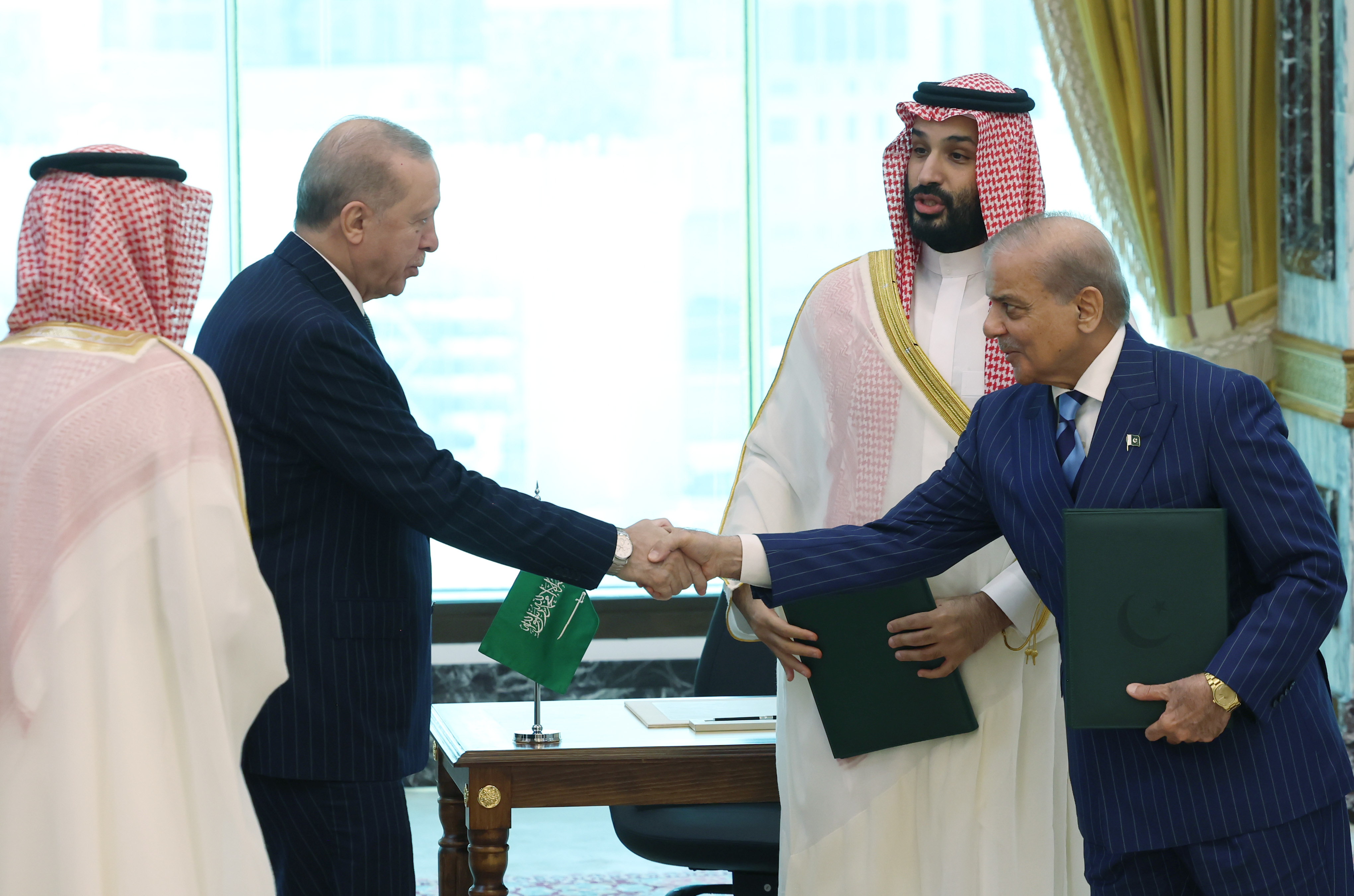
Turkish President Recep Tayyip Erdogan, Saudi Crown Prince Mohammed bin Salman, and Pakistani Prime Minister Shehbaz Sharif sign a trilateral defense agreement in Mecca, Saudi Arabia, on August 7, 2026.
Photo: TUR Presidency / Murat Cetinmuhurdar / Anadolu via Getty Images
A new Middle East order has yet to be defined, but two distinctive characteristics are already clear: the primacy of heightened regional agency and the new order’s multipolarity.
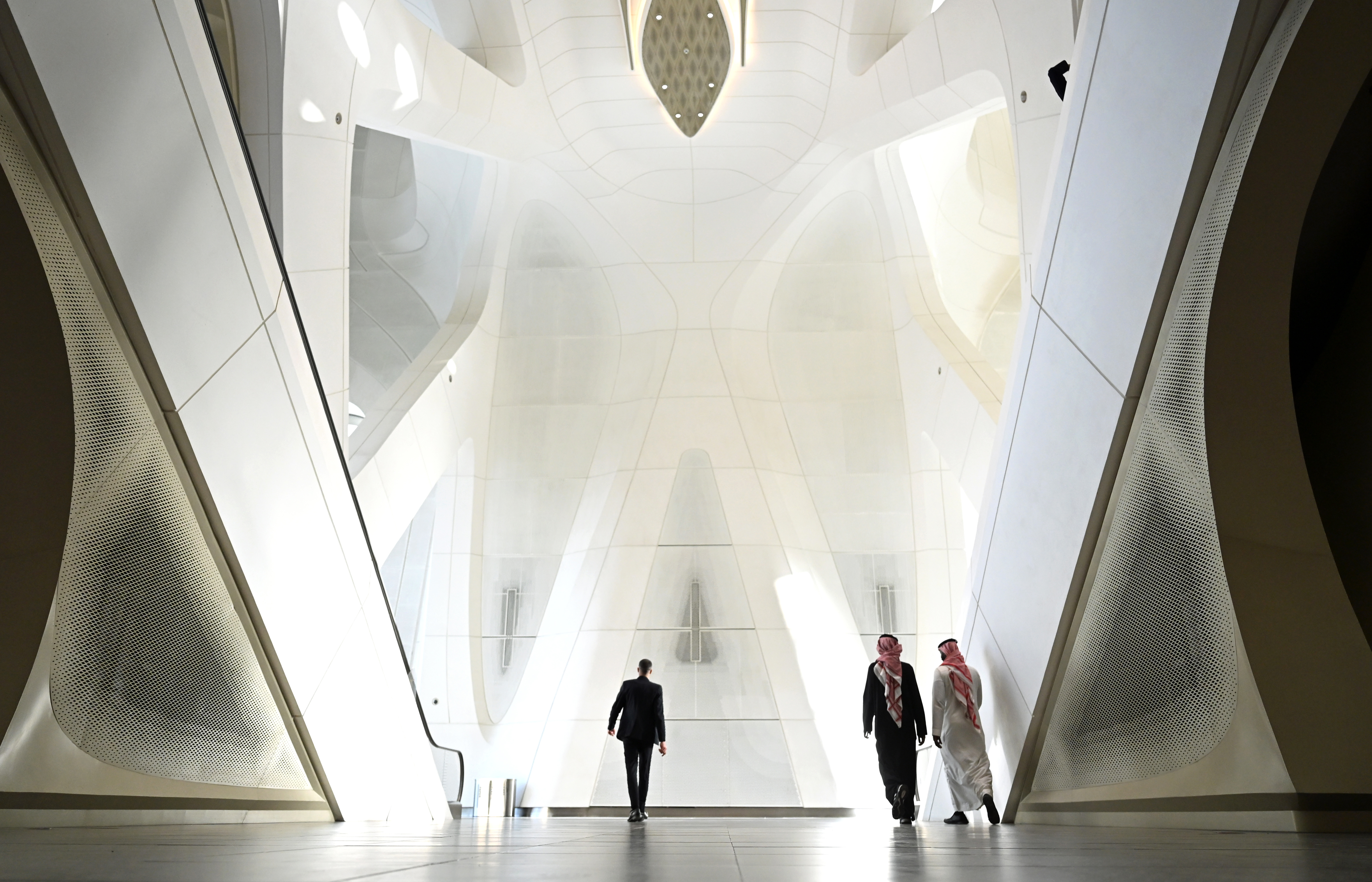
View inside the new KAFD Metro Station in Riyadh, Saudi Arabia, on February 1, 2026.
Photo: Elisa Schu / picture alliance via Getty Images
Ferment characterizes the Middle East’s era of disequilibrium. Embedded in this disorder is uncertainty and risk, plus the attendant challenges of navigating such turmoil. Many potential pathways exist. Indeed, in this period of sustained disequilibrium, the region is likely to vacillate among different futures. Some changes will put the Middle East on trajectories toward renewed conflict and even greater ruin. Other developments could trend toward stabilization and recovery.
Already, competition to shape the contours of a new order threatens to unleash new conflicts. Israel and Turkey are engaged in an increasingly dangerous rivalry in Syria as both seek to assert their interests in the country. The Red Sea and the Horn of Africa—already a major source of contention between Saudi Arabia and the UAE—could become another flashpoint given the region’s enhanced strategic importance to Gulf competitors following the closure of the Strait of Hormuz.
While the contours of the next Middle East order remain uncertain, broad “directions of travel” can be mapped as a first step toward steering through the tumult. Embracing the region’s uncertainty and developing an understanding of the various trajectories at play can inform approaches and equip stakeholders with the foresight necessary to make strategic rather than tactical decisions.
Somewhat counterintuitively, this period of disruption across the region holds the seeds for regrowth and regeneration. Embedded in the flux lies the opportunity to shape what comes next. While the messiness of disequilibrium is challenging, its unsettledness also allows stakeholders to create new possibilities and define a future order.
With their agency at the forefront, how various regional actors address key challenges will influence whether the Middle East arrives at a new equilibrium and regional order or if the period of disequilibrium protracts and worsens. Key dynamics defining the region’s contours will revolve around how Iran, the Arab Gulf states, Israel, and the Levant engage in the disorder and whether they favor maximalist, confrontational postures that define security and national interests as a zero-sum proposition or adopt more pragmatic approaches that flex and allow for compromise and greater interdependence.
For both Israel and Iran, a core issue centers on whether each can pivot from kinetic approaches to more long-term strategic positioning that allows for mutual coexistence in the region, perhaps based on a nonaggression pact. With forces stretched and growing internal strains, each country could pivot toward deescalation in the face of risks posed by overreach and endless conflict.
As the region’s center of gravity, the Gulf is best positioned to develop a regional modus vivendi. If Gulf countries can overcome internal rivalries and competition, they could build an effective collective security approach to deter Iran and balance Israel. The Levant’s trajectory also matters: Whether Syria can manage its transition from Assad-era brutality to inclusive governance, and whether Lebanon’s reform-minded government can make progress disarming Hezbollah, regaining sovereignty, and delivering long-demanded reforms, will determine whether the Levant becomes a stabilizing bridge between the Gulf and Europe or remains a source of continued fragility.
The United States will remain a critical—in some cases, indispensable—actor during this era of disruption. While the United States will no longer be the sole superpower in the Middle East, it can still play a significant catalyzing role. To revive its waning influence in the region, the United States must finally and truly pivot from a reflexive response favoring military interventions toward heightened diplomacy and economic engagement. This much-needed U.S. course correction could help guide the Middle East toward a new equilibrium that yields a stable and prosperous Middle East—an outcome clearly in the U.S. national interest. Rather than a source of conflict and economic disruption, the Middle East could transform into a vibrant region with new markets and other opportunities for U.S. business growth.
To get there, the United States must both rebuild old competencies and develop new tools. Diplomacy must once again be restored to a place of primacy. Washington can exercise its considerable leverage to push the region’s stakeholders toward a path of mutual coexistence and regional stability. It can double down on engagement with Gulf and other mediators to rejuvenate talks with Iran. It can build on the ceasefires negotiated in Gaza and Lebanon to translate these hollow agreements into real steps toward conflict resolution. And new approaches, transparent and devoid of corruption, that enable U.S. companies to play a role in the region’s massive reconstruction needs—estimated to exceed $500 billion—can enhance the U.S. commercial presence in the region, now dwarfed by China.
The Middle East is now in the throes of disequilibrium, wrought by the collapse of its prevailing order and a yet-to-be-born new order. It is undoubtedly a time of great danger and peril, with the potential for even greater ruin ahead. Yet, from the ashes of the region’s burning conflicts, there will also be the chance for rebirth and renewal. Ultimately, it will be for the region to decide which of these futures will define its new order.
Mona Yacoubian is the director and senior adviser of the Middle East Program at the Center for Strategic and International Studies in Washington, D.C.
