Israel’s Elections and the Future of the Middle East
November 12, 2026 • 10:00 – 11:00 am EST
Hosted by Middle East Program

Photo: Annabelle Gordon/CNP/Bloomberg/Getty Images
One year after Presidents Donald Trump and Xi Jinping reached the Busan Agreement, China’s rare earth exports to the United States remain substantially below levels recorded before Beijing imposed sweeping export restrictions in April 2025. Despite successive agreements in Geneva, London, and Busan intended to restore supplies, American manufacturers continue to face shortages of materials essential to automotive production, aerospace manufacturing, semiconductors, and national defense.
The problem extends beyond the volume of Chinese exports. While China’s overall shipments of controlled rare earth materials have remained relatively stable, exports to the United States and Japan have declined sharply, suggesting that Beijing continues to exercise significant discretion over which countries receive critical supplies. With the broader U.S.-China trade truce set to expire on January 10, 2027, the central question is whether Washington can translate diplomatic agreements into reliable access to rare earths, or whether China will continue to weaponize its dominance of critical mineral supply chains in trade negotiations.
Q1: What is the Busan Agreement and why was it needed?
A1: The Busan Agreement is a trade truce reached between President Trump and President Xi on October 30, 2025, in Busan, South Korea, following months of escalating tariffs, export controls, and retaliatory trade measures. It marked the latest in a series of negotiations aimed at easing trade tensions and restoring rare earth supplies to the United States.
The first breakthrough in the escalating trade war came on May 11, 2025, when U.S. and Chinese officials reached a 90-day tariff truce in Geneva, Switzerland. As part of the agreement, China committed to suspending certain retaliatory trade measures, including restrictions affecting U.S. companies’ access to rare earth supplies. However, implementation quickly faltered. China continued to delay the issuance of rare earth export licenses, contributing to severe shortages that threatened production across the automotive, robotics, and defense sectors. President Trump subsequently accused Beijing of violating the agreement, prompting another round of negotiations.
On June 11, following two days of talks in London, U.S. and Chinese officials finalized a new trade framework aimed at resolving the dispute. According to President Trump, Beijing agreed to resume exports of rare earth elements and permanent magnets to the United States, offering relief to manufacturers that had faced mounting supply disruptions since China’s April export restrictions. Nevertheless, China’s export licensing requirements remained in place. Several heavy rare earths were hit particularly hard. For example, before China’s April 2025 restrictions, the United States imported 333 tons of yttrium over an eight-month period. In the eight months afterward, imports fell to only 17 tons, a decline of approximately 95 percent.
Tensions escalated again in October 2025, when China announced sweeping new restrictions on rare earth exports, including controls on foreign-made products containing Chinese rare earth materials and restrictions on the transfer of processing technology. These measures set the stage for the October 30 Busan Agreement, under which China agreed to suspend its expanded export restrictions for one year in exchange for U.S. tariff reductions and a pause on certain semiconductor export controls. Although the agreement temporarily appeared to stabilize supply chains, it did not dismantle China’s underlying export licensing regime. The original agreement was scheduled to expire in November 2026, but Washington and Beijing agreed in September 2026 to extend the broader trade truce until January 10, 2027.
Q2: Did the Busan Agreement restore Chinese rare earth exports to the United States?
A2: China’s rare earth exports declined sharply following the imposition of its April 2025 export restrictions. Prior to the restrictions, between June 2024 and March 2025, the United States imported an average of 76.8 metric tons of rare earth compounds and metals from China per month. Between November 2025 and September 2026, the 11 months following the Busan Agreement, the United States imported an average of 19.3 metric tons of rare earth compounds and metals per month, a decrease of almost 75 percent.
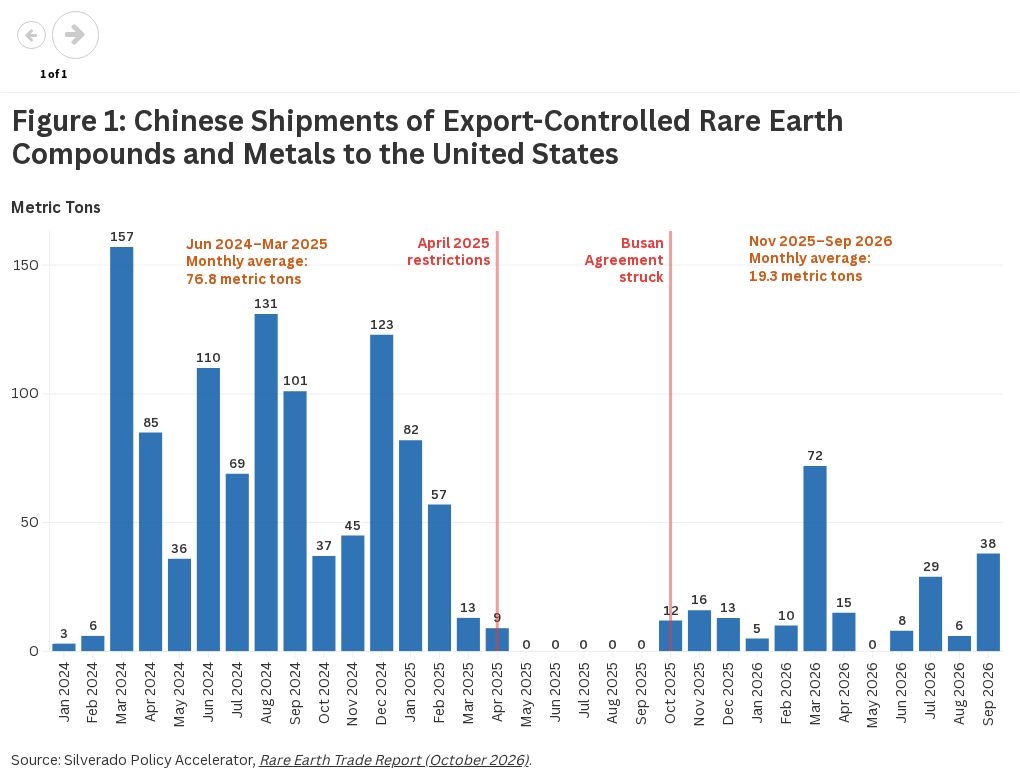
The recurring challenge is the persistent gap between China’s diplomatic commitments and actual export volumes. Despite successive agreements in Switzerland, London, and South Korea intended to restore supplies, shipments of controlled rare earth materials to the United States remain approximately 75 percent below pre-restriction levels. This demonstrates that diplomatic agreements without clear enforcement mechanisms offer limited reprieve.
Q3: What are the implications for U.S. and allied manufacturers?
A3: China’s April 2025 rare earth export restrictions triggered widespread concern among major global manufacturers, with several companies warning that dwindling inventories could force production shutdowns. Ford CEO Jim Farley acknowledged that the company was struggling to secure rare earth magnets, contributing to a temporary suspension of Ford Explorer production at its Chicago plant in May 2025. Suzuki Motor similarly suspended production of its Swift model because of component shortages reportedly linked to Chinese export restrictions. An industry association representing major manufacturers, including General Motors, Toyota, Volkswagen, and Hyundai, warned the Trump administration that shortages of rare earth magnets could force U.S. automotive factories to reduce production or shut down within weeks.
These supply vulnerabilities persisted even after the Busan Agreement, which should have led to a resumption in rare earth and permanent magnet exports. In December 2025, GE Vernova CEO Scott Strazik indicated that the company had sufficient yttrium inventories to last into 2026, without specifying how long those supplies would remain adequate. Yttrium shortages subsequently emerged as a particular concern for the aerospace industry, where the element is used in specialized coatings that protect jet engines and other high-temperature components. In February 2026, it was reported that two North American aerospace-coating suppliers had temporarily suspended production because of yttrium shortages. Another supplier had exhausted its inventories and stopped selling products containing yttrium oxide. These disruptions demonstrated that supply constraints were no longer anticipated risks but actual manufacturing interruptions.
The semiconductor industry also continued to experience shortages. In February 2026, it became public that U.S. semiconductor manufacturers were running low on scandium, another critical mineral subject to Chinese export controls, and had sought U.S. government assistance in securing export licenses. This demonstrated the broader implications of China’s restrictions on advanced manufacturing and technology supply chains. By late October 2026, the Financial Times reported that Japanese officials feared the country could exhaust its yttrium supplies within months, potentially by the end of the year.
These developments highlight the limitations of the Busan Agreement in restoring reliable access to critical minerals. Despite both a diplomatic truce and the U.S. government committing billions of dollars to building rare earth mining and processing projects, manufacturers are still battling inventory depletion, production interruptions, and challenges with accessing key materials.
Q4: Are these rare earth export restrictions being applied to all countries?
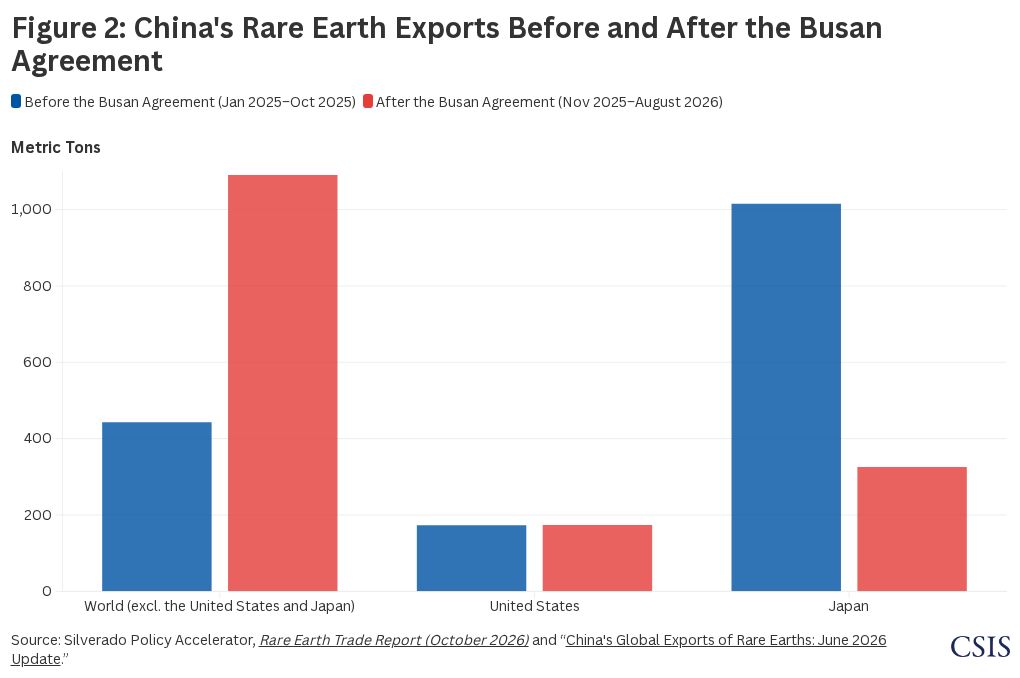
A4: No. China’s export data reveals a striking divergence between shipments to the United States and Japan and those destined for other markets. While China’s total exports of the covered rare earth materials declined by just 2.5 percent in the 10 months following the Busan Agreement, combined shipments to the United States and Japan fell by 58 percent. Meanwhile, exports to the rest of the world increased by approximately 146 percent. These trends suggest that China’s export licensing regime has continued to affect trading partners unevenly, despite diplomatic commitments to ease restrictions.
In the 10 months following the Busan Agreement (November 2025–August 2026), China’s total rare earth exports reached 1,590 metric tons, compared with 1,631 metric tons in the preceding 10 months (January–October 2025), a decline of just 2.5 percent. However, these aggregate figures obscure a substantial redistribution of exports away from the United States and Japan. Combined exports to these two countries fell from approximately 1,188 metric tons before the agreement to just 500 metric tons afterward, representing a 58 percent decline. By contrast, exports to the rest of the world increased from 443 metric tons to 1,090 metric tons over the same period, an increase of approximately 146 percent.
China’s rare earth exports to Japan declined sharply following the Busan Agreement, falling from 1,015.4 metric tons in the 10 months preceding the agreement (January–October 2025) to just 325.6 metric tons in the subsequent 10 months (November 2025–August 2026), a decline of approximately 68 percent. This reduction was driven in part by export restrictions China imposed on Japan on January 6, 2026, widely viewed as retaliation for remarks made by Japanese Prime Minister Sanae Takaichi in November 2025. Takaichi had suggested that a Chinese attack on Taiwan could constitute an existential threat to Japan, potentially justifying a Japanese military response.
As a result, the combined U.S. and Japanese share of China’s rare earth exports fell from approximately 73 percent before the Busan Agreement to just 31 percent afterward. Meanwhile, the share destined for all other countries rose from 27 percent to nearly 69 percent. South Korea’s share of Chinese rare earth exports increased, while the European Union’s share remained relatively stable.
These divergent trends suggest that China’s export licensing regime is not affecting all trading partners equally. While China has maintained relatively stable overall export volumes, shipments have increasingly been directed toward markets outside the United States and Japan. The data therefore suggests that Beijing has retained the ability to selectively constrain access to rare earths, even after agreeing to ease export restrictions under the Busan Agreement.
Q5: Are further negotiations expected before the Busan Agreement’s expiration on January 10, 2027?
A5: Yes. The United States and China are expected to hold further high-level discussions before the Busan Agreement expires on January 10, 2027, with two potential opportunities for Presidents Trump and Xi to meet before the end of 2026. China will host the Asia-Pacific Economic Cooperation (APEC) Leaders’ Meeting in Shenzhen on November 18–19, which President Trump is expected to attend. The United States will subsequently host the G20 Summit in Miami on December 14–15, providing another opportunity for the two leaders to meet in person before the agreement expires. In addition to these potential presidential meetings, the Financial Times reports that U.S. Treasury Secretary Scott Bessent and U.S. Trade Representative Jamieson Greer are expected to meet their Chinese counterparts between the APEC and G20 summits to address outstanding trade disputes, including China’s rare earth export restrictions.
China’s continued restrictions on rare earth exports suggest that Beijing is seeking to preserve its leverage ahead of renewed negotiations, mirroring the dynamics that preceded the October 2025 Busan Agreement. Despite repeated diplomatic commitments to ease restrictions, U.S. manufacturers continue to face supply shortages. The cost of these restrictions is significant. The International Energy Agency estimates that the full implementation of China’s expanded rare earth export controls could put approximately $6.5 trillion in annual downstream production outside China at risk.
Going forward, any renewed agreement should establish clear, verifiable export commitments, including agreed-upon shipment volumes, transparent licensing procedures, and regular monitoring of actual deliveries to U.S. buyers. Without these enforcement mechanisms, China will retain the ability to restrict critical mineral supplies even as broader trade negotiations produce additional diplomatic agreements.
Dr. Gracelin Baskaran is director of the Critical Minerals Security Program at the Center for Strategic and International Studies (CSIS) in Washington, D.C. Max Martin is a research associate with the Critical Minerals Security Program at CSIS.

Brief by Gracelin Baskaran and Meredith Schwartz — April 27, 2026

Critical Questions by Gracelin Baskaran — October 9, 2025

Critical Questions by Gracelin Baskaran and Meredith Schwartz — June 11, 2025