POSTPONED: A Conversation with Lebanon's Minister of Finance, H.E. Yassine Jaber
September 9, 2026 • 9:00 – 10:00 am EDT
Hosted by Middle East Program
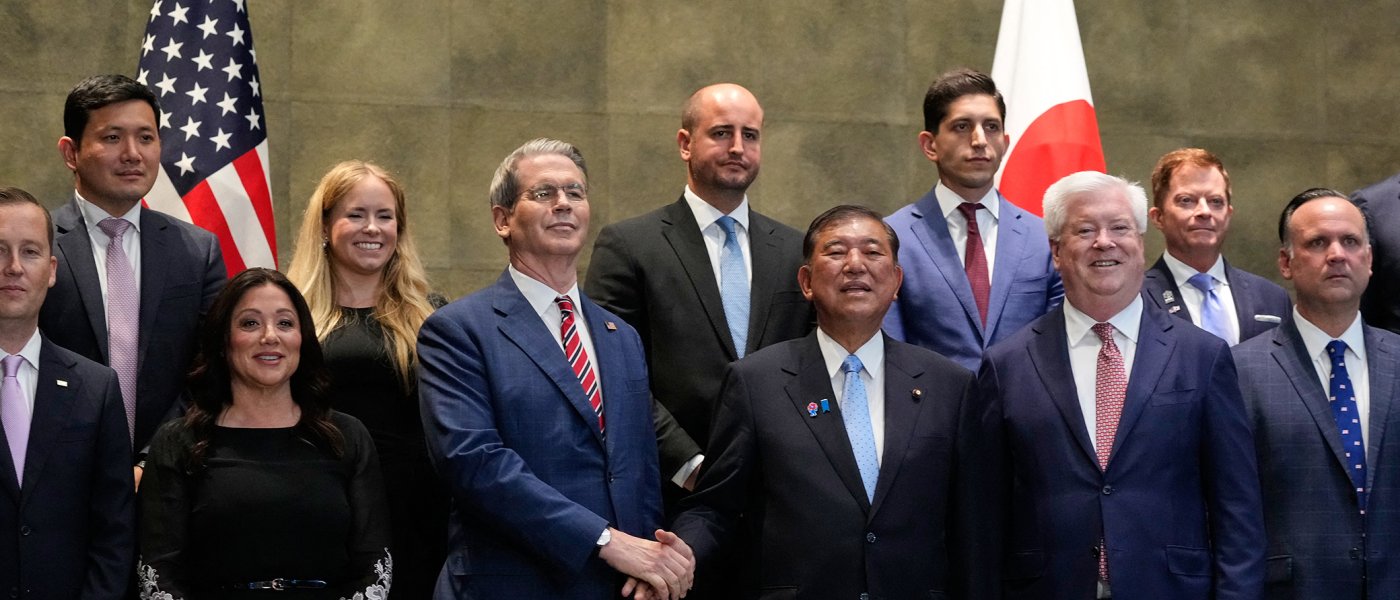
Photo: SHUJI KAJIYAMA/POOL/AFP/Getty Images
On July 22, it was announced that the United States and Japan had reached a trade deal after several months of active negotiations. The agreement is the most substantial struck so far by the Trump administration in terms of trade volume, and Prime Minister Shigeru Ishiba has claimed it as a significant diplomatic achievement in the wake of his party’s defeat in Japan’s upper house election on July 20. While details have yet to be released, the deal appears to address some of the major demands from the United States on investment and market access while also providing Japan with some relief in the form of reduced 15 percent rates on reciprocal tariffs and sector-specific automobile tariffs.
Q1: How did the trade deal come about?
A1: This deal is the result of eight rounds of talks between the United States and Japan that began on April 16. From the beginning, Japan was considered a priority candidate for U.S. tariff negotiations, and talks commenced with positive momentum. However, the gap in the negotiating positions of the two sides soon became clear. Japan initially took a tough stance, seeking the removal of all newly imposed U.S. tariffs, including those on steel, aluminum, and automobiles, which the Trump administration was unwilling to do despite Japanese offers of increased investment and concessions in other areas. Over the weeks that followed, negotiations appeared to stall due to automobiles and rice. Japan’s lead negotiator made it clear that there was no point in striking a deal without a reduction in automobile tariffs; autos and auto parts are Japan’s top exports to the United States, and roughly 10 percent of the Japanese labor force is connected to the industry. Meanwhile, President Trump expressed increasing frustration with Japan and sharply criticized the lack of market access for U.S. automobiles and rice, leading him to send Japan a letter threatening 25 percent reciprocal tariffs to be implemented beginning August 1.
The opening for a deal came in the lead-up to Trump’s August 1 deadline as the United States intensified its efforts to strike deals and as the Japanese Liberal Democratic Party (LDP) looked to the aftermath of Japan’s July 20 upper house election. The timing of the election posed challenges for Japan’s ruling LDP, whose leaders were reluctant to make a deal beforehand that might provoke backlash and alienate key constituents, but many observers speculated that there might be a narrow potential window to strike a deal during the 11-day window between the election and the U.S. deadline. In the end, the Japanese government did not end up making some of the more controversial concessions that were under speculation, such as large increases in the overall level of rice imports, which would have angered Japanese farmers. However, early reactions in Japan have been mixed, with the Ishiba administration touting the deal as a success and members of the opposition arguing that it is bad for the Japanese economy. Japanese stocks soared in response to the deal announcement.
Q2: What are the terms of the deal?
A2: The U.S.-Japan agreement follows the same model that the United States has used in other negotiations with the United Kingdom, China, Vietnam, and Indonesia, where parties agree upon a general framework and U.S. tariff rates but defer discussion of many more detailed elements usually included in comprehensive trade agreements.
According to the information currently available, Japanese exports will be subject to a 15 percent tariff, reduced from the 25 percent tariff rate threatened in Trump’s July 7 letter. Japanese automobile exports, which had already been subject to an additional 25 percent industry-specific tariff since April, will instead receive 15 percent tariffs, including a preexisting tariff of 2.5 percent. For Japan, these terms represent a substantial improvement from the alternative, and notably, this is the lowest reciprocal tariff rate negotiated to date by a country running a trade surplus with the United States. However, 15 percent tariffs will still pose a daunting challenge for the Japanese economy. Steel and aluminum were not included in the deal and continue to be subject to a separate 50 percent tariff.
In exchange for these tariff reductions, Japan will invest $550 billion in the United States. Ishiba said that these investments would come in areas important to economic security, such as semiconductors, pharmaceuticals, steel, shipbuilding, critical minerals, energy, automobiles, and AI technologies. Japan is already the top investor in the United States, and Ishiba previously pledged to increase Japan’s investment in the United States to $1 trillion at the Japan-U.S. Summit Meeting with President Trump in February, so it is unclear how the $550 billion mentioned in this new deal relates to Japan’s other commitments, though U.S. Secretary of the Treasury Scott Bessent has said that it is all new capital. Trump separately mentioned Japan would form a joint venture with the United States for liquified natural gas, and it has been suggested that he could influence where Japanese investments are directed.
Trump’s initial social media post also stated that the deal will increase market access for U.S. producers of cars, trucks, rice, and certain agricultural products, among other items. On rice, the Japanese government has clarified that it will retain its long-standing 770,000-ton quota of tariff-free rice imports, but it will increase the share of U.S. rice imported within that quota. On cars and trucks, Japan will accept vehicles built to U.S. safety standards without subjecting them to additional requirements, removing what has long been seen as a nontariff barrier to U.S. companies.
Q3: What happens next?
A3: Due to the broad nature of the U.S.-Japan trade deal, further details related to investment and other elements will need to be clarified moving forward. The precedent set by the U.S.-Japan deal is likely to provide a new negotiating target for South Korea, the European Union, and other countries that are trying to strike their own deals with the United States before the August 1 deadline, as well as for U.S. negotiators who may want to encourage investment pledges similar to that offered by Japan. For many stakeholders in U.S.-Japan relations, the announcement of this deal comes as a relief, as it may enable the two countries to move forward with cooperative bilateral endeavors related to economic security, the U.S.-Japan alliance, and other matters that have been sidelined by tariff issues since the beginning of the Trump administration. However, additional challenges lie ahead. The U.S. government has already indicated that it expects greater burden sharing from Japan and other allies, including a potential increase in Japanese defense spending, so these issues are expected to be on the bilateral agenda moving forward.
The deal announcement also comes at a time when Japanese politics are in flux. Immediately after the deal, there were reports that Prime Minister Ishiba might resign by the end of August, which Ishiba subsequently denied. There have been calls for Ishiba to resign due to his party’s weak performance in the upper house election. Immediately after the election, Ishiba declared his intention to continue as prime minister due to the importance of ongoing U.S. tariff negotiations, but with the deal now complete, questions continue to arise about his possible resignation and his potential successor. Japan’s next prime minister will inherit a challenging portfolio in both domestic politics and foreign policy, including future discussions with the United States on economic issues and defense burden sharing.
Kristi Govella is senior adviser and Japan Chair at the Center for Strategic and International Studies in Washington, D.C.

Critical Questions by Nicholas Szechenyi, Yuko Nakano, and Kristi Govella — July 21, 2025

Critical Questions by Kristi Govella — June 16, 2025
