U.S. and Allied Burden Sharing: A Progress Report
September 8, 2026 • 5:00 – 5:30 pm EDT
Hosted by All About the Base

Photo: Pita Simpson/Getty Images
In recent years, the Pacific Ocean has emerged as an increasingly important transit and destination hub for the global illicit drug trade. Cocaine and methamphetamine are among the most commonly trafficked drugs through the region, destined for markets in Australia and New Zealand where they can fetch some of the highest street values in the world. The principal actors involved are Chinese and Asian syndicates, Mexican and South American cartels, Australian and New Zealand organized crime groups, and local drug gangs. As of 2019, the illicit drug trade across the Asia-Pacific region was estimated to be worth between $30.3 billion and $61.4 billion.
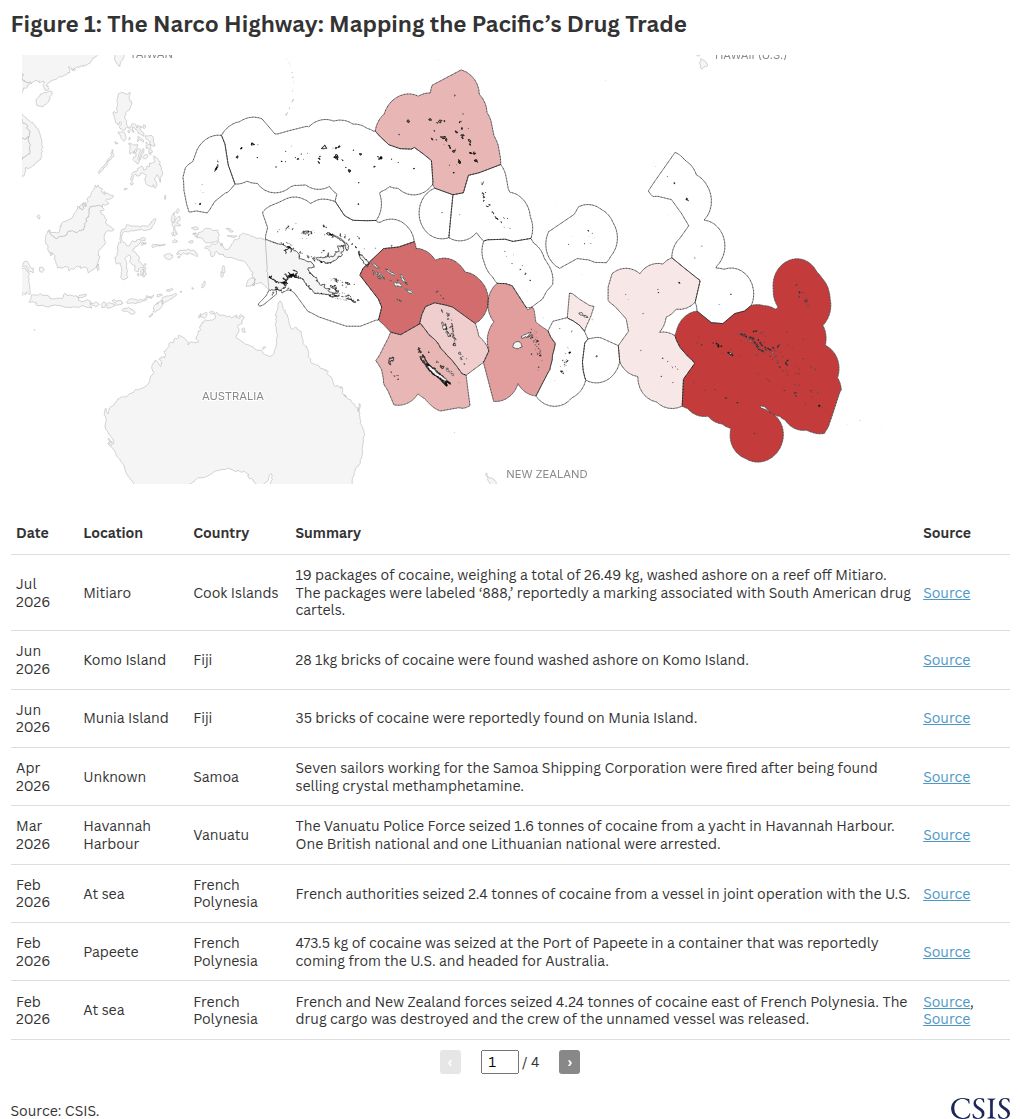
To track the uptick in incidents related to maritime drug trafficking, this map and data list highlight publicly reported seizures, arrests, and other drug-related incidents in the Pacific since the start of 2024. The dataset is based on incidents identified through publicly available sources and is not intended to be exhaustive.
In general, Pacific Islands’ exclusive economic zones (EEZs) are massive in comparison with each country’s actual land mass. For example, Kiribati’s EEZ covers 3.44 million square kilometers, more than 4,240 times the size of its land area, and Fiji’s EEZ covers 1.29 million square kilometers, more than 70 times the size of its land area. Pacific countries have limited resources to monitor their expansive EEZs, with many depending on partners such as the United States, Australia, and New Zealand to patrol their waters. This weak law enforcement capacity paired with limited coordination between regional and national agencies makes it more difficult to share intelligence and cooperate effectively in tackling cross-border crime.
In May 2026, Fijian Prime Minister Sitiveni Rabuka noted, “For generations, the Pacific Ocean has connected our islands, our economies, our cultures, our people. The very ocean that connects us is being increasingly exploited by transnational crime networks.” The rapid rise is straining already limited maritime law enforcement resources and creating broader health, social, and security challenges for Pacific Island nations. It has also caused a spillover effect, where countries have experienced an increase in local drug use, criminal activity, and corruption. Methamphetamine use has been reported among children as young as 10 years old and is increasingly widespread among teenagers and young adults. Additionally, drug use worsens existing social, welfare, and health challenges. In Tonga, 40 percent of mental health hospital admissions have been connected to drug addictions. In response to growing concerns over the impact of illegal drugs on communities, Palau President Surrangel Whipps Jr. declared 2026 the year to “just say no to illegal drugs.”
The unanimously endorsed Waqa Moana initiative launched this month at the Pacific Island Forum Leaders Meeting is a significant step forward in combating the illicit drug trade in the region. Australia announced a $600 million package to implement the program, with Prime Minister Anthony Albanese asserting that “For the good of every country in the region, including our own – we need to work together to stamp out the illicit drug trade.” As part of the deal, Australia will provide the Australian Federal Police $49 million and the Department of Defence $312 million to support and develop programs to combat transnational and organized crime. The implementation of the initiative will be important to watch, particularly whether this significant investment translates into a measurable reduction in the illicit drug trade across the region.
The Pacific’s geography, large EEZs, and limited maritime enforcement capacity and regional coordination have created vulnerabilities that transnational drug networks can exploit. Pacific Island nations are increasingly feeling the domestic effects from the illicit drug trade. No single nation can eliminate the illicit drug trade throughout the Pacific, making regional coordination critical. The Waqa Moana initiative marks a major step in the right direction to address the evolving threat of transnational organized crime in the Pacific.
John Augé is the program manager for the Australia Chair at the Center for Strategic and International Studies (CSIS) in Washington, D.C.