Manila Strategy Forum 2026
September 9 – 10, 2026
Hosted by Southeast Asia Program

Photo: ipopba/Adobe Stock
Achieving economic viability for minerals security is one of the most pressing hurdles facing U.S. minerals security objectives. While this challenge spans the entire critical minerals landscape, it is particularly acute for cobalt. Despite cobalt’s central role in both energy security and the defense industrial base, its market remains highly distorted in the critical minerals ecosystem. Prices have swung wildly over the past decade, driven less by supply-and-demand fundamentals than by strategic behavior, particularly persistent oversupply from People’s Republic of China (PRC) producers that dominate global mining, refining, and processing. Between May 2022 and May 2025, cobalt prices plunged 59.5 percent, falling from $41 to $16.62 per pound. This sharp decline coincided with China Molybdenum Company Limited (CMOC) nearly doubling its annual cobalt production in 2024, reaching record output levels despite market prices falling more than 60 percent. The surge in PRC output has pushed several Western operations out of the market. In 2022, Jervois opened the United States’ only cobalt mine in Idaho, only to shutter it that the following year as prices cratered. While cobalt prices have begun to show upward momentum after a long period of weakness, the benchmark price for refined cobalt remains around $22.30 per pound as of late November 2025. But this relief is fleeting. The DRC has already signaled that it will move away from an export ban—an action that will flood the market once again and put renewed downward pressure on cobalt prices. To avoid another collapse that forces non-PRC producers offline, the United States and its allies must move quickly to deploy price support mechanisms that keep Western mines operating and prevent the market from reverting to PRC dominance.
Cobalt is a crucial component of military technology. While often heralded as a pivotal battery material, over 50 percent of cobalt demand in the United States is driven by the superalloy industry. Cobalt’s ferromagnetism, thermal stability, and durability make it an ideal material for high-performance alloys used in aerospace applications such as jet engines, advanced nuclear reactors, and precision-guided missiles. Therefore, while the evolution of new battery chemistries may diminish cobalt’s importance to the commercial electric vehicle industry, the West will still require cobalt for a robust national defense.
It remains a challenge to source cobalt independently of China. Cobalt mining is highly concentrated in the DRC, accounting for 76 percent of the world’s cobalt supply in 2024. Chinese companies dominate cobalt mining in the DRC, enabled by the Sino-Congolais des Mines (Sicomines) agreement, a resources-for-infrastructure deal signed in 2007. Under the agreement, Chinese firms received mining rights to deposits near the city of Kolwezi valued at nearly $93 billion in exchange for infrastructure commitments worth just $3 billion. Today, China has ownership in 15 of the DRC’s 19 operating cobalt mines.
In contrast, Western firms have struggled to gain a foothold in the cobalt market amid periods of extreme price volatility. Two price cycles in the past ten years have particularly impacted Western cobalt operations, sending promising projects into care and maintenance, and in some cases, tanking new mines before they even get off the ground.
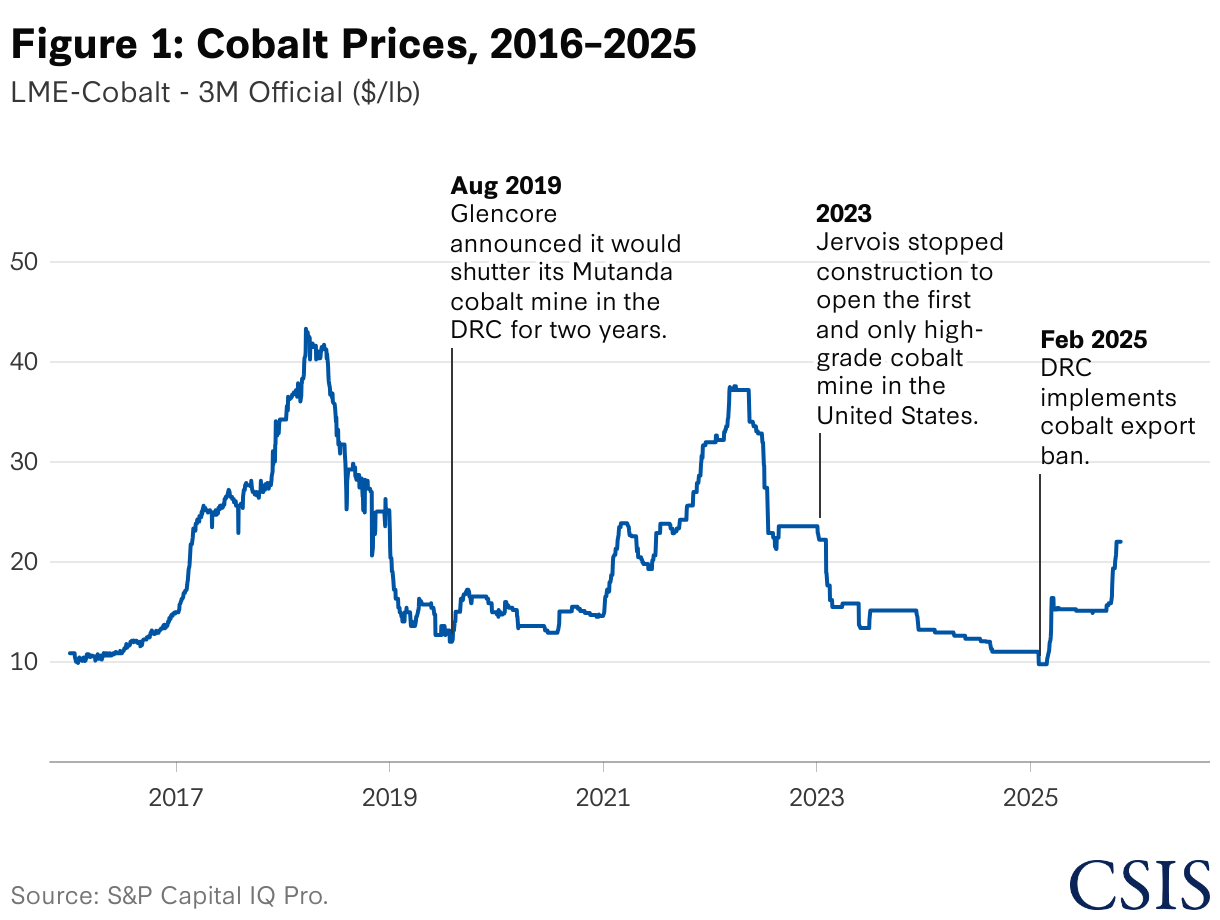
From 2016 to 2018, cobalt prices climbed to ten-year highs of $43.09 per pound. However, from March 2018 through December 2019, prices faltered due to sluggish electric vehicle demand, assertions from Tesla that cobalt content in batteries could be reduced to “almost nothing”, and Chinese oversupply from the DRC. Cobalt prices plummeted 70 percent to just $13 per pound by March 2019. In August 2019, Glencore announced it would shutter its Mutanda cobalt mine in the DRC for two years. At the time, the mine was responsible for over 27,000 metric tons, or one-fifth, of the world’s cobalt production. Glencore’s CEO attributed the mine’s suspension to weak prices, growing costs, and higher taxes impacting the mine’s economic viability. While the Mutanda mine reopened in 2021, the mine has yet to recover its cobalt production volumes or global preeminence. In 2018, Mutanda was the largest-producing cobalt mine in the world. In 2024, it ranked fifth, producing just 13 percent of the volume of cobalt produced by CMOC’s Kisanfu mine.
Western cobalt projects took another hit in 2023 as prices fell from a high of $37.20 per pound in April 2021 to $13.40 in June 2023. In October 2022, Australian mining company Jervois commissioned the opening of its Idaho mine and was on track to ramp up production at the only high-grade cobalt mine in the United States. However, as prices continued to decline into 2023, Jervois abruptly stopped construction and their CEO announced that the project would close until prices rose to $25 per pound—a figure close to double what prices were at the time. The mine has sat idle ever since, as prices fell even further in 2024 to $11.02. As of December 2025, the United States has no active cobalt mines.
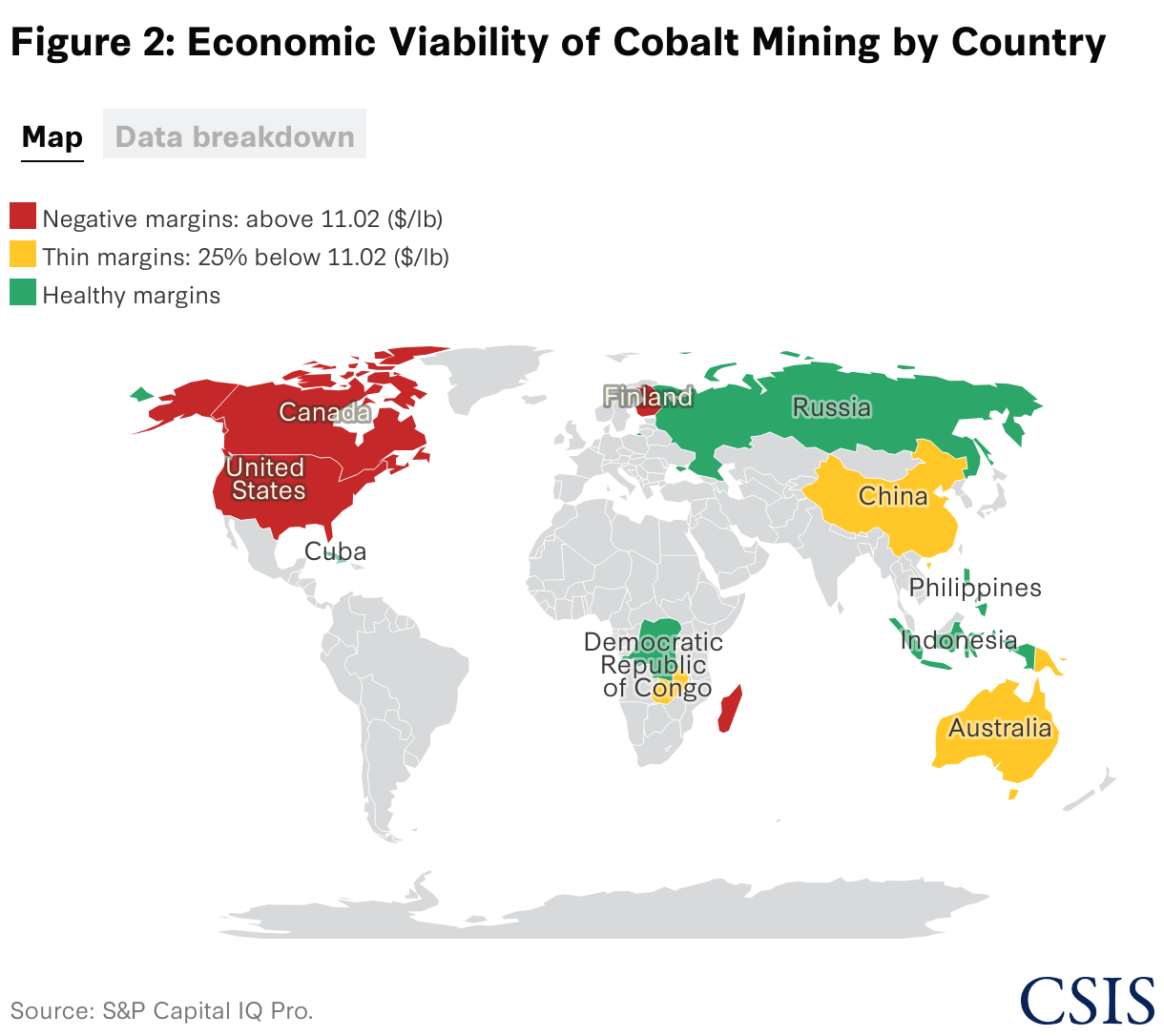
Entering 2025, cobalt prices fell to their lowest since 2016, threatening the economic viability of strategic Western cobalt mines. Top-ranking assets in Australia, Canada, and Madagascar (with Japanese and South Korean ownership) produced cobalt at a loss, as market prices sank below operating cash costs. The United States needs a diverse array of cobalt sourcing partners independent of China for the security of its defense supply chains, but Western and allied projects will struggle to sustain production unless their operations are economically viable.
Now is the time for the United States to counter PRC market manipulation and intervene in the cobalt market with price support mechanisms and other policy tools that bolster strategic projects for national security.
Achieving long-term economic feasibility is one of the greatest obstacles to establishing Western-controlled cobalt supply chains. There are two primary factors that determine the economics of a cobalt project: operation costs and geological coproducts. China has strategically prioritized projects that minimize costs and maximize geological output and has exploited this advantage by overproducing to drive prices down and push Western competitors, who have fiduciary responsibilities to run profitably, out of the market.
Operation costs are comprised of several factors: labor, energy, equipment and maintenance, transportation, and reagent costs that can vary depending on the mine’s location. The DRC is by far the lowest operating cost environment for cobalt mining. On average, operating costs of cobalt mining in 2025 are projected to be 54 percent higher in Australia and 75 percent higher in Canada than in the DRC. These significant production cost differences are attributable to the higher labor and energy costs of production in Australia and Canada. The average labor cost in the DRC is just 34.6 cents per pound of cobalt produced compared to 244.3 and 428.7 cents per pound in Canada and Australia, respectively. While low labor costs in the DRC increase the economic viability of cobalt mining, the highly negative perception of the industry creates reputational costs for Western firms. The DRC is notorious for unsafe working conditions with minimal safety standards, widespread labor abuses, low wages, and unregulated artisanal mining. Most miners earn less than the country’s minimum wage ($5) each day, with an estimated 40,000 children making $2.50 per day. In November 2025, at least 32 people were killed after a bridge collapsed at a cobalt mine. While the DRC has made efforts to advance national standards and formalize artisanal mines, the perceived risk by Western companies of investing in the country’s cobalt mines is still high. The cost of corruption is also high. In the DRC, companies can face taxes from upwards of 25 government bodies because there is no unified tax authority. The tax system is also highly opaque, leading at times to Congolese officials seizing expatriates’ passports over alleged unpaid, arbitrary taxes or for refusing to comply with sudden onerous tax demands.
The economic profitability of cobalt mining is greatly impacted by what other coproducts the mine produces. Cobalt deposits can be colocated with copper, nickel, gold, or platinum group metals. The varying geological makeup of cobalt mines means that some projects will be at an economic advantage to others. While nickel and palladium prices have flatlined, copper prices are highly stable. DRC cobalt mines are, on average, higher grade and colocated with high-grade copper deposits. CMOC’s Tenke Fungurume (TFM) mine in the DRC has cobalt ore grades of 0.25 percent colocated within the world’s fourth-largest copper deposit with the second-highest copper ore grades globally (2.24 percent). In contrast, mines in Australia and Canada face disadvantages of lower grades and less financially lucrative coproducts. Australia’s largest cobalt mine, Glencore’s Murrin Murrin, has cobalt ore grades of just 0.06 percent, colocated with nickel grades of 1.2 percent. Between March 2022 and May 2025, nickel prices dramatically declined by 69.5 percent, from $48,241 per ton in March 2022 to $14,720 per ton in December 2025.
The only Western cobalt projects with a positive profit margin were producing cobalt in small quantities as a secondary or tertiary commodity. These projects produce copper or nickel as primary commodities, with small quantities of cobalt, in the hundreds of metric tons, produced as a byproduct. While these projects may be more economically secure, they do not produce enough cobalt to meet industry needs. In 2023, U.S cobalt consumption reached an estimated 8,300 tons. Cobalt projects in Australia and Canada, operating with positive profit margins, produced a mere 1,300 tons that same year.
Finally, Western projects face competition with PRC cobalt producers that have a long history of manipulating commodity prices to drive Western competitors out of the market. China’s state-supported model of mining allows projects to remain operational even with razor-thin profit margins. For example, CMOC acquired TFM’s DRC cobalt asset from the United States’ Freeport-McMoRan in 2016, with Chinese state-owned banks providing $2.48 billion of the $2.68 billion in credit (in constant 2021 prices) issued for the mine acquisition. As cobalt prices crashed in 2018, TFM’s operating costs, at $23.85 per pound were even higher than Mutanda’s costs of $15.96 per pound. Yet, while Mutanda faced unreconcilable balance sheets and headed into suspension, TFM continued to produce, even at a loss, buoyed by the financial backing of the PRC government. Meanwhile, CMOC slashed costs at the TFM mine by streamlining transport networks, producing reagents on site, and cutting labor costs. By 2020, TFM’s operation cash costs were down 56 percent and Mutanda was struggling to get back into the market. Considering the steep barriers to profitability in the cobalt mining ecosystem, Western cobalt projects will only prevail if prices rise or are subsidized by governments for strategic interests.
The United States and other Western nations are not alone in recognizing the need for policy intervention in the cobalt market. The DRC faces an existential economic crisis if the cobalt market does not recover. In an attempt to curb supply and rally prices, the DRC introduced a ban on cobalt exports in February 2025. Between January 1 and March 14, 2025—shortly after the ban took effect—cobalt prices surged by 48 percent. The export ban disproportionately affected Chinese firms, particularly CMOC, which reported 48,600 metric tons of cobalt inventory in the first quarter of 2025—exceeding Switzerland-based Glencore’s entire 2024 cobalt production. The export restrictions have sparked a rift between Glencore and China-based CMOC. In May 2025, reports surfaced that CMOC was advocating for a rapid end to the embargo, while Glencore has maintained that Congolese cobalt exports should not resume until the market stabilizes. This divergence underscores the broader tensions between PRC and Western stakeholders in the DRC. Over the course of the six-month ban, cobalt prices have jumped 100 percent to $22.03 per pound.
While the DRC’s export ban temporarily pushed cobalt prices upward, such measures are inherently short-term and cannot substitute for durable market solutions. On October 16, 2025, the DRC transitioned to an export quota system, capping cobalt exports at 96,000 metric tons annually in 2026 and 2027, equal to just half the country’s total exports in 2024. Although this intervention has propped up prices, it ultimately undermines the long-term stability of the cobalt sector. Policy volatility and restrictive market interventions deter Western investment that is essential for building a more diverse and sustainable mining industry in the DRC.
Given these risks, it is important to evaluate alternative tools that can deliver more predictable price support without generating the policy uncertainty that suppresses foreign investment. One such tool is a price floor. Unlike quotas, which artificially constrain supply, price floors stimulate production by establishing a parallel market shielded from PRC price manipulation. In October 2025, U.S. Treasury Secretary Scott Bessent underscored this point, noting that “when you are facing a nonmarket economy like China, then you have to exercise industrial policy. . . . We’re going to set price floors and the forward buying to make sure that this doesn’t happen again,” referring to China’s rare earth export restrictions. The Department of Defense instituted a $110-per-kilogram price floor for MP Materials’ neodymium-praseodymium (NdPr). Under the agreement, the price floor will remain in place for 10 years, giving MP Materials the long-term certainty required to make significant investments in domestic rare earth and magnet manufacturing for the defense industrial base. MP Materials is now scaling up its permanent-magnet manufacturing capacity tenfold, with guaranteed offtake to the U.S. defense stockpile.
This U.S. policy support was vital—plummeting NdPr prices threatened the viability of a rare earth industry outside of China, as only eight non-PRC rare earth projects were forecasted to turn a profit by 2030 without market intervention. However, price floors can be a costly policy intervention In the case of MP Materials, NdPr prices had dropped to a low of under $60 per kilogram, meaning the U.S. government could bear an extra cost of over $50 per kilogram of rare earth material. Nevertheless, price floors are increasingly part of the conversation as a strategically necessary policy mechanism. Australia is also developing price support mechanisms for rare earth materials. The MP Materials and U.S.-Australia deals have cascading effects for the entire industry. U.S.-listed rare earth companies are experiencing a boom with share prices soaring over 100 percent. The domestic and allied rare earth industry is mobilizing and deploying capital to solve supply chain challenges at levels never seen before.
While the NdPr price floor will serve as an important case study for how government-led price support can support strategic national security interests, implementing a price floor for cobalt will undoubtedly be more complicated. The United States has no domestic cobalt projects and U.S. mining companies do not own and operate major cobalt assets abroad. However, considering cobalt’s strategic significance to U.S. national defense, the U.S. government could lend price support to allied operations in partner nations with offtake guarantees for the U.S. defense industry. Secretary Bessent noted that price floors will be used beyond rare earths for other strategic industries
The following sections calculate the costs to U.S. taxpayers of three price floors and conclude with recommendations for implementing and sustaining price support mechanisms for cobalt supply chains.
The fiscal burden associated with a cobalt price floor can be approximated by multiplying the differential between the administered price floor and the prevailing market price by the volume of U.S. primary cobalt consumption. In 2024, the United States consumed 8,000 metric tons of cobalt, but 2,000 tons of cobalt were produced from secondary sources including recycling and recovery from end-of-life products. Therefore, U.S. primary consumption of cobalt can be estimated at 6,000 metric tons or 13.23 million pounds. To calculate the cost value of a given price floor, we use the following formula:
Cost = (Pfloor - Pactual) x primary consumption
For the purpose of this exercise, the authors evaluate the costs at three different price floors. The first is at approximately the break-even point for an average cobalt mine in Australia and Canada, or $16 per pound. The second is approximately 50 percent above Western operation costs, or $24 per pound, and the third is 100 percent above the cost of operations, or $32 per pound.
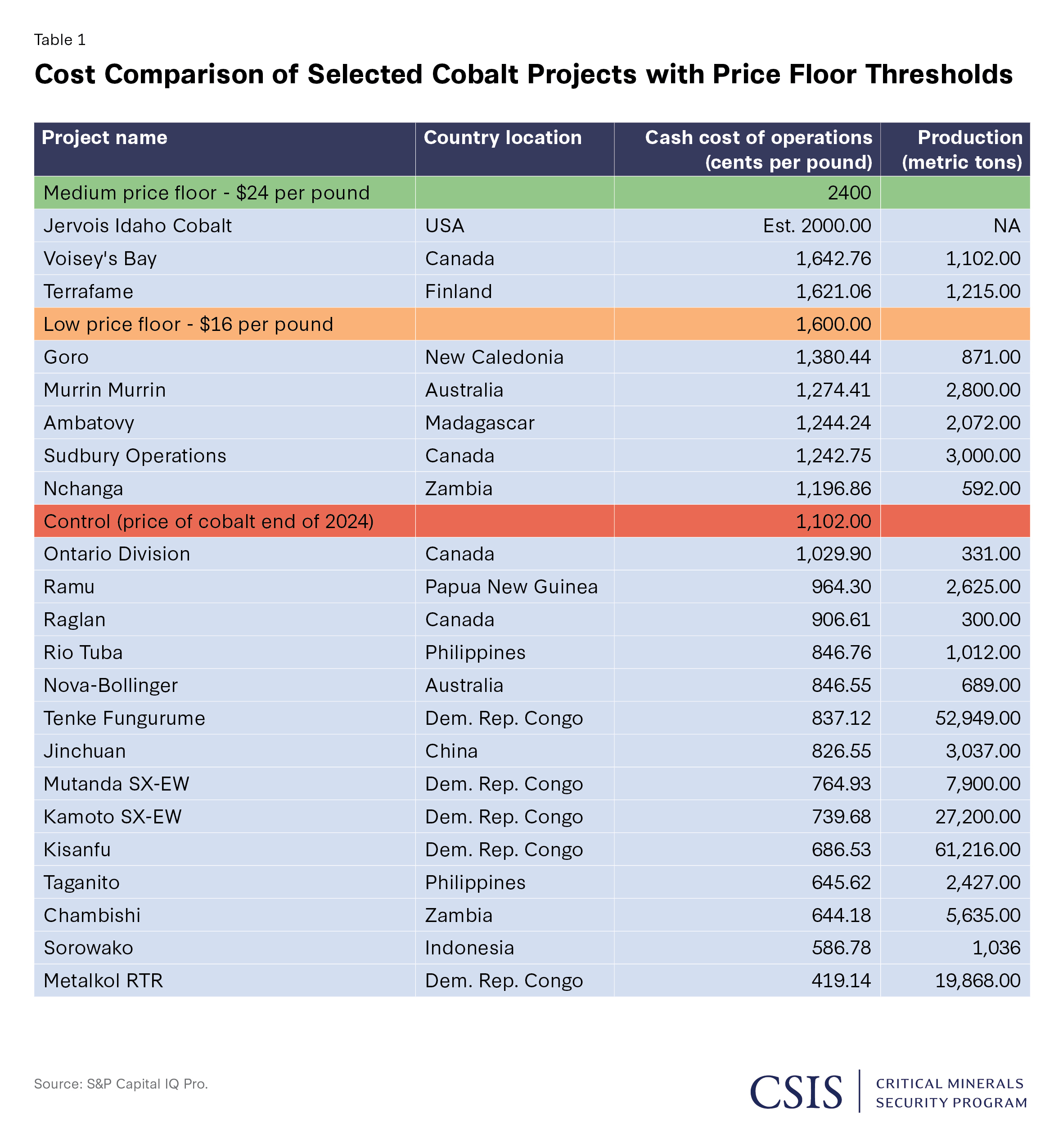
Without a price floor, there is no additional cash cost to the U.S. government, but significant strategic costs. Under current market conditions, large-scale cobalt projects operating in the West are extremely vulnerable to price volatility, and periods of low prices threaten the economic viability of these projects. As seen in Table 1, no large-scale cobalt projects producing more than 1,000 metric tons of cobalt per year operate profitably given higher operational costs and low cobalt prices. In light of these market conditions, there are no incentives for Western industry to build alternative cobalt mining and refining capabilities, leaving key defense and commercial industries reliant on Chinese cobalt sourced primarily from the DRC.
A minimum price floor of $16 per pound would allow most Western projects to break even considering their cash costs. For the price tag of approximately $66 million, projects such as the Murrin Murrin mine in Australia and Sudbury Operations in Canada could be incentivized to export cobalt products to the United States, as the price-guarantee bolsters profit margins. However, a $16 price floor leveraged by the United States alone may not be enough to keep strategic assets operational. The United States is a small global consumer of cobalt, accounting for just 3.6 percent of the market, requiring Western projects to seek additional buyers. Additionally, the floor is too low for fledgling domestic assets like the Jervois Idaho cobalt mine to operate sustainably. Furthermore, price support at this level is unlikely to be high enough to attract significant private sector investment to a high-risk industry undergoing constant policy volatility.
The total $66 million cost to taxpayers is relatively low compared to other government outlays aimed at supporting strategic projects. The Department of Defense awarded $90 million in Defense Production Act funds to Albemarle alone in 2023 for the reopening of the King’s Mountain lithium mine in North Carolina. The mine was originally scheduled to reopen in 2026, but production has been delayed due to the collapse of lithium prices. In 2025, lithium prices have hovered around $10 per kilogram. Albemarle CEO Kent Masters said a minimum of $20 per kilogram is necessary to drive investments in domestic lithium projects like King’s Mountain. Considering these price dynamics for both lithium and cobalt, directing the $90 million toward price support that buoys the entire domestic industry would be a more effective use of funds than grant funding awarded to just one project.
A moderate price floor of $24 per pound offers projects a profit cushion of approximately 50 percent of their cash costs. The costs are higher, but the support for domestic projects, such as Jervois Idaho, is more meaningful. Jervois has stated that cobalt prices would have to reach a minimum of $20 per pound for the site to reopen. For context, the One Big Beautiful Bill Act signed into law in July 2025, appropriated $2 billion to expand the National Defense Stockpile Act in 2025. The $172 million to support U.S. cobalt supply for defense, energy, and economic competitiveness would represent just 8.5 percent of this stockpile funding.
A high price floor of $32 per pound provides support worth approximately 100 percent of Western project’s average cash costs. At this price, Western cobalt projects are able to operate profitably and have the price certainty required to plan long-term investments to expand capacity. Greater availability of responsibly sourced cobalt feedstock enables the expansion of refining capacity as well for vertically integrated supply chains.
Electra Battery Materials is finally close to completing its five-year capital raise to build the first cobalt sulphate refinery in North America. The Ontario, Canada, facility stalled in 2023 due to cost overruns, supply chain disruptions, and financing gaps. Over the last two years, both the U.S. and Canadian governments have filled this gap with a $20 million Defense Production Act award in 2024 and a $17.5 million commitment from the Canadian government in 2025. The facility will source its cobalt from the DRC, but Electra is interested in building a North American supply chain with cobalt sourced from the United States. A government-supported price floor could both make North American cobalt mining more economically feasible and facilitate the flow of private capital into cobalt supply chains by providing signals to private investors that vertically integrated cobalt supply chains are a strategic priority for national defense. Therefore, while the price floor would cost approximately $288 million, the price support would augment other forms of government support to projects, including Defense Production Act Title III funds and Department of Energy loans, to enhance the long-term integration and resilience of Western supply chains.
Price floors are a powerful tool to support the diversification and resilience of cobalt supply chains amid volatile market conditions. However, price floors work best when implemented alongside additional policies to develop the entire mining ecosystem. Price floors are an effective supply-side intervention to bolster cobalt production. Nevertheless, for supply-side interventions to be sustainable, there must be corresponding demand-side interventions ensuring a streamlined mine-to-end-product supply chain.
Support domestic cobalt production and vertical integration as a strategic necessity with price support equating to a minimum threshold of $24 per pound. The United States currently has no cobalt mining or refining capabilities—a strategic liability that leaves critical industries vulnerable to disruption. The United States has already mobilized price support tools to counter PRC minerals dominance and bolster domestic supply chains with respect to rare earths. The U.S. government recognized that reliance on China for rare earths is an untenable risk and responded with proportional support to the top rare earth producer and magnet manufacturer in the United/ States. Rare earths are not the only commodities vulnerable to market distortion and PRC price manipulation. Given the economic challenges of cobalt production, the sector stands to benefit significantly from government-backed price stability measures including a minimum $24 per pound threshold to ensure cobalt mining is not just a feasible industry in the DRC, but also within U.S. borders. While U.S. mining operations will never be as cost efficient as Chinese operations in the DRC, national and economic security warrant paying the premium.
To be most effective, price floors should be just one policy tool within an arsenal addressing cobalt supply chains. The MP Materials deal combined price support with equity investment, offtake guarantees, and concessional financing to form a complete policy package addressing the multitude of obstacles facing the industry. Demand-side interventions such as tax credits for end-use product manufacturing including magnets, batteries, semiconductor chips, and superalloys can supplement supply side interventions such as price support and equity financing Securing the entire cobalt supply chain will require not only U.S. and allied cobalt production, but large-scale Western and allied manufacturing of end products to drive continuous demand for cobalt and offtake supply.
Leverage G7 and Australia partnerships alongside market coordination to scale up price support across multiple strategic commodities. Any U.S. effort to establish a price floor for cobalt—or for other vulnerable minerals—will be far more effective if undertaken in concert with allies. The United States is a relatively small consumer of cobalt, accounting for only 3.6 percent of global demand in 2024. Achieving meaningful economies of scale therefore requires coordinated action among major consuming and producing partners. Aligning price support policies across the G7 and Australia would amplify market impact, reduce unilateral exposure, and strengthen collective resilience to destabilizing pricing practices.
Australia and Canada are indispensable to any U.S.-aligned approach, given their substantial reserves—together representing 17.5 percent of global cobalt—and their established track record in responsible mining. The United States and Australia have begun exploring price coordination under their new Critical Minerals Framework, though operational details remain under development. At the same time, several G7 countries are considering price floors for rare earth elements and other strategic materials. Building on this momentum, the United States, Australia, Canada, and other G7 partners should pursue a standards-based trading architecture for critical minerals—one that provides predictable pricing, reinforces high-integrity production standards, and offers a credible alternative to China’s market dominance and its extractive practices in the DRC and across the Global South. Members of such a trading system would need to commit to retaining minerals supported by price interventions within Western control for processing, refining, and downstream manufacturing. They would also need to establish an equitable formula for distributing the fiscal burden of price floors. Cost sharing could be allocated, for instance, according to each member’s GDP or proportional consumption of the relevant materials.
Extend financial incentives, including a price floor, to Western operations in the DRC. China currently owns or holds equity stakes in 15 of the Democratic Republic of the Congo’s largest copper and cobalt mines, giving it outsized influence over production levels, pricing dynamics, and export flows. If the United States and its partners intend to expand the Western footprint in the DRC’s critical minerals sector, they will need to deploy more robust financial safeguards and de-risking instruments. With the DRC accounting for roughly half of global cobalt supply—and offering some of the world’s most cost-competitive production—creating meaningful incentives for Western investment is essential.
These tools could include establishing a guaranteed price floor to protect Western producers in the DRC from cyclical price collapses driven by Chinese oversupply, as well as offering incentives that lower operating and capital costs. Such measures are especially critical given the substantial up-front investment required to develop new projects in a high-risk environment such as the DRC, where political volatility, infrastructure gaps, and regulatory uncertainty significantly raise the cost of doing business. By reducing these risks, the United States can attract more Western firms into the market, diversify supply chains, and counterbalance China’s entrenched dominance in the region’s mineral sector. The DRC is familiar territory to Western companies; two decades ago companies such as Anglo American, BHP, Freeport-McMoRan, and First Quantum Minerals operated there.
Invest in innovation that can increase cobalt supply from black-mass recycling and other waste streams. The United States should accelerate investment in technologies that recover cobalt from end-of-life batteries, industrial scrap, and other secondary sources to reduce dependence on primary mining and mitigate exposure to volatile global markets. In 2024, an estimated 25 percent of all cobalt used in the United States came from recycled scrap rather than newly mined sources. Yet most cobalt-bearing battery recycling remains highly energy intensive, chemically demanding, and costly, limiting the scale of recycling expansion. Scaling up black-mass recycling can unlock a sizeable, underutilized supply base while lowering environmental and social risks associated with new extraction. Federal support should focus on advancing next-generation hydrometallurgical and direct-recycling processes, funding demonstration facilities, and creating predictable demand signals that incentivize private sector investment. By building a robust domestic recycling ecosystem, the United States can increase cobalt availability, improve supply chain resilience, and strengthen its position in the evolving battery materials landscape.
On the private sector side, firms such as Redwood Materials are driving innovation. In October, Redwood closed a $350 million funding round backed by Eclipse and NVentures (Nvidia’s venture arm), strengthening its business-to-business model of sourcing battery scrap and consumer electronics from partners such as Panasonic, BMW, Audi, and Lime. These partnerships help secure steady volumes of end-of-life batteries and production scrap, which are the key inputs for scaling black-mass recycling On the government side, in August 2025, the Department of Energy issued a Notice of Funding Opportunity of up to $500 million to expand U.S. critical minerals processing, battery manufacturing, and recycling capacity. Targeted deployment of these funds, including toward more efficient black-mass cobalt recycling, could accelerate technological progress and lower processing costs, increasing U.S. cobalt supply. A sustainable and reliable supply of cobalt for the U.S. and its allies will require continuous innovation to unlock supply from new feedstocks in ways that are more economically and environmentally sustainable.
Cobalt is central to both energy security and the defense industrial base, yet it remains one of the most distorted critical mineral markets with sharp price volatility over the past decade. As a result, U.S. and allied cobalt operations struggle to compete with heavily subsidized Chinese operations. The need for a secure cobalt supply calls for targeted policy intervention. A cobalt price floor can help stabilize markets and support supply chain diversification, but it should be paired with broader measures: prioritization of domestic cobalt production, market coordination with key partners, financial support for Western operations in the DRC, and new investments in next-generation recycling technologies to expand supply.
Gracelin Baskaran is director of the Critical Minerals Security Program at the Center for Strategic and International Studies (CSIS) in Washington, D.C. Meredith Schwartz is an associate fellow with the Critical Minerals Security Program at CSIS.
The authors would like to thank Kamal Aubakirov for his research support.
This brief was made possible through generous support from the Cobalt Institute to the CSIS Critical Minerals Security Program.


Commentary by Gracelin Baskaran — July 1, 2025

Commentary by Gracelin Baskaran — June 12, 2025

Commentary by Gracelin Baskaran and Meredith Schwartz — May 7, 2025
