The Strategic Implications of the Russia-North Korea Axis
November 16, 2026 • 9:00 am – 1:35 pm EST
Hosted by Korea Chair

Photo: Partnership 2020
VOLUME 2 | ISSUE 3 | JULY – SEPTEMBER 2021
VOLUME 2 | ISSUE 3 | JULY – SEPTEMBER 2021
Partnership 2020: Leveraging US-India Cooperation in Higher Education to Harness Economic Opportunities and Innovation is a project funded by the U.S. Department of State and executed by the University of Nebraska at Omaha (UNO), with the Center for Strategic and International Studies (CSIS) playing a key advisory role. It is a three-year project with most of the activities taking place in 2019, 2020, and 2021.
This quarterly newsletter serves as a way for college and university leaders, U.S. and Indian policymakers, and other relevant stakeholders to receive updates on Partnership 2020 work, new funding opportunities, policies, employment opportunities, and best practices in higher education partnerships.
In every edition we feature an article from a higher education leader explaining how they launched a U.S.-India partnership and what they are doing now. This edition's piece is by Ms. Yasmin Mesbah, program manager for The Global Links Initiative at Crummer Graduate School of Business, Rollins College.
In 2019, Crummer Graduate School of Business received a federal grant through Partnership 2020. With the award, the U.S. and Indian team created “Chain of Change,” a partnership between the Crummer Graduate School of Business at Rollins College, Florida, and Calcutta University in Kolkata, India. The goal of the project is to empower students and small entrepreneurs living in underserved communities to improve business achievement and economic livelihood. To deliver on this mission, students from Rollins College, Calcutta University, North Bengal University, and Tezpur University worked together to deploy class-based knowledge in their communities. The program was jointly led by Dr. Mary Conway Dato-on at the Crummer School of Business and Dr. Sharmistha Banerjee at Calcutta University.
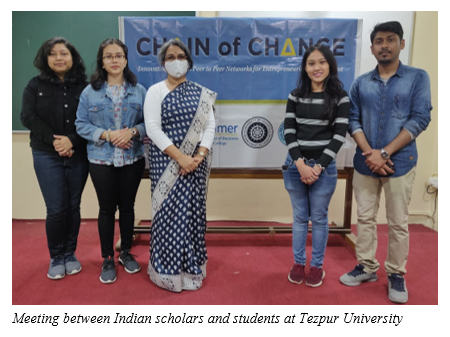
Due to Covid-19 travel restrictions, the U.S.-Indian student exchange was conducted virtually. The U.S. students, enrolled in an undergraduate social entrepreneurship course, developed a social enterprise concept to pitch in the “Ideas for Good Challenge.” The Indian student teams were paired with a pre-screened local entrepreneur from the second-tier cities and tasked with conducting a needs assessment to develop a business plan. The parallel processes of mentoring an entrepreneur and building a social enterprise idea provided students several opportunities for engagement and cross-pollination of ideas.
One important factor leading to Chain of Change’s accomplishments was its reliance on the previous work of The Global Links Initiative (GLI). The GLI is a cross-
cultural training program founded in 2011 to empower women in emerging countries through education and entrepreneurship. The GLI sponsors high-achieving female scholars, two of whom participated in Chain of Change, to foster social entrepreneurial knowledge and skills. This network, together with the team’s expertise, strengthened the educational and economic impacts of Chain of Change.
Despite Covid-19 challenges, the Chain of Change program effectively met its goals. The Indian students, together with their entrepreneurs, developed a business model canvas (BMC) that helped the entrepreneurs better organize business activities. At the same time, the U.S. students gained knowledge and empathy from the Indian students to refine their pitch competition submissions, resulting in three out of five teams progressing to the final stage.
The Chain of Change team has several initiatives planned to ensure the impact continues beyond the program’s end date. First, the team has published a book chapter and a journal article and presented at a conference, investigating students’ social entrepreneurial intentions and future career objectives. Additionally, the team will develop a proposal for a Rollins summer course that incorporates the model developed in the Chain of Change program. The strong relationships that the Chain of Change team has built among universities, local organizations, students, and entrepreneurs provides an efficacious, proven model that can be scaled to create positive economic transformation for participants and their communities.
In every edition we highlight a particular binational project and its current or planned outcomes. This edition's piece is by Dr. Mitali P. Wong, chair, Department of English at Claflin University.
From May 2020 through April 2022, Claflin University and Visva Bharati University collaborated in a Partnership 2020–funded project titled “Promoting women’s family-based entrepreneurship in West Bengal.” Claflin University, a nonprofit, private university in Orangeburg, South Carolina, and Visva Bharati University in West Bengal, India, developed this project for promoting women’s family-based entrepreneurship in West Bengal. The primary site of the project is at Visva Bharati University in Santiniketan.
Due to the ongoing pandemic, project staff from both universities have had to transform a face-to-face project into a virtual project via biweekly and weekly meetings on Zoom. Travel has not been feasible for the U.S. and Indian teams. Nonetheless, the success of this project became apparent during the recent three-day virtual conference hosted by Visva Bharati University on September 23 to 25, 2021, under the leadership of Dr. Amit Hazra and Ms. Sudeshna Mitra of Visva Bharati. Over 30 papers were presented at this conference. Selected papers will be published in a book collection.
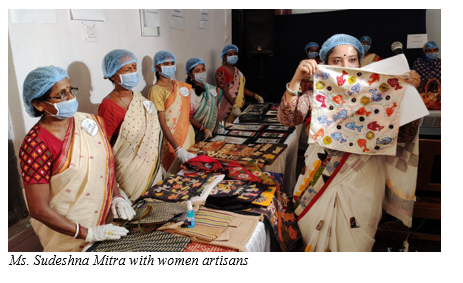
Women artisans who had completed the project’s two previous training sessions were awarded certificates during the conference. They also displayed their products on video at the virtual conference. More training programs are being planned for the final months of this project in Santiniketan. Ms. Perminder Kaur, director of ASSOCHAM India East and Northeast, serves as a consultant for this project to assist with networking in the region where Visva Bharati is located. The work for this collaborative project has involved 12 staff members from both institutions.
Both the partnering institutions are in small cities located in the middle of rural areas and have a student body that has more women than men. The conceptual framework for this project was developed from the findings of the
Women’s Entrepreneurship Development initiative in West Bengal, a three-year partnership between the University of Calcutta and Claflin University under the U.S.-India 21st Century Knowledge Initiative project that ended in 2019. Two professors from Calcutta University who worked on the U.S.-India 21st Century Knowledge Initiative project now serve as consultants for the current Partnership 2020 project.
This partnership project has also planned a training program for women’s home-based small businesses in South Carolina in the region where Claflin University is located. Participants have been recruited and Claflin is partnering with the Orangeburg County Small Business Development Center (SBDC) to offer training sessions in South Carolina.