Manila Strategy Forum 2026
September 9 – 10, 2026
Hosted by Southeast Asia Program

Seth Jones testified before the House Permanent Select Committee on Intelligence about how the international landscape, the threats to the United States, and intelligence challenges have dramatically evolved in the quarter century since the terrorist attacks on September 11, 2001.
Chairman Crawford, Ranking Member Himes, and distinguished members of the Committee, thank you for the opportunity to testify before the House Permanent Select Committee on Intelligence on the subject of “25 Years After 9/11: Confronting the Next Generation of Threats.” CSIS does not take policy positions. The views expressed in this testimony are my own and do not necessarily reflect those of my employer.
In the aftermath of the terrorist attacks on September 11, 2001, the 9/11 Commission was invaluable in identifying the nature of the evolving terrorist threat, U.S. intelligence gaps, and policy recommendations. As the final 9/11 report concluded, “Countering terrorism has become, beyond any doubt, the top national security priority for the United States. This shift has occurred with the full support of the Congress, both major political parties, the media, and the American people. The nation has committed enormous resources to national security and to countering terrorism.”1 Yet 25 years later, the international landscape, the threats to the United States, and intelligence challenges have dramatically evolved.
Today, the United States and its allies face a serious and growing threat at home and abroad from an authoritarian axis led by China that also includes countries such as Russia, Iran, and North Korea. The number of democratic and free countries in the world has declined for an astounding 20 consecutive years, highlighting the dangerous march of authoritarianism.2 China and the Chinese Communist Party (CCP) present the most serious threat to the United States, including to the U.S. homeland. Beijing is building conventional capabilities in all the domains of warfare, a growing arsenal of nuclear weapons, and a range of irregular and gray zone capabilities in such areas as offensive cyber operations, influence operations, covert action, subversion, and economic coercion. Russia, Iran, North Korea, terrorist groups, and other state and non-state actors also present threats to the United States.
As this testimony argues, the U.S. homeland is increasingly under threat from state and non-state actors. While the U.S.’s geographic position between two oceans was once a major source of security, the United States is now witnessing an end of this sanctuary and U.S. intelligence agencies need to adapt. First, U.S. adversaries—such as China, Russia, and North Korea—have significantly advanced their conventional and nuclear capabilities to strike the U.S. homeland. In addition, nuclear weapons are no longer a deterrent against conventional strikes against the homeland. Both Israeli and Russian cities have been targeted by adversary drones, cruise missiles, and ballistic missiles, even though both countries possess nuclear weapons.
Second, there has been a major evolution in irregular and gray zone threats to the U.S. homeland, such as offensive cyber operations, autonomous and AI-enabled unmanned systems, espionage, and AI-enabled influence campaigns on social media. Ukraine’s Operation Spider Web was a stark reminder that drones can be used to conduct strikes deep inside an adversary’s territory. So was Volt Typhoon, the Chinese cyber campaign that infiltrated U.S. critical infrastructure.
The rest of this testimony is divided into four sections. The first provides an overview of emerging conventional threats, including China. The second section outlines the threat from irregular and gray zone actions. The third assesses the end of sanctuary and the growing threat to the U.S. homeland. The fourth section provides intelligence recommendations for Congress.
The United States faces an evolving conventional threat from an axis of adversaries. The anchor of the axis is Beijing due to its size and military, economic, and technological power.
China has rapidly modernized its military through military-civil fusion in all the major domains of warfare, such as air, maritime, land, space, cyber, and nuclear. The People’s Liberation Army (PLA) possesses formidable air and naval power, long-range precision strike systems, and advanced space and cyber capabilities that can threaten the United States. China’s defense industrial base is producing substantial numbers of ships, aircraft, tanks, and other military systems at an alarming rate, and China is devoting significant resources to AI, quantum, and other technologies with defense applications. The U.S. military has lost “overmatch”—the ability to militarily overwhelm an adversary—in a war against China.3
U.S. and allied bases, surface vessels, and aircraft operating in the first and increasingly second island chains—the latter of which extends from Japan south through Guam and New Guinea—are highly vulnerable to Chinese cruise, ballistic, and hypersonic missiles. U.S. forces are still not sufficiently dispersed throughout the Pacific and lack underground fuel bladders, underground storage bunkers for munitions and other materiel, and enough area and point defenses. Iranian attacks against U.S. facilities in the Middle East during Operation Epic Fury should be a wake-up call about the nature of the threat, though China has significantly greater capabilities than Iran.
Russia, North Korea, and Iran also possess significant conventional capabilities. Russia continues to build a range of land-based intercontinental ballistic missiles, submarine-launched ballistic missiles, and cruise missiles. North Korea possesses a growing arsenal of intercontinental ballistic missiles, short- and medium-range ballistic missiles, cruise missiles, and ballistic missiles capable of carrying hypersonic glide vehicles. Collectively, these North Korean systems have greater range, mobility, survivability, and launch secrecy, which threaten the United States and its regional allies such as South Korea and Japan. As demonstrated during Operation Epic Fury, Iran possesses a range of missiles and drones capable of hitting U.S. and allied target across the Middle East and beyond.
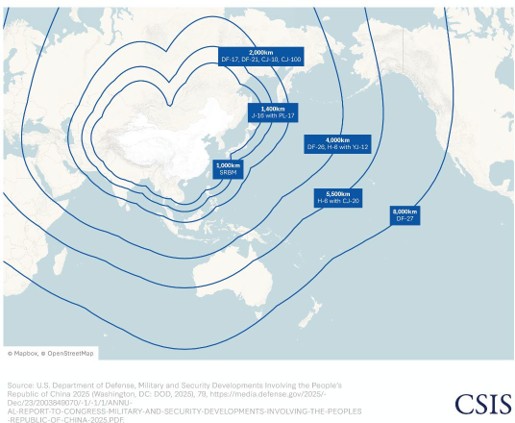
Figure 1: China’s Conventional Strike Capabilities and Ranges
As discussed later in this testimony, China, Russia, and North Korea’s expanding conventional and nuclear capabilities increasingly threaten the United States—including the U.S. homeland—in ways that did not exist in the aftermath of 9/11.
The United States also faces an evolving set of irregular—or gray zone—threats. Actions below the threshold of conventional warfare have long been an important component of statecraft.4 U.S. military doctrine refers to these types of actions as “irregular warfare.”5 Others have used such terms as gray zone activity, political warfare, asymmetric conflict, and low intensity conflict.6 Regardless of the term, the main components include:
Countries carry out these types of operations for several reasons. First, they allow military and intelligence agencies to conduct coercive activities below a level that is likely to trigger a costly or risky conventional war. Second, irregular and gray zone activity is relatively inexpensive for perpetrators. Unlike conventional war, these activities generally do not require vast sums of money or cause the perpetrator to suffer substantial casualties. Some of these actions—such as offensive cyber and influence operations—can also be done from a state’s own territory, a third country, or virtual networks that lie far from the target country. Third, these actions are often deniable and difficult to attribute. Targeted governments are frequently cautious about attributing them because they fear escalation or want to protect intelligence sources and methods.8 Fourth, actions below the threshold of conflict can impose costs on targeted countries. For example, Russian sabotage operations in Europe have caused hundreds of millions of dollars in damage to undersea cables, rail infrastructure, pipelines, and other infrastructure. Defensive measures to protect physical and cyber infrastructure can also be expensive.9
China: The most significant long-term threat to the United States likely comes from China, which uses a wide range of tools below the threshold of armed conflict to expand the influence of the CCP and weaken the United States. While some of these Chinese actions are overt, many are designed to be covert and deniable. The U.S. public and other international audiences are often unaware of the nature and scope of these activities, including those that target companies, government agencies, universities, news media, digital platforms, and other organizations. China’s activities are wide ranging and include:
These tools are not mutually exclusive but are overlapping, reinforcing, and occasionally even duplicative and competitive. Multiple organizations are involved, such as the PLA, Ministry of State Security, Ministry of Public Security, United Front Work Department, and Ministry of Foreign Affairs. A wide range of non-state or quasi-state actors are also involved, from hacktivists to private security companies.
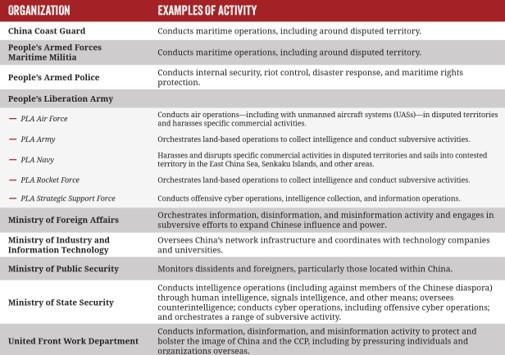
Figure 2: Chinese Organizations Involved in Irregular and Gray Zone Activity
China has several strategic goals in conducting irregular and gray zone activities. The most important is preservation of the CCP’s rule. Another is expanding Chinese influence and weakening the United States as part of balance-of-power competition. These goals are in line
with China’s national strategy of achieving “the great rejuvenation of the Chinese nation on all fronts.”12
Russia: Russia (and the Soviet Union before it) have a long tradition of conducting irregular and gray zone activities. During the Cold War, the Soviet Union developed an aggressive campaign to influence populations across the globe in ways that aided Soviet interests and undermined the United States and its allies, which was best captured in the phrase “active measures” (or активные меры).13 Today, Russian active measures support several types of foreign policy objectives:
Today, Russia is involved in a range of aggressive irregular and gray zone activity in the United States, from offensive cyber operations to espionage and disinformation. One of many recent examples is a Russian and Chinese intelligence campaign to spread disinformation on social media platforms about AI data centers in the United States.14 The Russian government has also conducted a campaign of sabotage and subversion—especially in Europe—designed to target countries, companies, and individuals that have provided support to Ukraine. Led by the Main Intelligence Department, or GRU, Russian attacks have included bombings, drone incursions, sabotage against undersea cables and pipelines, electronic attack, and cyber operations. Russia’s strategy has likely been to coerce governments and companies to stop providing assistance to Kyiv, deter Russian soldiers and citizens from defecting to the West, sow fear and division, and undermine public support for the Ukraine war.
Iran: Iran and Iranian-linked groups, such as Lebanese Hezbollah and the Houthis in Yemen, also pose an irregular and gray zone threat to the United States. Ayatollah Khomeini established the Islamic Revolutionary Guard Corps in 1988 to expand and improve Iran’s irregular warfare capabilities. The Quds Force (“Quds” is the Farsi word for Jerusalem) became Iran’s elite paramilitary arm, roughly equivalent to a mix of U.S. special operations forces and CIA paramilitary forces. It gathers intelligence, trains and equips partner forces, and conducts assassinations and bombings outside of Iranian territory.15 The Quds Force and Iranian-linked groups and individuals have plotted numerous attacks and assassinations inside the United States, including against U.S. President Donald Trump, former national security advisor John Bolton, and the Saudi ambassador to the United States.16 Iran has also engaged in a wide range of other irregular and gray zone activities, such as offensive cyber operations and disinformation campaigns.
Terrorist and Other Threats: The United States faces a significant threat from a range of terrorist groups, criminal organizations, and other non-state actors. Unlike during the period after 9/11, there is no clear paramount threat from a group like al-Qaeda. Instead, the United States faces formal groups, loose networks, and lone actors who are plotting to kill Americans and spread fear in the United States or otherwise threaten important U.S. security interests.17
Based on these threats, the U.S. homeland is more vulnerable than it has ever been, signaling an end of U.S. sanctuary. The homeland has, of course, never been entirely secure. The British burned Washington (including the White House) during the War of 1812, al-Qaeda terrorists attacked the United States on 9/11, and the Soviets posed a serious nuclear threat to the United States during much of the Cold War. The Japanese also struck Pearl Harbor before Hawaii was a state. Nevertheless, the Atlantic and Pacific Oceans have helped insulate the U.S. homeland from external attack, along with relatively friendly neighbors to the north and south.
Today, however, threats to the U.S. homeland are greater than they have ever been.
First, U.S. adversaries—such as China, Russia, and North Korea—have significantly advanced their conventional and nuclear capabilities to strike the U.S. homeland. China possesses a growing arsenal of land-based intercontinental ballistic missiles, such as the DF-41, which can hit targets across the continental United States; sea-based submarine-launched ballistic missiles, such as the JL-3, which can be launched from the PLA Navy’s nuclear powered submarines and can target locations across the U.S. homeland; and aircraft, such as the H-6N bomber, that can launch land-attack cruise missiles and air-launched ballistic missiles against the
U.S. homeland. In addition, Russia possesses a range of land-based intercontinental ballistic missiles, such as the RS-28 Sarmat and RS-24 Yars, capable of hitting the U.S. homeland; submarine-launched ballistic missiles, such as the Bulava, that can strike the continental United States from the Arctic or Pacific; and Kh-101 (conventional) and Kh-102 (nuclear) air-launched cruise missiles that can hit the United States from Russian aircraft. Finally, North Korea has intercontinental ballistic missiles, such as the Hwasong-18 and Hwasong-19, capable of hitting the U.S. homeland.18
During the Cold War, the U.S.’s nuclear arsenal was a deterrent against Soviet conventional and nuclear attack, including through the concept of Mutually Assured Destruction. But nuclear weapons are no longer a deterrent to conventional attack. Iran has conducted multiple attacks against nuclear-armed Israel with cruise missiles, ballistic missiles, and drones, as have Iranian partner forces such as Lebanese Hezbollah and the Houthis in Yemen. In addition, Ukraine has ramped up attacks against nuclear-armed Russia by orchestrating a series of short-, medium-, and long-range strikes to disrupt and destroy Russian logistics and supplies. Ukraine has struck several types of Russian targets with conventional weapons:
As Figure 3 illustrates, Ukraine has conducted long-range strikes (greater than 300 kilometers from Ukrainian territory) against such cities as St. Petersburg and Moscow. Ukraine has also orchestrated medium-range strikes (30–300 kilometers) against targets in Kursk, Kaluga, Belgorod, and other oblasts. Finally, Ukrainian forces have carried out short-range strikes (less than 30 kilometers) against thousands of targets just across the border in Russia and in Russian-controlled areas of Ukraine, such as Crimea.19
The implication is clear: the U.S.’s nuclear arsenal is no longer sufficient to deter conventional strikes

Figure 3: Location of Ukrainian Strikes in Russia, January 2025–June 2026
Second, there is an increase in irregular and gray zone threats and capabilities from state and non-state actors against the U.S. homeland. One example is the proliferation of commercially available, AI-enabled unmanned systems, which can be weaponized. Both Ukraine and Russia are building drones with longer ranges, higher payloads, a greater ability to evade electronic warfare and countermeasures, autonomy, and AI that allows for drone “swarming.”20 During Operation Spider Web in 2025, Ukraine smuggled drones into Russia inside of cargo trucks and conducted strikes that damaged or destroyed Russian military aircraft, including Tupolev Tu-95MS and Tu-22M3 strategic bombers.
U.S. military installations, nuclear power plants, and other critical infrastructure are experiencing a high volume of unauthorized drone incursions. Concerts, sports stadiums, transportation infrastructure, and other locations in the U.S. homeland are increasingly vulnerable to advanced unmanned air, ground, sea, and undersea systems. As Cathy Lanier, the Senior Vice President and Chief Security Officer of the National Football League, said at the Center for Strategic and International Studies in June 2026, “Our distance from our adversaries is no longer a sense of safety for us … If you think about just one mass gathering attack, the Super Bowl, we have 70,000-80,000 people, but we have a global stage.”21
Congress has made notable progress on countering drones, particularly with the passage of the Safer Skies Act. However, significant gaps in technology, bureaucracy, and implementation remain. There are still limited authorities for federal, state, and local officials to counter and mitigate the threat from drones. The Safer Skies Act does not grant counter-drone mitigation authority to private entities. Private venue operators, critical infrastructure owners, and hospitals remain legally barred from jamming or destroying unauthorized drones themselves. While the act provides a legal pathway for local authorities to intervene, commercial consumer drone technology is advancing much faster than the slow federal policy and equipment acquisition cycles. There is also a severe operational bottleneck caused by the Safer Skies Act’s requirement that all state and local law enforcement have to be certified by a single federal schoolhouse: the FBI’s National Counter-UAS Training Center in Huntsville, Alabama. More than 18,500 state, local, and correctional agencies depend on that training center, which opened in 2025.22 But only 61 officers had been official certified by July 1, 2026.23
In addition, there has been a significant increase in the offensive cyber threat to the U.S. homeland. Unlike traditional Chinese hacking groups that historically focused on intellectual property theft or political espionage, Volt Typhoon’s explicit mission was strategic sabotage of
U.S. critical infrastructure—such as power grids, water systems, communications hubs, and transportation hubs—that could be triggered in the event of a U.S.-China crisis.
Two and a half decades after 9/11, there is an urgent need to increase intelligence collection and analysis across federal, state, and local entities; identify and fix security gaps; and strengthen the American public’s resilience against enemies at home and abroad. This committee possesses the unique bipartisan oversight and legislative authorities to reshape the intelligence community for a new era. The 9/11 commission was helpful in improving intelligence sharing and coordination against an evolving terrorist threat. But U.S. intelligence efforts are far too siloed, under-resourced, and unprepared to deal with the evolving state-based threat to the United States—especially a U.S. homeland that is increasingly vulnerable to attack. I have included below several suggestions for consideration:
There are other steps that Congress should consider, but which fall outside of the jurisdictions of the House and Senate intelligence communities. One of the most significant is legislation that helps counter drone incursions in the U.S. homeland. While such legislation as the Safer Skies Act represents an important shift by granting state and local agencies the right to detect, track, and mitigate hostile drones, the legal and technical frameworks are still being established. Congress should also help ensure that the Department of Justice and the Department of Homeland Security have adequate appropriations to implement the mandatory national training and certification programs required for local officers. Congress should also build upon the Federal Communications Commission’s recent actions and consider establishing a clear framework allowing vetted, high-risk critical infrastructure operators to deploy approved counter-UAS systems under direct federal or state and local law enforcement supervision.
The 9/11 Commission report was instrumental in arguing that the United States faced a “generational challenge” from terrorist groups that threatened the United States.25 Today, there is a new generation of Americans and a new generational challenge—one based largely on adversary threats to the U.S. homeland and U.S. interests abroad. The United States is witnessing an end of sanctuary after decades of relative safety from foreign adversaries. President Dwight D. Eisenhower may have said it best in a radio address to the nation on May 19, 1953, when he emphasized the need for a sustainable defense of the nation, “A defense strong enough both to discourage aggression and beyond this to protect the nation—in the event of any aggression... This defense must, first of all, be one which we can bear for a long and indefinite period of time.”26
Please consult the PDF for references.