Emergency Episode: What's Happening with Korea? Military exercises, Kim Jong-un and Iran
August 17, 2026 • 2:45 – 3:15 pm EDT
Hosted by Korea Chair

A demonstration flight of the SBIR-funded Aeroviroment PUMA UAS.
Photo: JIM WATSON/AFP/Getty Images
Last year’s Small Business Innovation Research (SBIR) reauthorization debate was among the most contentious in the program’s four-decade history. Authorities lapsed for six months before April’s Small Business Innovation and Economic Security Act funded the program through 2031. As CSIS analysis noted during the debate, because the federal government does not produce standardized measures of SBIR performance, “it is easy for critics to cast doubt on the program’s efficacy.”
Nowhere was that clearer than in the debate over SBIR “mills.” Senator Joni Ernst (R-IA), whose INNOVATE Act typified the reform push, argued that firms with Beltway connections and grant-writing expertise “have been able to collect an outsized portion of the funding, with fewer results to show for it,” citing findings that the most frequent winners “were less productive in terms of commercialization, investments, and patents.” While Ernst’s proposed $75 million lifetime cap for grant recipients did not make it into law, similar reforms did, including agency-set annual proposal caps and a new premium award tier tied to matching private funds.
This prioritization of commercialization sits somewhat uneasily with the program’s origins. In 1945, Vannevar Bush, America’s wartime R&D cheif, published Science, the Endless Frontier, which argued that the government should fund the risky, long-term research that private industry would not. SBIR was an attempt to support such innovation outside of government labs and major corporations. The SBIR mill critique inverts this philosophy, treating the ability to attract private investment as the principal test of whether a firm deserves support from a program built to fund work the private sector would not.
Two business models coexist within the program today. Firms on the dual-use route develop commercial technology for both defense and civilian customers and finance that work partly with venture capital (VC). Firms on the defense route build for a single customer—the Pentagon—finance development through contracts, and are judged by the follow-on business they win. The two models are complementary: One imports commercial innovation into defense; the other sustains specialized capability that often has little commercial market. Any measure of efficacy must account for both.
Whether firms that win large numbers of SBIR contracts create demonstrably valuable innovation, as measured by conversion into follow-on defense contracts, patents, and private investment, sits at the heart of the debate. Conversion here means moving from subsidized awards to winning regular defense business, and it is the program’s own yardstick: SBIR’s statutory purpose is commercialization, and for defense technologies the paying customer is the Department of Defense (DOD). Fortunately, the question is answerable with records the government already publishes. Award histories sit on SBIR.gov. Federal contracts, including a flag identifying SBIR awards, appear on USAspending.gov. Patents and published measures of their significance are open data, and venture-style equity raises appear in Securities and Exchange Commission (SEC) Form D filings. New analysis links these records for all 10,280 firms that have won the more than 100,000 DOD SBIR awards since 1983. The combined dataset allows for the comparison of the 69 firms with 50 or more Phase II advanced-development awards (so-called SBIR mills) against awardees with three to nine awards (principally VC-backed firms).
Critics have argued that SBIR mills exploit permissive size rules and bureaucratic expertise to capture disproportionate funding, crowd out small innovators, and weaken technology transitions. Others have claimed the program has become a subsidy for grant-dependent research houses rather than a launchpad for innovation. Such arguments have spawned proposals to impose award caps, first-time-recipient requirements, and commercialization-focused funding. This drive to restructure the program, however, is informed by three structural misperceptions regarding the SBIR program:
1. Mills win awards but rarely “demonstrate commercial traction or follow-on contracts with non-SBIR dollars.” By that standard, however, the heaviest winners actually lead the program. Within five years of its first SBIR award, 71 percent of the 50-plus award group won at least one DOD contract of $50,000 or more outside the SBIR program, compared with 44 percent of the 3–9 award group (Figure 1). Over its time in the program, the median “mill” has won roughly 50 cents in non-SBIR DOD contract dollars for every SBIR dollar received, compared with 16 cents for the median firm in the 3–9 group. Nine in 10 of the heaviest winners have won production contracts at some point, compared with fewer than half of the 3–9 group. Reaching procurement is the norm for these firms, not the exception. Essentially, the firms that critics call mills are more likely than other awardees to become substantial defense contractors themselves, but they cross the “valley of death” through follow-on procurement rather than private investments. The public records show such transitions as contract activity; no dataset currently captures development into programs of record.

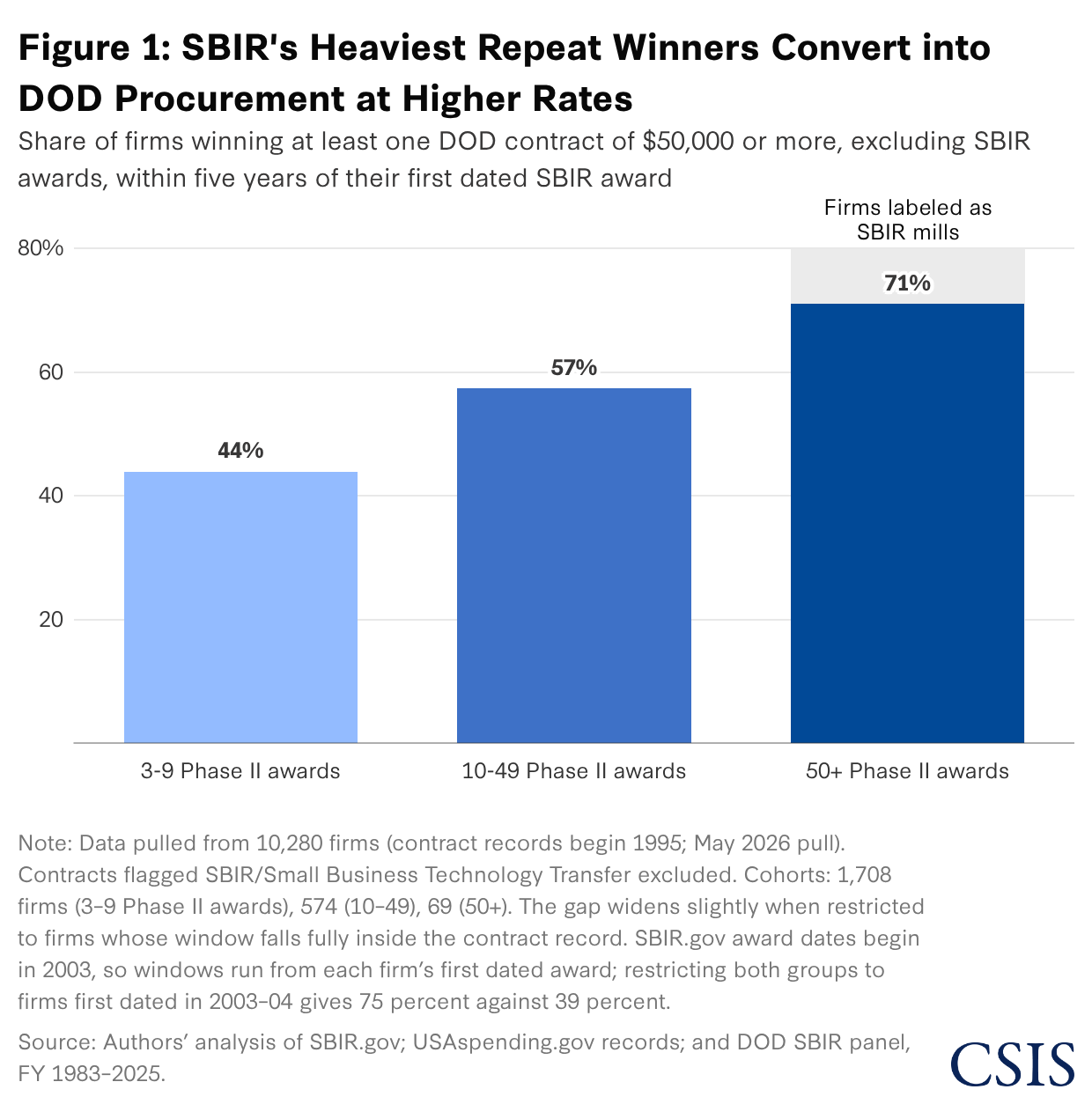
2. Mills innovate less. The Government Accountability Office found that the most frequent winners generate fewer patents per SBIR dollar. But at a per-firm rather than per-dollar level, the picture inverts: 55 percent of the heaviest winners produced at least one patent within five years of an award, compared with 30 percent of the 3–-9 group. On the standardized metrics of individual patent significance, the average mill patent scores about the same as patents produced by other SIBR recipients.
3. Mills rarely merit private investment. Here the record does show a gap. In the five years after an award, about one in 20 mills report a venture-style equity raise with the SEC, compared with roughly one in 10 of the 3–9 group (Figure 2). The problem is the presumption behind the critique: that every SBIR firm is, or should be, pursuing the dual-use venture model, and that those that do not are failing. That is a poor way to measure value, not least because the two pathways are complimentary: VC flocks to firms with dual-use potential, while defense specialists can continue to tap SBIR funds and pursue follow-on production contracts.
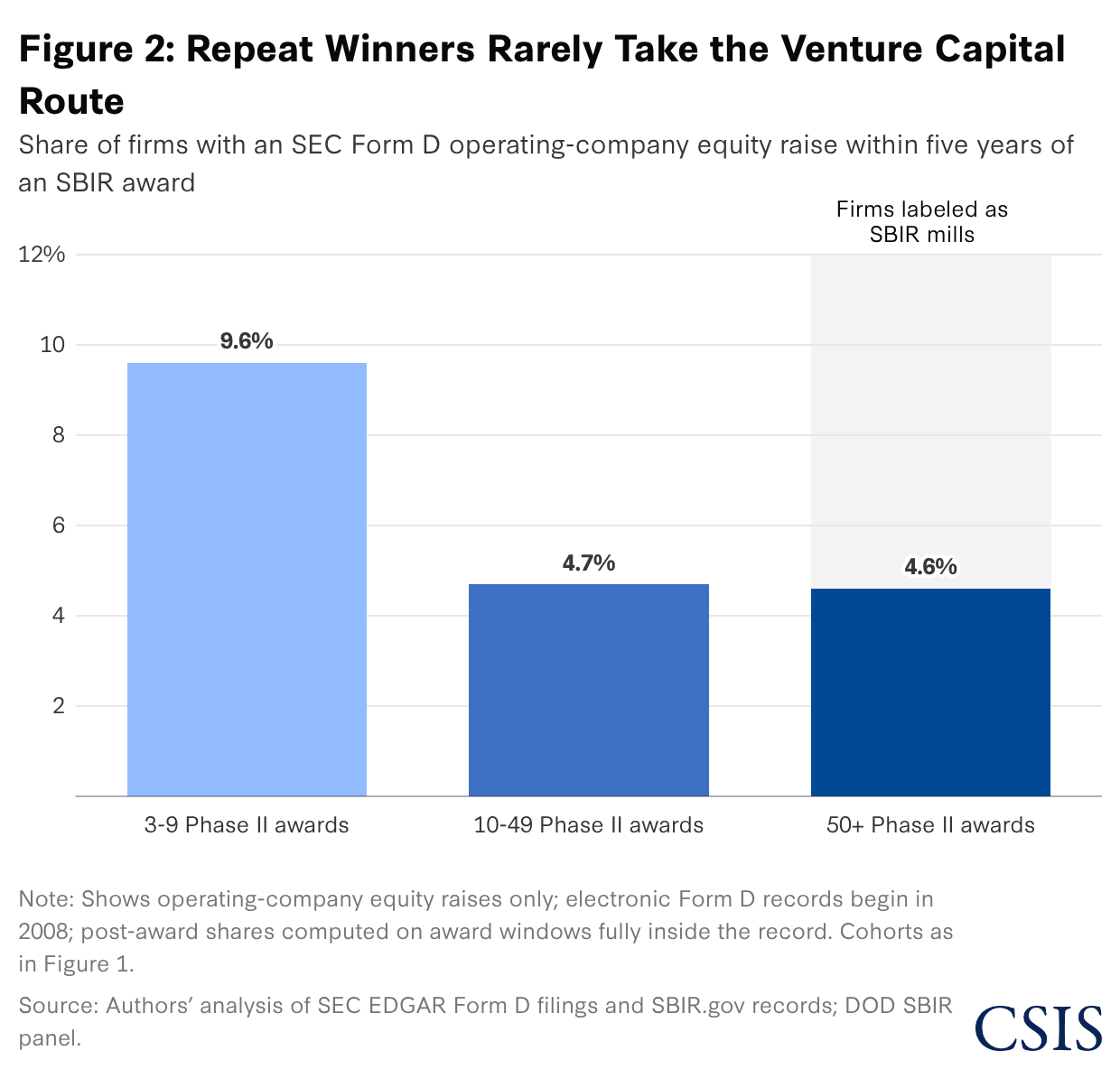
A firm with dual-use technology may take a single award to signal defense procurement expertise before raising private capital; in fact, some investors view repeated SBIR awards as a negative signal. Meanwhile, firms building defense-exclusive technology have historically faced difficulty raising private capital, making follow-on awards critical to their ability to deliver capabilities the DOD requires.
Together, these findings suggest mills are not gaming the system. Most are established defense contractors and patent holders in their own right. The dataset shows that only 7 percent of the mills are based in the Washington, D.C. area. Additionally, 59 percent of the heaviest winners held a $50,000-plus DOD contract before their first recorded SBIR award, and 55 percent issued a patent, each at least twice the rate of the 3–9 group. Additionally, approximately 80 percent of mills have pursued this business model for over 20 years. They simply commercialize through procurement rather than through the venture-and-exit track.
Congress appropriately prioritized swift reauthorization while also creating the Strategic Breakthrough Allocation, which offers awards of up to $30 million to firms that secure matching private capital or non-SBIR government funding. The provision is voluntary and could help all firms in the SBIR program. Its underlying assumption deserves scrutiny, however. The heaviest repeat winners already secure non-SBIR defense contracts at higher rates than other awardees, making award frequency a poor proxy for dependence on the program. Future reforms should focus on demonstrated outcomes.
Better measurement would make these outcomes more visible. Phase II applicants could disclose whether they intend to commercialize through private investment, commercial sales, federal procurement, or some combination of the three. The Pentagon’s November 2025 acquisition overhaul calls for clearer pathways from successful prototypes to production contracts. Establishing specific benchmarks for SBIR-derived technologies to qualify for sole-source Phase III awards would give that commitment a practical mechanism.
Reauthorization has secured the SBIR program through 2031. The next task is to build a system to better measure its results. Every finding in this analysis comes from public records that the government could systematize. They suggest that many repeat winners follow a distinct business model: develop technologies through SBIR funding and commercialize them through federal procurement. Venture-backed firms generally pursue a different path. Both models can generate meaningful value, and metrics that account for their complementary roles would help future discussions of the SBIR program more clearly assess its value.
Jacob Schwandt received his bachelor’s in economics at the London School of Economics and recently completed his master’s in economics and data science at the University of Cambridge, where he specialized on government procurement and in particular the SBIR program. Jerry McGinn is the director of the Center for the Industrial Base and a senior fellow in the Defense and Security Department at the Center for Strategic and International Studies in Washington, D.C.
The authors would like to thank Oliver Buntin, research assistant in the Center for the Industrial Base at CSIS, for his support on this piece.

Commentary by Jerry McGinn and Henry H. Carroll — September 15, 2025

Blog Post by Charles Wessner and Sujai Shivakumar — July 29, 2025

Critical Questions by Jerry McGinn, Alek Jovovic, and A.J. Dilts — March 17, 2026