Manila Strategy Forum 2026
September 9 – 10, 2026
Hosted by Southeast Asia Program

Photo: CSIS
Matthew Funaiole testified before the House Foreign Affairs East Asia and Pacific Subcommittee about how China’s increasing dominance in global shipbuilding threatens both U.S. competitiveness and that of its allies and partners in the Asia-Pacific.
Chairwoman Kim, Ranking Member Bera, distinguished members of the committee, I am honored to share my views with you on China’s dual-use shipbuilding industry and its implications for U.S. economic and national security. CSIS does not take policy positions. The views expressed in this testimony are my own and do not necessarily reflect those of my employer.
China has developed the largest shipbuilding industry in recent history and now uses it as an instrument of national power. Its leaders seek to displace the United States as the preeminent power in the Asia-Pacific and to project power far from China’s shores. Much of that ambition rests on a maritime industrial base encompassing naval and commercial shipbuilding, as well as shipping, ports, logistics, and maritime technology.
My testimony focuses primarily on the shipbuilding sector because it clearly demonstrates how the integration of military and commercial production creates strategic risks for the United States. China’s increasing dominance in global shipbuilding threatens to further erode the competitiveness of shipbuilders in key U.S. allies, particularly South Korea and Japan. What’s more, many of the Chinese shipyards that build the tankers and container ships that fill the world’s merchant fleets also build warships for the People’s Liberation Army (PLA) Navy.
By design, this ecosystem is opaque. Beijing obscures the ownership structures and military ties of its shipbuilding industry, making it difficult for foreign firms to fully assess the consequences of doing business with them. As a result, foreign orders, foreign technology, and foreign capital flow into the system, inadvertently helping to support China’s maritime industrial base.
These are not problems the United States can solve alone. Nor should Washington expect—or seek—to match China hull for hull in commercial shipbuilding. The objective should instead be to foster a more competitive global shipbuilding market in which a greater share of commercial capacity resides among trusted allies and partners. Expanding that capacity outside China will be a long-term undertaking requiring sustained commitment from the U.S. government and policies calibrated to manage adjustment costs, particularly those passed on to consumers.
A workable U.S. response requires three lines of effort: increasing transparency so companies can better assess the risks of placing orders with Chinese shipyards, investing selectively in segments of the maritime industry that play to U.S. strengths, and coordinating with allies and partners to align policy and expand industrial capacity.
China dominates commercial shipbuilding. From 2000 to 2025, China’s share of global shipbuilding output grew from less than 5 percent to more than 53 percent. The United States has not had a large presence in decades, but in recent years U.S. output has slowed to a trickle—to just 0.11 percent of the global share in 2024 and effectively none in 2025.1 The scale of China’s shipbuilding industry is difficult to overstate. A single state-owned conglomerate, the China State Shipbuilding Corporation (CSSC), builds more commercial vessels by tonnage each year than the entire U.S. shipbuilding industry has produced since the end of World War II.2 I dwell on these figures because any serious conversation about competing with China must begin with an honest assessment of the challenge we face.
Today’s market realities are the product of decades of sustained Chinese industrial policy. Beijing identified shipbuilding as a strategic industry more than 20 years ago and put the resources of the state behind it. One academic study estimates that subsidies from Chinese government entities totaled $91 billion between 2006 and 2013, equivalent to nearly half of China’s shipbuilding industry revenues during that period.3
As its shipbuilders grew more competitive, Chinese economic planners designated national champions—creating a list of handpicked yards approved for state financing and political support—and sustained that backing through boom-and-bust cycles that forced competitors elsewhere to downsize or shutter.
Direct subsidies to Chinese shipyards have slowed, but China’s broader industrial might continues to bestow advantages on the country’s shipbuilders. State-owned steel producers—which have come to dominate global production in their own right—supply Chinese shipyards with readily available, discounted domestic steel, allowing them to build ships more cheaply than many of their global counterparts.4 State-run banks also provide below-market financing to China’s major shipbuilders, driving down their borrowing costs and facilitating major capital investments.5
China’s maritime industrial base presents both economic and military challenges for the United States and its allies and partners.
Economically, China’s state-backed bid to dominate shipbuilding has upturned the global marketplace. While the United States has not been a major player in commercial shipbuilding for over 50 years, its few remaining commercial yards have been increasingly squeezed by China’s hold on the industry. Since 2010, three U.S. shipyards have shuttered or suspended operations, and employment in the sector has declined 15 percent, reducing opportunities for American workers.6
The industries of key U.S. allies have been hit even harder. South Korea and Japan have seen their combined share of global production fall from 58 percent to 38 percent over the last decade.7 Their loss of market share was initially concentrated in container ships, but they are increasingly losing share to China in more sophisticated areas of the industry, such as liquefied natural gas (LNG) carriers. European builders likewise face mounting Chinese competition in markets they have long led, such as cruise ships.
Future trendlines are even more worrying. Worldwide demand for new ships is booming, but new orders are increasingly flowing into Chinese shipyards. China holds over 60 percent of the global orderbook for new vessels, cementing its dominance for years to come.8
Beijing has a track record of using its economic and industrial advantages in other sectors to advance political objectives. In areas such as critical minerals and batteries, the United States has already begun reducing its exposure, but building alternative supply chains requires significant time and investment. The challenges in shipbuilding are less well understood, leaving policymakers with an incomplete picture of the dependencies China could exploit. Even the most ambitious efforts to reduce dependence on China will not remove it from the global marketplace. Rather, policymakers should ask what level of diversified shipbuilding capacity outside China is necessary to meaningfully reduce strategic risk.
Policymakers must also wrestle with military and national security concerns. China seeks to displace the United States as the leading power in the Asia-Pacific, and its maritime industrial base is critical to that effort. In China, commercial and military shipbuilding are not separate enterprises—they are deeply integrated. Nowhere is this clearer than in the case of the state-owned behemoth CSSC. With over 100 subsidiaries and affiliated shipyards under its banner, CSSC is the world’s largest commercial shipbuilding conglomerate as well as the principal builder of warships for the PLA Navy, producing everything from aircraft carriers to destroyers to submarines.
This is emblematic of Beijing’s military-civil fusion (MCF, 军民融合) strategy, which aims to fuse the country’s national security and economic development policies to simultaneously level up the defense industry and broader economy. At China’s major dual-use yards, gray hulls for the PLA Navy are built alongside container ships for Chinese and foreign customers, on shared infrastructure, with shared steel and dry docks. CSSC has spent billions of dollars to physically relocate several of its largest shipyards onto massive shipbuilding bases, like Changxing Island in Shanghai or Longxue Island in Guangzhou, enabling it to increase efficiencies between commercial and naval production.
This approach is, in part, aimed at leveraging commercial capabilities to support the PLA Navy. The chief engineer at CSSC’s Jiangnan Shipyard, one of China’s most prolific military and commercial yards, publicly called for the industry to “focus on the transfer of civilian technology to military technology, especially the transfer of shipyard civil shipbuilding methods.”9 The strength of China’s dual-use maritime industrial base has helped propel the rapid modernization and expansion of the PLA Navy, which already fields more battle force ships than the U.S. Navy and is projected to expand to roughly 425 ships by 2030. While the U.S. Navy retains important qualitative and technological advantages, China’s fleet is growing not only in size but also in capability.
China’s dual-use maritime industrial base could prove to be a vital advantage in a protracted regional conflict. Beyond replacing warship losses and repairing damaged vessels, China could draw on its commercial shipbuilding industry and merchant fleet to transport personnel, equipment, fuel, and supplies; expand sealift and logistics capacity; and rapidly produce or convert dual-use vessels to support military operations.10
China’s shipbuilding industry is a sprawling web of firms with complex ownership structures and overlapping commercial and military ties, many of which are intentionally obscured, making it challenging for foreign companies to navigate.
To address this problem, in March 2025, my colleagues and I published a comprehensive assessment of 307 Chinese shipyards that were active between 2019 and 2024. This assessment categorized each shipyard into one of four tiers based on their level of integration with the defense-related components of China’s maritime industrial base.
Market analysis of these shipyards showed that CSSC-owned shipyards (designated as Tier 1 and Tier 2) are among the most productive in China. Although they make up just 15 percent of China’s active shipyards, they produce roughly 40 percent of its commercial output by tonnage.
More than 75 percent of the commercial production at these yards between 2019 and 2024 was destined for buyers outside China.12 Many of these companies are headquartered in countries that are close U.S. allies and partners, including Denmark, France, Greece, Japan, South Korea, Singapore, Switzerland, and, strikingly, Taiwan.
China’s Shipbuilding by Tier, 2019–2024

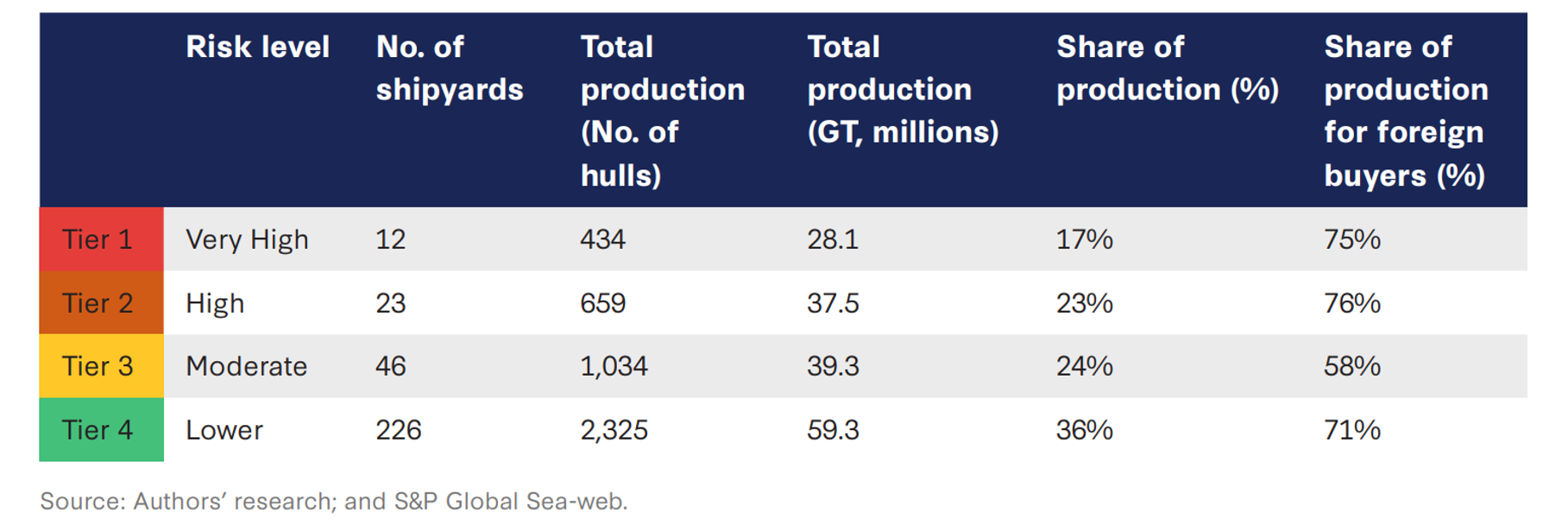
Owing to the dual-use nature of these shipyards, billions of dollars in foreign revenue flow into an integrated industrial ecosystem that supports both commercial and military activities. Although it is not possible to trace individual revenue streams across China’s largely state-owned shipbuilding sector, my assessment is that these revenues likely help offset shared fixed costs and support the broader industrial base on which China’s naval modernization depends.13 This approach does have some limits: Warships and commercial vessels have substantially different design and construction requirements, so integrating their production may create inefficiencies at individual shipyards. Nevertheless, Beijing has concluded that the strategic advantages of maintaining an integrated maritime industrial base outweigh those costs.
This integration also creates a significant transparency problem. Our research found no practical way to separate the commercial and military activities at many of China’s leading shipyards. Ownership structures, financial relationships, and production responsibilities frequently overlap. That opacity makes it difficult for foreign companies to understand how their commercial orders may be intertwined with China’s ongoing naval buildup.
Revenue flows are not the only concern. Foreign firms have also transferred dual-use technologies through joint ventures, licensing deals, and even direct sales, many of which have enabled the PLA Navy to clear technical hurdles in areas such as marine propulsion.14 Between 2013 and 2025, French and German companies directly sold hundreds of marine engines for use in PLA frigates and destroyers.15 Leading maritime technology companies have established joint ventures with military-affiliated firms to produce advanced systems like naval gas turbines and propellers in China. Foreign capital has also reached CSSC and its subsidiaries through financial markets, even after the U.S. government identified the company’s military role and placed 25 CSSC subsidiaries on the Commerce Department’s Entity List in 2020.16
China’s commercial success has left buyers with few viable alternatives. With capacity outside China constrained, particularly for large and technologically sophisticated vessels, many buyers have turned to Chinese shipyards not out of a fondness for Beijing but out of economic necessity. In many cases, China can offer shorter delivery times and lower costs than competing yards. The policy response, therefore, must wrestle with the underlying market conditions.
The United States is not going to build a commercial shipbuilding industry capable of rivaling China’s in the near term—nor should that be the objective. China’s position is the product of decades of sustained industrial policy, and no realistic strategy will erase that advantage overnight. The White House’s Maritime Action Plan recognizes this challenge, noting that “the United States does not have the capacity necessary to scale up the domestic shipbuilding industry to the rate required to meet national priorities.”17 Still, the United States can take actions to strengthen its own position and that of its allies. The goal should not be to replace China’s shipbuilding industry, but to steadily expand competitive shipbuilding capacity outside China.
I recommend Congress take a three-pronged approach: improving transparency so firms can make better-informed assessments, investing in segments of the maritime industry that play to U.S. strengths, and coordinating with allies and partners to align policy and industrial capacity.
First, promote transparency. The opaque nature of China’s policymaking system and the complexity of its sprawling shipbuilding industry make it difficult for companies to assess the trade-offs of doing business with Chinese shipyards. International firms have turned to Chinese shipyards out of economic necessity. The goal should not be to punish these companies for past dealings with Chinese yards but to create pathways for them to avoid doing business with China’s riskiest shipyards in the future.
One way the U.S. government can do this is by shedding light on China’s shipbuilding ecosystem. This can be accomplished by publishing regularly updated, unclassified analysis of which Chinese yards are tied to military production. Such analysis would be most effective if grounded in an assessment developed with allies to align views on the risks associated with supporting China’s maritime industrial base through commercial relationships.
Congress should mandate recurring, unclassified assessments of China’s dual-use shipbuilding industry. Those assessments should identify the shipyards producing warships and dual-use vessels for China’s navy, coast guard, or maritime militia; map the ownership networks of China’s leading state shipbuilders (CSSC and its subsidiaries chief among them); and, where possible, shed greater light on the financial relationships and revenue flows within China’s largely state-owned shipbuilding sector.
Second, compete with China on our own terms. The United States and its allies should focus their competitive efforts on the advanced and specialized segments of the industry, where China’s scale advantages are less pronounced. Those segments include new-energy and dual-fuel vessels, LNG carriers, icebreakers, undersea systems, research and support ships, and the high-end propulsion and autonomous technologies that will define the next generation of both commercial and naval platforms.
While China has grown more innovative, it still lags U.S. and allied companies at the leading edge of maritime technologies. Historically, its focus on state-directed consolidation and the prioritization of military demand has stifled competition and, by Beijing’s own record, bred corruption that has diverted resources from genuine innovation.18 However, China is now pushing hard to move up the value chain toward more advanced maritime technologies, such as autonomous navigation and new-energy propulsion.
The United States has an opportunity to compete at the forefront of maritime innovation, but this will require sequencing investments carefully, beginning with sectors where U.S. industry already has technological advantages before expanding into more complex areas. Identifying the ship types and industrial niches best suited for U.S. and allied investment should be an ongoing exercise as technology, global demand, and market conditions evolve. Congress can support this effort by establishing clear criteria for prioritization.
Congress should incentivize U.S. shipbuilding revitalization efforts in targeted areas. Specifically, Congress should provide tax incentives, low-cost financing, and other measures to drive investment into certain areas of U.S. industry, with a focus on high-value maritime components, systems, and emerging technologies, rather than focusing primarily on expanding broad commercial tonnage. Congress should also prioritize rebuilding U.S. shipbuilding capacity in areas most relevant to national security, such as the construction and maintenance of a strategic support fleet capable of advancing U.S. interests.
Third, coordinate with allies to fill gaps. Washington cannot afford to put competition with China on hold for decades while the United States builds up its own domestic shipbuilding capacity. Instead, the United States will need to bridge that gap by working closely with allies and partners, especially South Korea, Japan, and European powers with advanced maritime industries.
South Korean firms, in particular, have responded to decades of competition with Chinese companies by becoming extraordinarily efficient, operating advanced yards with highly trained workforces supported by automated systems. Leading South Korean firms are now actively investing in U.S. shipyards and workforce development.19 The United States should also look beyond traditional shipbuilding partners. India, for example, has articulated ambitious plans to expand its domestic shipbuilding industry and could become an increasingly important long-term player in building trusted global capacity.
Washington should develop a framework aimed at attracting a diverse range of allied investment and aligning purchasing so that more global demand flows to friendly builders rather than to China’s dual-use yards. Because shipbuilding investments require long-term planning, this framework should provide a consistent and predictable basis for cooperation for years to come.
Specifically, Congress should:
Please consult the PDF for references.
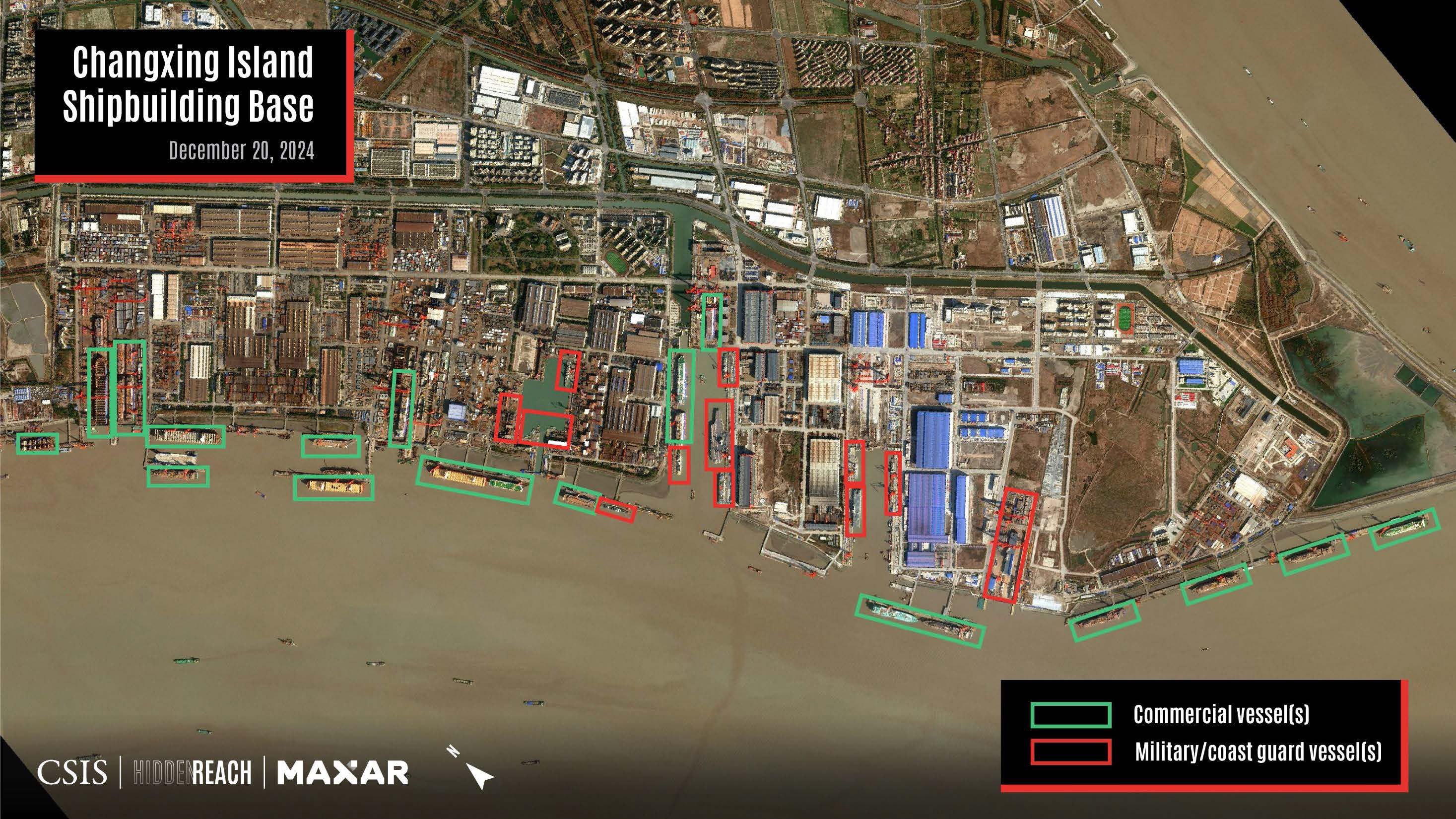
Integrated Commercial and Military Production Visible at Jiangnan Shipyard and Hudong-Zhonghua Shipyard on Changxing Island Shipbuilding Base, Shanghai
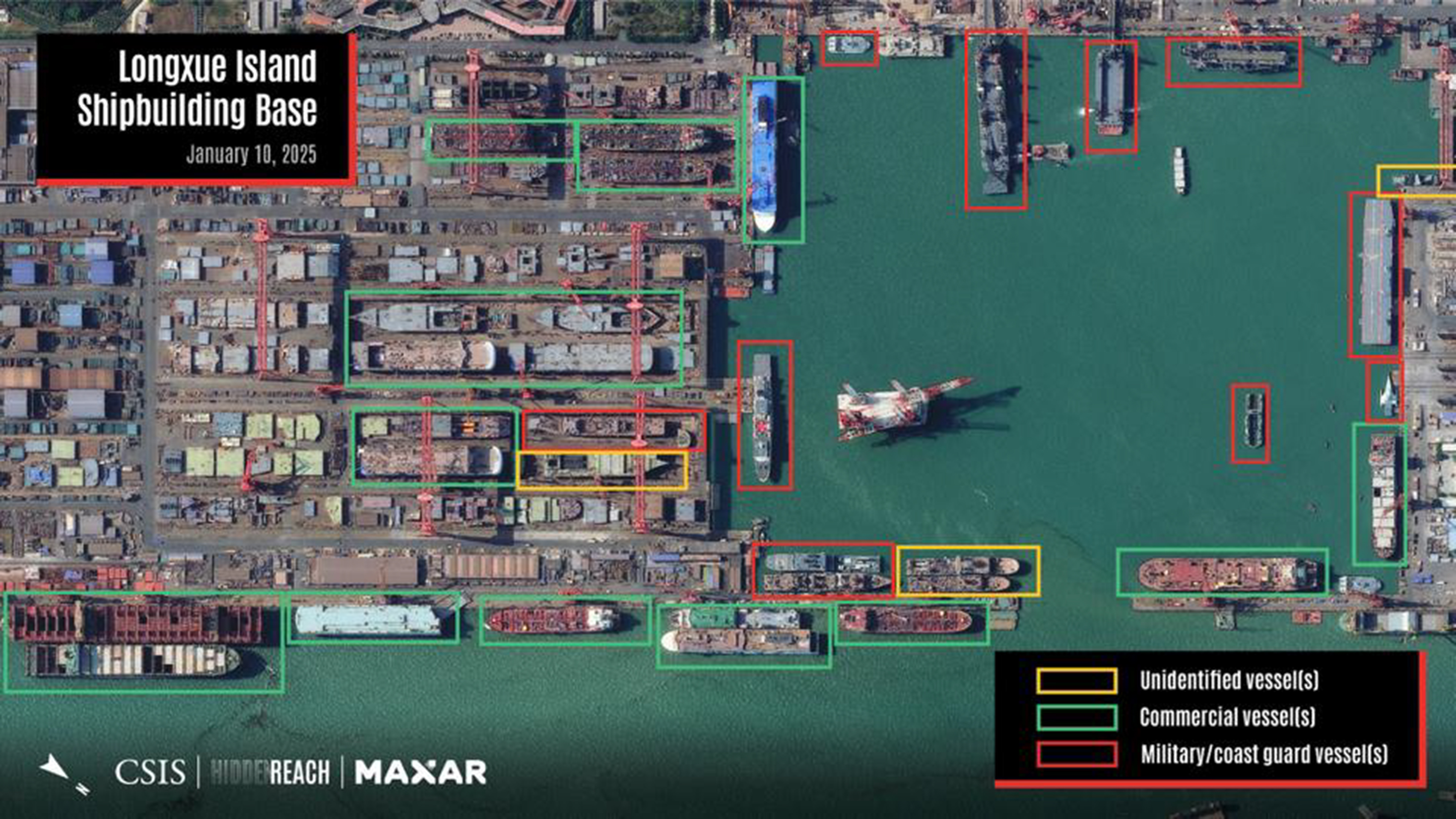
Integrated Commercial and Military Production Visible at Guangzhou Shipyard International on Longxue Island Shipbuilding Base, Guangzhou