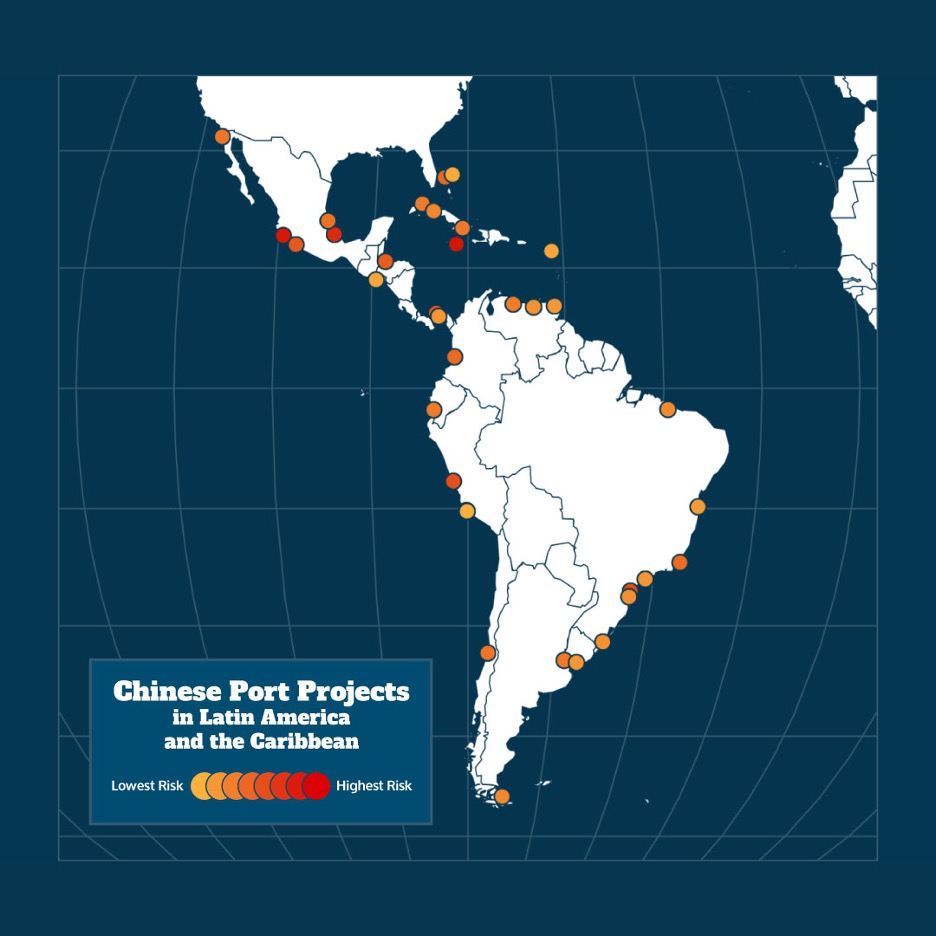
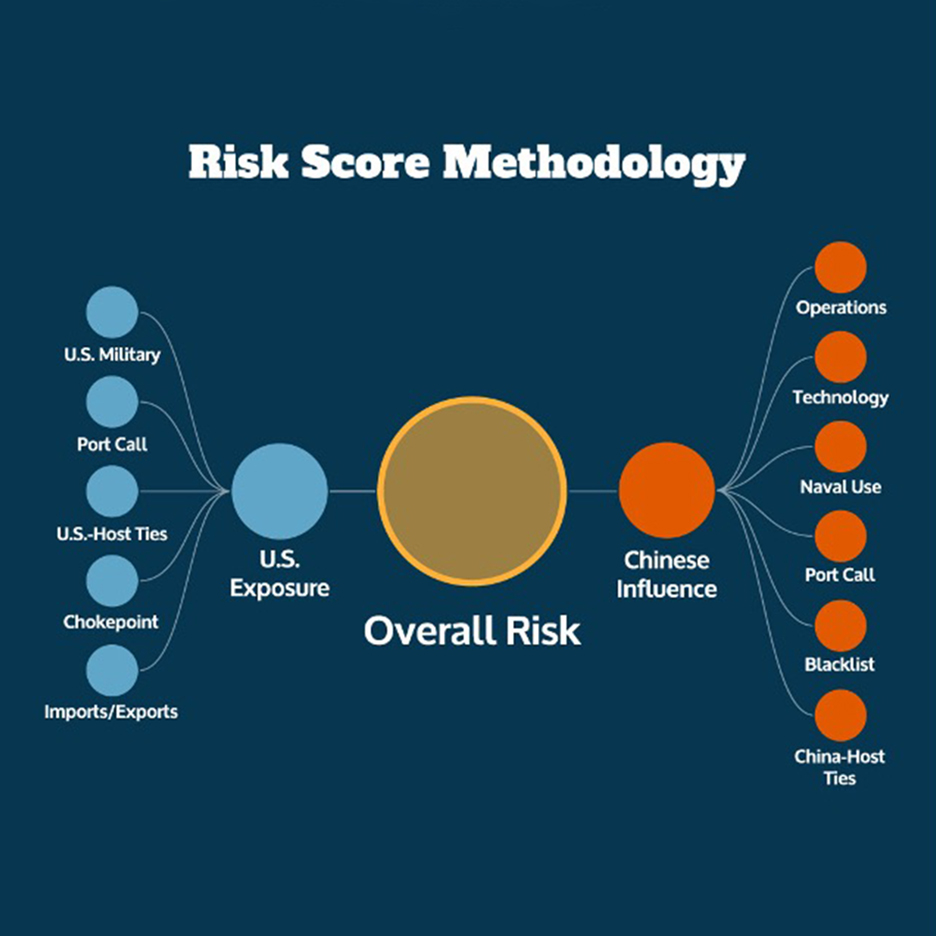
It is true that Chinese port projects often carry a hidden, or at least obfuscated, military objective. China’s inauguration of its first overseas military base in Djibouti, and the expansion of Chinese activity in Ream Naval Base in Cambodia suggest that the PRC is actively pursuing foreign naval base access.12 Meanwhile, in the United Arab Emirates, a Chinese construction project in the port of Khalifa was revealed by U.S. intelligence services to include military facilities within its premises. Another Chinese port construction project in Equatorial Guinea was later found to contain provisions in its contract that would ensure its facilities would be built to specifications allowing for the docking and replenishment of PLAN vessels.13
However, in the Americas, the possibility that ports investments could be repurposed to serve explicitly military fundtions seems remote. While ports operated by Chinese SOEs like Chancay, Peru, Kingston, Jamaica, and Paranaguá, Brazil are all large enough to host warships in addition to commercial vessels, strong anti-interventionist norms in LAC mean that negotiating military access in times of conflict would likely be a challenge.14 Even the United States has struggled to gain access to permanent military facilities in the region, with a recent referendum in Ecuador decisively defeating a measure that would have reversed the country’s current constitutional ban on foreign military bases. Chinese efforts to overtly establish a base in the Americas would also be viewed as highly escalatory by Washington—likely crossing a red line.15 For this reason, LAC has received the lowest number of port calls by PLAN vessels, and the majority of these have been conducted under the auspices of humanitarian missions by hospital ships like the Peace Ark and Silk Road Ark (including an ongoing mission to the region by the latter vessel).16
Although the appearance of grey-hulled PLAN warships in LAC ports seems unlikely, this does not mean China views its port assets in the region as militarily inconsequential. In peacetime, the ability to conduct port calls is a source of prestige and soft power, but in times of crisis or conflict, the sheer volume of trade that moves through ports allows them to become a potent source of intelligence, and an economic weapon.17 Approximately 80 percent of the world’s trade moves by sea, and in the case of the Panama Canal, fully 40 percent of U.S.-bound container traffic passes through that strategic waterway.18 Control over ports potentially offers China a remarkably granular window into the plumbing of the global economy. By seeing what goods are moving from where and to whom, the PRC could map out and identify key nodes and supply chain vulnerabilities for the United States. Even seemingly innocuous efforts to delay certain shipments, slow down port operations, or seize goods for additional inspection could have a cascading effect on economic security, while the total shutdown of port operations in a hub for trade with the United States such as Manzanillo, Mexico, could cost the U.S. economy more than $130 million a day.19
China could also leverage its power position in select ports to gain intelligence about U.S. military operations, including standard operating procedures and patterns of life that could help Beijing in a potential conflict in the Indo-Pacific. In 2025 alone, at least three U.S. warships called in to ports where Chinese companies operated at least one terminal. In April, the Arleigh Burke-class destroyer USS Gravely, docked in Veracruz, Mexico for a port call while conducting narcotics interdiction missions. In July, another Arleigh Burke destroyer, the USS Sampson, conducted a port call on Mexico’s Pacific coast in Manzanillo. Finally, the Ticonderoga-class cruiser USS Lake Erie docked in Hutchison-operated Balboa prior to transiting the Panama Canal to join the U.S. military buildup around Venezuela.20
The Hutchison Deal, Missing the Forest for the Trees
On December 7, 1999, the U.S. Congressional Subcommittee on Domestic and International Monetary Policy convened a hearing on the impending transfer of authority over the Panama Canal from U.S. to Panamanian hands. At the heart of the debate were concerns that, despite the Torrijos-Carter Treaties’ assurances of neutrality, a Panamanian-operated canal could open the door to adversarial influence, to the detriment of the United States’ strategic position in the Western Hemisphere. For critics of the impending transfer, the greatest threat stemmed from the People’s Republic of China. Dr. Tomas Cabal, a professor of business at the University of Panama and witness at the hearing, testified that “the truth of the matter is that the People’s Republic of China is rapidly filling the vacuum created by the departure of American military forces from the isthmus [of Panama]. . . Their presence adds to the danger of using the Colon Free Zone to purchase restricted technology with dual civilian-military use.”21
The specific actor filling the vacuum was the Hong Kong-based Hutchison Whampoa, which had secured leases in 1997 to operate two ports, Balboa and Cristóbal, at the Pacific and Atlantic approaches to the canal, respectively. Hong Kong itself had only two years prior come under Chinese sovereignty following the elapse of the United Kingdom’s 99-year lease on the territory. But while Hutchison Whampoa was itself ostensibly a private firm shielded from undue state interference under China’s “One Country, Two Systems” approach to the governance of Hong Kong, attendees at the hearing feared this was merely a distinction on paper. “Hutchison's chairman, Li Ka-Shing, is a key advisor to the Chinese leadership in Beijing. Mr. Li is a controversial figure who also serves on the board of China International Trust and Investment Corporation, which is a principal arm of the Chinese government and a technology acquiring source for the Chinese military,” Dr. Cabal testified.22 These concerns ultimately failed to scuttle either the handover of the canal or the expansion of Hutchison’s port acquisitions throughout the Americas.
More than two decades later, China has tightened its grip on Hong Kong, driving fears that what may have been credible safeguards against interference by the Chinese Communist Party in the 1990s no longer apply today. CK Hutchison Holdings, the rebranded version of Hutchison Whampoa, by 2025 had come to operate a total of seven ports in LAC via its subsidiary Hutchison Port Holdings. These include Balboa and Cristóbal, as well as four ports in Mexico, and Freeport in the Bahamas. Notably, Hutchison’s ports in Manzanillo and Veracruz ranked second and third overall on CSIS’ risk index, ahead of even the two Panamanian ports, owing mainly due to the high degree of U.S. exposure to the two ports.23 Economic risk is especially relevant here as the two ports are hubs for seaborne trade with the United States, while the United States has conducted military port calls at both in 2025.
Nevertheless, the Panama Canal issue continued to loom the largest, and in April 2025, Secretary of Defense Pete Hegseth visited Panama to sign a host of agreements aimed at allaying U.S. concerns over access to the Canal, including opening four former U.S. military bases along the Canal Zone which would host U.S. troops on a rotational basis. “China did not build this canal, China does not operate this canal and China will not weaponize this canal,” Hegseth remarked at a joint news conference.24 Prior to his visit, CK Hutchison also announced a landmark agreement with U.S. asset management firm BlackRock to sell 43 of its overseas ports, including all seven LAC sites, to a consortium headed by the latter company as well as the Swiss-Italian Mediterranean Shipping Company.25
This announcement drew harsh criticism from China, which opened an investigation into the deal spearheaded by the PRC’s State Administration for Market Regulation. Pressure from Beijing meant that the deal as initially conceived fell apart, and Hutchison, hoping to salvage the sale, allowed Chinese state-owned shipping company COSCO to enter the consortium of prospective buyers. Reports differ as to what exact role COSCO would have in a final agreement, ranging from a minority position with “veto rights,” presumably to ensure future deals could not be made behind China’s back, to demands for an outright majority ownership share.26 Nevertheless, these negotiations were interrupted when, on January 29, 2026, the Supreme Court of Panama ruled that Hutchison’s leases on Balboa and Cristóbal were unconstitutional and ordered the company to relinquish the two ports.27
It may be tempting for the United States to declare victory and retire, but nothing could be more dangerous for U.S. maritime security. While the ruling significantly reduces the CSIS risk scores for Balboa and Cristóbal, Hutchison’s five other port holdings in Mexico and the Bahamas could see their risk scores skyrocket if COSCO secures a majority or even a minority stake.28 The fact that China has seemingly ordered COSCO to cease shipping to Balboa in retaliation for the Panamanian court’s ruling should be further evidence that China views the state-owned company as an instrument of geoeconomic coercion.29 Without sustained attention on the Hutchison-BlackRock deal, the United States could find itself having scored a tactical victory, but suffering a strategic defeat.
Influence and Opportunity Costs in Chancay
The inauguration of the port of Chancay, Peru, during the November 2024 APEC summit was a watershed moment for China’s presence in LAC. While the PRC had been steadily expanding its presence in regional ports for decades by that point, and Chinese SOEs already held significant sway in megaports like Paranaguá and Kingston, Chancay was the first port in the Americas to be built from scratch and subsequently operated by a Chinese state-owned company. Again, COSCO would take center stage as the entity behind the promised $3.5 billion investment which aimed to transform Peru into China’s new gateway to South America. Indeed, according to a recent analysis of the port’s development in Asia Policy, “[t]he port cuts shipping times from Peru to China by one-third and reduces logistics costs by at least 20%.”30
But in March of 2024, just months before Chancay would open its gates, Peru’s National Port Authority requested the annulment of the 2021 agreement the government signed with COSCO. According to the agency, an “administrative error” meant that Peru had signed away exclusive rights to COSCO to operate the port, in contravention of Peruvian law.31 In response, COSCO threatened arbitration and to withdraw from the project entirely, leaving Peru with a partially-built port and dreams of newfound prosperity deferred. Facing this unenviable alternative, Peru chose instead to amend its ports law, allowing for a 30-year period of exclusivity for private ports.32 In the process, China showcased a new playbook for wielding influence through infrastructure. For years, China’s repossession of the Sri Lankan port of Hambantota was regarded as the archetypical case study of how the PRC leveraged investment for strategic ends. Today, however, the playbook looks more like Chancay, where Chinese firms leverage countries’ need for development and the lack of credible alternatives, to cut favorable deals.
Chancay also illustrates an underappreciated dimension of Chinese port investments, their vulnerability to capture by organized crime.33 Shortly after it opened, the port became a magnet for narcotrafficking activity, as criminal networks were eager to move into the once-quiet fishing town that found itself South America’s new gateway to the world. According to a September 2025 report from Bloomberg, extortion in Chancay is up 25 percent since the port has opened, while the province the city is located in now reports the fifth-highest homicide rate in the country.34 For the time being, organized crime seems to be opportunistic in nature, mainly driven by increased economic activity in the city of Chancay rather than the port itself. However, Peru is the second-largest coca growing country in the world, and while narcotraffickers previously relied on Ecuadorian ports to move their contraband, Chancay has allowed them to diversify. China itself has been complicit in the plundering of South American fisheries including in Peru, via its deep-water fishing fleet, which ranks among the most notorious perpetrators of illegal, unreported, and unregulated fishing. The same year Chancay opened, the Peruvian government intensivied efforts to track illegal fishing vessels within its exclusive economic zone, though this has not ended their predations but merely pushed the fleets further south to Chile.35
Both COSCO and the PRC were seemingly unprepared for this possibility, but the nexus between Chinese owned and operated ports and criminal activity is a trend deserving closer investigation. Several of Hutchison’s port holdings in Mexico have come to be associated with criminal activity, from Lázaro Cárdenas, which in 2013 was used heavily for iron ore smuggling to China, to Manzanillo, a key source for fentanyl precursors arriving from China, and even Ensenada, which a Reuters investigation recently highlighted as playing a role in Mexican cartels’ fuel theft rings.36 To be clear, it remains unclear whether Chinese owned and operated ports are more vulnerable to criminal penetration than other ports, but Beijing’s predeliction for opacity in its business dealings, coupled with the dramatic rise in China-LAC trade over the past two decades certainly appears to have created new opportunities for organized crime.37
China has also set the stage for durable influence through Chancay. When it opened, the port had a capacity of approximately 1 million twenty-foot equivalent units (TEUs) per year, a figure which, while impressive, would place the port well below other regional hubs like Santos or Manzanillo which moved 4.3 and 3.7 million TEUs in 2023, respectively.38 Peru is banking on continued investment by COSCO to expand the port, as well as the construction of a much-anticipated Bi-Oceanic Railway Corridor that would link Brazilian agricultural and mineral resources wit Peru’s Pacific coast.39 This infrastructure has yet to materialize however, meaning that Peru cannot afford to alienate China if it wants the transformative economic growth Chancay was marketed with. For the United States, this means PRC influence in Peru could prove far more resilient than in Panama, and even if such efforts proved successful in getting Chancay out of COSCO’s hands, China has other irons in the fire in South America.
Brazil, China’s Next Best Hope
Brazil stands out as the country with the greatest growth potential for Chinese port investments. Seven of the 37 ports identified in CSIS’ dataset were located in Brazil, the most of any country in LAC. All seven of these projects also featured at least one SOE, meaning that China can expect to exercise a greater degree of control over the process and subsequent operation.40 Furthermore, several key projects were launched in the past eight years into specialized export terminals aimed at increasing China’s supply chain security for energy and agricultural products.
These projects include the Port of Açu, Brazil’s largest export terminal for Very Large Crude Carriers, where state-owned China Merchants Port moved to acquire a 70 percent stake in 2025.41 With the United States is leaning heavily on Venezuela to curtail its ties to China, Brazil, a country that could produce more than five million barrels per day by 2030 according to some projections, which would make it a top five oil producer globally, offers an appealing hedge in a chaotic global oil market. In a similar fashion, Chinese state-owned agricultural giant COFCO also acquired the STS11 grain export terminal in Brazil’s Port of Santos, while the China Communications Construction Company helped to develop the Babitonga Grain Terminal in São Francisco do Sul.42 These investments have both proven prescient as U.S. soy exports to China have cratered amid trade tensions, while Brazil has picked up a windfall of new business exporting to Beijing and backfilling U.S. orders. Most recently, the South China Morning Post, reported on overtures from both COSCO and China Merchants Port seeking to be allowed to bid on a tender to develop a new container terminal at the Port of Santos, efforts that have raised scrutiny from the U.S. embassy in Brazil.43
Brazil is also an appealing partner for China as the current government of President Luiz Inácio Lula da Silva has shown itself willing to weather U.S. economic pressure. Even under the previous Bolsonaro government, China’s trade with Brazil continued to increase due to strong macroeconomic complementarities.44 Notably, Brazil welcomed the arrival of the PLAN’s Silk Road Ark hospital ship, which sailed into Rio de Janeiro in January 2026. The ship has since been denied authorization to operate in Chile as Santiago seeks to pivot towards Washington.45 Even in the event of a realignment between Brasília and Washington, China is likely counting on this fact to ensure that its investments in Brazilian port infrastructure remain relatively secure.
Brazil nevertheless is at a geographic disadvantage for China. The country lacks a Pacific coastline, meaning all exports must either pass through the Panama Canal, or south, through the Drake Passage or Strait of Magellan. To correct for this, China has long sought to acquire a strategic port in the south of Chile or Argentina, oscillating between the two as opportunities arise.46 The Brazil-Peru railway project is also an effort to develop a land connection in the event of disruptions to the maritime routes. Finally, China’s indignation over the loss of Hutchison’s Panamanian ports should be understood as evidence of the strategic importance Beijing accorded to the Panama Canal.
More than a Port, Infrastructure as a Tool for Power Projection and Influence
While ports are doubtless key elements of China’s strategic advance in the Americas, they represent but one type of infrastructure that the PRC has invested in. Within the maritime domain alone, China has made significant strides in exporting its physical and digital technologies far and wide. Perhaps the most concerning exorts in this regard are ZPMC cranes and Nuctech scanners. ZPMC is the foremost supplier of ship-to-shore cranes globally, with an extensive presence in U.S. ports as well. Indeed, a 2024 report by the U.S. House Select Committee on Competition with the CCP found evidence that ZPMC cranes were outfitted with unauthorized communications equipment, rendering them a potential intelligence risk.47 Nuctech provides cargo scanners and port security equipment, often at heavily discounted rates to ports in LAC. While it is officially a private company, China’s web of national security laws ensures that the PRC could likely requisition the firm’s records whenever it should need them, if it is not collecting this information already.48
At least 17 of the 37 ports in CSIS’ database were confirmed to sport ZPMC cranes, while nine had taken delivery of Nuctech scanners.49 However, because this equipment is sold independently to ports, PRC technology has proliferated to several LAC ports even where non-PRC companies oversee operations. Often ZPMC and Nuctech boast features that make them appealing to port operators but present major risks at the strategic level. For example, Nuctech scanners can reportedly be integrated into local law enforcement databases to cross-reference the biometric data of port workers with government records.
Beyond ports themselves, China is actively working to fuse commercial investments with infrastructure in an effort to cement its control over key supply chains. In Peru, copper miner Jinzhao is set to become the second Chinese firm to acquire a port in the country, investing more than $400 million in the San Juan de Marcona terminal to facilitate the company’s mineral exports from its nearby Pampa de Pongo project.50 China has also invested in the 580,000 square meter Phoenix Park Industrial Estate near Point Lisas, Trinidad and Tobago’s second-largest seaport, and is working to develop a new Special Economic Zone in partnership with the government of Antigua and Barbuda.51 These projects illustrate how ports themselves can act as launch pads for further PRC influence in host countries’ economies.
Another emerging challenge stems from China’s investments in energy generation and distribution infrastructure in LAC. The PRC has poured billions into hydroelectric dams, solar projects, but also more recently into acquiring electrical utilities. These investments have steadily accreted more and more influence in the hands of Chinese companies, which are estimated to control approximarly 12 percent of all power distribution in Brazil, more than half of all distribution in Chile, and fully 100 percent of electrical transmission to the 11 million inhabitants of Lima, Peru.52 Many of these investments transpired through acquisitions—and because few countries in LAC possess a CFIUS-like institution to scrutinize inbound foreign investment.
Ultimately, control over critical infrastructure may represent China’s most important lever of influence in the face of a more strident U.S. approach to the Western Hemisphere. While China cannot match the globally-scoped financial sanctions architecture the United States has crafted, it can clearly hold at risk large segments of the physical economy in countries that have welcomed billions in PRC investment. For countries that depend on Chinese firms to operate their ports, maintain their power plants, and expand their road and railways, the prospect of losing such a partner surely gives some governments pause. Accordingly, for the United States, putting forward a resource-backed counteroffer to China’s infrastructure projects is not merely a matter of showcasing goodwill, it could make or break the White House’s current effort to restore U.S. primacy in its own hemisphere.
Policy Recommendations
- Incentivize Port Buybacks and Buyouts. Although COSCO’s efforts to acquire a stake in the consortium represent a major strategic risk, at the time of its announcement the Hutchison-BlackRock deal was a coup for the United States. In one fell swoop, the United States successfully leveraged political pressure and private capital to transfer 43 overseas ports into safer hands. Congress should, at a minimum, raise awareness of Hutchison’s holdings in LAC ports outside of the Panama Canal zone, and seek to ensure that any final agreement does not allow COSCO to expand its reach into ports in Mexico and the Bahamas. Washington must also go on the offensive to try and limit China’s ability to further penetrate the regional port ecosystem. The recently re-authorized U.S. International Development Finance Corporation is perhaps the best tool in Washington’s arsenal to compete with China on ports. The DFC’s expanded remit and higher capital ceiling are welcome developments, but the agency’s finances are not unlimited. The DFC should explore partnerships with U.S.-aligned port operators and consortiums, taking a minority stake with the condition that ports managed by these entities cannot be sold to PRC companies, or acquire sensitive technologies from China-linked firms without DFC approval.53 Other agencies, including the Department of Commerce, U.S. Export-Import Bank, and Department of State must also play a role in identifying major upcoming port tenders and ensuring that U.S. firms are brought in to compete in line with the 2025 National Security Strategy’s exhortation that “[a]ll our embassies must be aware of major business opportunities in their country, especially major government contracts.”54 In some cases, a relevant U.S. company may not be available, but an allied country may be able to fill the gap. While ZPMC dominates the ship-to-shore crane business, Japan and Korea both manufacture these devices as well.55
- Avoid Port Calls at PRC-Influenced Ports. As the United States increases its military presence in the Western Hemisphere, it must ensure that this does not expose U.S. forces to operational security risks. U.S. Navy and Coast Guard vessels must accordingly avoid conducting port calls at facilities where China exercises undue influence. Beyond this, the United States should also endeavor to map out ports where the presence of ZPMC cranes, Nuctech scanners, and PRC-provided security cameras could allow China to surveil even without an ownership or operational stake in the port itself. Where possible, the United States should work with LAC governments in the region to identify secure locations, such as naval bases, where U.S. warships can conduct resupply when deployed to the region. To this end, the recent authorization of $1.5 billion in foreign military sales to Peru to help the country modernize its naval base at Callao is a welcome development.56 While Callao does not eliminate the risk posed by Chancay to the north, it hopefully will provide a locus for U.S.-Peru naval cooperation that is better insulated from potential prying eyes.
- Add a Port Security Pillar to the Shield of the Americas. The United States must recognize that China’s influence in regional ports is, to an extent, here to stay. While efforts to box China out from future investments are important, the increased presence of PRC SOEs in port ownership and operations means Beijing’s influence over key sites like Chancay will be difficult to displace. In these cases, the United States should lean on its comparative advantage in security cooperation to ensure that partner governments have the tools at their disposal to inspect port facilities, deter organized crime, and identify potential malicious activity. Especially given the elevated presence of criminal activity around Chinese-operated ports, the United States should seize upon the momentum of the recent “Shield of the Americas” summit, and Americas Counter Cartel Coalition to highlight the nexus between China and organized crime.57 Agencies like the Department of State’s Bureau of International Narcotics and Law Enforcement Affairs should increase trainings for customs officials and facilitate the transfer of best practices on port inspections to ensure partner governments have full visibility into their ports.58
- Leverage the Army Corps of Engineers. Construction and modernization are also key challenges for LAC ports, many of which need significant work on dredging channels and extended piers to accommodate larger vessels. China can move quickly to meet partner government requirements, and indeed, 21 of the 37 ports in CSIS’ database involve construction by a Chinese company in some way shape or form.59 Meanwhile the United States suffers from a paucity of private companies capable of undertaking large-scale port development efforts. The United States Army Corps of Engineers could step in for these cases to help LAC governments build up their ports for the modern age. In the summer of 2025 the corps signed a letter of agreement with the government of Guatemala for a $110 million project to modernize the country’s Pacific and Atlantics ports in a major step forward for the country’s export potential.60 The United States should consider expanding partnerships with the Army Corps of Engineers to other countries in the region as a means of competing more effectively with China in the ports construction space.
- Promote Investment Screening Best Practices. China is able to expand its influence in LAC in no small part thanks to the absence of strong investment screening mechanisms. Unlike in the United States, where the Committee on Foreign Investment in the United States (CFIUS) plays an important role in domestic economic security, equivalent agencies in LAC are either disempowered and underfunded, or else absent entirely. In the case of Chancay, for instance, a more careful investment review process could have detected the “administrative error” granting COSCO exclusive operational control before the deal was inked. Bolstering government systems can go a long way towards empowering U.S. allies in the Americas to recognize problematic investments when they arise and respond appropriately. The United States should consider leading a delegation from CFIUS to visit with key LAC partners in order to transmit best practices and socialize ideas around foreign investment monitoring in the region.61
- Shift Messaging from Malign Influence to Defending Sovereignty. U.S. rhetoric towards China routinely falls upon deaf ears in LAC. Often countries either do not perceive downside risks to partnering with China, or otherwise recognize the risks of PRC port and infrastructure deals, but believe that they have no other credible offers to meet their development goals. At the same time that the United States was threatening to seize the Panama Canal and pressuring Hutchison to the negotiating table with BlackRock, Panama’s Comptroller General released the findings of an audit which concluded that Hutchison owed the Panamanian government some $300 million in unpaid fees, taxes, and penalties. What was a geopolitical concern for Washington was a corruption concern for Panama City.62 Similarly, the surge in criminal activity around Chancay following the opening of the port has failed to capture headlines in the same way that stories about great power competition have, but LAC countries may be more wary of launching new PRC-backed port ventures if they feel Beijing lacks a credible security plan. Washington should not seek to convince partners that China’s investments are uniformely bad, but rather to give these countries the tools to discern for themselves what types of influence are corrosive to their sovereignty and what are not. In doing so, the United States should seek to enlist countries like Panama to be interlocutors who can share their experiences dealing with PRC pressure campaigns and provide advice to the rest of the region.
Please consult the PDF for references.