Energy Shots | Fracking Flashback and Data Center Demand
August 14, 2026 • 9:30 – 10:00 am EDT

Photo: Konstantin Yuganov/Adobe Stock
Creative industries are a source of economic growth, contributing to the U.S. dominance of digital platforms and its service export surplus. At the same time, they are also part of broader digital ecosystems and long-term international influence, as competition over global audiences and information space intensifies. As Japan moves to strengthen creative industries as a strategic pillar of its long-term economic competitiveness, it is a perfect partner to work with the United States to enhance industrial collaboration and audience engagement across the Indo-Pacific. By combining their complementary strengths, such as Japan’s globally competitive intellectual property (IP) and the United States’ digital platforms, the two countries can expand their global reach, deepen digital trade, and compete more effectively in an increasingly contested entertainment market. They can also work together to shape the information environment in positive ways while strengthening U.S.-Japan relations through people-to-people ties in the long term.
Creative industries, such as cultural expressions, media and entertainment, creative services, and digital- and technology-based content, are no longer treated as niche sectors but are now widely regarded as important engines of economic growth. Digital platforms have given creative sectors several attractive economic characteristics—high value-added potential, low marginal distribution costs, scalability, and resilience to physical supply chain disruptions. The global entertainment and media market reached nearly $3 trillion in 2024, roughly three times larger than the global semiconductor market, and it is projected to expand by an additional $577 billion by 2029. Global exports of creative services more than doubled over the past decade, reaching $477 billion in 2024 and growing at an average annual rate of 8 percent.
The United States remains a global powerhouse in the entertainment industry. Arts and cultural production account for 4.2 percent of U.S. GDP, while the sector generated a trade surplus of $36.8 billion in 2023. For decades, the United States has been the world’s leading producer of entertainment content, creating globally recognized entertainment franchises such as Mickey Mouse & Friends, Star Wars, Barbie, and Batman. Today, its greatest competitive advantage lies in powerful global distribution platforms—Netflix, Amazon Prime Video, YouTube, and Disney+—which enable U.S. firms to reach consumers worldwide instantaneously and at unprecedented scale. Netflix provides a striking example: More than half of its $40 billion in annual revenue is generated outside North America. More broadly, the U.S. digital entertainment sector maintained a trade surplus averaging more than $10 billion annually between 2020 and 2024, “larger than each of the telecommunications, transportation, insurance, and health-related services sectors.”
However, competition among digital entertainment ecosystems is intensifying. China has also made remarkable progress in the quality and competitiveness of its film and animation industries. Ne Zha 2 became the world’s highest-grossing film of 2025 despite deriving most of its revenue from the Chinese domestic market, marking one of the most significant box office achievements ever by a non-Hollywood production. Competition is even more serious in the gaming industry. Chinese firms such as Tencent, NetEase, and miHoYo are rapidly expanding their international presence. Supported by scale, capital, and a vast domestic user base, Chinese companies are emerging as major global players, especially among younger audiences. Chinese game publishers reportedly account for nearly half of global mobile gaming revenue. Tencent’s investments in U.S. gaming companies, including Epic Games in North Carolina and Riot Games in California, further demonstrate how Chinese firms are integrating themselves into the broader global entertainment ecosystem.
This competition matters because creative sectors have a strong ripple effect in other industries and fields. IP is a crucial national asset; IP-driven businesses generate long-term compound value through licensing, merchandising, and cross-platform adaptations. IP also serves as a hub and entry point for other industries through advertisements or other related information. This is, in other words, a competition over which platforms, ecosystems, and stories become the default backdrop of daily life for the next generation of global audiences.
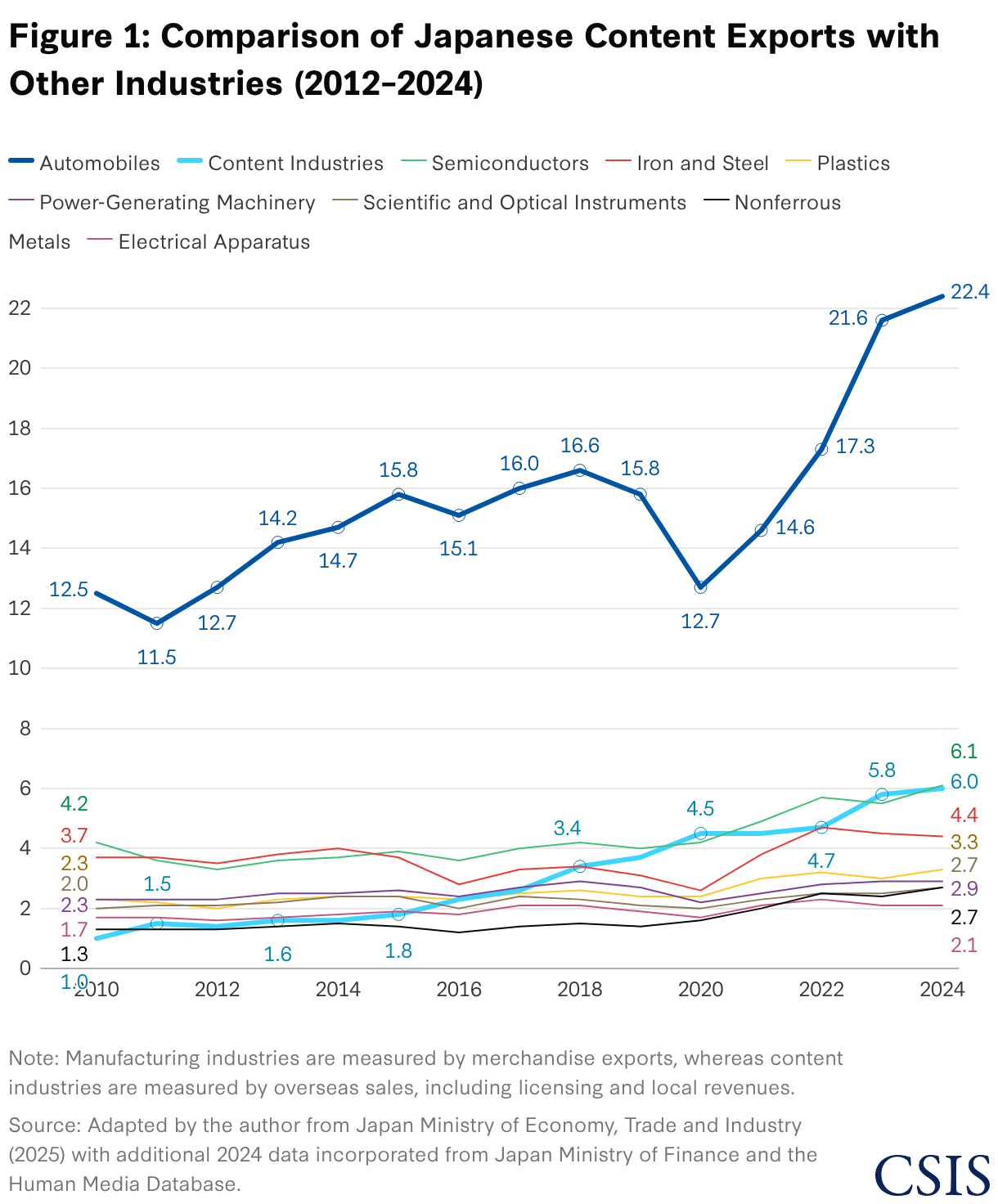
The Takaichi administration has designated the content industry as one of Japan’s 17 priority growth sectors, a significant departure for a sector that had long been viewed as peripheral to Japan’s economic strategy. Japan’s repositioning of creative industries as a national economic priority has implications that extend beyond trade balances—it reflects a broader recognition that cultural presence and strategic influence are increasingly intertwined. Japanese content exports have tripled over the past decade and now exceed steel and semiconductor exports, second only to automobiles (see Figure 1). Japanese IP offers globally recognized franchises capable of attracting audiences across both developed and emerging markets. According to one private sector survey, 10 of the top 25 entertainment franchises by cumulative global revenue originated in Japan, including Pokémon, Hello Kitty, and Dragon Ball.
Investors and large firms are increasingly paying attention to the long-term growth potential of Japanese content industries. Keidanren, Japan’s largest business federation, has published policy proposals to boost Japanese IP in global markets since 2023. Sony now derives around 60 percent of its consolidated sales from entertainment businesses, up from roughly 20 percent a decade ago. Kodansha has established a production entity in Hollywood to develop live-action film and drama projects based on its own IP—a first for a Japanese publishing company. Toho, Japan’s largest filmmaker and owner of Godzilla IP, has announced investment plans to increase overseas revenue from 10 percent to 30 percent by 2032. More and more publishers, studios, and gaming firms are accelerating overseas expansion efforts.
For Japan, the growth of creative industries offers a rare opportunity to generate export earnings and global economic influence without relying on population growth or resource-intensive manufacturing. In addition to designating the content industry as a priority growth sector, related funding for content industry promotion and overseas expansion initiatives was doubled in the FY 2025 supplementary budget. These measures were accompanied by a long-term action plan aimed at increasing overseas revenue from Japan’s content industries from ¥5.8 trillion in 2023 to ¥20 trillion by 2033. In June 2026, the administration announced a plan for public and private investment totaling ¥33.7 trillion in the industry.
Importantly, the current shift differs from the earlier Cool Japan Strategy. Previous efforts often emphasized branding campaigns and infrastructure-heavy support models that struggled to generate sustained commercial success. The current transition is becoming more market-driven, creator-centered, and globally oriented, driven largely by growing recognition within the private sector that future growth depends on overseas markets rather than domestic consumption alone due to demographic decline and a shrinking domestic market. It is worth acknowledging criticisms of government intervention in this industry, yet several structural challenges—including working conditions, talent shortages, and accelerating outsourcing—do require policy attention.
The convergence of U.S. and Japan’s strength is generating commercial momentum—but its significance is not purely economic. Shared platforms and co-produced content help shape the information ecosystems through which Indo-Pacific audiences encounter the world. These developments are creating significant new opportunities for U.S.-Japan collaboration in the creative industries.
The most promising area lies in the synergy between Japan’s globally competitive IP and the United States’ dominant digital platforms. Japan possesses internationally recognized strengths in anime, manga, gaming, and character-based entertainment, while the United States retains unparalleled capabilities in global-scale distribution. Together, these complementary assets enable both countries to expand their global reach, deepen digital trade, and compete more effectively in an increasingly contested entertainment market.
The commercial logic is clear: When more than half of Netflix’s global subscribers watch anime and viewership has tripled in five years, Japanese content is not a cultural add-on but a core driver of platform growth. Crunchyroll, the anime-focused streaming platform in the United States acquired by Sony Group in 2021, has already reached 21 million subscribers in 2026, a dramatic increase from 17 million last year. Japan contributes not only audiences but source material: distinctive worlds, compelling narratives, and richly developed characters that give U.S. platforms and studios a continuous pipeline of proven IP to adapt and distribute globally. At the same time, U.S. entertainment companies are increasingly adapting Japanese IP such as One Piece, Alice in Borderland, The Legend of Zelda, and Gundam into live-action productions.
Technology offers another promising avenue for cooperation. From Pokémon GO’s integration of Japanese IP with U.S. augmented reality to Japanese studios’ adoption of U.S.-developed game engines, creative and technological capabilities are increasingly intertwined. Yamaha Music, for instance, has integrated multiple U.S.-based entertainment technology startups called “createch” into its customer services, illustrating how Japanese firms can provide access to international markets for U.S. innovations, while U.S. startups contribute cutting-edge creator tools and digital production capabilities. These cross-border partnerships are likely to deepen as entertainment and technology ecosystems continue to converge.
Taken together, these developments represent more than a traditional licensing relationship. They increasingly resemble a transpacific entertainment ecosystem built on shared commercial incentives, complementary capabilities, and mutually reinforcing strengths. By enabling creators and companies in both countries to reach global audiences more effectively, this ecosystem has the potential to expand services exports from both the United States and Japan. As creative industries become more digital, global, and technology-driven, the U.S.-Japan partnership is well positioned to emerge as one of the defining collaborations in the global entertainment economy.
The significance of these trends extends beyond industrial policy. Competition in creative industries increasingly plays a role in broader competition for attention, shaping where people choose to spend their limited leisure time. The information and narratives individuals encounter through content platforms influence decisionmaking, including consumer preferences, purchasing behavior, and sometimes perceptions of countries.
In this context, understanding who captures audience attention, and through which platforms and ecosystems, will become an increasingly important strategic question in the divided platform world. Chinese entertainment platforms and gaming ecosystems are rapidly expanding across Southeast Asia, the Middle East, and other parts of the Global South, driven in part by the global success of Chinese titles such as Genshin Impact and Black Myth: Wukong. Under the national goal of becoming a strong cultural nation by 2035, the Chinese government continues to support the development of its cultural industries as a means of strengthening Chinese cultural soft power and expanding international influence.
This does not mean that creative industries should be viewed solely through a zero-sum geopolitical lens. However, maintaining a meaningful share of the broader global information space has strategic significance, including efforts to counter disinformation over the long term. From the United States’ perspective, Japan plays an important role because Japanese content is closely connected to broader networks of democratic partners and trusted alliance structures. In the Indo-Pacific, where Chinese platforms and entertainment ecosystems are rapidly expanding their footprint among younger generations, U.S.-Japan cooperation in creative industries offers a meaningful counter-presence—one grounded in open platforms, creator autonomy, and shared democratic values rather than state-directed narratives. In this sense, cooperation between the United States and Japan in the creative industries is relevant not only to business opportunities, but also to long-term strategic and security interests.
Finally, it is essential to emphasize that content also makes a significant contribution to the long-term stability of relations between countries. Content fans create online communities, meet at physical events, and promote grassroots-level exchanges and personal ties. For example, Anime Expo in Los Angeles attracts a total of 422,000 attendees from around the world, with attendance continuing to grow. Such fan communities can serve as subnational actors in international relations and public diplomacy. Content also provides opportunities for people to develop an interest in each other’s culture and language. More than 90 percent of Japanese language learners in the United States reportedly cite entertainment as their initial point of interest. In the latest Gallup World Affairs poll, Japan was the most favorably viewed country among the American people, with 85 percent expressing a positive opinion. Although this result is not due to creative industries alone, many experts emphasize that creative industries now constitute a major component of Japan’s global influence.
Challenges remain. Japanese industrial policy may not fully deliver the intended outcomes for its creative industries. Japanese firms continue to face questions about how to capture more economic value domestically from globally successful IP. Regulatory fragmentation, growing geopolitical tensions, and debates surrounding generative AI and copyright protection also create uncertainty for creators and companies on both sides of the Pacific. Nevertheless, momentum for deeper U.S.-Japan cooperation in creative industries is clearly building.
Creative industries should no longer be viewed as peripheral to discussions of economic strategy or alliance relations. As digital platforms, IP, and audience ecosystems become increasingly important sources of economic and geopolitical influence, cooperation between Japan and the United States in the creative sector is likely to deepen further. The strategic significance of entertainment content will continue to grow as global competition increasingly extends into the digital attention economy.
Makoto Tsujiguchi is a visiting fellow from the Japan Business Federation (Keidanren) with the Japan Chair at the Center for Strategic and International Studies in Washington, D.C.

Commentary by Makoto Tsujiguchi — January 13, 2026

Commentary by Makoto Tsujiguchi — August 28, 2025

Commentary by Makoto Tsujiguchi and Moyuru Tanaka — January 21, 2025