AUKUS at Five: Progress, Challenges, and the Way Forward
September 17, 2026 • 8:00 – 9:00 am EDT
Hosted by Australia Chair

Photo: Satellite image ©2026 Vantor
For decades, Cuba’s proximity to the United States has made the island strategically valuable for foreign intelligence collection. Recent warnings from senior U.S. officials about expanding Chinese and Russian intelligence activities have once again drawn attention to Cuba’s role in supporting those efforts just 90 miles from U.S. shores.
In 2024, CSIS identified four Cuban sites featuring equipment that could support signals intelligence (SIGINT) collection, including several with possible links to China. Follow-on analysis of two of these sites, conducted in 2025, found major changes underway at one location, while work at the other had largely stalled. Now, new commercial satellite imagery reveals that activity at both sites has continued, though the pace and scale of development differ considerably.
At an expansive SIGINT site in Bejucal, near Havana, recent satellite imagery shows construction work completed on a new large circularly disposed antenna array (CDAA).
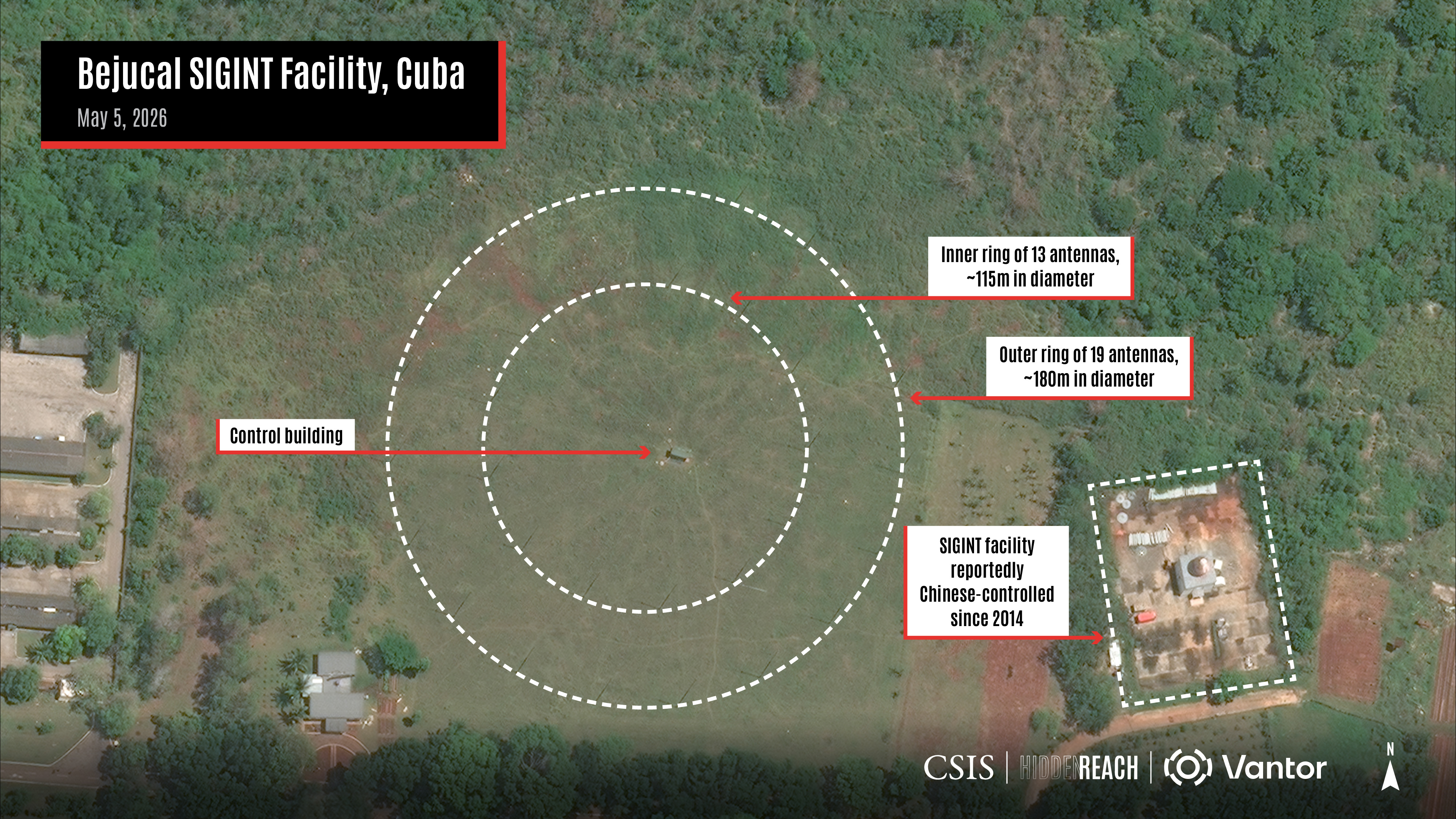

Over the last two years, an antenna field at the northeast end of the facility has been converted from a linear antenna grid to a CDAA. Imagery published by CSIS in April 2025 captured ongoing groundwork to lay cables between the antennas and the central control facility. Construction now appears to be complete and the facility has very likely begun operations.
The array of 32 antennas (19 outer and 13 inner) is larger and likely more capable than any Cuban CDAA previously observed by CSIS. CDAAs are primarily used for high-frequency direction finding, which involves intercepting and geolocating incoming radio transmissions over a wide range of frequencies.
From Bejucal’s location in Cuba’s northwest, the CDAA could improve the ability of Cuban authorities—or potentially their foreign partners—to monitor sensitive U.S. activities in the Caribbean and across the southeastern seaboard. U.S. naval and air operations in the region have escalated amid the Trump administration’s prioritization of the Western Hemisphere, increasing the potential value of monitoring U.S. movements in the Caribbean and the Gulf of Mexico.
The Bejucal facility has long been associated with China in public reporting, congressional testimony, and statements by U.S. officials. No clear publicly available evidence proves China’s involvement there, but Bejucal is likely one of the three sites in Cuba that U.S. officials have recently acknowledged is operated by China.
At another suspected CDAA site at El Salao, which was first uncovered by CSIS in 2024, progress has slowed nearly to a halt. New imagery captured in May 2026 shows little substantial development at the site since last year.
Work on the facility began in 2021, with much of the initial groundwork installed by 2024—including the central control building, the foundations for an inner ring of 16 antennas, and utility right-of-way with access vaults. An updated analysis of the site in 2025 revealed that construction there had largely ceased, with no antennas erected around the central control building and grass reclaiming the graded area within the CDAA’s rings.
Little has changed in the imagery from May 2026. No antennas have been installed and no apparent changes have been made to the surrounding buildings that would indicate that the site is operational.
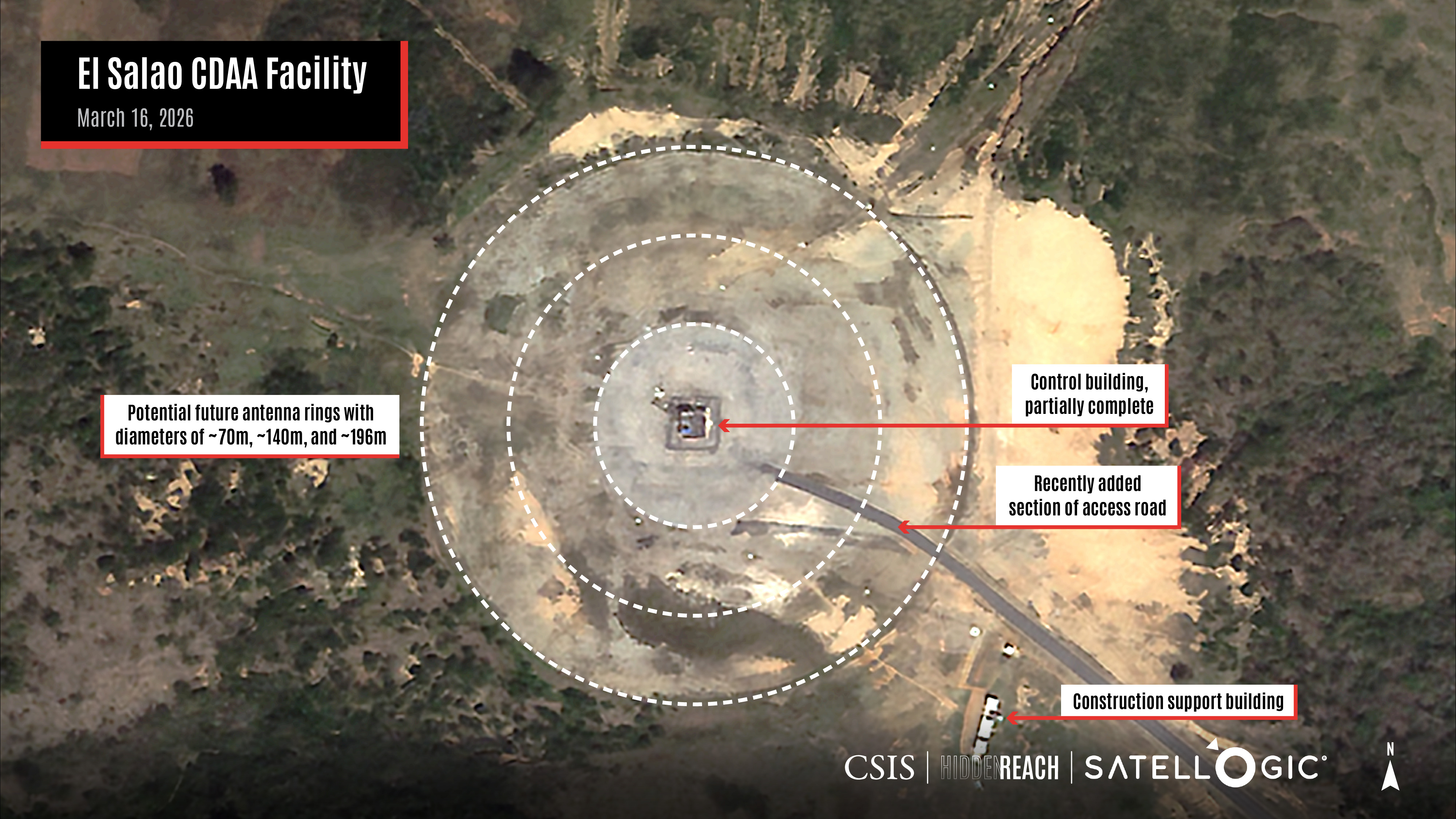
Still, it appears that work there may be slowly continuing. An access road that previously led to an off-center area of the site has been repaved and repositioned toward the center of the array. The significance of the new road is not clear, but it would be unusual to establish a paved road through the center of an active antenna array. This suggests that the site has not been fully abandoned, but it remains to be seen whether it will be completed as originally planned or repurposed for another use.
If it is eventually completed, El Salao could offer a powerful complement to the CDAA at Bejucal by extending geographic coverage over the Southeast Caribbean. Working in concert, the two facilities would further enhance Cuba’s ability to triangulate signals emanating across Central America and the Western Atlantic region.
The continued expansion of these sites may become a flashpoint as the Trump administration accelerates its push to pressure the Cuban regime. In a May 2026 executive order placing new sanctions on the Cuban government, the White House cited Cuba’s hosting of “foreign adversary facilities” targeting sensitive U.S. national security information as evidence of “malign influence.” The status of these sites could be a key part of any negotiations between Washington and Havana about Cuba’s future.
Matthew P. Funaiole is vice president of the iDeas Lab, Andreas C. Dracopoulos Chair in Innovation, and senior fellow in the China Power Project at the Center for Strategic and International Studies (CSIS) in Washington, D.C. Brian Hart is deputy director and fellow of the China Power Project at CSIS. Joseph Bermudez Jr. is senior fellow for imagery analysis at CSIS. Aidan Powers-Riggs is an associate fellow with the iDeas Lab at CSIS.

Digital Feature by CSIS Scholars — July 1, 2024

Digital Feature by Matthew P. Funaiole, Brian Hart, Aidan Powers-Riggs, and Joseph S. Bermudez Jr. — May 6, 2025


