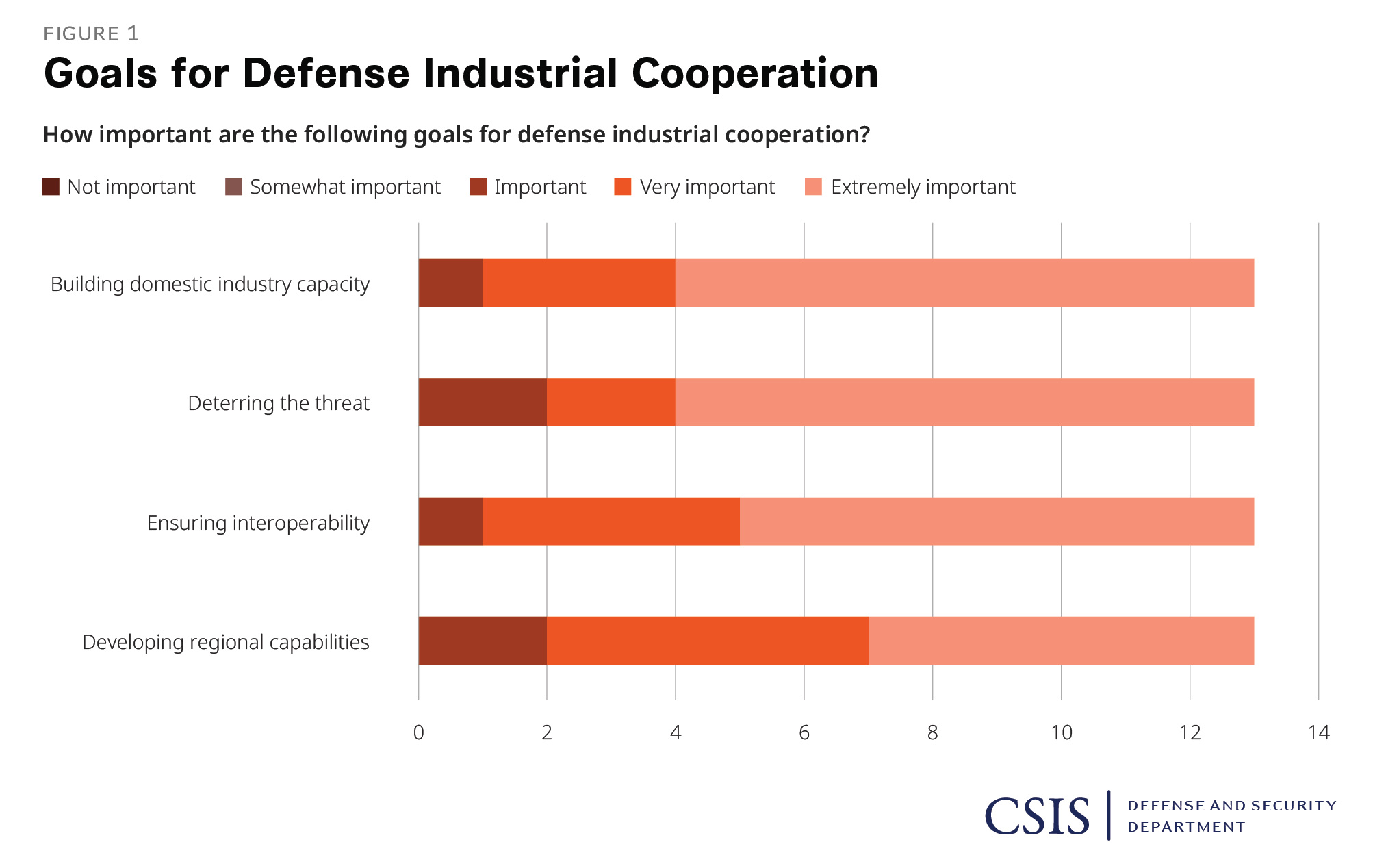
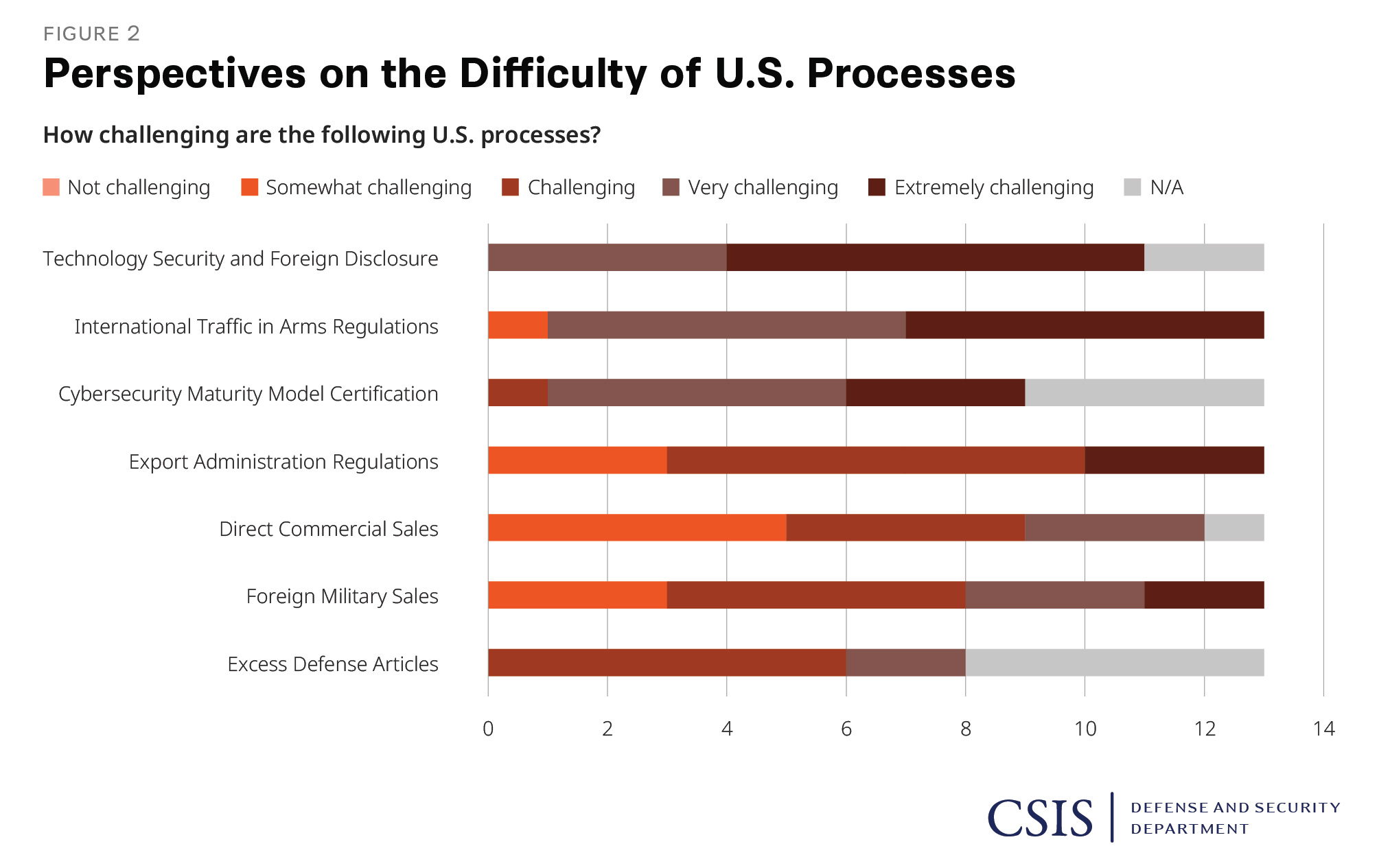
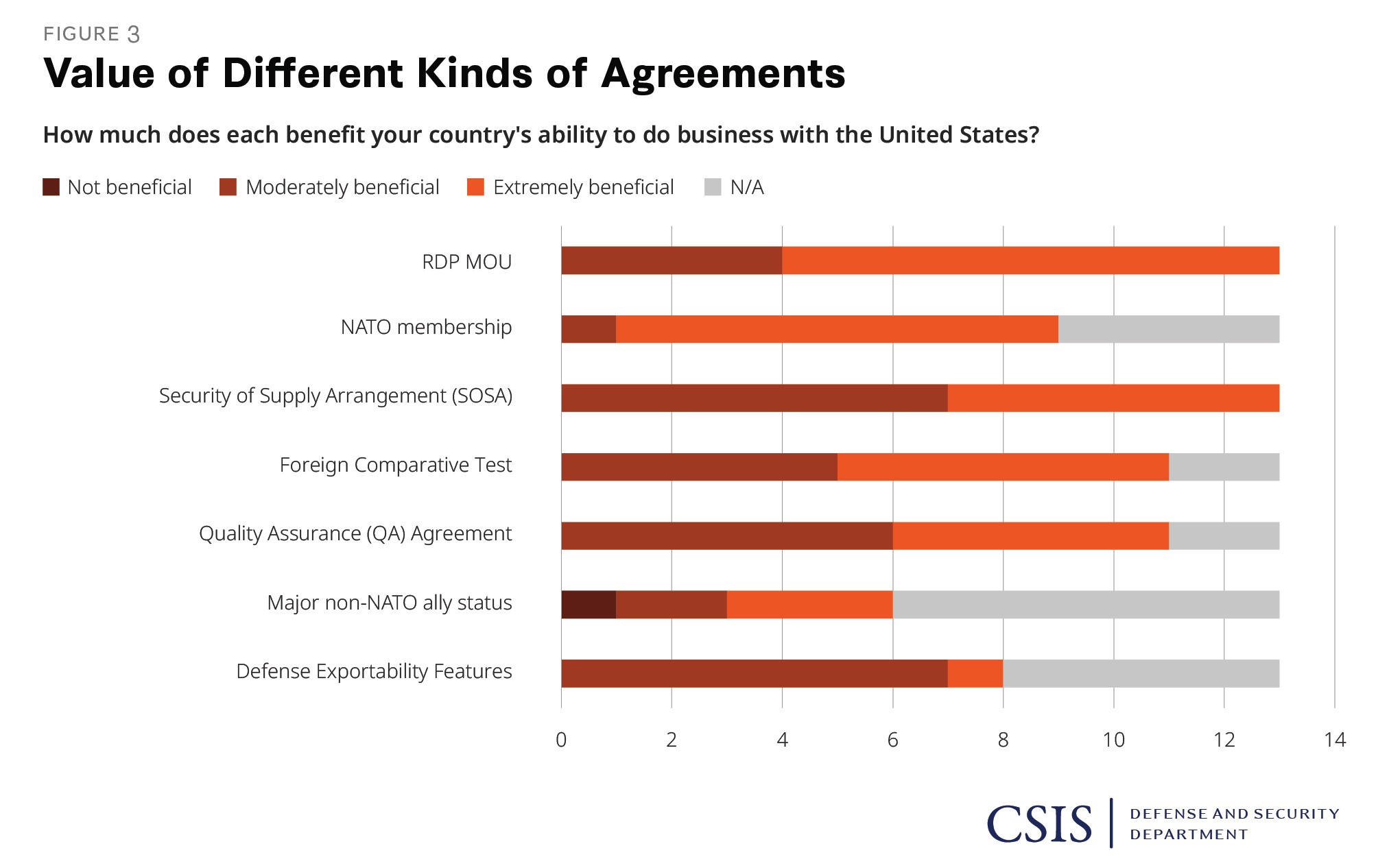
While none of these findings are particularly surprising, the survey’s sample of respondents beyond just the United States’ largest and closest partners confirmed the pervasiveness of these challenges and offers an initial baseline against which the impact of future changes in policy can be measured. These findings also highlight specific areas of focus for the United States to address.
Arms sales and technology transfer play a large role in ensuring the United States and its allies are properly equipped to build a competitive advantage. Though export controls are required—and necessary—to protect a nation’s technological advancements and intellectual property, complex and lengthy export control processes may limit important partnerships that underpin deterrence. The following recommendations will serve to ease existing regulatory restrictions, help allies achieve their domestic defense industrial priorities, enhance interoperability to strengthen coalition operations, and bolster production diplomacy to counteract the defense industrial capabilities of U.S. adversaries.
Combine Review of Weapons Requests from Allies: There was no call to eliminate export controls, but rather to reengineer them. President Trump’s April 9, 2025, executive order on FMS highlights the goal of the reduction of barriers to exporting weapons to allies. For instance, every bilateral arrangement requires a separate review, even if two close allies are buying the same equipment. Throughout the congressional notification process, past approvals don’t seem to hold merit when reviewing FMS requests. Allies working as a group to procure U.S. systems, or the United States combining reviews, could be structural solutions to speed the process. While extensive deliberation between Congress and the executive branch would be required to create “bins” for allies, countries that hold an RDP MOU would be a good place to start. A smaller trial subset could be Canada and AUKUS members.
Periodically Review Export Controls and Classification Markings: Periodic reviews of export control and classification marking policies would be useful to ensure that they are appropriately limiting technology proliferation without causing undue delays and complications. Export controls, while critical to safeguard U.S. technologies, are not prepared to meet the challenges of the current geopolitical moment. Institutionalized, systematic reviews of export control regimes, like ITAR, and sales and transfer mechanisms, like FMS, can help ensure the United States can get weapons and technologies to its friends at speed and scale. Similarly, document markings, such as CUI and NOFORN, should be carefully managed to ensure that they do not needlessly limit cooperation and are intentional and justified.
Close the Ally and Partner Knowledge Gap of U.S. Processes: Survey participants have an incomplete understanding of U.S. government regulations. Given that these individuals play an important role in enhancing bilateral defense cooperation, this knowledge gap may lead to unnecessary delays in international arms acquisitions. Formal training offered by the United States is a low-cost solution to help facilitate arms sales, technology transfer, and defense industrial cooperation. Additionally, a coherent understanding of U.S. processes in foreign program offices does not singularly benefit U.S. allies, but engaging with a well-informed partner workforce helps speed acquisitions and lower bureaucratic inefficiencies. This means the United States can sell systems, components, and services faster, and thus provide a more stable demand signal to U.S. industry.
Offer RDP MOU Training to U.S. Program Offices: Survey respondents were consistent in their feedback that RDP MOUs are not particularly well understood in U.S. program offices. This limits the ability of the DOD to draw on the expertise of allies. A recent Defense Innovation Board report addressed this directly, suggesting that “all DoD program managers should be trained on the RDP MoU and additional Buy American waivers and exemptions. In addition, the office that negotiates these waivers must be empowered to inform and educate the DoD contracting and acquisition workforce on the proper use of these existing authorities.” Continual education for relevant parties and government organizations as part of required acquisition certifications would address this challenge.
Design for Exportability to Facilitate Defense Trade: Designing for exportability early in a program’s life cycle prevents costly, last-minute, and time-consuming retrofits and redesigns to safeguard sensitive technology. This approach also helps enforce standardization and interoperability, enabling U.S. allies and partners to “plug-and-play” by integrating foreign vendor technologies into one loosely coupled but standardized system.
Develop and Support Institutional Frameworks to Enhance Exports and Encourage Cooperation: To enhance defense industrial cooperation, the United States should develop and expand institutional mechanisms that facilitate export exemptions and industrial collaboration. While Australia, Canada, and the United Kingdom demonstrate that ITAR and Export Administration Regulations waivers remain limited in scope and difficult to obtain, they still serve as a valuable benchmark for other allies to work toward. Moreover, the United States should continue to engage allies and partners to increase the number of RDP MOUs and Security of Supply Arrangements.
Limited defense industrial cooperation between the United States and its allies contributes to vulnerabilities that adversaries can exploit to wield their influence across the global strategic landscape. The United States alone is not prepared to ramp up production to meet current demand in the near term, and some capabilities may take a decade or longer to build. Without an integrated defense industrial base, the United States and its allies will be less effective in the development, production, and sustainment of critical military capabilities—and will ultimately struggle to fight together.
Cynthia Cook is director of the Defense-Industrial Initiatives Group and senior fellow with the Defense and Security Department at the Center for Strategic and International Studies (CSIS) in Washington, D.C. Audrey Aldisert is a research associate in the Defense and Security Department at CSIS.