Ensuring Economic and Energy Security: Opportunities for U.S.-Japan Leadership
September 24, 2026 • 9:00 am – 12:00 pm EDT
Hosted by Japan Chair
Photo: John Moore/Getty Images
In its first year, the second Trump administration has implemented substantial changes to the H-1B immigration program. Some of these changes will create significant economic harm; others have the potential to improve efficiency and support industrial policy goals, with further adjustments. In September 2025, the administration announced a $100,000 fee on new petitions for H-1B visas outside of the United States, a likely prohibitive increase in costs for many firms seeking to hire skilled immigrant labor. In parallel, the administration released a final rule last December to increase the visa lottery system’s allocation efficiency. The administration’s lottery reform would benefit from additional changes to better distribute the economic dividends of skilled immigration to underserved geographies and priority sectors. Such policy changes are critically important to U.S. competitiveness, given the program’s track record of success in attracting global talent and driving economic growth. To strengthen the United States’ technological advantage, innovation ecosystem, and economic prosperity, policymakers should look to expand the H-1B program and reform its incentives while limiting costly new barriers to its use.
The Trump administration is undertaking major reforms to the H-1B visa system by raising fees, curbing eligibility, and implementing changes to the lottery system. In September 2025, the White House imposed a $100,000 fee for new H-1B visas—a 1,500 to 5,800 percent increase over previous filing fees. The administration is also moving away from a simple lottery (with each entry having an equal chance) to a wage-based lottery that rewards higher-wage offers with a higher probability of receiving a visa. This approach will neither protect American workers nor help firms succeed in a global market. Rather, it threatens to reduce innovation, accelerate offshoring, and strengthen global competitors. Nevertheless, the H-1B program could greatly benefit from reforms: With adjustments, it could allow the United States to better harness skilled immigration as a competitive advantage.
This brief outlines how practical immigration policy can serve as a critical economic engine. It then demonstrates how the $100,000 fee and the newly adopted lottery system pose challenges to U.S. economic interests. Lastly, it discusses evidence-backed approaches to program reform to address legitimate equity concerns and unlock the visa’s potential as a force multiplier, concluding with a set of actionable policy recommendations. Below is a summary of key challenges and recommendations.
Recent changes to the H-1B program risk undermining U.S. economic and strategic interests in several ways:
Targeted reforms can strengthen the H-1B program as a strategic lever for economic growth. The U.S. government should take the following actions:
Practical immigration policy is central to U.S. economic performance. It shapes the country’s ability to attract and deploy scarce human capital in sectors where talent constraints increasingly bind growth. In an economy defined by strategic technology competition and acute workforce shortages, changes to high-skilled immigration rules can produce outsized effects on innovation and productivity. Three key challenges to U.S. interests underscore immigration’s strategic importance.
In an economy defined by strategic technology competition and acute workforce shortages, changes to high-skilled immigration rules can produce outsized effects on innovation and productivity.
The industries that will likely define the twenty-first century—including AI, biotechnology, quantum computing, and clean energy—all depend on access to world-class human capital. Immigrants account for a quarter of all STEM workers and a disproportionate share of patents and scientific breakthroughs. Restricting this talent pipeline is akin to taxing innovation itself.
Cognizant of the benefits of skilled immigration, U.S. competitors are moving to attract foreign talent. Canada has launched new “Tech Talent” visas to attract workers displaced by U.S. restrictions. The United Kingdom, Germany, and Australia have streamlined high-skill immigration pathways, recognizing that talent is the ultimate competitive advantage. China, long focused on building domestic capabilities, now actively recruits foreign scientists and engineers to support its AI and semiconductor ambitions.
While the H-1B program’s most dominant industry category is “professional, scientific, and technical services”—making up around 48 percent of total H-1Bs distributed between 2021 and 2024—the visa can also be a source of talent acquisition for other sectors that are critical to U.S. economic interests, such as manufacturing, healthcare, and education services (see Figure 1).
These H-1B industries are in dire need of a larger talent pool. As of early 2025, more than 450,000 manufacturing jobs remained unfilled in the United States, with projections that 2.1 million roles could go vacant by 2030. Over the coming years, contractors will need to bring on an additional 300,000 to 546,000 workers each year—beyond their usual hiring—to keep up with labor demand. The Bureau of Health Workforce projects shortages for many health roles, including shortages of an estimated 207,980 registered nurses, 187,130 physicians, and 113,930 addiction counselors by 2037. Without sustained inflows of skilled immigrants, the United States risks falling behind in industries that define prosperity.
In addition to current labor shortages, immigration policy choices carry long-term labor market implications. The United States is set to confront an increasingly challenging labor picture as it contends with slowing population growth and an aging workforce.
The United States is set to confront an increasingly challenging labor picture as it contends with slowing population growth and an aging workforce.
The population of Americans aged 65 and older is expected to grow from 58 million in 2022 to 82 million by 2050—a 41 percent increase. During the same period, this age group is projected to rise from 17 percent to 23 percent of the total U.S. population.
Aging in the United States could have a drastic impact on the country’s economic performance: A 2023 study finds that a 10 percent rise in the proportion of the population older than 60 lowers per capita GDP by 5.5 percent. About one-third of the decline comes from slower employment growth, and two-thirds comes from reduced productivity; wages and compensation also fall. Immigration has served as a balancing factor in this demographic shift, helping drive the expansion of the U.S. labor force and overall employment as the number of native-born workers entering the workforce has steadily declined.
To achieve productive reform, policymakers must understand that skilled immigration is an economic multiplier, not a zero-sum competition for jobs. It is a clear driver of major economic gains.
Immigration yields significant productivity dividends. Every 1 percent increase in immigrant employment share boosts total factor productivity by 1.2 percent at the state level. This gain extends far beyond the immigrants themselves, benefiting native-born workers through complementarity effects, knowledge spillovers, and expanded specialization opportunities.
Immigration’s impact on innovation is also pronounced. A 2010 paper demonstrates that a 10 percent increase in H-1B admissions raises total invention by up to 2 percent. This relationship highlights a fundamental economic reality: Skilled immigrant talent is not a substitute for domestic workers but complements them to generate increasing returns. The startup data tells the same story. Over half of U.S. unicorn companies were founded or co-founded by immigrants, many entering initially on H-1B visas. These firms did not just create jobs for their immigrant founders—they generated millions of jobs for American workers across entire industries.
The aggregate benefits of immigration are staggering. The Congressional Budget Office projects nominal GDP over the 2024–2034 period is $8.9 trillion greater than expected due to a surge of 8.7 million people via U.S. immigration inflows between 2021 and 2026. A 2011 paper estimates that removing significant global migration barriers could increase world GDP by 50 to 150 percent—dwarfing the gains from trade liberalization or technological advancement.
H-1B reforms could further unlock the program’s full potential to serve U.S. economic interests. However, calls for revisions should not ignore that the visa has already delivered great economic returns.
Established in 1990 with an initial allocation of 65,000 visas annually, the H-1B program enables U.S. employers to recruit foreign professionals for positions requiring advanced technical expertise and, typically, a bachelor’s degree or higher in a relevant field. What began as a targeted response to specific labor market gaps has evolved into a cornerstone of the United States’ talent acquisition strategy, facilitating the employment of highly skilled professionals who contribute expertise that might otherwise be unavailable domestically. The program’s temporary nature (initially allowing three-year stays, with possible three-year extensions) was designed to provide workforce flexibility while addressing immediate skill shortages.
Despite its relatively constrained scale, the H-1B program has delivered economic returns far exceeding its original scope. Even under severe capacity limitations, estimates suggest the program generates $7.5–$31.8 billion in annual net benefits. Native workers experience wage gains rather than losses, while companies winning H-1B lotteries achieve higher job growth, productivity, and profit margins compared to similar firms denied visas.
Native workers experience wage gains rather than losses, while companies winning H-1B lotteries achieve higher job growth, productivity, and profit margins compared to similar firms denied visas.
The Trump administration’s recent changes to the H-1B program reflect a dual-track approach: raising new barriers to entry while attempting to reallocate scarce visas toward higher-wage roles. This section evaluates the administration’s reforms—the $100,000 entry-linked fee and the shift to wage-weighted lottery selection—and assesses how, in their current form, they may impact U.S. economic competitiveness even as they aim to improve allocation efficiency.
On September 19, 2025, a presidential proclamation established a $100,000 payment as a prerequisite for the entry of certain H-1B workers. Although cast as a measure to protect U.S. workers and strengthen the labor market, the policy is best understood as a large, targeted surcharge on the importation of high-skilled labor. The operational effect is to increase the marginal cost of hiring globally mobile talent by six figures, in precisely the cases where employers rely on the H-1B program to relocate a worker from abroad.
U.S. Citizenship and Immigration Services (USCIS) implementation guidance posted on October 20, 2025, clarified the mechanics and scope of this reform. For petitions filed on or after the effective date, the fee is generally required where the beneficiary is outside the United States and does not hold a valid H-1B visa, or where the petition—despite being filed while the beneficiary is in the United States—requests consular, port-of-entry, or preflight inspection notification (i.e., a pathway that contemplates visa issuance abroad and entry thereafter). By contrast, the payment is not required for amended H-1B petitions, extensions of stay in H-1B status, or changes of status for H-1B beneficiaries who remain in the United States.
For covered cases, employers must remit the $100,000 payment before filing the H-1B petition. Petitioners must include proof of payment with the initial filing, and USCIS has indicated that it will deny petitions that do not include it. This approach effectively front-loads compliance and shifts the burden onto employers to demonstrate eligibility to file, rather than allowing adjudication to determine applicability later in the process.
Market Distortion
The H-1B program’s demonstrated benefits could expand dramatically if not for artificial constraints that create extreme undersupply. The current annual cap of 85,000 visas faces oversubscription ratios exceeding three to one. While the U.S. population has grown by 36 percent since the program’s inception, there has been no corresponding increase in the ordinary visa cap, outside of a brief period between 1999 and 2003 (Figure 2).
This mismatch between economic demand and bureaucratic limits is a missed opportunity, and the fee’s imposition exacerbates these economic distortions, which will reshape industries in destructive ways. Large technology companies can absorb $100,000 costs or pass them on to consumers; it is much more painful for smaller firms and academic institutions to do so. Research consistently shows young firms as the primary drivers of growth, and firms less than five years old account for nearly all net job creation in the U.S. economy.
The access to global talent that the H-1B program allows has shown an enormous benefit to young firms, boosting their chances of raising venture capital, reaching a public offering or acquisition, and driving innovation. A 2020 study finds that firms with higher visa H-1B lottery “win rates” are more likely to secure external funding, attract elite venture capitalists, and generate patents. Moreover, a higher win rate significantly increases the probability of a successful exit through a public offering or acquisition.
The $100,000 fee distortion amounts to government intervention designed to entrench established incumbents at the expense of entrepreneurial competition. By making it prohibitively expensive for crucial economic actors to access skilled labor, it reduces economy-wide dynamism and growth.
The Offshoring Reality: How Restrictions Backfire
Research from CSIS Senior Associate and University of Pennsylvania Assistant Professor Britta Glennon’s 2020 analysis of corporate responses to H-1B visa limitations shows the counter-productive nature of the fee’s restrictions. Her research challenges the Trump administration’s rationale that limiting foreign worker access increases domestic hiring.
Instead, Glennon finds that firms denied H-1B visas are more likely to offshore jobs. For every rejected H-1B application, multinational corporations hire 0.4 employees abroad—a ratio that reaches 0.9 foreign hires per denied visa among the most globally integrated firms. Figure 3 below shows this effect quite clearly, utilizing the reduction in H-1B visas that occurred in 2004 when the cap on the total number of visas fell from 195,000 to 65,000. Firms that are the most dependent on H-1B visas respond to reduced visa availability by expanding foreign affiliate employment rather than by adjusting domestic hiring.
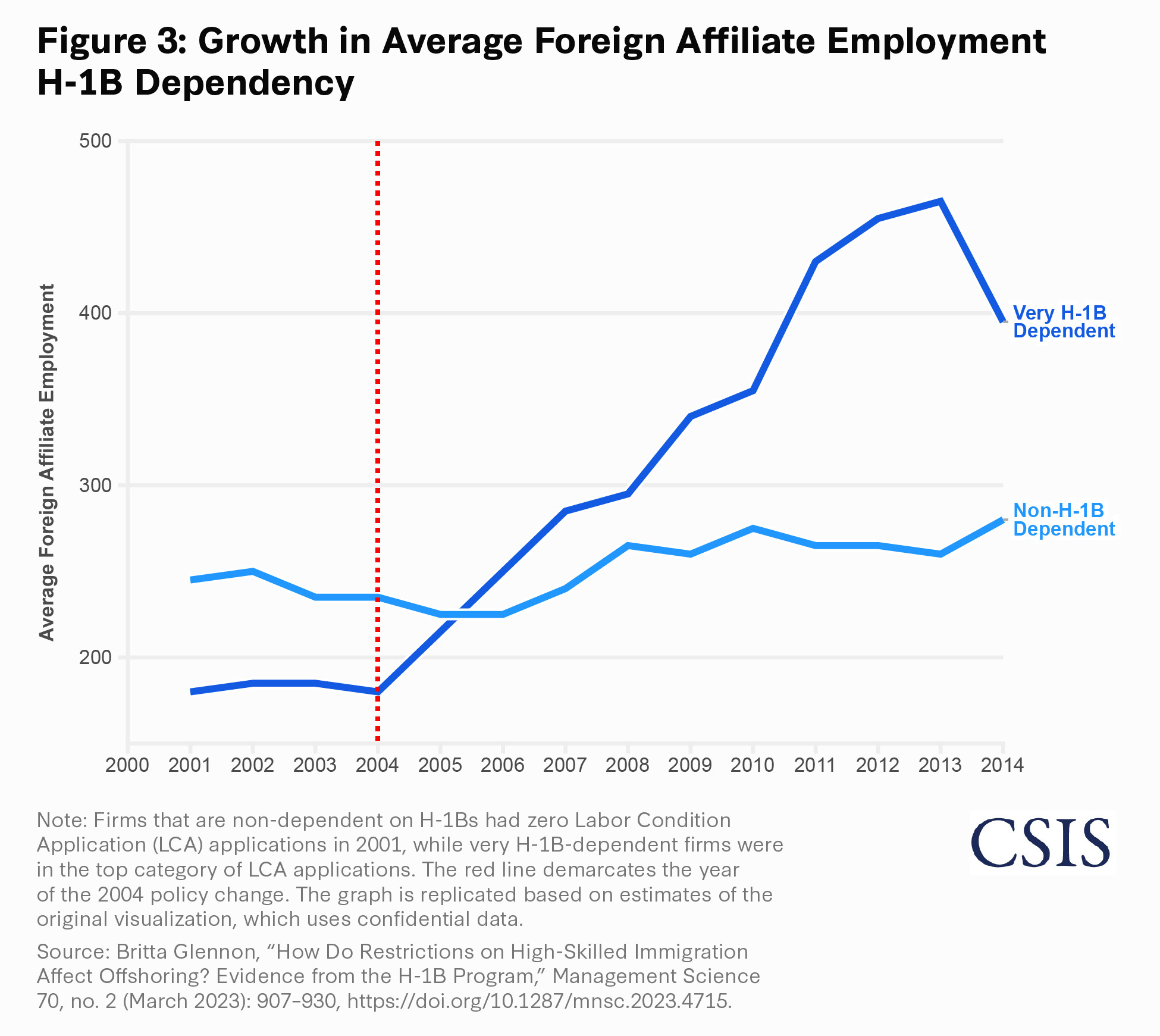
The conclusion is unavoidable: H-1B restrictions do not protect American jobs, they result in more hiring abroad. The $100,000 fee will accelerate this trend, pushing high-value positions to countries eager to welcome the talent the United States is rejecting. It will likely result in reducing both immigrant and native employment while strengthening competitors’ economic positions.
H-1B restrictions do not protect American jobs, they result in more hiring abroad. The $100,000 fee will accelerate this trend, pushing high-value positions to countries eager to welcome the talent the United States is rejecting.
The Trump administration’s announcement of a fee came with indications of a broader overhaul of the H-1B system. The White House is replacing the randomized visa lottery with a wage-weighting system, prioritizing “higher-paying, higher-skilled” positions.
Several economic principles underpin weighting H-1B lottery entries by wage:
The wage-weighted concept was formally recognized in the Department of Homeland Security’s final rule, “Weighted Selection Process for Registrants and Petitioners Seeking to File Cap-Subject H-1B Petitions,” on December 29, 2025.
Wage Levels
The rule leverages the Department of Labor’s Occupational Employment and Wage Statistics (OEWS) system, which contextualizes a worker’s wage relative to the distribution of income for their occupation in their geographic area. The OEWS system surveys for both (1) the corresponding occupation, as defined by Standard Occupational Classification (SOC) codes, and (2) the relevant geographic area, as defined by Office of Management and Budget (OMB). This serves as a proxy for skill level within that given profession; for example, a worker earning $100,000 in Mississippi is likely more skilled than a worker of the same occupation earning $100,000 in Massachusetts.
The OEWS defines the four wage levels within percentiles:
Prospective employers filing a Labor Condition Application—the first step to successfully receiving an H-1B—would need to identify the highest OEWS wage level that the offered salary meets or exceeds.
Weighting Mechanism
Instead of a purely random lottery, registrations offering higher wages would receive additional “weight”—effectively, more lottery entries. Under the new system, a Level IV wage would receive four entries, Level III would receive three, Level II would receive two, and Level I would receive just one. As such, Level I applicants would still be eligible to receive a visa, but their chances would diminish relative to applicants categorized in other wage levels. Roughly 10,000 low-wage H-1B approvals annually would be reallocated to higher-wage categories, without changing the statutory total of 85,000 cap-subject visas.
Because visa numbers are fixed, these redistributions would manifest as wage increases, not net increases in employment. The Department of Homeland Security (DHS) projects that $502 million more in wages would be paid to H-1B workers in FY 2026, rising to over $2 billion annually from FY 2029 through FY 2035. Cumulatively, according to the DHS, the 10-year period would yield approximately $17 billion in gross wage transfers toward higher-paid H-1B employees. The DHS also estimates annualized monetized benefits of around $1.6 billion from FY 2026 to FY 2035 in gains from productivity, output, and payroll tax revenue.
The Policy Framework’s Goals
The DHS is utilizing wage as a proxy for worker value and potential productivity. As such, the rule aims to allocate visas to more productive or capital-intensive roles while encouraging employers to offer competitive salaries. The Trump administration argues that this system will reward employers offering higher salaries and reduce the misuse of H-1B visas for low-wage positions. The administration also aims for the new weighted approach’s wage shifts to generate secondary effects, such as higher payroll tax contributions and modest growth in total labor income, while keeping the total H-1B headcount constant.
Wages are not just a measure of productivity; they differ by occupation and geography for many other reasons. By contextualizing a worker’s wage within their occupation and geographic area, wage levels aim to ensure that the most skilled and productive workers receive higher weighting. The administration is right to account for these differences by leveraging the OEWS structure. Without occupational adjustments, high-paying sectors like biotech and finance may dominate visa allocations, while critical but less lucrative industries such as education and regional healthcare could lose access to needed professionals. Likewise, without geographic controls, employers in smaller cities or rural areas—where wages are lower due to cost-of-living standards—would have far slimmer odds of selection, potentially worsening skilled labor shortages in underserved regions.
Drawbacks of the Wage-Weighting Approach
The wage-level approach requires careful consideration of how it may generate incentives to game the system, such as reclassifying a vacancy to change lottery odds. The administration would need to invest in additional enforcement capabilities to ensure the system works appropriately.
In addition, the wage-weighted approach may provide a structural advantage to large corporations with substantial salary budgets—which could therefore more easily offer Level III and IV paychecks—and penalize early-stage companies. DHS analysis estimates that approximately 30 percent of cap-subject filers, which are particularly dependent on workers classified as Level I, could experience significant economic impact due to lost access to H-1B labor. These firms may respond by increasing compensation offers to move higher within OEWS wage bands. However, they might instead prioritize remote or offshore staffing, or at least reduce operations or growth in sectors dependent on entry-level technical talent.
The wage-level approach prioritizes seniority instead of prioritizing highest wages or targeting specific skills. Wage levels rank applicants within an occupation and area; they do not account for differences across occupations. In other words, a Level IV application is not necessarily a high-wage or high-skill job relative to other H-1B occupations; a Level I or II position may exceed it in terms of absolute pay and skill. Consider an example from the Economic Innovation Group (EIG). A software developer in San Francisco earning $155,000 is relatively low on the pay distribution for their location and occupation, leading them to be classified as Level I; on the other hand, an exercise physiologist in Jacksonville earning $55,000 would be Level IV for their area and occupation and receive four times the weighting.
In short, while the wage level method is a sound way to protect individual wages, the administration should also take into consideration how the U.S. economy may need H-1B policy reform to prioritize specific skills. Further adjustments would improve the effectiveness of the H-1B system and account for additional U.S. policy objectives.
H-1B structural adjustments could advance U.S. economic priorities, including regional revitalization, industrial growth, and support for entrepreneurs and new businesses. By prioritizing visas for underserved geographies and critical industries while protecting access for small firms and recent graduates, the system could better address labor shortages without undermining equity. Furthermore, expanding the cap and eliminating burdensome fees would yield significant economic benefits, strengthen key industries, and ensure fairer treatment for both U.S. and immigrant workers.
Congressional intent behind the H-1B program was in part to enable U.S. employers to fill shortages in positions requiring highly skilled and highly educated workers. The reformed H-1B program should channel talent to the industries most critical to U.S. competitiveness and economic resilience.
Sectors that are key to U.S. technological and military supremacy, like AI, quantum computing, and shipbuilding, require access to deep pools of global talent. These are not simply areas of labor need; they are also strategic priorities where global leadership will determine the trajectory of U.S. prosperity and security. A targeted visa allocation could help sustain the United States’ edge in technologies that underpin economic and military strength, from semiconductor fabrication to shipbuilding. Empirical evidence underscores why such targeting matters. Many strategic sectors are set to experience a labor gap in the coming years; Figure 4 below provides an illustrative example from the semiconductor industry.
In addition, as mentioned before, skilled immigrants are a cornerstone of progress. H-1B workers yield wage gains rather than losses for their native counterparts; they inject dynamism into their respective industries, leading to the founding of more high-performance startups. Firms with a higher proportion of visa recipients achieve better job growth, boost productivity, and enhance profit margins. High levels of innovation and productivity drive technological advancement and economic efficiency; sustained job creation and profitability attract investment and talent, reinforcing a virtuous cycle of competitiveness. Directing these dividends toward sectors which underpin technological competition should be a feature of the U.S. national security strategy.
Conversely, de-facto restrictions on talent recruitment in these industries—whether resulting from the wage-weighted approach’s burdens on young firms or from insufficient H-1B visa allocations—may cause the United States to fall behind. Dr. Glennon’s research demonstrates that firms facing H-1B restrictions tend to offshore jobs. Losing talent to other countries is a missed economic opportunity; in the case of strategic sectors, it is also a national security risk. Global competitors are already moving to secure this talent advantage: China has begun actively recruiting foreign researchers to support its AI and semiconductor ambitions.
The contest for talent is also a contest for technology leadership. A strategically reformed H-1B program would invest in the frontier industries that will define U.S. competitiveness for decades.
The administration could adjust its immigration strategy in two ways: either by allocating strategic sectors additional “weight” in its wage levels–based rule or by allowing these sectors to benefit from cap exemptions alongside universities and nonprofits. The administration should also establish set-asides for small firms—those with lower wage-paying capacity compared to large tech firms—for the same positions, to avoid entrenching incumbents. By steering visas toward areas of greatest economic and national value, the United States can ensure a more forward-looking distribution of global talent.
In addition to sectoral priorities, the administration’s new rules could be augmented to address challenges inherent to the wage-weighting scheme. In its current state, the wage-weighted scheme disadvantages foreign early-career workers whose wage offers are naturally lower but who may have strong potential and long-term economic value; the selection probability for Level I “entry-level” registrants is projected to decline by roughly 48 percent.
In parallel, international students graduating from U.S. academic institutions would be disadvantaged with the wage-weighting approach: According to the Institute for Progress, the rule will cut visas to F-1 graduates by around 7 percent. The United States is already facing obstacles to maintaining its historically strong track record of attracting promising foreign students to its academic institutions, as international student arrivals into the United States have fallen by 19 percent in the 2025–26 academic year. Barriers to post-graduation opportunities would only worsen that picture.
By improving chances for early-career graduates, H-1B reform would support two related objectives: (1) unlocking the program’s potential as a crucial pipeline to attract early-career graduate talent to the United States, and (2) incentivizing foreign students to attend U.S. universities by demonstrating post-graduation career prospects. To address these concerns, a reformed visa allocation program could create separate lottery pools or wage-level adjustments for recent graduates, recognizing that their current wage offers do not reflect lifetime productivity potential.
A concern of U.S. labor groups is that H-1B holders compete unfairly with U.S. workers. However, wage disadvantages experienced by native workers stem not from H-1B workers accepting lower wages per se but from the structural constraints that reduce H-1B workers’ bargaining power. With its current structure, the visa restricts the ability of workers to switch jobs by requiring a new visa application, where denial can lead to deportation. This dynamic puts employers in a strong bargaining position, and this power imbalance creates the very wage depression effects that critics attribute to the program itself.
Wage disadvantages experienced by native workers stem not from H-1B workers accepting lower wages per se but from the structural constraints that reduce H-1B workers’ bargaining power.
Empirical studies document this dynamic clearly. A 2017 study finds that H-1B workers earn 5 to 10 percent less than comparable native workers in similar positions, while research from 2013 demonstrates that job mobility constraints are the primary driver of these wage gaps, rather than inherent skill differences. The mechanism is straightforward: Workers only have a limited time to find a new job if separated from their firm—a tall task for most—which means that workers do not have credible outside options when negotiating for higher wages. Since they cannot negotiate effectively, H-1B holders can appear as a cheaper option than American workers. But this creates a policy-induced market distortion, not a natural competitive advantage.
The solution is straightforward: providing visa holders greater job transition flexibility and longer periods to secure new employment when separated from employers. This would eliminate artificial wage depression while making the program fairer for all participants, addressing legitimate labor concerns without restricting overall program benefits.
H-1B visas have historically been associated with high-income geographies (see Figure 5). Adjusting lottery weights to reflect regional priorities could spread the benefits of H-1B workers more broadly, enhancing local economic development while meeting labor needs in underserved geographies.
Far from taking resources away from underserved areas and occupations, H-1B workers are shown to greatly enhance any geographic region’s development. For example, a one-percentage-point rise in the share of H-1B workers in an occupation is associated with an increase of roughly 0.1 to 0.26 percentage points in that occupation’s earnings growth rate. Rather than displace opportunities, H-1B workers serve as catalysts for local economic advancement and occupational prosperity. Reforms would generate far greater economic benefits than the current system while addressing many legitimate concerns about the program’s implementation. For example, increasing the odds of granting a visa for jobs in states with below-median GDP per capita would incentivize economic expansion in critical sectors in states that need employment growth.
Lastly, in addition to the above alterations to the existing system, the simplest and perhaps most impactful change would be to increase the cap for H-1B visas. The current policy to impose a $100,000 dollar fee would raise $7.6 billion in additional annual revenue for the federal government, which would come from firms hiring foreign workers. That falls well short of the estimated benefit of doubling the size of the H-1B program, which would generate between $7.5 and $31.8 billion annually in additional economic activity.
Additionally, the U.S. economy will increasingly need non-native workers. Declining fertility rates and an aging workforce mean that domestic labor supply cannot meet rising demand, especially as industrial policies create millions of new jobs. Immigrants already play a critical role in sustaining the country’s labor force. Restrictive visa systems prevent the United States from further benefiting from a critical supply of workers.
Reforming the H-1B visa has the potential to yield significant economic benefits to the U.S. economy. But the Trump administration’s effort to calibrate the visa should consider how restrictions will likely backfire—ultimately harming American workers, the country’s standing in the global technology race, and critical sectors with acute labor shortages.
Extensive economic literature unambiguously demonstrates that high-skilled immigration is a strategic asset that multiplies U.S. economic strength. Countries that compete successfully for global talent will dominate the industries of the future, while those that restrict access will find themselves increasingly isolated from global innovation networks.
Policymakers who care about U.S. economic leadership should reject the fee approach and instead pursue evidence-based reforms that harness immigration as an engine of economic growth. Rather than treat immigration as a problematic burden to be restricted, Washington should consider practical steps to unlock the program’s full potential.
Thoughtful reform can transform the H-1B visa from a narrow, oversubscribed lottery into an economic security tool. A wage-weighted selection system balanced with safeguards for entry-level workers, smaller institutions, and underserved regions would ensure that visas go where they generate the greatest value while preserving fairness and diversity.
By modernizing the program in these ways, the United States can better meet urgent labor demands, revitalize local economies, and maintain the country’s position as a global leader in attracting and harnessing talent.
Philip A. Luck is the director of the Economics Program and Scholl Chair in International Business at the Center for Strategic and International Studies (CSIS) in Washington, DC. Thibault Denamiel is a fellow with the Economics Program and Scholl Chair in International Business.
The authors would like to thank David Yang and Duc Minh Nguyet (Moon) Nguyen for their assistance in the research and writing of this piece.
This report is made possible by general support to CSIS. No direct sponsorship contributed to this report.

