Energy Shots: $100 is the new $60
March 27, 2026 • 9:30 – 10:00 am EDT

Photo: TIM SLOAN/AFP/Getty Images
Sometime this summer—after South Korea proved to be one of the best countries at slowing the coronavirus, after Parasite won Best Picture, and after I became enthralled with Hospital Playlist on Netflix—I remembered a maxim about change that I first heard from Bill Gates: people tend to overestimate how much can change in two years and underestimate how much can change in 10.
Ten years ago, South Korea was caught up in the hype of hosting the G20 Summit, a gathering of the leaders of the 20 richest countries. Those leaders were still trying to end the global financial crisis that began two years earlier. South Korea’s then-president Lee Myung-bak and his top appointees saw the summit as their version of the 1988 Olympics in Seoul, which showed the world South Korea was a developed nation. One of Lee’s top organizers said he would not be happy unless the G20 summit convinced South Koreans they were now among the world’s top economic powers. Even some foreign policy aides to President Barack Obama joined Seoul’s promotion of the summit as “a kind of coming out for South Korea on the global stage.”
As a correspondent in Seoul at the time, I wrote about the hype, tried to puncture it, but, in the end, probably added to it. The Wall Street Journal, where I worked, chose the event to publish one of its periodic special sections taking a snapshot of a country and its place in the world at that moment. Those sections allowed the writers who covered a country to go into more depth than usual. And they gave the Journal’s business side a chance to approach some advertisers who did not routinely buy ads with the publication. The section appeared on November 8, 2010, and my cover-page article, with the headline “The Miracle Is Over. Now What?” implicitly embraced the same belief that lay behind the South Korean government’s goals for the summit: that the country’s economic rise held lessons for, or could be an example to, developing countries.
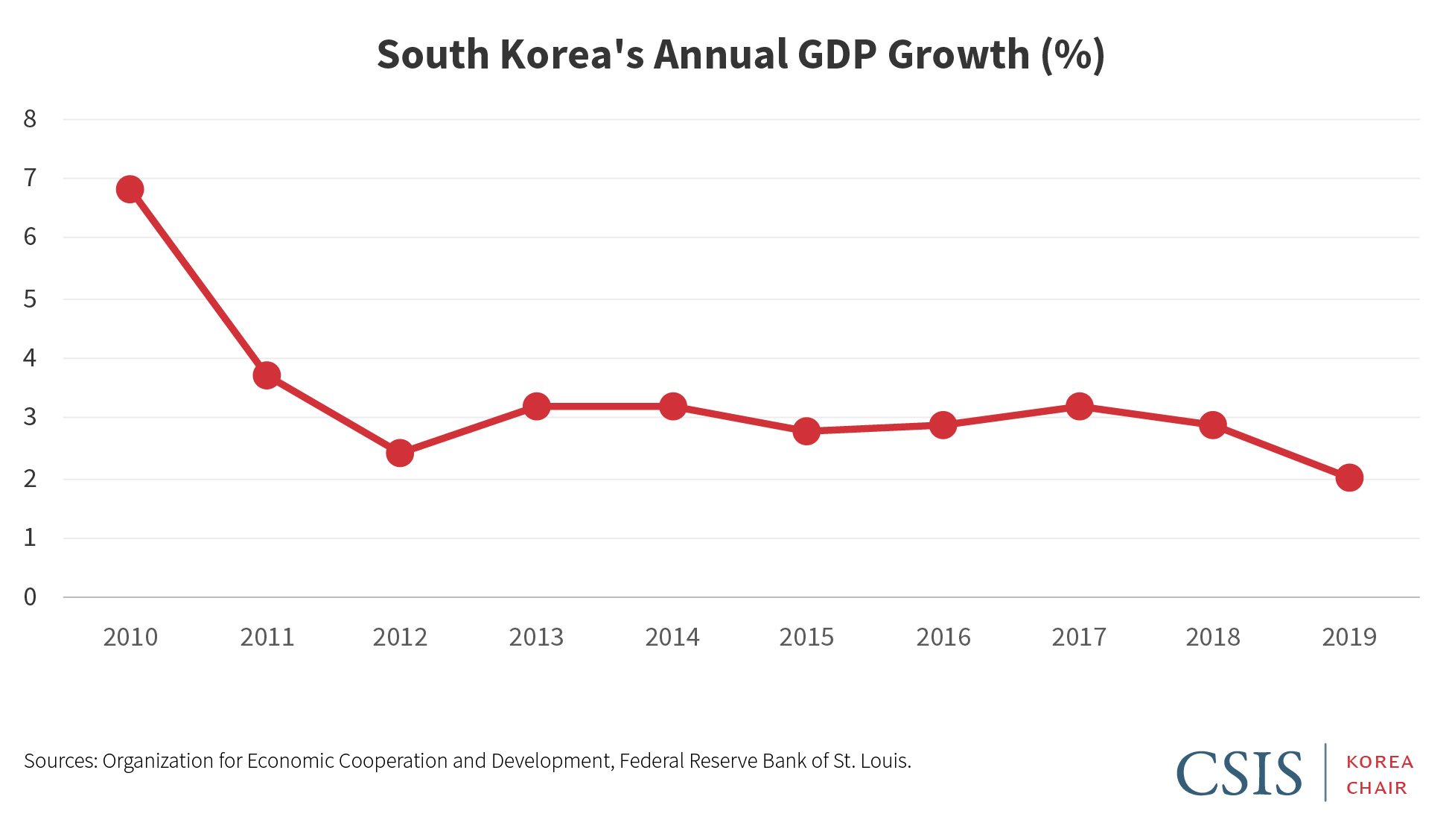
A decade later—and a sign of how South Korea fits the Gates aphorism—the implicit starting point for an overview of the country’s role in the global economy is much different. While it is still struggling to move beyond its old paradigm, South Korea’s economic performance today chiefly holds lessons for developed countries. Despite a change in political leadership and direction in 2017, the country’s growth has become slower and slower, even before the effects of the coronavirus pandemic, which sent South Korea, like most places, into recession. That slow growth—which has averaged under 3 percent a year since 2011—has made it harder for South Korea to overcome some of the challenges that existed in 2010 and before. Among them remains an acute gender imbalance in the workforce and immense difficulties for young adults entering work.
On the plus side, each time BTS produces a hit song or a grocery store in Australia or Austria puts gochujang or kimchi on the shelf, South Korea experiences a cultural win and an economic gain. And it has managed fairly well the challenge of steering between the competing interests of China and the United States, its top trading partners. South Korea has taken punches from both countries but kept trade growing with them until the pandemic hit. As well, ambition still characterizes the country and its people. But in the economic realm, that ambition a decade ago revolved around market liberalization and regional dominance. Today, one of the leading contenders to become the country’s next president is presiding over an experiment in universal basic income.
South Korea in the 2000s was at the tail end of the rapid rise out of poverty that began in the 1960s. A financial crisis in 1997-98 threw the Asian Tigers into recession, arrested South Korea’s long period of ultrafast growth, and opened the door to the questions I was still raising in 2010. Throughout the 2000s, South Korean economists and policymakers debated how to move beyond its export-focused growth model, how to create more domestic consumption, and when to lower trade barriers that protected its companies from outside competition. South Korea embraced free trade—striking deals with Chile, the European Union, and the United States—partly to force change upon certain sectors of its economy. Leaders on both sides of the country’s political divide held up lofty transformative goals, such as turning Seoul into a regional financial center akin to Hong Kong or Singapore. And data that challenged such ambition, such as declines in birth rate and growth potential, routinely made headlines as the cautionary signals they were.
My 2010 article started taking shape when I heard South Korean finance minister Yoon Jeung-hyun that year say there is “a limit for export industries to create new jobs and added value.” South Korea had passed the “middle income trap” by that time, and its per capita income was nearing $30,000. But more than any other developed country, it still relied on exports to power its growth.
The prescription for change that my article described was not new to anyone familiar with the situation: Bring more women and immigrants into the workforce. Encourage innovators. Reduce the government’s regulation and role in the economy. Shed some hierarchical cultural practices. When the Journal’s top economics writer and I got the chance to interview President Lee the week before the summit, he seemed to agree. “There is a lot of work to do in reforming many of the social institutions or the norms and the practices and traditions we've had in this country for many, many years,” he said. “Some of them have been an obstacle to us becoming a more advanced country.”
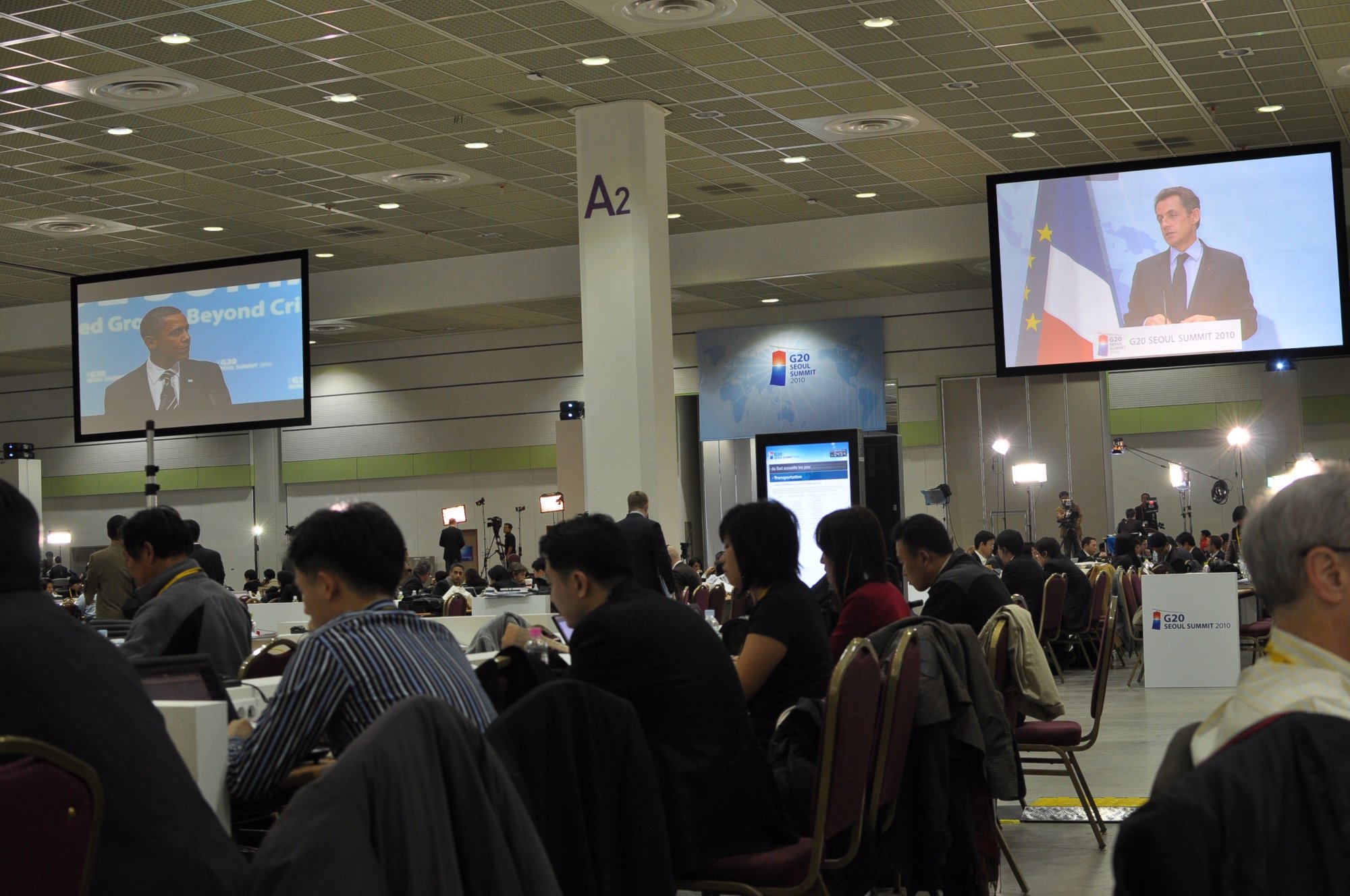
Photo credit: Evan Ramstad
At the 2010 G20 Summit, the most difficult and headline-getting negotiations were over steps to fuel the still-unfolding global recovery, notably a new framework for bank capital and liquidity. But Lee and his team also persuaded the other rich nations to put development of poorer countries on the G20 agenda, where it has been ever since. And South Korea also scored some validation for its development history, which relied heavily on government involvement. The final communiqué contained what the South Koreans titled the “Seoul Development Consensus,” playing off the name of the so-called “Washington Consensus” from the late 1980s while refuting its free-market solutions to crises that arise as countries develop. “There is no ‘one size fits all’ formula for development success,” the communiqué from the Seoul summit read.
Lee’s eagerness to pop the mystique of the Washington Consensus had historic roots. South Koreans at a young age learn that government and the economy are bound tightly. They learn that the World Bank in the 1960s rejected its leaders’ desire to build a highway from Seoul to Busan—and that South Korea built it anyway. They learn that South Koreans sacrificed personal jewelry so the country could overcome debt repayments imposed by the IMF as a solution to the 1998 financial crisis. And they learn that in 2008, executives and workers all took pay cuts to help the country avoid layoffs.
Throughout the 2010s, the back and forth in South Korea over the government’s hand in the economy has been interesting to watch. One industry that, for journalists at least, has been a bellwether measure on the matter is beer. The government eliminated a production quota in 2014 to foster the rise of craft beermakers, then eased tax restrictions last year to stimulate more imports. In the process, the power of a duo of giant domestic brewers has diminished.
At the start of his presidency, Lee, among other liberalizing moves, proposed privatizing about 10 percent of South Korea’s approximately 400 government-owned companies. One of the most interesting that was contemplated was a stock listing for the company that runs the nation’s biggest airports. But none of that came about.
His successor Park Geun-hye began to loosen government’s rules on some industries, but her effort ground to a halt after the sinking in 2014 of the Sewol ferry ship, killing more than 300 passengers. Part of the blame for the tragedy landed on a decision years earlier to loosen a restriction on how long ships could be in service, which had allowed the Sewol to operate. A year later, the government pension service, one of the largest investors in South Korea, backed a merger of two Samsung companies despite the loss in value it would cause to the pension’s investments in them. The pension fund’s support of the merger was popular among South Koreans because it defended Samsung against an U.S. investment firm trying to block the deal. But in 2016, it became a flashpoint in an influence scandal that ultimately led to Park’s impeachment, ouster, and imprisonment. The episode continues to vex the current South Korean government because the U.S. investor is now suing to recover its losses.
When Moon Jae-in was elected president in 2017, he asserted the government’s economic role in a new way with a strategy he called “income-led growth.” His idea was that job creation would spark growth and the government could lead the way by creating more public sector jobs. At the same time, Moon sharply raised the country’s minimum wage, making it more expensive for employers to create jobs. The only way to make that work was to create an environment in which employers would see a sharp increase in productivity, a metric where South Koreans continue to lag behind other developed countries. But that would mean ending some practices and structures that are deeply entrenched in South Korean culture—long working hours, short or no vacations, and business structures that concentrate decisions and power. Aside from encouraging vacation, Moon did little to change cultural habits or to create labor flexibility.
Meanwhile, the inequality of the South Korean workplace continues to hold back the country’s growth. Since 2001, the year a presidential commission on gender equality became a cabinet-level ministry in the South Korean government, the percentage of women ages 25-54 in the labor force grew to 68 percent from 58 percent, data from the Organization for Economic Cooperation and Development show. That is still among the lowest of developed countries and nearly 10 points back from the U.S. level of 77 percent. When a broader range of 15-64 is considered, female workforce gains look worse, at 60 percent now from 53 percent. Japan, which put a stronger emphasis on attracting women to work over the past decade, saw its percentage of working women ages 15-64 rise to 73 percent last year from 60 percent in 2001.
South Korea’s challenges with low growth are not unique. But in the decade since I highlighted them in that special section at the time of the G20 meeting, they have become more pronounced. And that is where the lessons are for other developed countries in the grip of the same forces. Privatization and immigration reform are apparently off the table in South Korea at the moment, and cultural change remains stubbornly difficult. That leaves the experiment with universal basic income in Gyeonggi province, which wraps around the city of Seoul and is the country’s most populous with 13.5 million people, something to watch for the rest of Moon’s presidency.
To counter the coronavirus downturn, the province created a special assistance payment to residents in the form of a regional currency that could only be spent with mom-and-pop establishments, not corporate-affiliated stores. Governor Lee Jae-myung has been promoting the concept of a universal basic income for years. The pandemic relief built on a smaller program Lee created for adults in their mid-20s who received about $230 per quarter, or about $900 per year. About 150,000 youths qualified for that program and the province, able to track their spending, found an upswing in spending at small businesses. Meanwhile, the virus-related payment was smaller, around $85 per quarter, but went to millions of people with the same caveat for where the money had to be spent. The governor has proposed that the national government embrace the universal basic income concept by distributing about $430 to everyone in South Korea annually. News accounts say he would like to see that eventually become a monthly payment. Lee envisions paying for it with taxes on land, fuel emissions, and digital services.
With the next presidential election 17 months away, Governor Lee is a leader in favorability surveys. A lot can change before South Koreans choose the next leader, of course. And because South Korea managed the coronavirus outbreak better than many other places, its economy may recover more quickly. But the fundamental challenge of living with slow growth will remain. Normal political divisions aside, South Koreans since the late 1990s have demonstrated a social cohesion that helped them pull through three economic crises. Perhaps that bond will allow them to forge a solution for other slow-growing developed countries to emulate.
Evan Ramstad is a senior associate (non-resident) with the Korea Chair at the Center for Strategic and International Studies in Washington, D.C.
Commentary is produced by the Center for Strategic and International Studies (CSIS), a private, tax-exempt institution focusing on international public policy issues. Its research is nonpartisan and nonproprietary. CSIS does not take specific policy positions. Accordingly, all views, positions, and conclusions expressed in this publication should be understood to be solely those of the author(s).
© 2020 by the Center for Strategic and International Studies. All rights reserved.