Ensuring Economic and Energy Security: Opportunities for U.S.-Japan Leadership
September 24, 2026 • 9:00 am – 12:00 pm EDT
Hosted by Japan Chair

Photo: Andrew Harnik/Getty Images
President Donald Trump’s visit to China this week offers an opportunity to revisit trade negotiations on critical minerals. When President Trump met with Chinese leader Xi Jinping last October in Busan, South Korea, the two sides agreed to step back from an escalating economic dispute, including by pausing export restrictions affecting critical minerals such as rare earths and lesser-known critical minerals like gallium, germanium, and antimony.
Despite the Busan “trade truce,” new evidence suggests that access to Chinese-origin gallium remains constrained for U.S. industry, creating challenges for critical defense and high-tech production lines.
Gallium is a little-known metal with outsized strategic and economic significance due to its importance to advanced technology supply chains. It was first caught up in escalating U.S.-China tensions in 2023, when Beijing launched its opening salvo of export controls targeting strategic minerals, including gallium and germanium.
Those initial controls—which required exporters to obtain licenses and disclose end-use information about their clients—caused alarm due to China’s near-total dominance over the world’s supply of gallium. China produces a startling 99 percent of primary gallium globally, largely due to years of supportive industrial policies that pushed competitors out of the market.

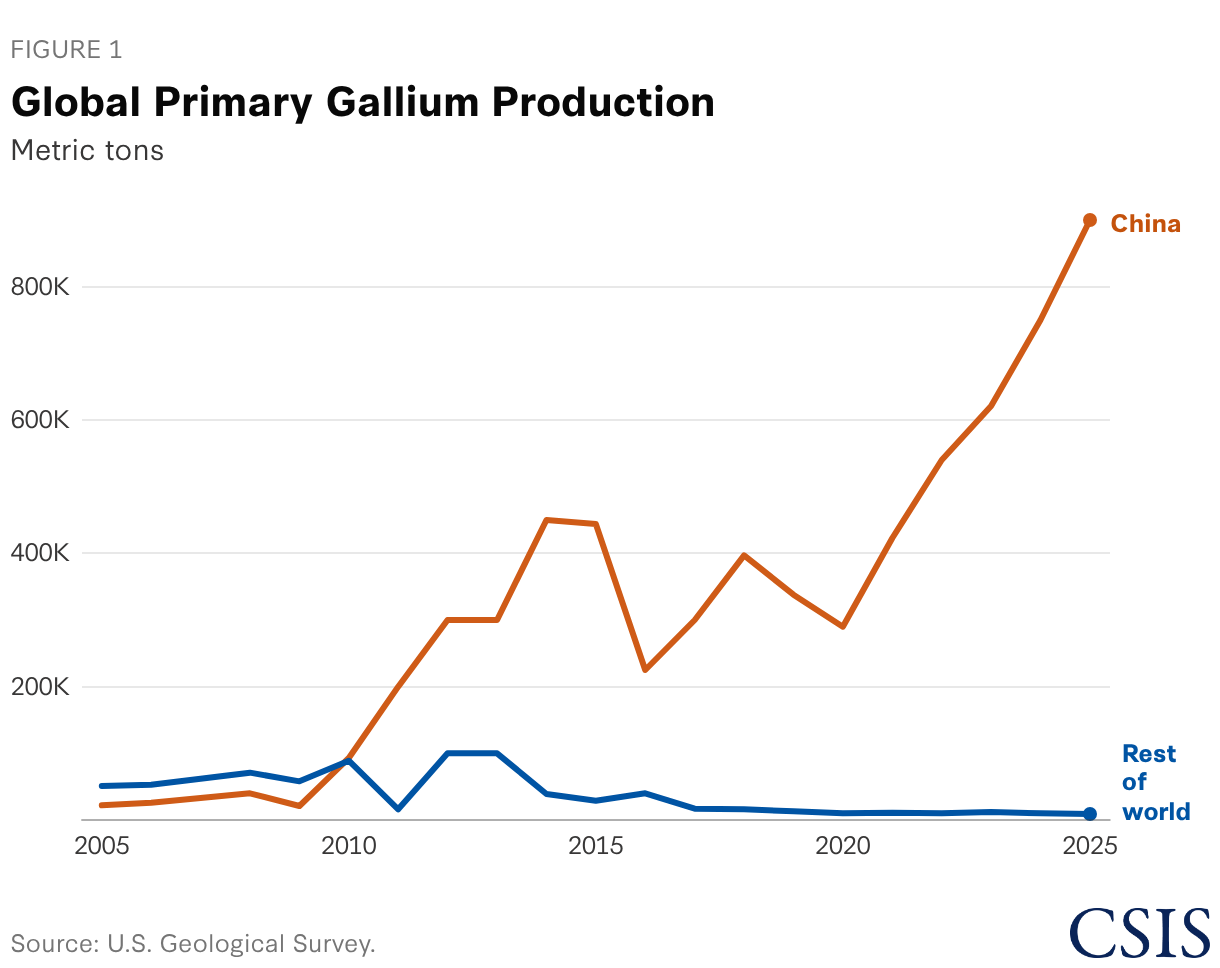
While most export licenses were initially approved, China escalated its gallium controls further on December 3, 2024, when its Ministry of Commerce (MOFCOM) issued Document No. 46. This unprecedented rule explicitly named the United States as the target of an export ban on dual-use products, creating a presumption of denial for any exporters seeking to sell gallium to U.S. end users.
After a year of broad economic escalation, Presidents Trump and Xi met in October 2025 on the sidelines of the Asia-Pacific Economic Cooperation (APEC) summit, where they notionally agreed to roll back or suspend many of the more extreme measures each had implemented in the preceding year, including on critical minerals. The official White House fact sheet outlining the terms of the deal explained that, among other actions: “China will issue general licenses valid for exports of rare earths, gallium, germanium, antimony, and graphite for the benefit of U.S. end users and their suppliers around the world. The general license means the de facto removal of controls China imposed since 2023” (emphasis added).
China did not release a similarly detailed readout, but roughly a week later, MOFCOM issued Document No. 72, which suspended for one year the presumption-of-denial ban on gallium and other dual-use exports to the United States that it had introduced in December 2024. No mention was made of China’s earlier dual-use export licensing requirements first implemented in 2023, but the expectation appears to have been that license approvals would again be granted under normal procedures.
Despite the November 2025 policy adjustment after Busan, there is growing evidence that Chinese exports of gallium to the United States have not resumed in a meaningful way, intensifying the shortage of the material for U.S. and global markets.
One signal of the growing supply crunch is price behavior. Over the last year, gallium prices outside China have surged to unprecedented levels. Spot prices reported by Fastmarkets, a leading industry price tracker, reached a record high of $1,850 per kilogram in April 2026—an increase of over 200 percent since the start of 2025. Prices within China, meanwhile, have held steady, creating a clearly bifurcated market within and outside of China.
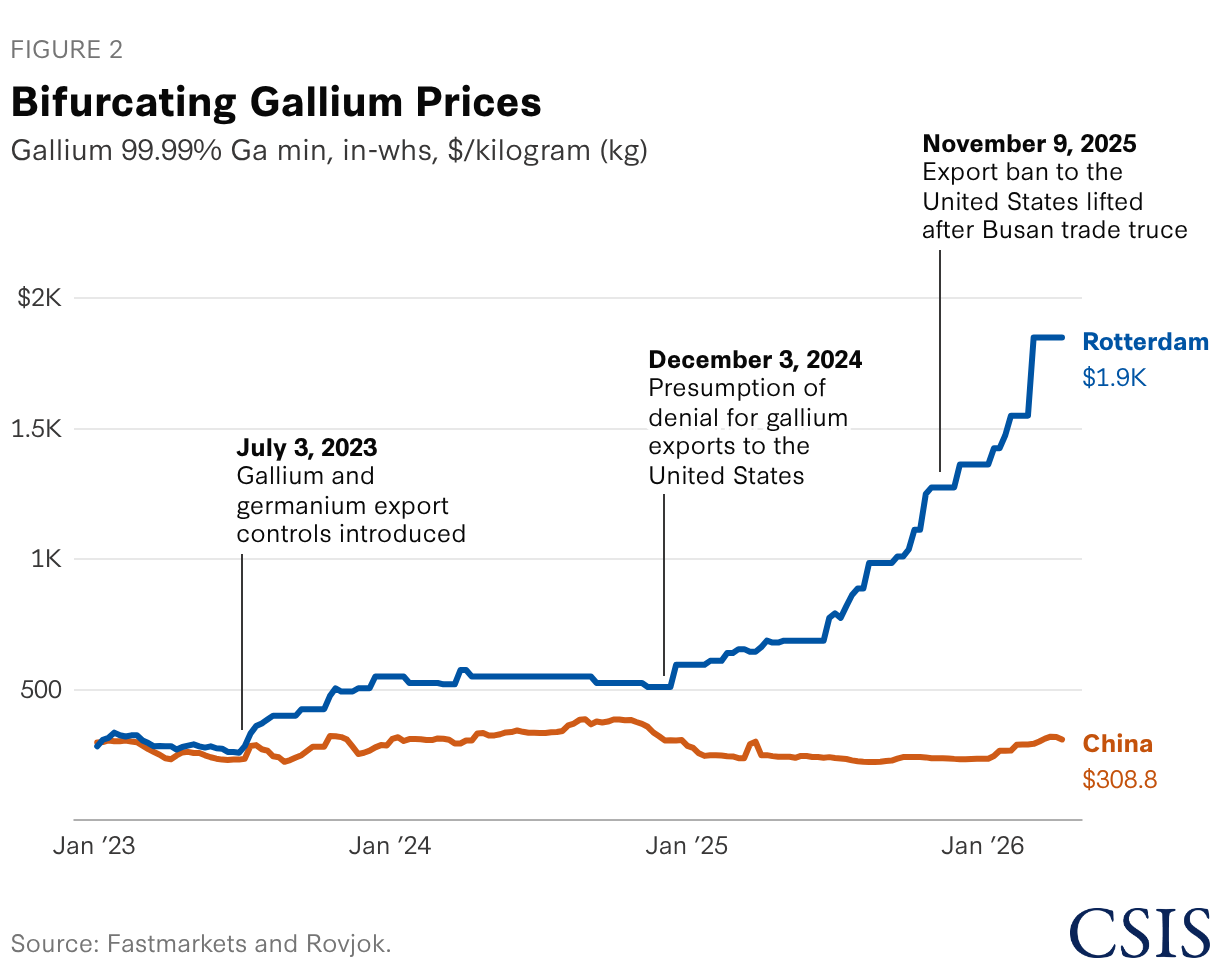
This reflects a market with insufficient supply. Gallium is a niche metal, with less than a thousand metric tons consumed globally each year. Any major infusion of supply—as would have been expected if China lifted its export ban—should lessen the supply and demand mismatch and put downward pressure on prices. Instead, prices have continued to rise rapidly as supply tightens.
Some of this increase in prices could be attributable to growing demand, especially if companies are hedging against future instability by stockpiling gallium. Yet, Chinese customs data offers additional evidence that China has not resumed significant exports of unwrought gallium. In 2025, China’s exports of unwrought gallium fell 94 percent from 2024 levels, and they have not yet recovered in 2026. Exports to the United States have effectively disappeared in Chinese customs data since 2023.

There are discrepancies between Chinese and U.S. customs data, but the U.S. data shows a similar overall trend: Imports of unwrought gallium from China all but stopped after March 2025. Only a single shipment of roughly 3 kilograms arrived in July.
While total U.S. imports of unwrought gallium jumped significantly in 2025, the sources shifted dramatically, with China’s share dropping below 5 percent, down from roughly 38 percent in 2022. It is possible that some Chinese-origin gallium is being transshipped through third countries, but China’s customs data suggests that very little unwrought gallium is leaving the country for any market.
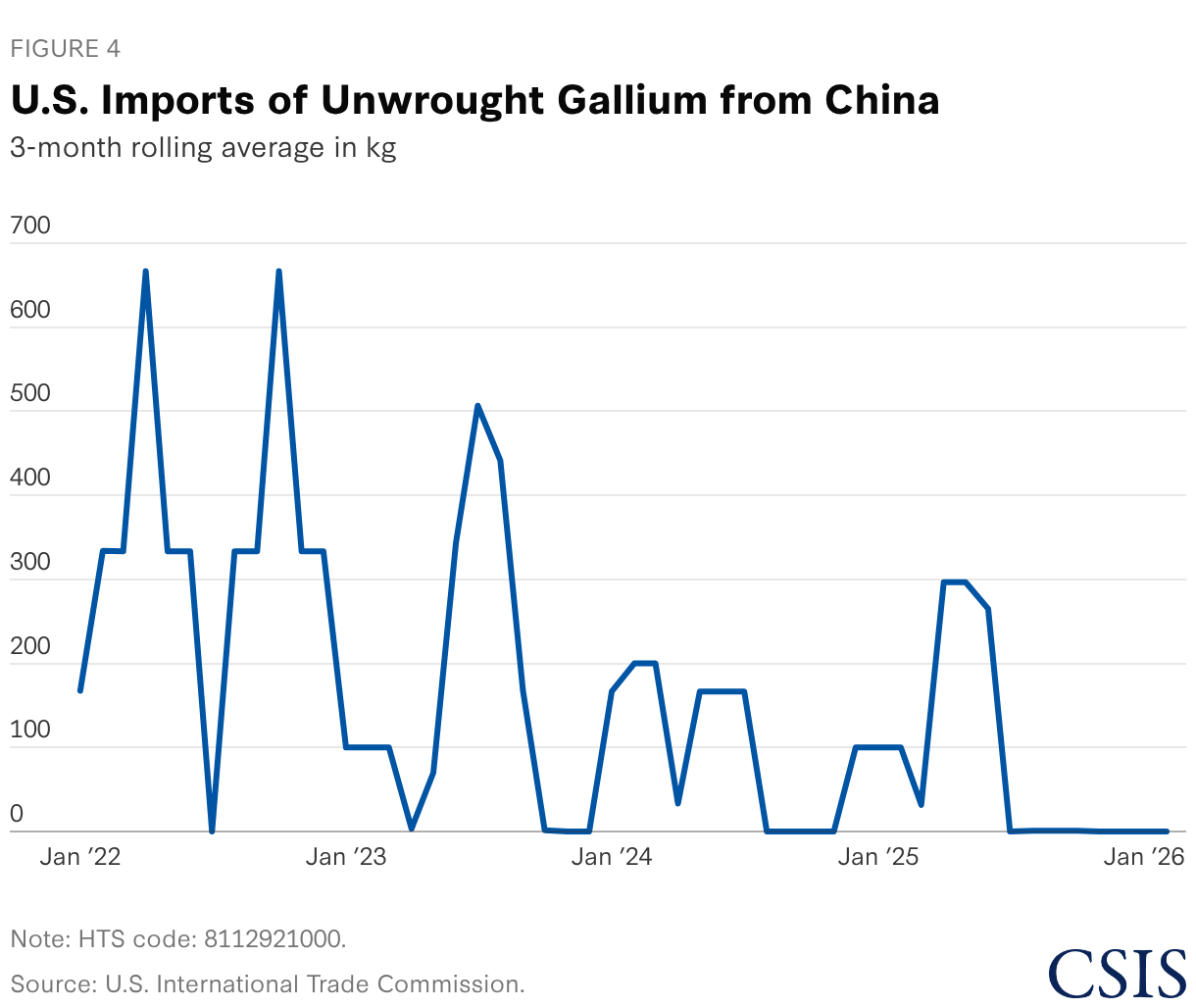
The remaining U.S. imports came primarily from Germany, Japan, Taiwan, South Korea, and Slovakia. These countries do not produce primary gallium, but they have facilities that recycle gallium from semiconductor manufacturing waste. The material reaching the United States from these countries is therefore likely derived from scrap recovery rather than new production, and thus ultimately relies on the same Chinese feedstock.

Trade data should be interpreted cautiously given gallium’s opaque and relatively small market. Customs and trade agencies around the world do not record gallium trade in uniform ways, making direct comparison difficult.
Additionally, companies often move material between their affiliated facilities in different countries, inflating the appearance of cross-border trade. For example, Neo Performance Materials, one of the main suppliers serving North American customers, operates facilities in both Canada and the United States, and likely frequently transports material across the border between its facilities.
There is also evidence of attempts to circumvent China’s restrictions. In July 2025, a U.S. company reported that Chinese suppliers were successfully shipping gallium by intentionally mislabeling it as other materials and routing it through third countries in order to evade export controls. Given the rapidly rising price of gallium in global markets, incentives for Chinese suppliers to smuggle their product will continue to grow.
Chinese authorities have attempted to clamp down on these practices, but enforcement is difficult. Gallium is traded in small quantities and required only in modest volumes for many applications, which makes illicit shipments harder to detect.
Even accounting for these complexities, the price surge and trade data both point to the same conclusion: Little Chinese gallium is reaching global markets.
Public statements from global companies provide additional insight. AXT, a major producer of gallium arsenide semiconductor substrates with operations in both China and the United States, acknowledged in its Q4 2025 earnings report that while it “has generally received the required permits for exports to countries in Asia and Europe, our U.S. gallium arsenide customers are considered ‘dual use’ customers. . . . As such, no permits for the export of gallium arsenide to the U.S. have yet been approved.”
Neo Performance Materials, the primary North American supplier, has reported similar pressures. In its Q4 2025 earnings release, the company stated that Chinese export restrictions continued to limit gallium availability and push prices higher. While Neo has the ability to recycle gallium scrap, the company noted that “despite strong demand, rising prices, and expanding margins, business growth is restrained by limited gallium scrap supply.”
Taken together, these indicators suggest that China’s suspension of the presumption-of-denial rule has not translated into a meaningful increase in exports. Some gallium continues to circulate through recycling and indirect channels, but the total volume available to global markets has fallen sharply.
Without direct visibility into the policy process in Beijing, it is impossible to determine the precise reason for the continued delay in gallium export licensing. Still, it is worth considering several plausible explanations:
While policy attention in Washington has understandably focused on acute shortages of more high-profile minerals such as rare earths and tungsten, gallium should not be ignored. Gallium plays a critical role in several emerging technologies that are central to U.S. economic and national security interests. GaN semiconductors are widely used in power electronics for data centers, electric vehicles, and renewable energy systems. They also enable high-performance radar and electronic warfare systems used by modern militaries.
Demand for these technologies is expected to increase sharply in the coming decade. Planned investments in missile defense and advanced radar systems, such as the Golden Dome homeland defense system proposed by President Trump, will require substantial quantities of gallium to produce.
Ongoing conflicts are creating an even more urgent need to replace equipment made with gallium. Experts estimate that a single Terminal High-Altitude Area Defense (THAAD) missile defense battery, for example, requires roughly 77 kilograms of gallium. Public reporting suggests that Iranian strikes have damaged or destroyed several of these systems at military bases across the Middle East in its war with the United States and Israel in early 2026, meaning they will need to be replaced.
Unfortunately, the United States has few good options in the short term. Despite rapidly rising demand from strategic sectors, there is simply no immediate alternative to China for gallium. Under the Trump administration, the Pentagon and other agencies have committed millions in new investments in both domestic and overseas gallium production facilities to create stable substitute suppliers. However, these projects are still nascent and will likely not reach full operational capacity before mid-2027, at best. In the meantime, recycling can help offset some shortages, but recoverable gallium is limited to recycled feedstock from pre-consumer scrap—and is ultimately still reliant on Chinese-origin supply.
Stockpiling is another potential response, but it creates its own challenges. The United States has launched Project Vault, an ambitious $12 billion effort to create a stockpile for strategic minerals. However, the utility of stockpiling is diminished once a shortage has already materialized. Large new purchases by government buyers in an already tight market could push prices even higher and worsen the shortage.
Diplomacy can play a role in the immediate term. President Trump’s visit to China this week provides an opportunity to raise these issues. During the visit and in future U.S.-China trade talks, U.S. negotiators will need to keep critical minerals, including gallium, on the agenda and work to ensure that China abides by its commitments.
Aidan Powers-Riggs is an associate fellow with the iDeas Lab at the Center for Strategic and International Studies (CSIS) in Washington, D.C. Brian Hart is deputy director and fellow of the China Power Project at CSIS. Matthew P. Funaiole is vice president of the iDeas Lab, Andreas C. Dracopoulos Chair in Innovation, and senior fellow in the China Power Project at CSIS.

Brief by CSIS Scholars — July 17, 2025

Digital Feature by Matthew P. Funaiole, Brian Hart, and Aidan Powers-Riggs — July 18, 2023

Report by Matthew P. Funaiole, Brian Hart, and Aidan Powers-Riggs — August 3, 2023

