Proportional to the Mischief: International Law and U.S. Grand Strategy
October 26, 2026 • 3:30 – 4:30 pm EDT
Hosted by Defense and Security

Photo: Liza/Adobe Stock
Today, government leaders and policymakers emphasize the importance of unlocking private sector innovation, improving the government’s access to new ideas, and modernizing how the government buys and maintains cutting-edge capabilities. Instead of buying a device, piece of equipment, or system from a company, which the government then owns and operates using government personnel, the government is increasingly turning to “as-a-service” models for acquiring certain capabilities from the private sector. This trend is particularly pronounced in space, as government agencies that buy and use space capabilities—like the National Aeronautics and Space Administration (NASA), the Department of Defense (DOD), and the intelligence community, among others—seek to use space startups and innovative space companies to help them accomplish their missions.
To date, however, there is no policy guidance that can be applied across federal agencies to help officials choose between an as-a-service model or a traditional model—where the government owns and operates a system—for carrying out space missions and functions. This choice shapes the acquisition process but is more than an acquisition issue. The decision is essentially between different operating models: (1) government-owned, government-operated; (2) government-owned, contractor-operated; (3) contractor-owned, government-operated; or (4) contractor-owned, contractor-operated. Three of these models—government-owned, contractor-operated; contractor-owned, government-operated; and contractor-owned, contractor-operated—involve buying all or part of a function as a service and are all flavors of an as-a-service model. Existing policies aimed at maximizing the use of commercial solutions generally—and for use in space missions specifically, such as the executive order to ensure U.S. space superiority issued on December 18, 2025—do not provide guidance for operating model selection because commercial solutions can be used as part of any operating model. The specific meaning of the commercial label has also blurred, leading to a lack of clarity on what is specifically meant by the commercial designation.
Instead of the commercial distinction, this paper places the focus on the operating model and outlines considerations that NASA, defense, intelligence, and other federal officials could use to determine which model is most appropriate to fulfill a given space requirement. At the most fundamental level, these considerations are performance, schedule, and cost—essentially, the project management triangle—and whether the use case in question qualifies as an inherently governmental function. The Pentagon’s acquisition transformation strategy, released in November 2025, already focuses on performance, schedule, and cost—a focus that should apply government-wide. Based on the statutory definition of an inherently governmental function, no space mission area should qualify as one. It should be noted that there is no statutory or regulatory provision, or even a Pentagon directive, prohibiting a contractor or contractor-owned-and-operated system from using force.
Before deciding the acquisition and development path to meet a space requirement, decisionmakers should assess how performance, schedule, and cost—specifically, costs over a requirement’s lifetime—vary based on the selection of operating model. To fully assess these considerations, government officials will need to do apples-to-apples cost comparisons over the capability lifetime of each use case or program going on contract. Additionally, industry partners will need to provide life cycle cost data to help government officials better understand how costs to the government could change over the life cycle of a service.
When the government purchases a service, it is not buying a tangible item but rather securing a commitment from a provider for an agreed-upon result, outcome, or task. The provision of a service is intrinsically linked to an ongoing relationship with the provider, whereas the relationship with a vendor can be separated upon delivery of an item or good that will be owned by the government. From a consumer or business-to-business standpoint, many companies use as-a-service models to offer everything from music, movies, and legal advice to transportation, housing, house cleaning, and healthcare. A service may be purchased on a fixed-term basis, covering a specified period or certain activity, or an ongoing basis until terminated by the customer.
Typically, four operating models are used to describe who owns and operates the capabilities the government uses:
The GOCO, COGO, and COCO models involve all or part of a capability being provided as a service; therefore, all three use as-a-service approaches. Although these models are typically used to describe how the DOD operates capabilities, they apply just as well to capabilities operated by other agencies and departments. The military’s use of satellite communications and launch services provided by companies are long-standing examples of the use of a COCO approach for space. In the non-space domain, the Army’s Aerial Reconnaissance and Targeting Exploitation Multi-Mission Intelligence System (ARTEMIS) and Airborne Reconnaissance and Electronic Warfare System (ARES) are programs that used a COCO model for intelligence, surveillance, and reconnaissance (ISR) capabilities. The Navy uses commercial services for conducting airborne supply missions using helicopters to ships at sea. Additionally, NASA’s use of launch services and the Department of Commerce’s acquisition of space data from companies—for example, weather and space situational awareness data—are examples of the COCO operating model.
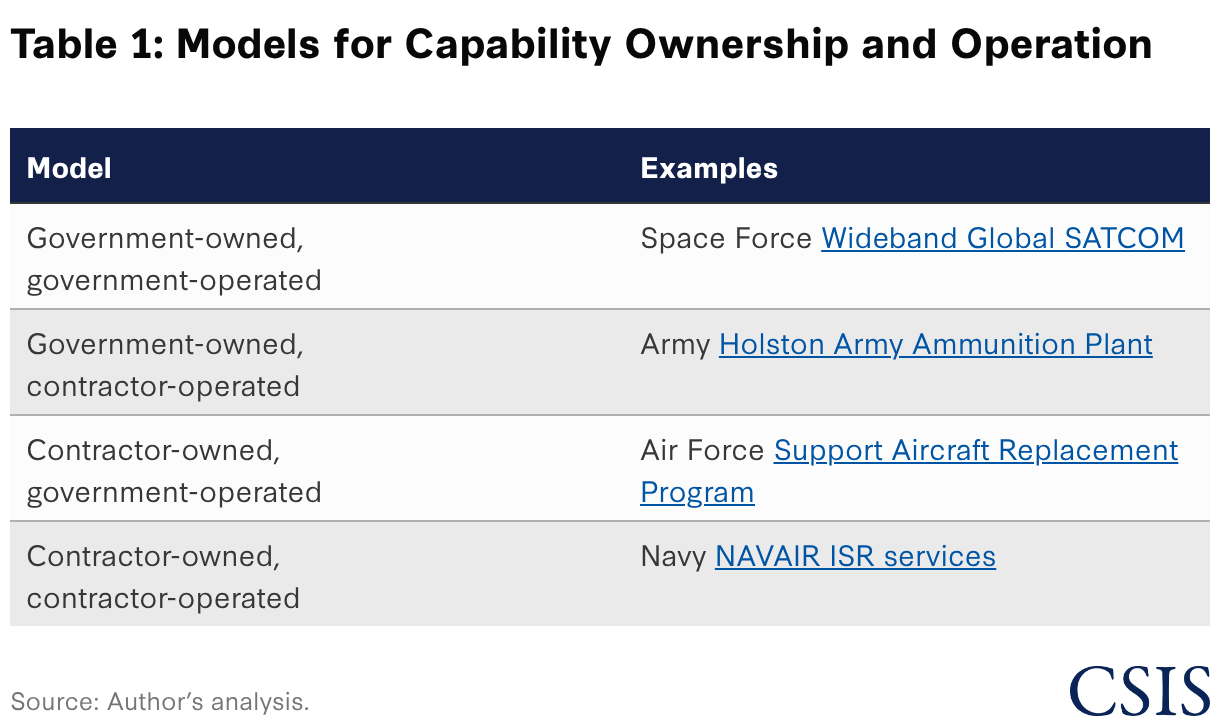
Only under the GOGO model does the government retain sole ownership and control. In this case, the government owns the equipment or system, which is operated by government personnel. The GOGO model is the traditional, legacy approach to government operations—for example, NASA owned and operated the Space Shuttle and the Space Force owns and operates the GPS and Wideband Global SATCOM systems. However, even with the GOGO model, the government may not own the intellectual property associated with the asset, meaning the contractor still would retain some level of control over the system. All three other models rely, at least in part, on a service provided by a company to the government. In the GOCO model, private sector workers, also called contractors, operate government-owned equipment. In the COGO model, the government leases physical space, equipment, other hardware, or software that is operated by government personnel. In the COCO model, a company and its employees operate company-owned equipment. Using a COCO model, the government buys services such as cloud computing, broadband connectivity, and janitorial and transportation services.
Many of the words used to describe each of the four operating models are either not defined or defined inconsistently in U.S. law, regulations, and departmental and agency-specific directives. For example, there is no definition of a service in the U.S. Code. Part 37 of the Federal Acquisition Regulation (FAR), however, provides direction for the “acquisition and management of services by contract.” While the U.S. Code does not define “service” as a standalone term, it does define commercial service in Title 41 as any service “of a type offered and sold competitively, in substantial quantities, in the commercial marketplace.” However, there is no legal definition of a commercial marketplace. Rather, the U.S. Code defines a “commercially available off-the-shelf item,” which could be a service or other item offered to the federal government “without modification” from that offered to other customers.
The origins of U.S. private spaceflight date back to the launch of an amateur radio satellite called OSCAR-1 in 1961 and Telstar 1, the first privately operated communications satellite, in 1962. Intelsat 1 became the first commercial communications satellite in geostationary orbit when it was launched in 1965. In 1982, Conestoga 1, launched from the Texas coast, became the world’s first privately owned rocket to reach space. In 1984, President Ronald Reagan signed the Commercial Space Launch Act into law, ending the U.S. government monopoly on space launch. It also added a new clause to NASA’s statutory mission statement: “Congress declares that the general welfare of the United States requires that the Administration seek and encourage, to the maximum extent possible, the fullest commercial use of space.” The Land Remote Sensing Policy Act of 1992 similarly opened up the satellite imagery market to companies, authorizing the Department of Commerce to issue licenses to companies for operating remote sensing satellites.
Beginning in the 1990s, the U.S. government began turning to space services provided by companies for government requirements. In 1988, a presidential directive stated that the government should “purchase commercially available space goods and services to the fullest extent feasible” for government space needs unless there were national security reasons not to do so. In 1990, President George H. W. Bush signed the Launch Services Purchase Act, which required NASA to purchase commercially available launch services for its main payloads. During the first Gulf War, the military extensively used commercial satellite communications, with 24 percent of all theater satellite communications traffic carried over commercial satellites—coincidentally, the same dependency on commercial satellite communications played out more recently in Ukraine. In 1994, the U.S. government established the Evolved Expendable Launch Vehicle (EELV) program to create two launchers that could support military and national security space access.
Since 2000, successive presidential administrations have sought to foster growth in the U.S. space sector and encourage the U.S. government to buy and use space services as much as possible. The space policies of Presidents George W. Bush, Barack Obama, and Donald Trump called for government departments and agencies to use commercial solutions to the “maximum practicable extent” when commercial options meet government requirements. Both the Obama and Trump administrations’ policies specified that commercial solutions should be modified to meet government requirements when those modifications offer a “more cost-effective and timely acquisition approach” than building a system from scratch for the government. The Obama and Trump policies also defined commercial as applying to
goods, services, or activities provided by private sector enterprises that bear a reasonable portion of the investment risk and responsibility for the activity, operate in accordance with typical market-based incentives for controlling cost and optimizing return on investment, and have the legal capacity to offer those goods or services to existing or potential nongovernmental customers.
At least on paper, a commercial preference, which implies a COCO and as-a-service model in many cases, will play a key role in future space-related acquisitions by the U.S. military and national security agencies. The release of two related commercial space strategies in April 2024—the department-wide Commercial Space Integration Strategy and the U.S. Space Force Commercial Space Strategy—reflect a growing urgency by military leaders to figure out how to better use space services. On the heels of the strategies’ release, the Defense Science Board published a commercial space system report in May 2024 with recommendations for improving the use and integration of commercial space. In 2025, the Space Force established a working capital fund for buying space services, indicated strong demand for satellite communications services, and made progress with the Commercial Augmentation Space Reserve initiative to use and integrate more services. But commercial does not only denote an as-a-service model—and as-a-service products could be sold by a company with only a government customer in mind.
The intelligence community also continues to buy space services, including National Geospatial-Intelligence Agency programs to buy geospatial analytics and National Reconnaissance Office purchases of remote sensing data from private sector operators. The utility of remote sensing data provided by companies in warfare has been made abundantly clear since Russia’s invasion of Ukraine in 2022, providing Ukrainian forces access to critical battlefield information. Additionally, NASA has turned to an as-a-service model for space transportation requirements—for cargo, scientific payloads, and astronauts—beyond launching satellites into space. NASA’s decision to use the as-a-service model for a variety of purposes is based on several assumptions, including that such a model can save taxpayer money, foster innovation, strengthen the competitiveness of U.S. space companies, and lay the foundation for a nongovernmental market for certain space services.
NASA’s use of space services started in 2006, when it established the Commercial Orbital Transportation Services (COTS) program, aiming to develop U.S. space launchers to compete in a global launch market, then dominated by European company Arianespace, and ferry cargo to the International Space Station (ISS). As part of the COTS program, SpaceX conducted the first docking of a private spacecraft with the ISS in 2012. In 2018, NASA stood up the Commercial Lunar Payload Services (CLPS) program, through which NASA would buy transportation services for government payloads to the Moon. As part of NASA’s Commercial Crew Program, which sought to use spacecraft operated by companies to transport astronauts to and from the ISS, SpaceX conducted the first privately operated crewed mission to both reach orbit and dock with the ISS in 2020. In 2021, NASA established the Commercial LEO Destinations (CLD) program—another as-a-service approach using space stations operated by companies—to maintain the post-ISS U.S. continuous human presence in low Earth orbit.
As of 2025, current NASA initiatives to use space services focus on low Earth orbit (e.g., COTS, Commercial Crew, and CLD), the Moon (e.g., CLPS), and space launch. NASA has plans—called the Communications Services Project (CSP)—to replace its Tracking and Data Relay Satellite (TDRS) network with data relay services provided by private sector satellite communications operators and has expressed broad interest in using more services to meet its communications needs. Other civil space agencies also acquire capabilities as a service. For example, the National Oceanic and Atmospheric Administration buys weather data and forecasting from the private sector, while the Office of Space Commerce in the Department of Commerce buys space situation awareness data and services from companies.
When selecting an operating model, the overarching question is whether the function is considered an inherently governmental function and, if so, can be performed only by government personnel. When the answer is no, the key considerations determining operating model selection can be grouped into three categories: performance, schedule, and cost. This may seem obvious, but other considerations, outlined in this section, sometimes cloud a clear-cut analysis of performance, schedule, and cost factors. When speaking about costs, this paper refers to life cycle costs, which include operations and maintenance costs, and not merely the cost to develop and initially field a new system. The schedule includes not only the time to develop a capability but also to train personnel to operate and use the capability.
An important limit on what type of activity can be carried out using an as-a-service model is whether the activity qualifies as an inherently governmental function. This phrase has a specific meaning in law, which does not relate to the criticality of a function. However, there is a tendency in the military space community to categorize functions as inherently governmental or closely associated with inherently governmental functions based on their criticality and, thus, rule out their performance using a service provided by a company.
There is a tendency in the military space community to categorize functions as inherently governmental . . . based on their criticality.
The United States did not have a statutory definition of an inherently governmental function until the Federal Activities Inventory Reform Act of 1998, which sought to narrowly define what only the government could do. When codifying the definition of “inherently governmental,” policymakers aimed to encourage greater use of commercial services by narrowly defining what jobs must be performed by government workers, limiting them to functions “so intimately related to the public interest as to require performance by Federal Government employees.” Included alongside this definition is a nonexhaustive list of inherently governmental functions, including directing military, diplomatic, and judicial actions; managing government resources and personnel; and acting on behalf of and representing the government.
Additionally, the Office of Management and Budget (OMB) Circular No. A-76 and FAR Subpart 7.5 provide further guidance on inherently governmental functions, including a nonexhaustive list of specific activities that must be performed by government employees and not contractors. The common thread is that inherently governmental functions are about making decisions, directing government resources and personnel, and acting on behalf of and representing the government. The criticality of an activity plays no role in this definition.
FAR Subpart 7.503(d) also provides a nonexhaustive list of functions “not considered to be inherently governmental functions” but that are closely associated with inherently governmental functions. This list includes activities like budget preparation, reorganization planning, development of regulations, acquisition planning, helping develop statements of work, contractors attending conferences on behalf of an agency, and providing inspection services, among other functions. The common thread across the examples in this list is that they can disproportionately influence government decisionmaking and give the impression that a contractor is acting on behalf of and representing the government—activities that are defined as inherently governmental functions. Again, the criticality of an activity to the government’s mission plays no role.
On top of these government-wide rules, the DOD has its own regulations and policies that specify what contractors can do when supporting military operations. There is no bright-line prohibition on contractors participating in frontline or offensive operations, though the DOD does not intentionally place nongovernment personnel in such situations. Some have argued that the Anti-Pinkerton Act of 1893 bans the use of contractors in combat roles (e.g., as mercenaries). However, a 1977 court ruling, a subsequent interpretation and decision by the Government Accountability Office, and a federal regulation leave more questions than answers as to how this law would apply to the military use of services and contractors in operations.
The Space Force and DOD commercial space strategies released in 2024 identified 13 military space functions: combat power projection; command and control; cyberspace operations; electronic warfare; environmental monitoring; ISR; missile warning; nuclear detonation detection; positioning, navigation, and timing; space access, mobility, and logistics; satellite communications; space domain awareness; and space operations. Of these 13 functions, only combat power projection may involve the direct application of force. The remaining 12 functions support government decisionmaking, action taking, and joint force operations by providing services such as communications and data. They support government personnel doing inherently governmental work.
There is no statutory or regulatory provision, or even a DOD directive, prohibiting a contractor or contractor-owned-and-operated system from using force.
It should be noted that there is no statutory or regulatory provision, or even a DOD directive, prohibiting a contractor or contractor-owned-and-operated system from using force. During the wars in Iraq and Afghanistan, the U.S. military acquired a variety of as-a-service functions, including security services, from thousands of contractors. Military rules allowed these contractors to use deadly force for self-defense or, in the case of contractors providing security services, when deadly force “reasonably appears necessary” to execute their mission. Thus, according to statute and regulation, as well as this precedent, no military space function would qualify as an inherently governmental function. Beyond the DOD, there is also no evidence that any space function performed by any other federal entity qualifies as an inherently governmental function. The space functions themselves do not make decisions, direct government resources and personnel, or act on behalf of or represent the government.
Relatedly, Section 1603 of the National Defense Authorization Act for Fiscal Year 2026 adds a provision to Title 10 directing the DOD to “acquire and operate space systems to be used primarily for space warfighting and control,” while also allowing “commercial space systems to augment” government-owned-and-operated space warfighting and control systems. This language complements the definition of inherently governmental functions provided in the Federal Activities Inventory Reform Act of 1998, OMB Circular No. A-76, and FAR Subpart 7.5, placing emphasis on the need for government personnel to maintain control of decisions, while allowing that the systems and technologies used to carry out those decisions can operate using as-a-service models.
The selection of the operating model may not affect performance, though that is not always apparent in rhetoric from U.S. government acquisition officials. In statements and directives, Pentagon leaders have, on occasion, implied that services are inherently deficient or inferior to government-owned-and-operated systems in terms of performance. For example, senior military and civilian officials have suggested that services cannot meet required levels of quality or cybersecurity, that services are unreliable because companies might shut off or withhold access, and that buying a service carries greater risk of vendor lock than other operating models.
Recent strategy documents for integrating commercial space solutions into military operations contain implicit performance critiques of space-based services provided by companies. In contemporary usage, commercial solutions are often, though not always, synonymous with as-a-service models. The Pentagon’s Commercial Space Integration Strategy, issued in 2024, observes that the selection of commercial solutions, rather than “purpose-built government systems,” risks security and that “technological and functional differences” suggest that commercial solutions cannot meet the same performance as government-operated systems. The commercial strategy issued by the U.S. Space Force in 2024 does not explain the criteria or methodology used to determine which “mission areas [are] considered suitable” for as-a-service models, other than suggesting that commercial solutions provided by companies could be used so long as government-operated systems are still performing critical functions.
In contemporary usage, commercial solutions are often, though not always, synonymous with as-a-service models.
The government can specify a level of performance independent of the operating model, though operating model selections will have cost and schedule implications. For example, it may be more costly on an annual basis for the government to own and operate the information technology running the Department of Veterans Affairs website than it would be to contract out that function to a company that maintains and operates the site for the government. Both a GOGO and COCO information technology architecture could provide a comparable level of performance, yet one option will carry a higher price tag. Conversely, it may be cheaper for the government to own and operate drones conducting ISR in areas where aircraft face a significant threat of damage or destruction than it would be for the government to buy such a capability as a service. In this case, the life cycle costs of obtaining ISR from a COCO system may be higher than those of a GOGO system.
Operating model selection might significantly influence delivery timelines. If a space requirement can be met with an unmodified version of a service a company already sells, there may be a significant schedule benefit to using a COCO model. But if a new system or capability must be designed and built from the ground up to meet a requirement, there may be little difference in schedule between the operating models. For example, there would be no noteworthy difference in the time it takes General Motors to design and produce a car that would be offered for lease versus one for outright purchase. Similarly, it does not take a construction company any longer to build and market a condominium for purchase than to build and ready the same structure for lease as apartments.
Training government personnel to operate and maintain a system and use the capability adds other schedule considerations that might factor into decisions on operating models. In a COCO model, a company is responsible for operating and maintaining a system, meaning that the government would not have to spend time training personnel on operations and maintenance. The government would be responsible for integration and use of any capability, regardless of whether it is provided as a service or through something owned and operated by the government. In situations where delivery time is critical, government acquisition personnel should thoroughly assess the delivery schedules associated with operating model selection.
While production costs probably do not depend on whether a capability is sold as a service or as an item to be owned by the customer—as noted, building a car that will be leased costs the same as building a car that is sold—the government’s lifetime costs can vary significantly based on the operating model. A GOGO model will almost certainly carry higher upfront nonrecurring costs than other models, but it may have lower long-term recurring costs because the government has already absorbed the costs associated with developing and deploying the capability. These same costs could be amortized by a company providing a service over a long period and could be reflected in the service per unit price.
A variation in long-term operational costs between the government-owned and contractor-owned models may also result from the risk to privately owned assets derived from where the assets are used or located. A company will often use insurance to mitigate risk, including risk of damage or destruction of its assets, and to limit its third-party liability. Uncertainty about the nature of a risk can also result in high insurance rates because underwriters want to limit their own financial exposure to unknown or extreme liabilities. Insurers have deemed their financial exposure from war and cyberattacks so great that they normally exclude coverage for damages arising from war and cyberattacks. However, the U.S. government can provide war risk insurance under certain conditions for maritime and air transportation.
While it is difficult to measure, the risk to private sector space operators is real. Geopolitical adversaries of the United States and its allies have placed companies providing space services to the government in the crosshairs. If the company provides a service that directly increases warfighter lethality, the risk to such a company is probably high. The threat also varies depending on the physical location in which the company’s assets are operating. For a satellite operating in space, outside national boundaries, the threat is particularly acute. These risks will affect a space company’s balance sheet even if executives do not yet fully understand the risks in space. A company will, rightly, aim to protect its bottom line, and seek to price risk to its assets into any service sold to the government. This means the COCO model may come with hidden costs.
The COCO model may come with hidden costs.
Other risk factors could manifest in a company’s bottom line. For example, if a satellite communications operator intends to sell broadband connectivity to a government customer in a specific region, how does the business case change if that service is jammed for the region where the government wants access? If the government wants to buy remote sensing data from a company that operates electro-optical or synthetic aperture radar satellites, what happens if an adversary uses a laser dazzler or signal jammer, respectively, to blind satellites’ sensors flying over the area of interest? In these cases, the government might not want to pay for a service it cannot receive or use. To mitigate this potential lost revenue, should an operator charge more today, when it can and does provide the government a service? Or is there an insurance product the company can purchase to buy down its financial risk?
That cost may be passed on to the government customer, meaning the government could end up paying more for a service to cover those very real and foreseeable business risks to satellite operators. For companies offering ISR-as-a-service models, flying both crewed and uncrewed aircraft, the price per unit of capacity would likely depend on where the aircraft would need to fly. Is the ISR needed over an area where the company-owned asset might come under fire? This is the reason why the Civil Reserve Air Fleet has been used only to transport goods and people to and from areas outside of zones of active hostilities. Shipping costs also vary based on the threat landscape. During times when maritime shipping faces armed threats in the Red Sea, global transportation costs skyrocket as shippers try to mitigate their financial risk.
It might seem like company-owned satellites supporting military activities would be more at risk than satellites performing purely civilian functions. It would be risky to make that assumption and trust Russia and China to make such a distinction. In a conflict with the United States, they would undoubtedly prioritize certain satellites for disruption or destruction and try to disable or disrupt any satellite in orbit performing a function that could have a military use. Thus, even company-owned remote sensing or communications satellites doing no business with the U.S. military would probably find themselves in the crosshairs, assuming they were not under threat in cyberspace already. Moreover, an issue with space is that there is no easy way to delineate zones of active hostilities and zones of peace. In this way, outer space looks a lot like cyberspace. How a satellite operator factors in this financial risk—in cases where a company is not conducting business with the U.S. military—is an important question for company executives, investors, and insurance underwriters but is beyond the scope of this paper.
The government, as the customer, and satellite operators should consider how these risks could impact business models and pricing for as-a-service space functions. Even if they are not apparent today, that does not mean such considerations will not come into play in the near future. Passing on the cost of mitigating a satellite operator’s risk from threats to the U.S. government will ultimately affect the life cycle costs for use of a space-based service to meet government needs. Such costs—such as the costs of wartime insurance for maritime shipping—may be steep enough that they should be considered part of a best value assessment when choosing between operating models. Although switching to cloud services was touted as a way to save money, cloud computing costs have been rising over the last several years. Using a space-based service may appear to have cost advantages today, but that does not mean such advantages will hold over time.
In addition to performance, schedule, and cost considerations, NASA, the Space Force, the National Reconnaissance Office, and the National Geospatial-Intelligence Agency have argued that acquiring space services not only supports government requirements but also positions U.S. companies for success in a global space market, which includes nongovernment and international government customers. Officials often have justified purchasing services based on projections of future growth in the nongovernment space economy, from which the government will derive future cost savings. They also argue that government spending can jump-start the space economy. NASA has been particularly vocal about growing the low Earth orbit and lunar economies through its commercial initiatives. Other than launch services, which took a huge leap forward thanks to U.S. government investments in SpaceX, government spending on space has not produced a breakout moment for any other space subsector, like remote sensing, space stations, or lunar transportation, nor broken any other space subsector’s dependence on government customers and funding. Nongovernment customers have historically made up the majority of the satellite communications market—a fact that is still true today.
National security and NASA efforts to strengthen and increase the cost competitiveness of U.S. space companies have long focused on space launch services. In the mid-1990s, defense officials established the EELV system to reduce launch costs by consolidating the number of U.S. space launch options and creating new payload interface standards. Through these actions, officials also hoped the remaining U.S. launchers would become more competitive in the global launch market, which was projected to grow due to new constellations, like Teledesic and Iridium, deployed to non-geostationary orbit (NGSO). Further, they hoped capturing a greater share of worldwide launches and the expected growth of the launch market would decrease the costs of national security space launches. However, the anticipated cost savings did not materialize because (1) predictions for sustained growth in NGSO constellations were wrong and (2) EELV launchers were not cost competitive for the international launch market. Instead, Arianespace launchers were cheaper and dominated the international market.
NASA’s COTS program, established in the mid-2000s, had a similar goal to EELV, seeking to make “domestic launch vehicles more competitive in global markets.” In 2005, U.S. space launch providers had less than 6 percent of the world’s launch market share, and U.S. space launchers were not cost competitive with rivals from Russia and Europe. But that soon changed when SpaceX’s Falcon 9, a rocket developed as part of the COTS initiative and successfully launched for the first time in 2010, succeeded in bringing to market a low-cost U.S. space launcher. In 2016, the United States surpassed Europe for annual launch revenue. U.S. companies conducted 11 of the 21 worldwide launches for company-owned satellites, and 7 of those 11 launches used the Falcon 9.
Why did COTS succeed in supporting the development of a cost-competitive new space launcher, but EELV did not? One reason may have been timing. Falcon 9 came online during a time of growth in the global launch market, whereas the launch boom predicted by the architects of the EELV program did not happen in the 1990s. Another reason may have been that SpaceX was willing to make significant upfront investments in Falcon 9 with no guarantee of success, let alone financial return. SpaceX was also led by Elon Musk, who possessed a singular drive and leadership style that set him apart from many other private sector leaders of his age. Further, SpaceX marketed the Falcon 9 to customers across the U.S. government, creating a critical mass of buyers that likely helped reduce launch costs.
Predicting market growth and the role of government procurements in shaping nongovernment markets is difficult.
No matter the reasons, the main lesson is that predicting market growth and the role of government procurements in shaping nongovernment markets is difficult. NASA’s focus on using the COCO model for space stations after the sunset of the ISS exposes a similar issue. There are inconsistent and limited signs today of a strong nongovernment market for space station services that would exist independent from government requirements to use crewed space stations. While that could change in the future, based on the government’s experience with EELV and COTS, it would be sensible to view predictions of nongovernment customer growth for space stations with some skepticism. The same could be said of the nongovernment market for remote sensing data: Remote sensing satellite operators depend on the government for business, and there is no sign that is changing soon. There is also no clear sign that NASA’s CLPS program is significantly expanding the market for transportation of equipment and cargo to the Moon. That market is dominated by government customers, with nongovernment payloads dependent on rideshares subsidized by NASA money. Assuming that government spending on a space service will create a new space market or that a new space market will organically develop, creating a situation where the government is one of many buyers and lowering the cost for the government, is a risky assumption based on lessons from the past.
A final consideration results from the fact that the U.S. government may come across as-a-service offerings with favorable performance, schedule, and cost considerations sold by a company headquartered not in the United States but, potentially, in an allied nation. While the United States undoubtedly wants to use allies and their industrial bases to facilitate U.S. national security, relying on a company in another country to provide an ongoing service poses a thorny question: Can the U.S. government count on that service? The same question is asked about the wisdom of trusting a U.S. company to provide a critical service. Allegations that SpaceX shut down Starlink service during a Ukrainian offensive in September 2022 and Microsoft’s termination of certain Azure services to Israel’s military in September 2025 raise such a question. Google’s decision to end its work for the Pentagon on Project Maven in response to employee backlash against the program is another example—specifically, one in which a U.S. company decided to stop providing a service to the U.S. government. In these cases, the decision to terminate service was made based not on a direct profit-and-loss consideration but on professed principles or moral reasons.
Although the U.S. government did not compel Google to continue providing a service, the government does have tools, such as authorities under the Defense Production Act of 1950, that can be used to require companies to enter into contracts or prioritize work needed for U.S. national security. In 2020, these authorities were used during the Covid-19 pandemic to require companies to produce supplies and provide services necessary for the government’s emergency response. The government has also used financial tools to persuade the private sector to keep providing services. After Iridium filed for bankruptcy in 1999, a group of investors agreed to save the company only after the military agreed to a contract to provide 20,000 government subscribers with unlimited airtime.
While the U.S. government could use a lucrative contract to rescue a foreign company from financial insolvency, as it did with Iridium, it might find that the Defense Production Act is insufficient to compel a foreign company to accede to its wishes, if that company is pressured to do otherwise by its home government. This same concern would apply to a U.S. company that has critical or enabling infrastructure outside U.S. jurisdiction, such as launch facilities, space-to-Earth or Earth-to-space communications, information technology systems, manufacturing facilities, or supply chain partners. The risk to U.S. government operations resulting from reliance on a service provided by a company based in an allied nation is difficult to quantify. Nevertheless, it is a risk that should be recognized, as it stems from the U.S. government’s lack of control over the foreign company’s operations. The risk could be reduced by locating a portion of the foreign company’s infrastructure in the United States, providing the U.S. government a degree of control over the company’s operational decisions and actions.
Historically, “commercial” merely meant something sold by and acquired from a company. After World War II, the government increasingly turned to the private sector to do work that would have previously been done by federal personnel, the goal being to save taxpayer money. But in recent decades, with respect to its contemporary usage in government circles, the word has become essentially meaningless—because it has come to mean too many different things. Commercial can refer to the government purchasing products and services that (1) are sold to nongovernment customers; (2) are slightly modified from versions sold to nongovernment customers; (3) companies are capable of selling to nongovernment customers; and (4) companies offer, but perhaps not actually sell, to nongovernment customers. Commercial usually, but not always, refers to as-a-service models. It might not even refer to what the government buys but rather to development and contracting methods used by the government.
If commercial has any consistent meaning, it is to distinguish between companies that historically have not done business with the government (e.g., “commercial” companies) and companies that have built their entire businesses around work for the government (e.g., the big primes). This distinction can carry the implication that “commercial” companies are the most innovative companies. The reality is that innovation does not discriminate and can arise from all types of companies and individuals—a fact borne out by the history of innovation and the use of innovation by government in the United States.
The reality is that innovation does not discriminate and can arise from all types of companies.
The United States has produced the most innovative companies of their eras—from the Bell Telephone Company and General Electric to IBM, Dell, Hewlett Packard, Microsoft, Apple, Google, and SpaceX. The development of these companies shared some common elements. Each grew from the mind of a visionary innovator who had access to capital. Each created a new market or disrupted an established market, evidence of “creative destruction,” a phrase coined by Austrian economist Joseph Schumpeter in 1913. Some of these companies rose to the greatest heights of success before being eclipsed by the next big idea, themselves consumed by the never-ending cycle of creative destruction. Government and military innovation capitalized on these dynamics and came about when innovative companies went to work on specific challenges related to their areas of expertise.
In 1917, because of its work on gas turbines, the U.S. government asked General Electric to design a turbosupercharger for engines that could be used for combat aircraft. Due to its expertise with electronics, Bell Labs was asked to work on a variety of military projects, like the two-way radio, proximity fuses, anti-aircraft gun directors, an electrical trigger for the bazooka, and an encrypted communications system, during World War II. General Motors developed an amphibious truck, called the DUKW, which played an important role during the D-Day landings in 1944. Kodak engineers developed anti-aircraft rangefinders and radiation-detecting film. Polaroid designed the optics for the U-2 spy plane—a program kicked off by a memo from Polaroid’s founder to the CIA director in 1954. Innovation also comes from companies that entirely do business for the government–modern stealth technology was developed by Lockheed Martin and Northrop Grumman. Somewhat counterintuitively, innovation from government contractors can produce products that end up revolutionizing a nongovernmental market—Raytheon invented and patented the microwave oven in the 1940s.
In these cases, the government simply asked companies with a proven innovation track record in certain areas, such as optics, electronics, turbines, and motor vehicles, to apply their expertise to the government’s challenges. By looking at what products companies could already routinely build and deliver, in most cases for nongovernment customers, the government could assess with some degree of confidence whether these companies could deliver on what the government asked them to do. The track record of a company can also reveal whether the company possesses a workforce with applicable skills—expertise and talent are important precursors and enablers for innovation. Though General Electric traces its lineage back to Thomas Edison’s invention of the light bulb, by the time the government asked for help with aircraft engines, the company was one of the largest firms in the country. General Electric, Bell Telephone, General Motors, Kodak, and Polaroid were all startups at some point—but the government tapped them after they had successfully commercialized their ideas.
Firstly, with respect to government decisionmaking, the oft-applied commercial distinction (i.e., commercial service and commercial product) has become a distraction, as it takes the focus away from outcomes and places it on checking a box—commercial or not. The applicability of as-a-service operating models to specific space requirements should be assessed independently of whether such a service would qualify for the commercial label. A service designed and sold only to the government may make sense, particularly when the as-a-service solution offers the best value—from a cost, schedule, and performance standpoint—to the government. If there is a need for a commercial distinction, the clearest distinction is made by the U.S. Code in the definition of a commercially available off-the-shelf item. That definition states that such an item qualifies only if it is offered to the federal government “without modification” from that offered to other customers. But the idea behind the commercially available off-the-shelf preference was cost savings—not innovation.
Procurement directives and policies that create a litmus test around what is or is not “commercial” will limit the aperture for new ideas and innovation and miss the essential question about selecting the operating model. Innovation can happen using any operating model and can come from any type of company. Coincidentally, the inventor of radio communications, Guglielmo Marconi, sold his earliest radio technology as a service, with equipment leased to customers. It is important for policymakers to understand how innovation happens and recognize the independence of innovation from operating model selection. Moving past this distraction—whether something is commercial or not—refocuses the decision on operating model selection.
Procurement officials should recognize how few—if any—space functions under consideration for purchase as a service would meet the threshold set in statute for an inherently governmental function.
Secondly, procurement officials should recognize how few—if any—space functions under consideration for purchase as a service would meet the threshold set in statute for an inherently governmental function. While the statutory definition for an inherently governmental function does not provide an inclusive list of all activities that government personnel must perform, it does provide sufficient examples to clarify the intent of the definition: Inherently governmental functions are decisionmaking activities. The litmus test for an inherently governmental function is whether the activity binds or commits the U.S. government to a course of action. By this definition, activities that support the ability of U.S. government personnel to make decisions and take political, military, diplomatic, or judicial actions are not inherently governmental, though many such activities could be rightly labeled important or even critical.
But being critical or important to the functioning of the U.S. government alone does not meet the inherently governmental definitional bar. That the U.S. government has always owned and operated a particular type of equipment or system does not make it inherently governmental. There is no activity performed by a satellite or other space-based capability that could be called an inherently governmental function according to the term’s legal definition. Therefore, a space service offered by a company is unlikely to qualify as an inherently governmental function; that something is an inherently governmental function would rarely be a legally defensible reason to remove a space service from consideration.
Thirdly, operating model selection should be driven by the same factors that shape all government programs and acquisitions: performance, schedule, and cost. This sounds obvious, but other considerations, such as a misapplication of the inherently governmental standard and worries about control, which is an addressable issue no matter the operating model, influence decisionmaking. Procurement officials will need to determine the balance across these three considerations on a case-by-case basis. The balance is likely to be specific to each procurement and program, and the prioritization of performance, schedule, and cost considerations should determine every decision for a given acquisition, including selection of the operating model. This means that officials should not preordain a certain operating model before understanding the performance, schedule, and cost implications that derive from model selection. Unless an activity meets the definition of an inherently governmental function, proposals using service models should be evaluated alongside options in which the government would own and operate a capability. This evaluation and operating model selection should happen before choosing an acquisition pathway on the Adaptive Acquisition Framework.
Officials should not preordain a certain operating model before understanding the performance, schedule, and cost implications that derive from model selection.
This approach requires acceptance that performance requirements—for factors such as technical capability, cybersecurity, resilience or redundancy, or quality of service—can be met using any operating model. A service could be developed from scratch to meet all government-specific requirements and offered solely to the government. Many space services today are marketed and sold to just one customer: the government. Therefore, from a performance standpoint, a service is not inherently inferior to a government-owned-and-operated capability. But a service currently sold to consumers or enterprise business customers—the common understanding of a commercial service, though it is not defined that way in the U.S. Code—may not necessarily meet all government requirements. Certain levels of performance may rule out the unmodified use of preexisting commercial products or services, as these terms are defined in Title 41, but money and time can buy the required modifications. A government customer can also modify requirements in the interest of saving money or time.
To assess projected lifetime capability costs by comparing options using different operating models, the government would need to continue improving how it conducts cost estimates. The government should work specifically to improve the predictability of recurring long-term costs, which for a service might involve annual cost increases over time and for a government-owned-and-operated system would include operations, maintenance, and sustainment costs. Improved cost estimates overall would help illuminate cost differences over the lifetime of a capability, should it be acquired as a service or obtained from a government-owned-and-operated system.
A true apples-to-apples comparison of lifetime costs would also require the government to understand and record costs associated with maintaining skilled workers and talent responsible for operations, maintenance, and sustainment of government-owned-and-operated equipment. Such a cost estimate should also consider the costs likely to be passed on to the government from a company operating equipment in areas of high risk. The risk to private sector assets operating in space, like satellites, is not zero. Because it is probably greater than the risk to infrastructure operating in U.S. territory providing services to the military, like company-owned data centers, it should be better understood and quantified. Assessments of schedule need to consider the time required to train personnel to operate and maintain a system.
The risk to private sector assets operating in space, like satellites, is not zero.
In cases where an unmodified space service already sold to nongovernment customers meets government requirements, buying and using that service will almost certainly be cheaper and can be acquired faster than anything custom built for the government. Space launch services and satellite communications from both geostationary orbit and low Earth orbit probably meet this bar, but even these services are designed to meet specific government requirements in areas like cyber and supply chain security. Arguably, there is no true commercial, off-the-shelf solution for space services that is equivalent to buying toilet paper, as companies will design their systems and processes with government security requirements in mind (e.g., FedRAMP, Cybersecurity Maturity Model Certification, and Infrastructure Asset Pre-Assessment). Companies that did not plan to sell to government customers would otherwise have no reason to design their products around government standards, whose implementation costs companies money. It might be reasonable to expect, however, that modifying a service that is already sold to nongovernment customers and meets a significant portion of the government’s requirements would still be cheaper and less time-consuming than developing a new capability from scratch.
Fourthly, the government should consider greater use of hybrid as-a-service models, such as COGO and GOCO, which could offer advantages over unadulterated COCO services or government ownership and operation. For example, the Space Force is using GOCO models because they limit the financial risks to companies, as the hardware placed in possible harm is owned by the government and not a company. Other hybrid models—such as having government personnel perform some roles while contractors do others for certain systems—should also be considered. For example, contractors are responsible for the maintenance of the missiles, silos, and support equipment for the ground-based midcourse defense system, making it the only strategic weapon system that does not have military maintainers, while military personnel operate the system.
Other as-yet-unnamed hybrid models may involve government ownership and operation of hardware, such as the satellite, but not the software—perhaps where the government owns and operates a satellite and associated hardware by using software provided entirely as a service. This model may look like personal use of a mobile phone: The user may own the hardware, but the operating system is provided and maintained for free, in this case to the user. Another hybrid model may involve hosted payloads on satellites, with the government owning and operating a sensor or other type of equipment that is “hosted” by a company-owned-and-operated satellite. The Space Force already has interest in using such a model for space domain awareness sensors.
Finally, the government should think twice about presuming a nongovernment market will materialize for the same, or even highly similar, space capabilities required by the government. Predictions about the growth of the nongovernment customer in the space economy have generally proved untrue: Among everything sold from space, only the satellite communications market would exist without a government buyer as the main customer. This means questioning assumptions about future cost savings for using services predicated on the growth of a nongovernment customer and on economies of scale driving down costs.
NASA bet on a winner when it invested in SpaceX as part of the COTS program. However, that success is the outlier, and there is no clear evidence that government funding helped create a new market. SpaceX may have just happened onto the scene at the right time with the right leader when market forces collided to create more demand for space access. The government can hope that buying a space service might help position a U.S. company for success selling that same service to nongovernment customers in the future, but officials should recognize the elusiveness of manufacturing such an outcome. Officials should also recognize that innovation comes from many avenues—not only from startups but also from established companies with proven track records of delivering products at scale.
The lesson is not that an as-a-service model—either COCO, GOCO, or COGO—or the GOGO model is always better; it is that both, as well as hybrids, should be on the table in the decisionmaking process, and none should be ruled out arbitrarily. At times, an as-a-service model will offer the best value to the government in terms of performance, schedule, and cost. But other times it makes sense for the government to own and operate a capability based on the same considerations. In many cases, cost will end up as the most salient determinant of these three factors, because (1) money can buy performance and schedule and (2) government users will likely have a clear sense of their performance and schedule requirements and some willingness to trade on cost to get the desired performance and schedule.
Because of the importance of cost and pricing in decisionmaking, government officials will need to have a better understanding of life cycle costs for space systems—data on ones they own and operate and data on costs from capabilities obtained as a service. Industry partners will need to do a better job of helping the government understand the change in prices they intend to charge over a product’s lifetime to help government officials make cost comparisons between operating models. The threat environment of space will ultimately drive up the costs of as-a-service offerings requiring company-owned assets operating in space, and that cost increase will mean that GOGO and GOCO models will end up making a lot of sense from a cost perspective.
Decisionmakers should recognize the pitfalls of letting other considerations drive decisions on operating models. For space functions, officials should keep in mind the definition of an inherently governmental function and functions closely associated with inherently governmental functions. These definitions set a very high bar and include activities which involve decisionmaking and representing the interests of the U.S. government—the criticality of a function to the government’s mission is not a factor in these definitions. Most concerns about control of as-a-service options can be addressed through contract and legal provisions. Additionally, officials should be wary of too much emphasis on the commercial label, as the diverse and many meanings of the term have rendered it almost meaningless.
The bottom line is that officials should place a laser focus on outcomes, which leads to a militant adherence to performance, schedule, and cost. The good news is that the Pentagon’s new acquisition transformation strategy emphasizes this very focus. If the government wants to buy something as a service or own and operate that capability itself, it should base its judgment on performance, schedule, and cost considerations and avoid letting other considerations, which mainly serve as distractions, cloud that focus.
Clayton Swope is the deputy director of the Aerospace Security Project and a senior fellow in the Defense and Security Department at the Center for Strategic and International Studies in Washington, D.C.
The author would like to acknowledge and thank Kari Bingen, Frank Calvelli, Jacob Cohn, Dave McFarland, Sarah Mineiro, Jose Ocasio-Christian, Jonathan Sharma, Hilary Tomeny, and Mandy Vaughn for their time, advice, and feedback on earlier versions and revisions of this paper.
This report was made possible by the support of Peraton.
