COUNTRY
Croatia
DATE
29 December 2025 (first round), 12 January 2025 (possible second round)
ELECTION TYPE
Presidential
Background
- Croatia elects their President for five-year terms with the possibility to be re-elected once.
- The President has a ceremonial role and does not have direct political power.
- A candidate must gain over 50% of the votes to be elected. If no candidate obtains a majority of the votes in the first round, a second round is held between the top two performing candidates from the first round. The candidate that secures the most votes in the second round is then elected.
- There are 8 candidates in this year's Presidential elections. Some are backed by a party while others are independent candidates. A candidate must gather a minimum of 10,000 signatures from eligible voters to be placed on the ballot.
Main Contenders
- Zoran Milanović
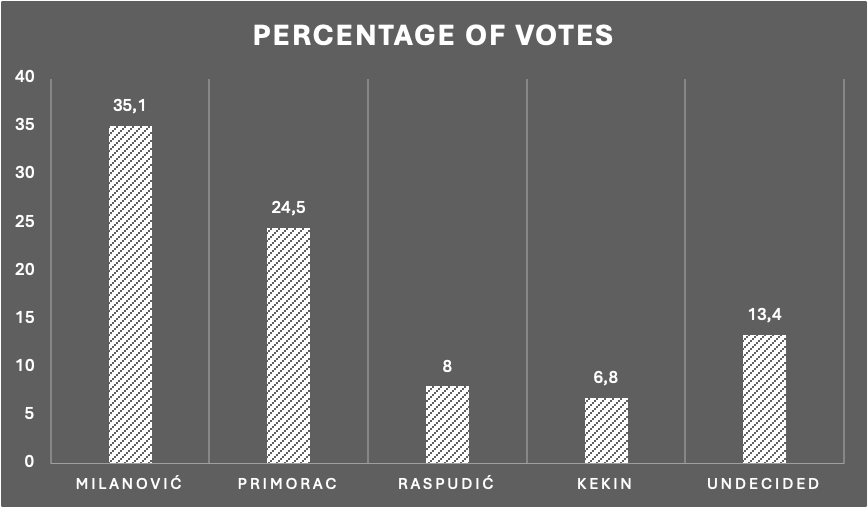
- The sitting President Zoran Milanović is a left-wing populist and is supported by the center-left Social Democratic Party. He has been critical of sanctions against Russia and has opposed the Croatian government's support for Ukraine and the participation of Croatian troops in NATO's training missions for Ukrainian soldiers. Milanović is relatively popular in Croatia and is expected to take the lead in the first round of elections, polling at around 35% of the vote.
- Dragan Primorac
- Primorac is the main opponent of President Milanović. The conservative doctor and former Minister of Science, Education, and Youth is backed by the center-right Christian Democratic Union (HDZ) He is polling behind President Milanović at around 24.5% of the vote. The two are expected to run against each other in a second round of elections as neither candidate is expected to take home a majority in the first round. In a runoff, Milanović is expected to trump Primorac, taking home an estimated 53.5% compared to Primorac's 30%.
- Marija Selak Raspudić
- Raspudić is a current member of Parliament and is running as an independent candidate. She is a philosopher and bioethicist, and her Presidential campaign is largely framed around her opposition to President Milanović. She is polling at 8% and it is considered unlikely that she will advance to the second round.
- Ivana Kekin
- Kekin is a politician and member of Parliament under the left-wing, Green We Can! Her campaign has highlighted her previous efforts to improve the healthcare system, social welfare and better management of public resources. Kekin is polling closely behind Raspudić at about 7% of the vote.
Impact on U.S. Interests
- Croatia is an important ally of the United States in the Balkan region, and it plays a particularly important role in stabilizing and Europeanizing its neighbor Bosnia and Herzegovina. The United States ambassador to Croatia, Nathalie Rayes, highlights that the relationship between Croatia and the United States. example, Croatia recently joined the Visa Waiver Program and the Global Entry programs, making travel significantly easier to the United States. In addition, Croatia and the United States signed the Agreement on the Avoidance of Double Taxation for citizens of both countries.
- Croatia has been a NATO ally since 2009. The United States closely cooperates with Croatia bilaterally and has provided nearly a billion dollars in military aid since they joined NATO.
- The re-election of sitting President Milanović would follow shifts in other Central and Eastern European elections where populist, pro-Russian candidates have been successful. A re-election for President Milanović could mean that Croatia forges closer ties with Russia.
Key Issues to Watch
- The Presidential elections are the third elections in Croatia this year following the general elections in April and European Parliament elections in June. Croatia has had high inflation and unemployment levels while experiencing labor shortages and increasing migration from non-EU countries. These factors likely influenced the general elections and European Parliament elections which resulted in a success for the center-right and far-right, conservative political groups. If sitting President Milanović is re-elected, these elections would be the third victory for such political groups this year.
- The Christian Democratic Union (HDZ) party has held significant political power since Croatia gained its independence in the early 1990s. However, the HDZ has been involved with numerous corruption scandals in the past few years and some think that voters might use this election to punish or protest the HDZ by not voting for their candidate Dragan Primorac. Croatia is the 5th most corrupt country in the European Union according to Transparency International.