The Implications of the Hormuz Energy Crisis for Energy Policymaking in Southeast Asia
October 2, 2026 • 8:30 – 9:30 am EDT
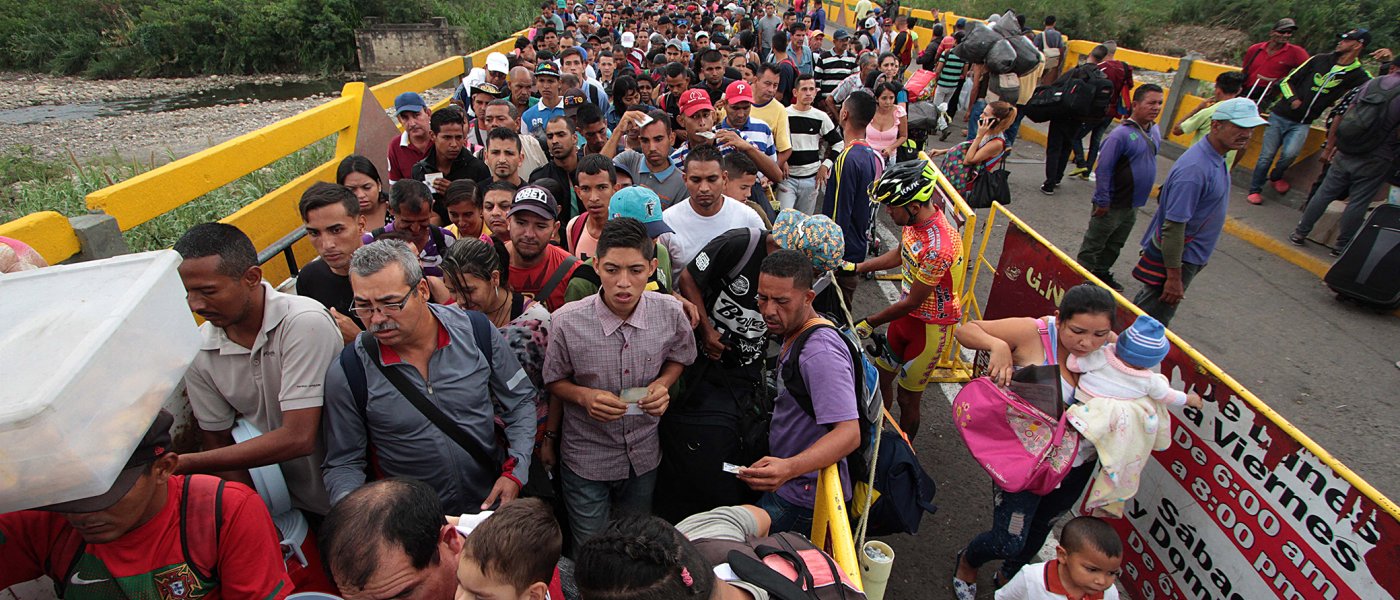
Photo: GEORGE CASTELLANOS/AFP/Getty Images
Trafficking in persons (TIP) remains a critical threat to the personal security of migrant populations while also undermining governance, economic stability, migration management, and the broader security of both countries of origin and destination. The fragile security situations in both Colombia and Venezuela further exacerbate these risks and create conditions that allow criminal and nonstate armed groups to expand their influence.
Following the U.S. capture of Nicolás Maduro on January 3, 2026, the risk of human trafficking for Venezuelan migrants has entered a more complex phase marked by legal uncertainty and endemic criminal influence. Though many Venezuelans remain optimistic about the restoration of democracy and support the U.S. capture of Maduro, the political realities inside Venezuela are fragile. Concerns linger over deeper instability, a prolonged or indefinite electoral process, and slowed economic recovery. Furthermore, the U.S. government’s push to reopen consular services and repatriate migrants places Venezuelans at a higher risk of being targeted by traffickers who exploit their desperation.
In March, journalist Hollie McKay visited Medellín in northwestern Colombia to assess the impact of Maduro’s capture on the trafficking of Venezuelans in Colombia. She writes that migrants are not expressing any indication of returning to Venezuela in the near future, and doubts that Colombia will see any immediate improvements in TIP: “It’s going to stay stagnant because people aren’t returning until they know they will have some kind of future, economic stability. I don’t see the situation improving, might not get worse but won’t improve.”
The Colombian government has warned that though the situation has not yet deteriorated, it remains fragile and could trigger a sudden influx of migrants at any time. In the immediate days following Maduro’s capture, Colombia created a three-phase plan focused on regularization, increased resources, and humanitarian response in case of an influx. While the plan addresses many underlying causes of TIP, it fails to outline concrete steps for TIP prevention and intervention. Large influxes of migrants to Colombia have correlated with increases in reported trafficking. Without a plan to address trafficking in the case of a sudden surge, Colombia remains at risk for increased trafficking activities.
Furthermore, the trafficking of Venezuelan migrants will continue to contribute to destabilization in Colombia, a key regional ally in the Western Hemisphere that has experienced setbacks in the peace process and increased violence this past year. The continuation of the Maduro regime under Delcy Rodríguez sustains groups such as the Ejército de Liberación Nacional (ELN), further complicating hopes for peaceful demobilization peacefully.
By 2025, Venezuela had experienced one of the largest mass exoduses in the world, with over 7.9 million Venezuelans having fled the country since 2014, 6.9 million of whom relocated to other countries within Latin America and the Caribbean. As of November 2025, there were a reported 2.8 million Venezuelan migrants in Colombia, making Colombia home to the third-largest refugee population in the world.
Human trafficking remains an urgent and escalating threat for Venezuelan migrants in Colombia, with the UN Office on Drugs and Crime reporting a steady rise in identified survivors since 2018. Between 2018 and 2023, the Colombian Ministry of the Interior reported 275 Venezuelan migrants as survivors of TIP, although these statistics are believed to be widely underreported. Despite a robust system to regularize Venezuelan migrants and refugees in Colombia, difficulties persist in accessing local services and navigating judicial systems for the reporting of trafficking threats and incidents. In addition to systemic barriers, intimidation and fear of retribution further contribute to underreporting.
The sharpest increases in reported TIP cases have correlated with increased migration flows into Colombia, as evidenced by the rise in reported cases from 75 in 2016 to 436 in 2024. The number of Venezuelans identified as victims of TIP also nearly doubled from 2020 to 2021 and remains at record highs. Together, these trends suggest a strong correlation between rising Venezuelan migration and trafficking vulnerability in Colombia. They also highlight the vulnerability of Venezuelan women in particular, given that women make up the overwhelming majority of trafficking victims.

Access to regularization has also correlated with increased reporting of TIP cases in Colombia. In 2018, Colombia introduced the Special Permanence Permission (PEP), a temporary regularization measure that allowed Venezuelan migrants to live, work, and access social services for up to two years. A March 2026 study found that cities with higher numbers of registered PEP participants recorded more reports of domestic and sexual violence among female Venezuelan migrants. This pattern suggests that the policy enabled vulnerable women to come forward and report abuse without fearing deportation. Supporting survey evidence also indicates that women with PEP status were significantly more likely to file complaints than those who remained undocumented.
An increase in reported cases between 2022 and 2025 can also be attributed to additional favorable immigration policies for Venezuelans residing in Colombia. In 2021, Colombia created the Temporary Protected Status, a 10-year migratory regularization policy for Venezuelan immigrants that allows legal residency, work authorization, and access to public healthcare services. By the end of 2025, 67 percent of Venezuelans in Colombia had received legal status, creating meaningful gains in regularization and stronger pathways to reporting and identifying survivors.
Despite regularization efforts aimed at reducing migrant vulnerability, TIP both contributes to and accelerates regional migration flows. In this environment, the lines between voluntary migration, human smuggling, and forced exploitation are often blurred.
According to the Department of State’s 2025 Trafficking in Persons Report, traffickers recruit Venezuelan migrants and refugees using false promises of safe migration and fake work opportunities. These practices are especially prevalent along the Venezuela-Colombia border and in the Darién Gap, where large numbers of migrants pass through daily. Upon arrival in Colombia, many migrants are offered food and shelter only to become trapped in predatory repayment schemes. When they are unable to repay the debts owed to traffickers, they are often subjected to additional forms of exploitation and trafficking. Continued passage north to the United States poses additional risks, as it is estimated that 33 percent of Venezuelan migrants who arrived in the United States experienced sexual abuse during their migration, compared to only 4 percent of those in Peru and Colombia.
Bianca Fidone, a project manager at Colombian NGO Espacios de Mujer, confirmed in an interview with the authors that armed groups use forced participation in illicit activities as a way for migrants to “repay” the debts incurred: “These are methods that armed groups are using to settle debts—or, to put it another way, this is the strategy that armed groups are employing—and when we say ‘employing,’ we mean in every sense of the word, because they pay monthly salaries to carry out this type of activity.”
Since the beginning of the migration crisis in 2014, patterns of both migration routes and tactics used by nonstate actors have evolved to continue to identify, target, and exploit migrants seeking opportunities abroad. This is exemplified in the shift in trafficking hotspots: Migrants and refugees were initially more vulnerable to trafficking in border towns leading into Colombia from Venezuela, but popular tourist destinations and large cities have become more common.
Discrimination and marginalization of Venezuelans in Colombia persist and contribute to both social and systemic barriers to integration. A recent public opinion study by the Center for Global Democracy shows that the vast majority of Venezuelan migrants report working in the informal sector, leaving most migrants without labor protections, benefits, or stable incomes. A 2024 study by the International Organization for Migration confirms the prevalence of informal labor participation and notes that although 90 percent of the working-age Venezuelan migrant population is employed, only 18 percent are employed in their respective fields.
A 2023 statement from the UN Special Rapporteur on trafficking in persons, especially women and children, highlighted the limited identification of survivors of trafficking, or individuals at risk of trafficking, for purposes of labor exploitation in Colombia. It noted that high levels of informality in sectors such as agriculture and domestic work posed serious concerns, alongside significant risks of trafficking linked to illegal mining. Moreover, as of 2023, there were no reported criminal prosecutions or convictions for trafficking for purposes of labor exploitation, pointing to substantial systemic deficiencies. This gap is further compounded by the absence of specialized services for labor trafficking survivors.
Beyond underreporting, impunity remains a significant issue for survivors and advocates seeking justice, despite Colombia having enacted several laws aimed at preventing human trafficking and prosecuting those responsible. For instance, only 52 out of the 908 reported cases of human trafficking between 2011 and 2016 resulted in convictions. Colombia’s internal armed conflict further complicates justice for survivors, as there is no national legislation recognizing recruitment into armed groups as a form of human trafficking.
The trafficking of Venezuelan migrants into exploitative labor systems poses a threat to Colombia’s broader security, as it perpetuates a shadow labor market that empowers and enriches armed groups. Furthermore, trafficking is detrimental to Colombia’s recent labor reforms, which focus on fair wages, formalization, stability, and job creation in hopes of curtailing armed group recruitment and bolstering a rising middle class. Venezuelan migrant labor has contributed meaningfully to the Colombian economy, making migrant participation in the formal sector imperative to supporting future productivity.
TIP in Colombia often takes the form of sex trafficking, and most registered cases involve women. In Colombia, prostitution is legal among consenting adults, but local authorities can regulate where it is allowed, as well as impose certain health and hygiene standards. At the same time, profiting from or facilitating prostitution is illegal, even though it is common for sex workers to rely on intermediaries for security. As a result, sex work often falls into a legal gray zone, where it is not only difficult to distinguish between voluntary and coerced sex work, but where there is also a contradiction between how the system works in practice and what the law stipulates. Venezuelan women are particularly vulnerable to trafficking through sex work because they are more likely to have experienced displacement and to lack the documentation needed to access formal jobs. This makes them more vulnerable to false job promises and more likely to rely on intermediaries for security, while their irregular status can also prevent them from denouncing abuse.
Another important beneficiary of TIP is organized crime, including transnational organized crime. These groups lure or force victims to engage in sexual exploitation, forced labor, forced marriage, and other activities that generate profit and expand revenue beyond drug trafficking alone. Illegal mining is an important source of revenue for organized crime. Criminal groups take advantage of weak government presence in parts of Colombia or operate with the complicity of state officials in Venezuela, where the systematic exploitation of minerals has become a source of income not only for traffickers but also for corrupt government authorities. TIP in Venezuela and Colombia is ubiquitous where illegal mining is found. Sex trafficking, for instance, has become closely intertwined with illegal mining, as the areas where this activity takes place create a high-risk environment for women, are often far from state control, and see an influx of mostly male workers that creates high demand for prostitution. Men and boys are also exploited through coerced or forced labor, facing deplorable working conditions and often lacking a real choice because of desperate economic situations. Child labor in mines is also commonplace; children as young as 10 years old are often forced to work for very low wages under inhumane conditions.
Organizations that create regional instability, like the ELN, Tren de Aragua, the Clan del Golfo, and other groups that have been allowed to operate in Venezuela with state complicity, use TIP not just as a form of opportunistic abuse, but as a component of a structured business model. If disrupting drug trafficking, preventing illegal migration, and advancing regional stability are core objectives for the region, actions that directly target TIP are essential, not only from a humanitarian perspective, but also from a security and stability standpoint. An International Labor Organization study reports that each person subjected to sexual exploitation has a profit value of more than $27,000 per year, amounting to an aggregate revenue of approximately $1.46 billion for organizations involved in human trafficking in the United States, Colombia, and Peru.
Furthermore, TIP reinforces weak governance and a lack of institutional control over territory. The State Department’s 2025 TIP Report cites corruption and official complicity in trafficking crimes as significant concerns. State corruption and trafficking work hand in hand, where both benefit from the other. Corruption is perpetuated through trafficking revenues, which are used as payments for bribes and subsequently expand the political and economic influence of nonstate actors. Once state control is weakened by the expansion and influence of nonstate actors through TIP activities, justice systems erode with near-total impunity for offenders.
TIP is thus not only a symptom of a lack of state control but is also a mechanism to sustain state fragility on both sides of the border. For that reason, anti-trafficking efforts should not be treated as a secondary humanitarian issue, but as central to any strategy focused on migration, organized crime, and regional stability.
Juliana Rubio is an associate director with the Americas Program at the Center for Strategic and International Studies (CSIS) in Washington, D.C. Kaela Werchniak is interim program coordinator with the CSIS Americas Program.