A Close Encounter in Space: What Is Russia Planning? | Space Strategic Dialogue
October 21, 2026 • 8:00 – 9:00 am EDT
Hosted by Aerospace Security Project

Photo: CSIS
This report is part of Strategic Japan, a CSIS Japan Chair initiative featuring analysis by Japan’s leading foreign policy scholars on key regional and global challenges and the implications for the U.S.-Japan alliance.
Military cooperation among autocratic powers in Asia is no longer a future wartime scenario. China-Russia military coordination has already become a visible operational challenge for Japan and the U.S.-Japan alliance. This paper examines how China-Russia coordination is intensifying military pressure in Asia, and what challenges this poses for the alliance.
The paper first reviews Japan’s assessment of coordination among autocratic powers, with a particular focus on China-Russia military coordination. It then examines the China-Russia joint strategic bomber flight in December 2025 and analyzes qualitative changes in its timing and route, U.S.-Japan responses and continued Chinese and Russian bomber activities around Japan, and what those alliance responses reveal about the boundary between deterrence and compellence. Finally, the paper offers policy recommendations for Japan and the United States focused on sharing threat perceptions, reaffirming common interests, and comprehensively assessing a range of response approaches—from deterrence to compellence—for sustained and increasingly intense military pressure below the threshold of war.
This section reviews how Japan, as a frontline observer, understands coordination among autocratic powers in Asia. In Japan’s security environment assessments, coordination among autocratic powers primarily refers to China, Russia, and North Korea. In U.S. policy discussions, Iran is often included in this group. For Japan, however, Iran remains relatively peripheral.
Japanese government documents tend not to treat China, Russia, and North Korea as a single bloc or a new axis. Rather, they analyze these actors in terms of overlapping bilateral relationships: China-Russia, Russia-North Korea, and China-North Korea. In Japan’s Defense White Paper and Diplomatic Bluebook, these relationships are discussed separately. The emphasis is on assessing each bilateral relationship and its security implications.
At the same time, concerns are growing that the three countries could coordinate in a future crisis or armed conflict. A report by an expert panel convened by Japan’s Ministry of Defense (JMOD) has suggested that if a contingency occurs in East Asia, it is likely China, Russia, and North Korea would coordinate. In other words, the Japanese government currently understands coordination among autocratic powers primarily through bilateral relationships. This framing, however, is accompanied by a growing concern that China, Russia, and North Korea could coordinate more closely in a future regional crisis or armed conflict.
Among these bilateral relationships, the Japanese government is most concerned about China-Russia military coordination in Asia. In the 2025 Defense White Paper, the term “China-Russia” appears approximately 47 times, far exceeding references to Russia-North Korea or China-North Korea relations, which number only in the single digits. The Defense White Paper also assesses that China and Russia seek to shape an international environment favorable to themselves by taking aligned positions on security issues, including Taiwan and NATO’s eastward expansion, on which each is at odds with the United States and others.
This concern has also been reflected at the strategic and policy level. The development of China-Russia coordination has been identified as one element of the changing security environment that prompted Japan to bring forward by one year—from 2027 to 2026—the review of its three strategic documents: the National Security Strategy, the National Defense Strategy, and the Defense Buildup Program.
In practice, China-Russia military coordination in Asia has expanded beyond exchanges among senior military officials and joint exercises to include operational activities such as joint naval navigation and joint bomber flights. The 2025 Defense White Paper assesses that these repeated joint activities are “clearly intended for demonstration of force against Japan” and constitute “a grave concern” for Japan’s national security.
The Japanese government has paid particular attention to joint flights by Chinese and Russian strategic bombers. Conducted annually since 2019, these flights have evolved to include an increase in frequency to twice a year since 2022, mutual landings in 2022, fighter escort flights in 2023, and the first confirmed participation of China’s nuclear-capable H-6N bomber in 2024. Based on these developments, JMOD has assessed that China and Russia have been steadily strengthening coordination.
Most recently, in December 2025, China and Russia conducted another joint strategic bomber flight. While this flight can be understood as part of the continuing development of China-Russia coordination, it also showed further qualitative changes, which will be examined in the next section.
This section examines the tenth China-Russia joint strategic bomber flight, conducted in December 2025, and analyzes how China-Russia coordination is increasing the intensity of short-of-war military pressure in Asia. It identifies two qualitative changes from previous joint bomber flights: its timing and its route.
First, the China-Russia joint strategic bomber flight was timed closely with China’s political interests, rather than common China-Russia interests. The flight took place while China was increasing pressure on Japan in response to remarks by Prime Minister Sanae Takaichi regarding Taiwan. In November 2025, she stated in the Diet that Japan could recognize a “survival-threatening situation” (i.e., a legal threshold required for Japan’s limited exercise of collective self-defense) if an armed attack against Taiwan and a maritime blockade were to develop in a way that involved U.S. military intervention and attacks on U.S. vessels. This statement did not alter Japan’s security legislation or policy. Nevertheless, China responded by increasing diplomatic, economic, and military pressure on Japan.
On the military side, beginning on December 5, 2025, multiple Chinese naval vessels, including the aircraft carrier Liaoning, transited through the Southwest Islands and operated in the Pacific. On December 6, fighter aircraft launched from Liaoning directed radar at Japan Air Self-Defense Force (JASDF) aircraft in two incidents. In the second incident, radar lock-on continued intermittently for approximately 30 minutes. In this context of rising pressure on Japan, China and Russia then conducted their joint strategic bomber flight on December 9.
There is also an earlier example of a politically timed China-Russia joint strategic bomber flight, though that case mainly served the shared interests of China and Russia in countering growing U.S.-led regional coordination. This took place on May 24, 2022, during a Quad summit in Tokyo, which brought together the leaders of Japan, the United States, Australia, and India. The 2025 Defense White Paper assessed that this flight was intended as a demonstration of force against Japan and was more provocative than previous activities.
By contrast, the December 2025 joint flight was conducted in the context of China increasing pressure on Japan in relation to Taiwan, which China describes as being at the heart of its core interests. That flight therefore suggests that China and Russia now have a relationship in which China can apply pressure on Japan with the support of Russian military power at a time that serves China’s political interests.
The route taken by the December 2025 flight also showed an important change compared to previous flights. Two Russian Tu-95 bombers and two Chinese H-6 bombers joined over the East China Sea, passed through the Southwest Islands, and then flew more than 600 miles in a straight line toward the Pacific Ocean off Shikoku (author’s calculation based on the latitude and longitude coordinates provided in a Joint Staff press release).
The key difference from previous flights lay in what happened after the aircraft crossed the Southwest Islands. Although previous China-Russia joint strategic bomber flights had often passed through the Southwest Islands, they generally remained within or around that area. By contrast, the December 2025 flight continued far beyond the Southwest Islands. As shown in Figure 1 below, if extended further, this trajectory would point toward the Tokyo area. Defense Minister Shinjiro Koizumi stated that the repeated joint bomber flights had to be regarded as a demonstration of force against Japan and expressed grave concerns over the flight.
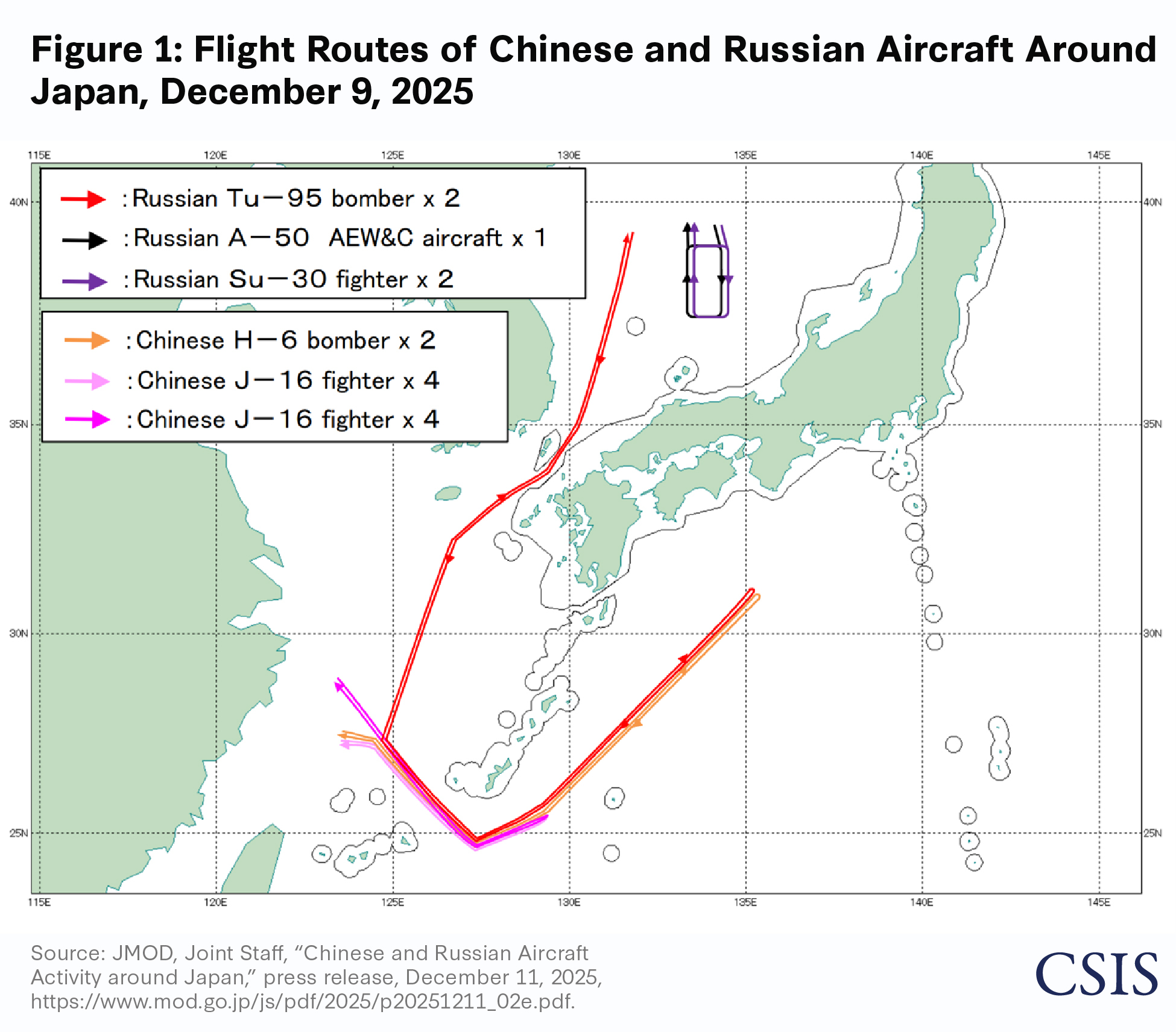
The December 2025 China-Russia strategic bomber flight showed that China can apply military pressure on Japan in coordination with Russia, including through nuclear- and conventional-capable assets, at a time that serves China’s political interests and along a more coercive route. In this sense, the pressure that Japan faces below the threshold of war has been intensifying in several ways. Horizontally, pressure previously associated mainly with China is increasingly accompanied by China-Russia coordination. Vertically, pressure previously centered on conventional assets also includes nuclear-capable platforms. Qualitatively, the pattern of behavior itself is becoming more coercive.
This section examines the U.S.-Japan alliance’s response to the China-Russia joint strategic bomber flight. While China was increasing diplomatic, economic, and military pressure on Japan, U.S. government agencies were relatively restrained in their diplomatic messaging and public communication in support of Japan. The military response of the U.S.-Japan alliance, however, was swift, visible, and strong.
In response to the China-Russia strategic bomber flight, Japan immediately scrambled fighter aircraft and took measures against possible airspace violations. The following day, on December 10, Japan and the United States conducted a bilateral exercise over the Sea of Japan with two U.S. B-52 strategic bombers, three JASDF F-35 fighters, and three JASDF F-15 fighters. Japan’s Joint Staff stated that the exercise was conducted “amid an increasingly severe security environment surrounding Japan” and that “this bilateral exercise reaffirms the strong will between Japan and U.S. not to tolerate unilateral changes to the status quo by force.” The timing of the exercise led it to be reported as part of the alliance response to the China-Russia strategic bomber flight.
However, this first U.S.-Japan response did not immediately end Chinese and Russian strategic bomber activities around Japan. Although the aircraft carrier Liaoning returned to waters west of the Southwest Islands, Chinese and Russian strategic bomber flights continued. For example, on December 29, 2025, two Chinese H-6 bombers flew near the Southwest Islands, accompanied by two intelligence-gathering aircraft and four fighter aircraft. Russia also conducted a flight over the Sea of Japan on January 21, 2026, in which two Tu-95 bombers and two fighter aircraft repeatedly flew toward Japan. In other words, even after the first U.S.-Japan response, Chinese and Russian strategic bomber activities constituted a form of continuing operational pressure.
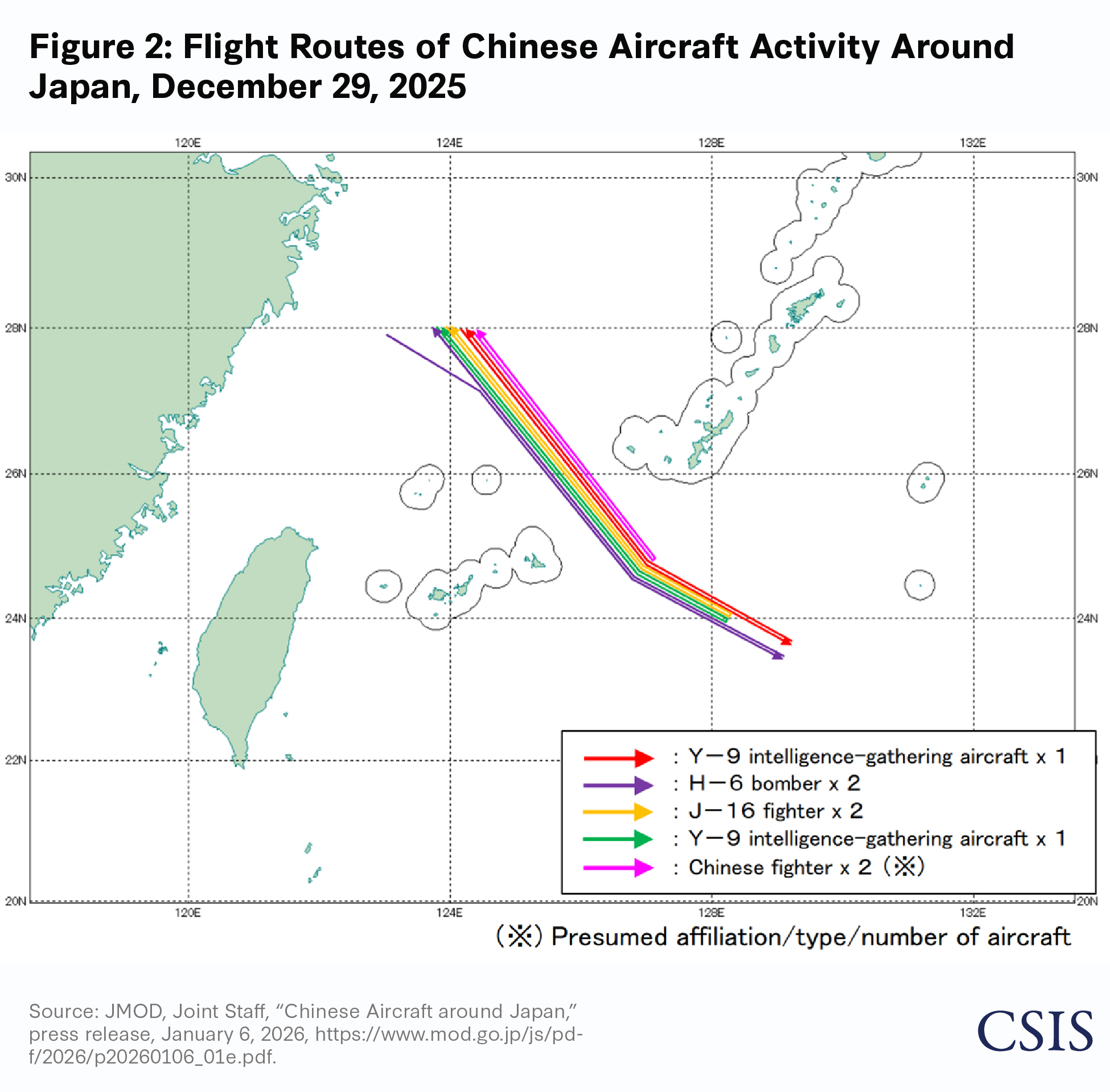
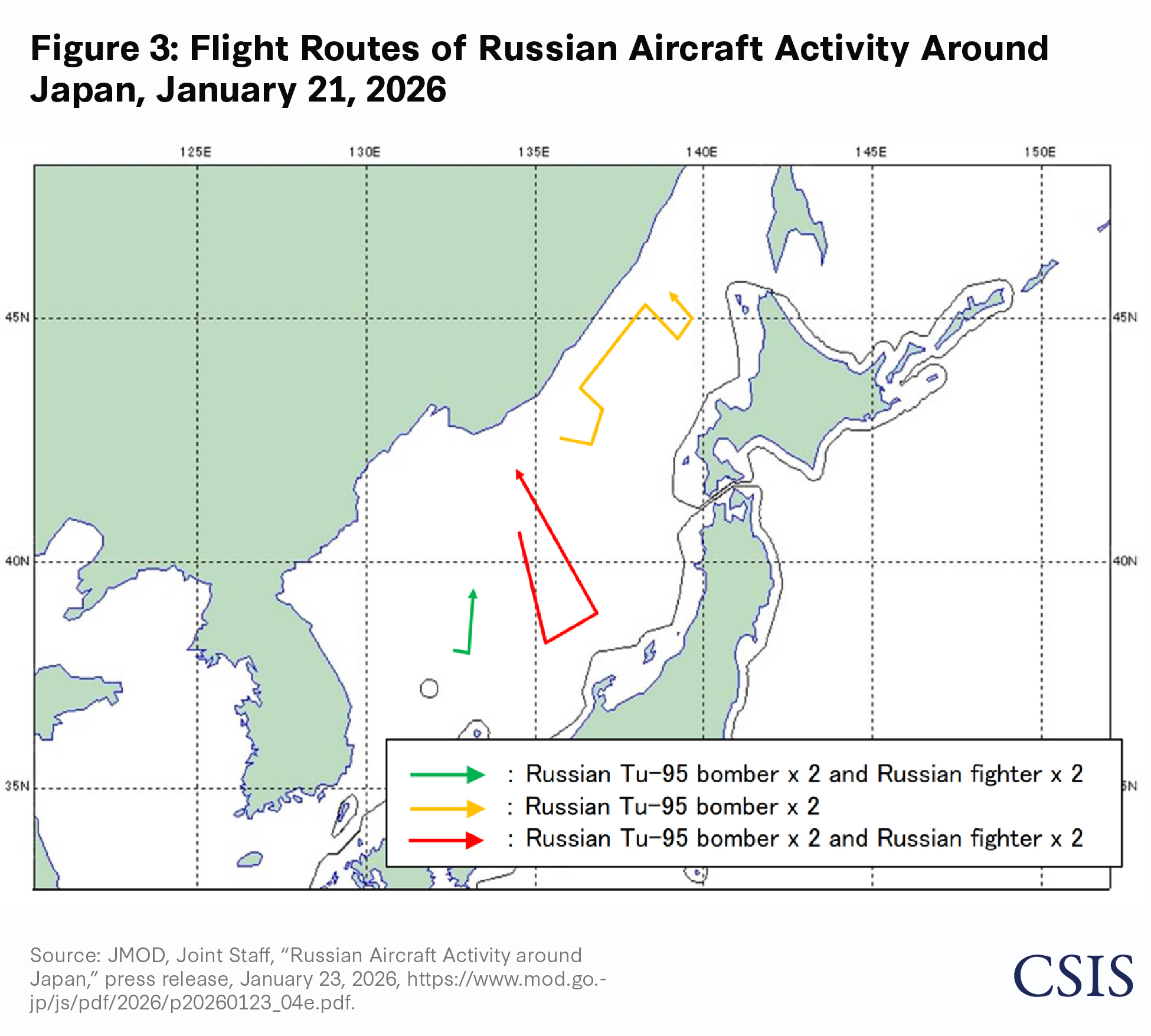
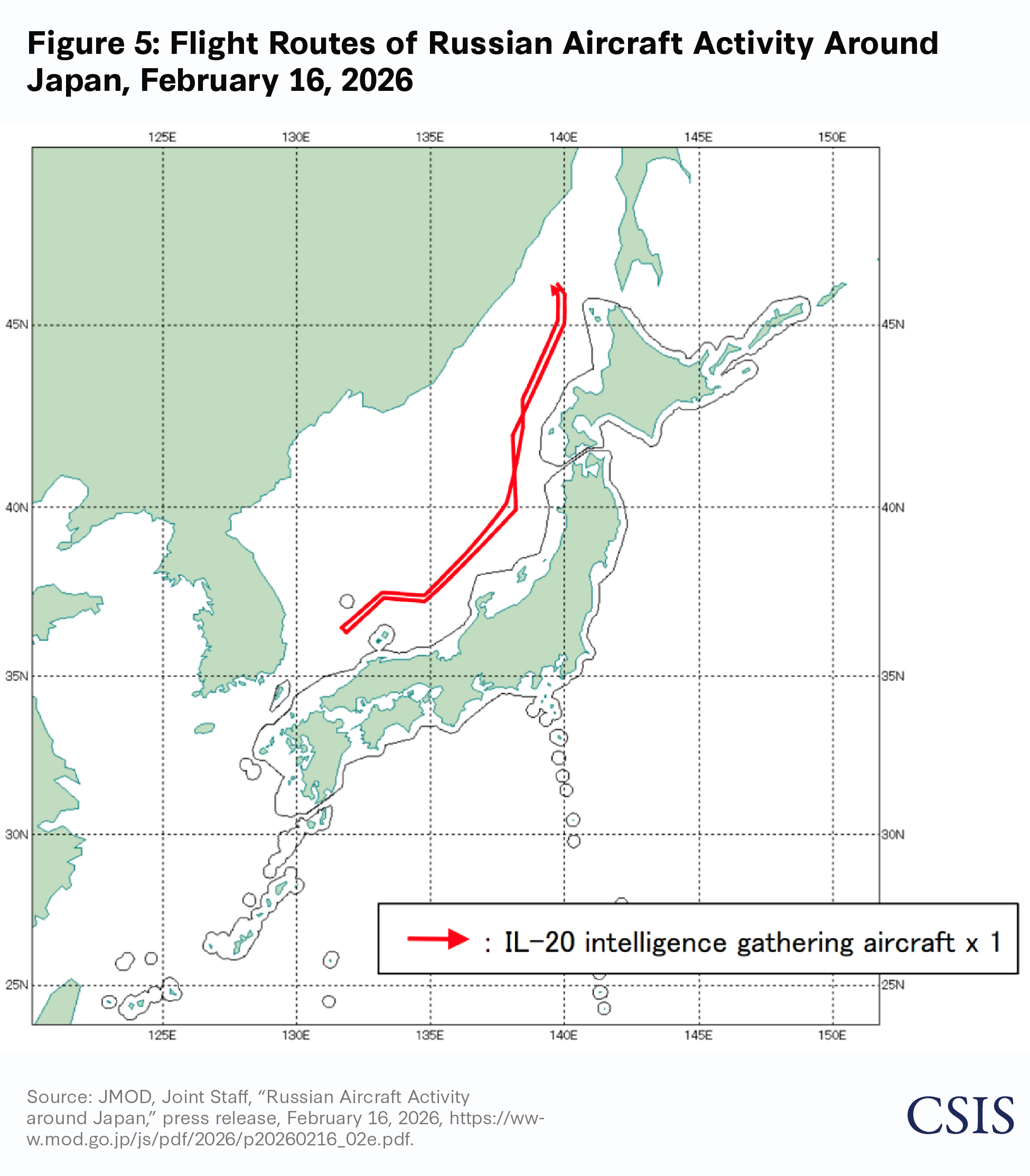
Against this backdrop, Japan and the United States conducted a second set of bilateral exercises on February 16 and 18, 2026. These exercises included four U.S. B-52 strategic bombers, six JASDF F-2 fighters, and five JASDF F-15 fighters, and they took place over the Sea of Japan and the East China Sea. Compared with the first bilateral exercise, the number of participating aircraft nearly doubled. In recent publicly announced bilateral and multilateral exercises in which both Japan and the United States participated, the number of strategic bombers has generally been limited to one or two aircraft. (In a review of exercises between FY 2020 and FY 2025, specifically in Japan’s annual Defense White Paper, the author could not identify any case in which three or more B-52 bombers participated. In FY 2020, there was one case involving three B-1 bombers, but the B-1 is a conventional-only bomber.) The participation of four B-52s was therefore unusual in scale.
After the second U.S.-Japan response, China and Russia continued to operate intelligence-gathering aircraft, including Y-9 and IL-20 aircraft, around Japan. Thus, China-Russia operational pressure did not disappear completely. However, based on publicly available information, no similar China-Russia strategic bomber flights were conducted in the weeks following the second response.
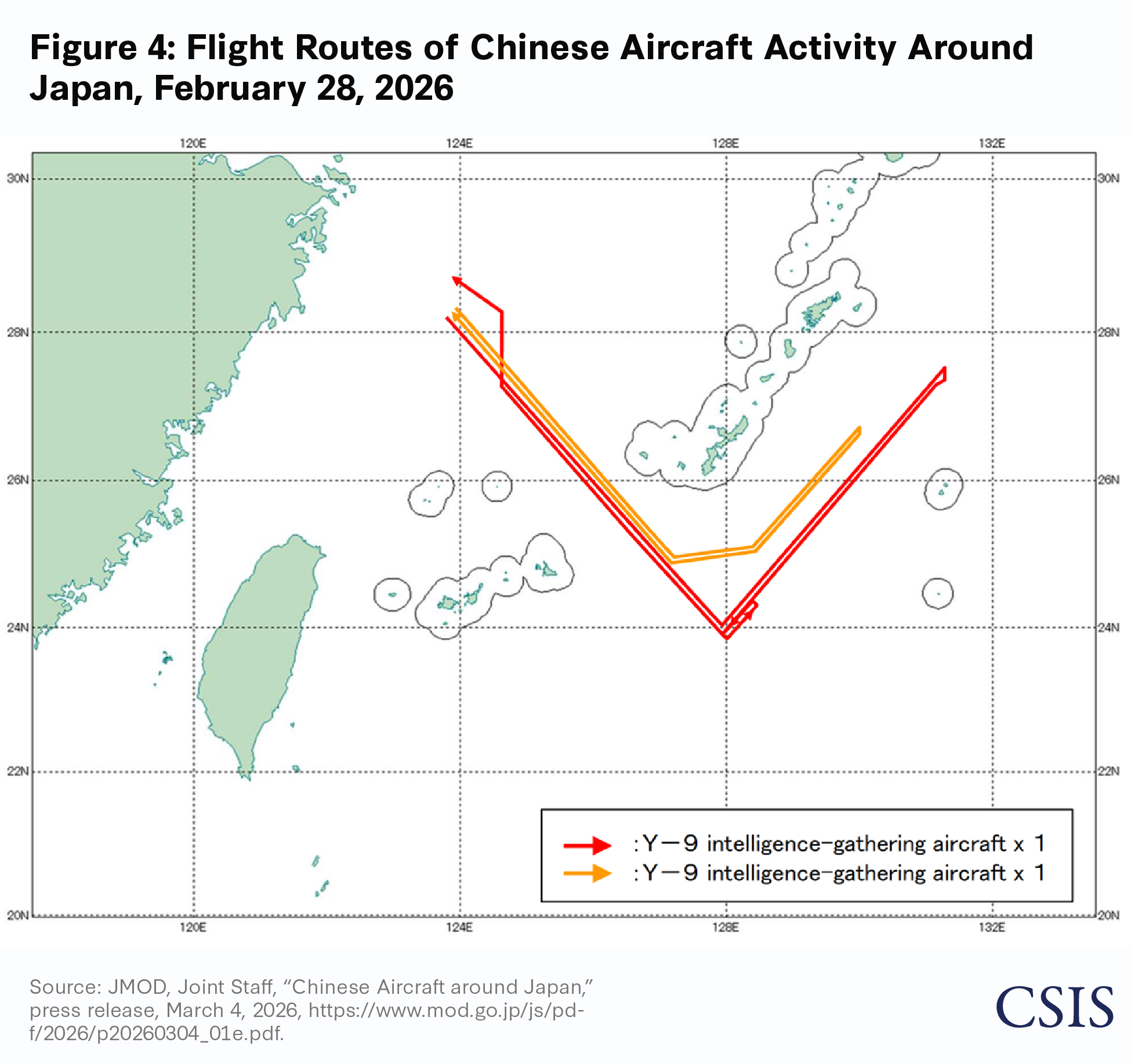
As this case demonstrates, the U.S.-Japan alliance has needed not only to deter armed attack, but also to respond to repeated military pressure below the threshold of war, which is becoming more intense through China-Russia coordination. The U.S.-Japan response in this case suggests that the alliance is beginning to adapt to this new environment. At the same time, when examined through the framework of military coercion, the nature of that response varies depending on the timeframe through which the situation is viewed.
Military coercion, defined broadly as the threat of military power to change an opponent’s course of action, is often divided into deterrence and compellence. Deterrence seeks to prevent an opponent from taking an unwanted action. Compellence seeks to induce an opponent to take a specific action, including taking a new desired action, stopping an ongoing action, or reversing a change to the status quo that the opponent has created.
Although deterrence and compellence can be distinguished conceptually, they often overlap in practice. If each action is treated as a discrete incident, a response that seeks to prevent further action can be understood as deterrence. If the same actions are understood as a continuing pattern of pressure, however, a response that seeks to stop that pattern can also be understood as a form of compellence aimed at halting continuing behavior.
From this perspective, the second U.S.-Japan response can be understood in two ways. If the Chinese and Russian flights are seen as individual incidents, the response can be understood as deterrence aimed at preventing further China-Russia strategic bomber flights. But if Chinese and Russian activities are seen as a continuing pattern of pressure, the response can also be read as having an element of compellence, as it seeks to stop an ongoing pattern.
This suggests that, in an environment where increasingly intense short-of-war pressure continues over time, the boundary between deterrence—aimed at preventing further action—and compellence—aimed at stopping an ongoing pattern of behavior—becomes blurred. Building on this point, the next section offers policy recommendations on how the U.S.-Japan alliance should identify and organize potential response approaches for addressing sustained and increasingly intense short-of-war pressure in Asia.
As China-Russia coordination advances, short-of-war pressure in Asia is expanding and intensifying. To respond effectively, Japan and the United States should pursue three forms of policy coordination.
First, Japan and the United States should develop a shared threat perception based on the recognition that China-Russia military coordination is already increasing the intensity of short-of-war military pressure in Asia and could also shape a future contingency in ways unfavorable to the alliance.
Second, Japan and the United States should reaffirm their common interests. Given that China-Russia coordination is increasing the intensity of short-of-war pressure, the alliance should reaffirm that its common interests include not only deterring armed attack but also responding to the accumulation of such pressure.
Third, based on this shared threat perception and common interest, Japan and the United States should identify and examine a broader set of potential response approaches for sustained and increasingly intense short-of-war military pressure. They need to examine at what stage, for what purpose, and with what expected effect they would respond to such situations, considering both deterrence and compellence.
This does not replace existing efforts to strengthen alliance capabilities; it clarifies how those capabilities should be used. Japan and the United States have already expanded the scope of response from wartime response to situations below the threshold of war. They have been strengthening “deterrence and response capabilities” across all phases. In addition, through alliance coordination mechanisms, Japan and the United States have advanced bilateral planning, including bilateral Flexible Deterrent Options (FDOs). FDOs can be understood as preplanned sets of options composed of diplomatic, informational, military, and economic measures, with both escalatory and de-escalatory effects, and designed mainly to deter adversary actions before or during a crisis.
However, in an environment where short-of-war military pressure is repeated and accumulates over time, response approaches centered mainly on preventing armed attack, crisis onset, or further short-of-war actions may not be sufficient. As discussed above, the second U.S.-Japan response to the Chinese and Russian bomber flights can be understood both as deterrence aimed at preventing further actions and as compellence aimed at halting a series of actions. In addressing intense and continuing short-of-war pressure, the boundary between deterrence and compellence can become blurred. Japan and the United States therefore need to identify and examine the full range of potential response approaches to short-of-war military pressure.
The broader categories of military coercion, including both deterrence and compellence, are useful for identifying potential response approaches. Deterrence and compellence can be divided into several types according to timing, purpose, and demand. Deterrence includes general deterrence, which seeks to prevent unwanted actions over the long term and in non-crisis situations, and immediate deterrence, which seeks to prevent an imminent attack, typically during a crisis. Compellence includes demands to stop an ongoing action, restore the original status quo, and take a new desired action.
If these categories are recast as response approaches to repeated and increasingly intense short-of-war pressure, at least eight types can be identified. These are: (1) deterring armed attack, (2) deterring the outbreak of a crisis, (3) deterring further short-of-war actions, (4) demanding a halt to a continuing series of actions, (5) demanding an immediate halt to an ongoing action, (6) demanding restoration of a situation created by a series of actions that change the status quo, (7) demanding restoration of a situation created by a single action that changes the status quo, and (8) demanding a new desired action. Options 1 through 3 are deterrence-oriented approaches aimed at preventing the adversary from taking actions beyond the red lines—armed attack, crisis onset, or further short-of-war actions. Options 4 through 8 are compellence-oriented approaches aimed at inducing the adversary to take a specific action. More precisely, options 4 and 5 are halt-type compellence to stop continuing or ongoing actions; options 6 and 7 are rollback-type compellence to reverse unfavorable situations; and option 8 is action-inducing-type compellence to demand a new desired action.
This framework does not suggest that Japan and the United States should immediately adopt more coercive measures. Rather, even if deterrence of further short-of-war actions works (option 3), accumulated pressure or an unfavorable situation normalized as a fait accompli may still persist. Simply deterring further action could result in accepting a deteriorated operational environment as a given.
Therefore, Japan and the United States need to reconsider the range of alliance response approaches for addressing intensifying short-of-war military pressure. These approaches should include not only deterrence-oriented approaches but also halt-type, rollback-type, and action-inducing types of compellence.
These response options differ not only in timing, purpose, and demand, but also in risk and required capabilities. Japan and the United States should therefore examine which response approaches are necessary or desirable for addressing expanding short-of-war military pressure, and whether those approaches reflect their shared interests and capabilities. If a necessary or desirable approach is not feasible, the allies should identify the constraints and jointly consider alternative measures to avoid gaps in their response.
In this sense, examining response approaches is not merely a matter of advance planning or operational coordination. It requires distinguishing desirable from feasible options and considering how to close the gap in the face of intense and continuing short-of-war military pressure. The complex nature of this challenge necessitates strategic dialogue on how to adapt the U.S.-Japan alliance to a new regional security environment defined by sustained and intensifying short-of-war military pressure from autocratic powers.
China-Russia military coordination in Asia is no longer an abstract risk for a future contingency. It has already emerged as operational pressure around Japan. The U.S.-Japan alliance has begun to adapt to this new environment.
To respond effectively to intensified short-of-war military pressure, Japanese and U.S. strategists should do three things. First, they should share this understanding of the security environment. Second, they should reaffirm that responding to short-of-war pressure is a common alliance interest. Third, they should comprehensively examine response approaches. If a gap exists between desirable and feasible options, they should identify the constraints and consider alternative measures to avoid leaving that gap unaddressed.
JMOD has also identified “enhancing the effectiveness of the U.S.-Japan alliance from a strategic perspective” as one of the issues requiring further consideration, alongside the need to further strengthen deterrence and response capabilities in light of the strengthening of China-Russia and Russia-North Korea strategic coordination. A strategic dialogue on the revitalization of the U.S.-Japan alliance for the next era of regional security is once again taking shape.
Riho Aizawa is a research fellow in the Department of Area Studies at the National Institute for Defense Studies (NIDS).
The views expressed in this paper are those of the author and do not represent the views of the National Institute for Defense Studies, the Ministry of Defense, the government of Japan, or any other organization.
This report is made possible with support from the government of Japan.


Commentary by Bonny Lin and Kristi Govella — December 5, 2025