Energy Shots | Iran: Turbulent Truce, Resurgent Risk
July 10, 2026 • 9:30 – 10:00 am EDT

Photo: LUIS TATO/AFP/Getty Images
The African continent is witnessing an increase in Gen Z–led protests. Unlike the opposition-led protests of the past, the protests today, driven mostly by people under the age of 30, have been largely leaderless, digitally mobilized, and focused on renegotiating the social contract. These Gen Z–led protests are also occurring within formally democratic, multiparty states, representing a significant departure from past uprisings that have often targeted one-party regimes or dictatorships.
The demands of these youth, driven by a desire to dismantle elitist political structures and institutions they see as no longer fit for purpose, have emerged as a powerful force reshaping governance. The movements are reinforced by the reality that as the population on the continent rapidly transforms, economic demands are also evolving, yet political systems have remained stagnant.
Youthful demographics, rapid urbanization, and the expiration of old political narratives are clashing to create an insatiable demand for political change across states that have very diverse histories and political economies. Political stagnation has been brought about by forever presidents, underperforming incumbent political parties, and a self-serving political class that trades power after each election cycle. While specific triggers for these protests vary, a common thread is youth frustration with economic strain due to high levels of unemployment, entrenched corruption leading to poor service delivery, and growing frustration with aging political elites who refuse to let go of power. Over the past five years, these movements have proven to be more than episodic outbursts—rather, youth in Africa have created a new mode of political engagement. The question remains, however, whether these protests can create the type of changes that the youth are demanding.
Across Africa, Gen Z–led protests often go beyond traditional opposition-led movements. In 2024, Kenyan youth took to the streets to protest a proposed finance bill. The protests forced President William Ruto to withdraw elements of his administration’s tax legislation and reshuffle his cabinet, though he remained in office, and little reform followed. In Morocco, decentralized youth groups took to the streets in late 2025 to protest unemployment, underinvestment in healthcare and education, and lavish spending on events like the 2030 FIFA World Cup. The protests pushed the government to announce youth-focused reforms, including incentives for young political candidates and increased budgets for public services. However, arrests and repression accompanied these concessions, and systemic reforms remain limited.
While a change in government is often called for in these protests, Madagascar is a cautionary tale in how corrupt and weak institutions can remain entrenched even after protests. In Madagascar, youth protests erupted in September 2025 over chronic water and power shortages and rapidly escalated into nationwide calls for political overhaul. Ironically, the ousted president, Andry Rajoelina, came to power in 2009 at 34 following protests. Now, under the leadership of the military, Madagascar has no clear path to stronger democratic institutions.
This pattern reflects a broader dilemma: Protests can spotlight grievances and even unseat leaders, but without strategic political engagement, they rarely yield systemic change. History offers cautionary parallels. Ugandan President Yoweri Museveni, for example, built a political career by mobilizing youth through armed struggle before transitioning into decades-long rule opposed by many of the youth in Uganda’s population. Likewise, in Burkina Faso, President Ibrahim Traoré has garnered youthful support by positioning himself as a break from old elites, yet his military-led government has shrunk civic space and centralized power even as it pursues food security, economic independence, and national sovereignty. These examples underscore the limitation of protests alone without a political strategy.
The central challenge for Gen Z protests is not mobilization, but transformation. According to Afrobarometer data, African youth lag behind the older generation in political and civic participation, except when it comes to participation in protests. Protests alone cannot substitute for political strategy. The speed of social media–driven work cannot be substituted for the slow, disciplined work of institutional, legislative, and economic reform. These protests are effective in identifying and spotlighting problems, but without a strategy, these actions rarely outlast election cycles or leadership changes.
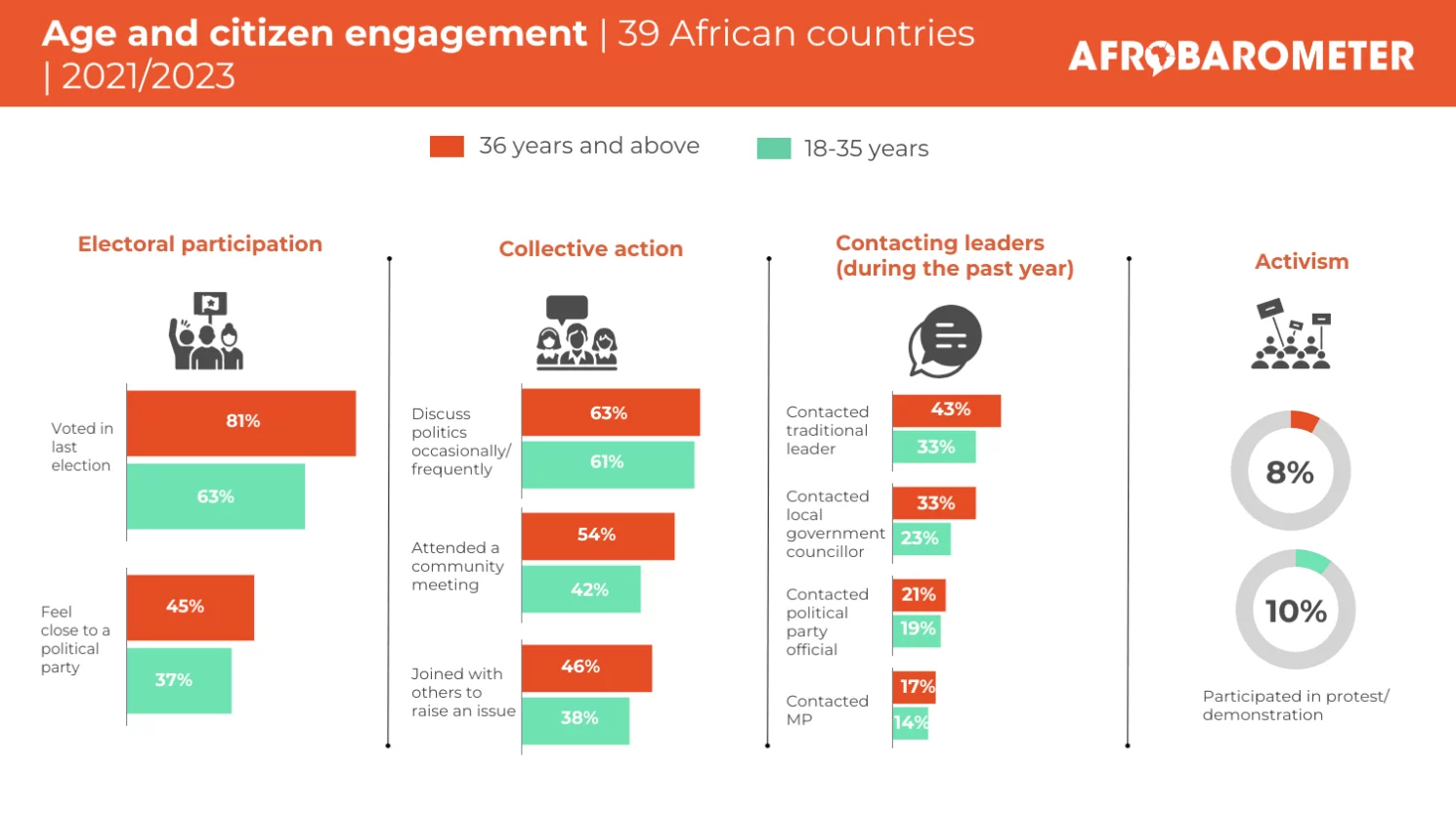
Source: Afrobarometer Data, 39 countries, Round 9, 2021/2023, available at https://www.afrobarometer.org/articles/african-youth-lag-behind-elders-in-political-and-civic-participation-except-for-protest-new-afrobarometer-flagship-report-reveals/.
The ultimate success of these Gen-Z–led protests will depend on their ability to build alliances with civil society, labor unions, and, in some cases, the private sector to turn temporary protests into lasting institutional change. The story of Gen-Z–led protests in Africa is still unfolding. As we look to the future, several potentially triggering events are on the horizon, including upcoming elections in Kenya, Nigeria, and Zimbabwe, which carry risks of increased civil unrest. Simultaneously, a reduction in international funding for democracy and governance support programs has also created a challenging environment for civic organizers to sustain their activities.
These reoccurring Gen-Z–led protests offer critical lessons for policymakers regarding the implications of bad governance and the rise of a highly networked, digital native generation. But they also create opportunities for learning and for governments to cocreate new approaches with young people in their countries. Nevertheless, the biggest test ahead is whether these Gen-Z–led protests can transition from resistance to real change: Can protestors shift their actions from protesting what they oppose to truly defining and working to build the future systems and institutions they seek? And will leaders and institutions recognize the opportunity that lies within this demographic and adapt?
The long-term impacts of these Gen-Z–led protests remain uncertain, and only time will tell if this rising wave of activism will solidify into permanent policy shifts and institutional reform, or simply become another, albeit louder, chapter in the history of African generational dissent.
Khasai Makhulo is a research assistant with the Africa Program at the Center for Strategic and International Studies (CSIS) in Washington, D.C. Oge Onubogu is director and senior fellow of the Africa Program at CSIS.

Podcast Episode by Khasai Makhulo — June 27, 2024