AUKUS at Five: Progress, Challenges, and the Way Forward
September 17, 2026 • 8:00 – 9:00 am EDT
Hosted by Australia Chair

Photo: Sai Aung MAIN/AFP/Getty Images
North Korea’s Naegohyang Women’s Football Club is scheduled to arrive in South Korea on May 17, ahead of its match against South Korea’s Suwon FC Women in the semifinal of the Asian Football Confederation Women’s Champions League on May 20. This will be the first visit by North Korean athletes to South Korea since December 2018, and the first time a North Korean club football team has visited South Korea. The visiting North Korean delegation includes 27 players and 12 support staff, and they will reportedly stay together with the South Korean team at a local hotel. The winner of the final—against Australia’s Melbourne City or Japan’s Tokyo Verdy Beleza—will receive $1 million in prize money, with the runner-up receiving $500,000.
Q1: What is the diplomatic significance of this sporting match?
A1: From when the two Koreas fielded a joint table tennis team in 1991 to beat China, to the first joint march under the unification flag during the 2000 Sydney Summer Olympics, to North Korea’s high-level participation in South Korea’s 2018 Pyeongchang Winter Olympics, sports diplomacy has always been an important tool of inter-Korean diplomacy. In 2018, Kim Jong-un’s sister Kim Yo-jong participated in the opening ceremony of the Pyeongchang Olympics, which contributed to diplomatic openings that tempered the “fire and fury” threats between Trump and Kim Jong-un in 2017 and led to the April 2018 inter-Korean summit and subsequent Trump summits in Singapore and Hanoi.
Q2: Has sports diplomacy been successful in the past?
A2: Yes, South Korea has been successful at using sports to advance diplomatic goals. Everyone thinks of ping pong diplomacy with Nixon and China, but South Korea successfully used the 1988 Seoul Summer Olympics as a vehicle to open dialogue with the Soviet Union, eventually leading to normalization of relations in 1990. Two years after the Seoul Olympics, South Korea supported China at the 1990 Beijing Asian Games with advertising revenue, logistics support, and tourism despite global sanctions against China for the massacre of citizens at Tiananmen Square. This helped pave the way to normalization of China–South Korea relations in 1992.
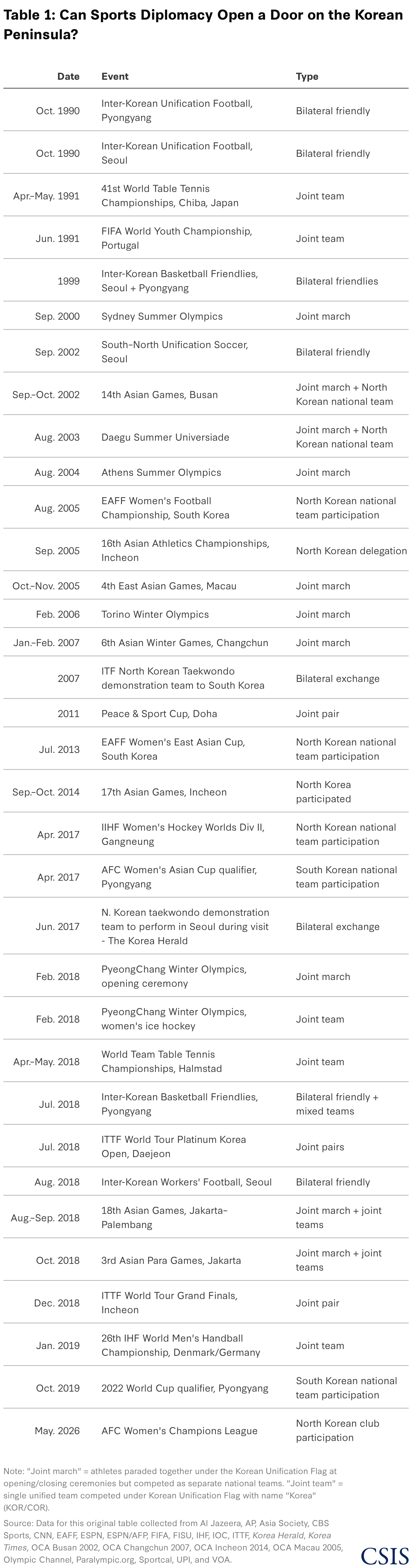
Table 1 provides a history of past inter-Korean sports events since 1990.
Q3: Can a football match facilitate a diplomatic breakthrough?
A3: Hard to say. If the visit goes through as scheduled, it produces three useful data points worth tracking. First, the fact that Pyongyang allowed athletes to travel to South Korea is significant given North Korea’s shutdown of all dialogue with South Korea and its assertion of the enemy-state declaration vis-à-vis Seoul. In this regard, the football match could demonstrate the potential to separate cultural exchanges from politics.
Second, the football match follows the conciliatory North Korean response in April to South Korea’s statement of regret over the unauthorized flying of drones into North Korea. That rare gesture, delivered through Kim Yo-jong, shows space for potential inter-Korean dialogue. There is no existing agreement on drones in the 2018 inter-Korean Comprehensive Military Agreement even though drone flights by either side could lead to inadvertent escalation.
Third is President Trump’s political will to meet Kim Jong-un, which he made clear in the run-up to the Asia-Pacific Economic Cooperation meeting last fall. Another entreaty to Kim is possible as Trump prepares to go to Beijing in the coming days. If this meeting were to take place, it would likely occur after the Trump-Xi meeting, so as not to upstage China.
Q4: What is Naegohyang Women’s Football Club?
A4: Naegohyang (meaning “My Homeland”) Women’s FC, based in Pyongyang, is sponsored by the Korean People’s Army-owned conglomerate of the same name—a maker of cigarettes (including the 7.27 brand reportedly favored by Kim Jong-un), electronics, sports apparel, and soju. The team is a football powerhouse and a two-time North Korean Women’s Premier League champion. It beat Suwon FC Women 3-0 in the November 2025 group stage and is heavily favored in the upcoming match.
Victor Cha is president of the Geopolitics and Foreign Policy Department and Korea chair at the Center for Strategic and International Studies (CSIS) in Washington, D.C. Andy Lim is deputy director and fellow with the Korea Chair at CSIS.
The authors appreciate Phillip Meylan’s and Kharle Wu’s work in publishing this article.

