The Future of U.S.–Africa Minerals Diplomacy
September 18, 2026 • 10:00 am – 4:00 pm EDT
Hosted by Critical Minerals Security Program

Photo: Pavlo Bahmut / Ukrinform/Future Publishing/Getty Images
This commentary is part of a report from the CSIS Defense and Security Department entitled War and the Modern Battlefield: Insights from Ukraine and the Middle East.

Digital Feature by The CSIS Defense and Security Department — September 16, 2025
The conflicts in Ukraine and the Middle East present the best opportunity to assess wartime naval operations since the 1982 Falklands War. Nothing is simulated, operations include all of the messiness of the real world, and difficulties cannot be assumed away as they can in peacetime exercises. Although maritime operations in these conflicts have had secondary—or even tertiary—importance after the ground and air campaigns, the experience they provide merits close analysis, as it can offer valuable insights about the future of seapower.
Having a variety of naval capabilities available facilitates a response even if the tools are not initially available in the desired quantity. Expanding an existing capability is much easier than developing a new one in the crucible of conflict.
In parallel with these conflicts, analysis of a hypothetical U.S.-China conflict over Taiwan has suggested how a modern air and naval campaign might unfold (discussed further below). While these assessments lack the authority of actual operations, they complement insights derived from the current wars.
This chapter discusses five questions that arise from these conflicts and analyses:
The discussion of each question contains a summary of wartime experience and ends with insights into how navies can adapt to the new maritime environment. Because current data is imperfect and not necessarily indicative of a war between great powers, each discussion also includes indicators that can show where naval combat may be headed.
Ukraine has achieved extraordinary naval success in its war with Russia.1 Without the conventional attributes of a navy—ships and land-based aircraft—it has sunk or destroyed eight major Russian surface ships and one submarine, pushed Russian naval forces out of Russia’s forward naval base at Sevastopol, and contested the entire Black Sea. This success particularly raises the question of the future viability of surface ships.
Wartime Experience
Ukraine’s sinking of the Russian battlecruiser Moskva by long-range antiship missiles launched from the shore shocked Russia and the world. Nor was this an isolated event: Other Russian surface ships have fallen victim to one-way (“suicide”) drones (two ships destroyed) and long-range surface-to-surface missiles (six ships destroyed).2
Wargames by CSIS, the Center for Strategic and Budgetary Assessments, the Hudson Institute, and the International Institute for Strategic Studies have questioned the survivability of surface ships in a great power conflict against China, especially large surface combatants (LSCs), the multibillion-dollar destroyers and cruisers that have been the backbone of fleets since World War II.3 Volleys of Chinese missiles can overwhelm ship defenses and push surface ships back hundreds of miles to seek safety until Chinese missile inventories are depleted. Perhaps naval warfare has reached the state envisioned by Admiral Karl Dönitz, the head of Nazi Germany’s fleet during World War II. Dönitz had a painting in his office entitled “The Fleet in 1955” (see below). It showed an empty ocean, reflecting his belief that submarines would become so dominant that surface ships would be rendered obsolete. That did not happen in 1955, but has it happened in 2025 because of antiship missiles?4
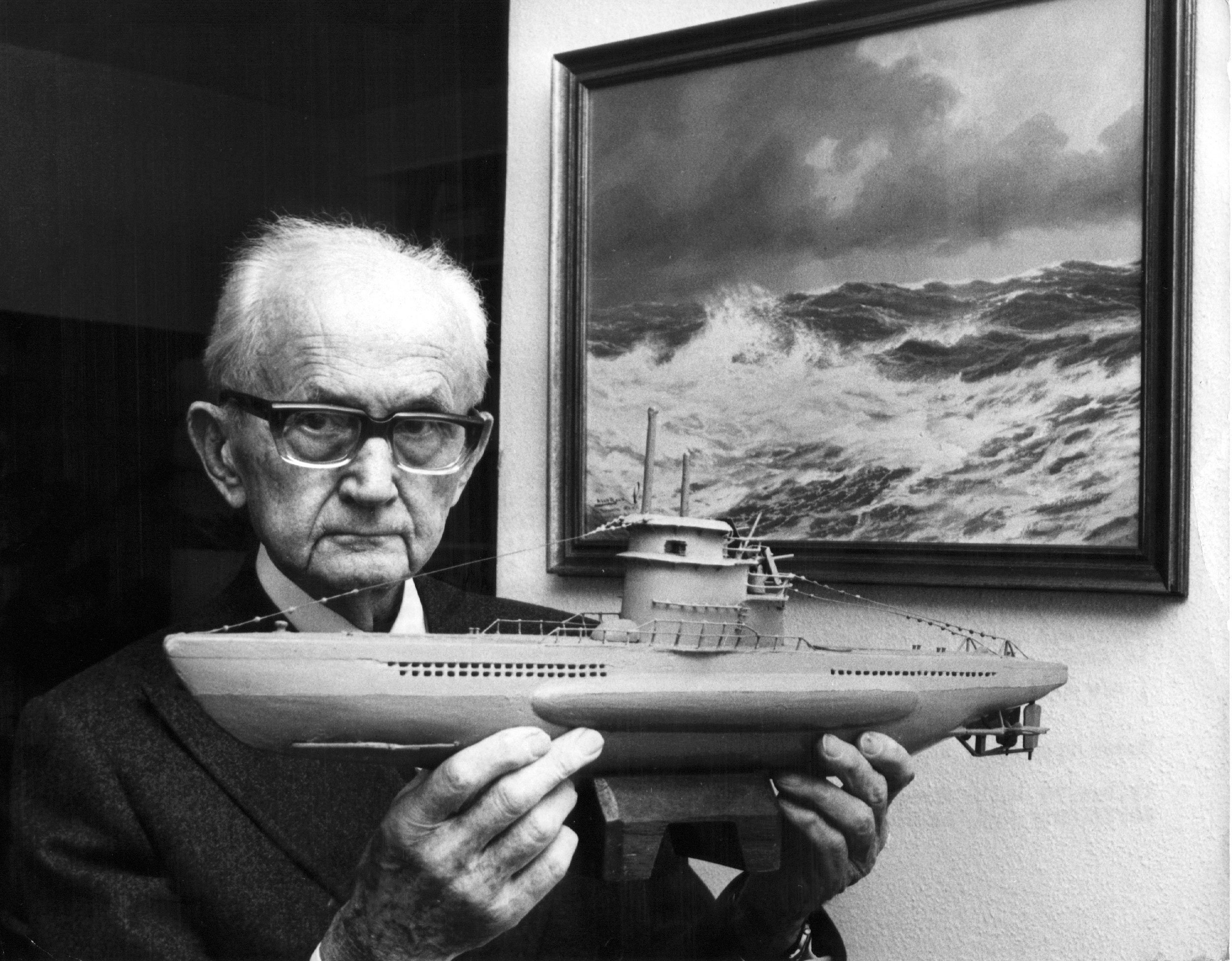
Admiral Karl Dönitz shown with the painting “The Fleet in 1955” in his home in December 1974. Photo: Werner Baum/picture alliance via Getty Images.
While Russian naval losses might suggest that for high-end conflicts, U.S. LSCs have nonetheless been valuable in the Red Sea and Gaza operations. Positioned in the Red Sea and Eastern Mediterranean, these ships have had 400 engagements with Houthi missiles. No missiles hit the warships, few hit Israel, and maritime traffic continued through the Red Sea, though at a reduced level. The ships’ missile defenses were highly effective against the small missile volleys that the Houthis could launch. While this success is encouraging, it is not determinative; the ships remain untested against the volume of fire that a great power such as China could employ.
Adapting to the New Environment
Given this uncertainty, the U.S. Navy appears to be hedging its bets. The current fleet has 85 LSCs in a total fleet of 293.5 This is far below the 104 LSC goal in the 355-ship Navy called for by the first Trump administration.6 However, it roughly equals the 87 LSC goal in the Navy’s 2023 381-ship fleet plan. Thus, between 2016 and 2023, the overall fleet plan increased by 7 percent, but the goal for LSCs decreased by 8 percent, reflecting this concern about LSC survivability. The U.S. Navy’s alternative shipbuilding plan for FY 2025 further sacrificed surface fleet numbers to reduce shipbuilding costs, projecting a gradual decline in LSCs to 70 total.7 Extrapolating these long-term plans produces an even lower projection for LSCs: The plan envisions a 1-2-1-2-1 building profile (i.e., three ships every two years) for the late 2030s.8 With an expected LSC service life of 35 years, that equates to a long-term inventory of 53 vessels.9
The recent reconciliation bill (“One Big Beautiful Bill”) developed by Congress and signed by the president added two destroyers, indicating some support for LSCs if funding were available.10
China’s Navy—the People’s Liberation Army Navy (PLAN)—has taken the opposite approach, building a large fleet of LSCs now numbering more than 100.11 Where the United States builds two to three LSCs per year, China builds five.12 Although China has made advances in uncrewed systems, the PLAN has prioritized building LSCs for its near-seas defense.13
Looking Ahead
An event showing high surface ship vulnerability, which is already widely discussed, would push many navies to reconsider their LSC programs. Alternatively, a revival could occur, driven by uncrewed surface vessels (USVs) equipped with sensors. These USVs would act as scouts, thereby reducing the vulnerability of surface ships. Regardless, ships need a lot of sea room to survive. The days of fleets standing close off a hostile shore are gone.
If LSCs struggle to survive in modern naval combat, aircraft carriers—the apex surface combatants—would be even more threatened. This is a perennial debate, having gone on for 50 years. It affects the U.S. Navy the most, as it operates 11 aircraft carriers, but eight other countries have invested in carriers: China (3), the United Kingdom (2), India (2), Italy (2), Japan (2), France (1), Spain (1), and Turkey (1).
Wartime Experience
Unfortunately, current events provide little insight into the role of aircraft carriers in combat between highly capable opponents. Russia’s sole carrier has not participated in the Ukraine war. The sinking of the Moskva, an old battlecruiser without escorts, does not provide a sufficient example of what might happen to a modern aircraft carrier with its air wing and escorts. Events in the Eastern Mediterranean reinforce historical experience. U.S. carriers have conducted many missions to intercept Iranian and Houthi missiles. Missile threats did not force them to retreat. However, the carriers did not face the massive missile salvos that Russia or China could launch.
The debate on aircraft carriers might fade into the background, except that recent wargaming has also raised questions about aircraft carrier survivability. China’s massive missile inventories could overwhelm carrier air defenses, and its fleet of 65 submarines might penetrate a carrier’s defensive screen. Wargames alone are unlikely to change naval attitudes toward carriers, but they have kept the question on the table. And the matter of carrier cost is always present.14 Nuclear carriers cost about $13 billion each, plus $8 billion for the air wing and another $8 billion for escorts. Helicopter and short-takeoff carriers cost about half that.
On the other hand, carriers show their usefulness every day for crisis response, regional conflicts, and deterrence. (For a more detailed description of this debate, see the carrier discussion in the 2022 CSIS report on military forces.15) U.S. carriers have been in constant demand and routinely conduct real-world missions. The same is true for other countries. Since 2014, UK and French aircraft carriers have launched airstrikes against ISIS targets in Iraq and Syria as part of an international coalition.16 Carriers also played a key role in enforcing the NATO no-fly zone during the Libyan Civil War.17
As a result, the number of nations operating aircraft carriers has not changed. There are nine today, and there were nine 50 years ago in 1975 (Argentina, Australia, Brazil, France, India, Spain, the United Kingdom, the United States, and the Soviet Union). What has changed is that some medium powers have dropped out (Argentina, Australia, and Brazil), while some rising powers have joined the group (China and Turkey), as has Italy, a reviving naval power.18
Adapting to the New Environment
Aircraft carrier usefulness for regional conflicts and crisis response, coupled with the maritime prestige they bring, will keep them in the world’s navies going forward. For most countries, cost and naval budgets will drive carrier construction decisions more than theory.
The U.S. Navy is doing what it did before World War II: pursuing all options until an answer is clear. In the 1930s, that meant maintaining both battleships and aircraft carriers. Today, it means sustaining aircraft carriers as well as potential replacements such as ground-based missiles, long-range aircraft equipped with antiship missiles, uncrewed systems, and submarines. Interestingly, the reconciliation bill does not provide any money for aircraft carriers despite having $29 billion for shipbuilding overall.
All countries face an additional influence in designing naval forces: the need to maintain a viable shipbuilding industrial base. For the U.S. Navy, that requirement has sometimes driven it to consider unwise policies, such as building more nuclear aircraft carriers, to satisfy the shipbuilding industry, but retiring older carriers early to satisfy critics. This increases the amortized cost of an aircraft carrier from $220 million per year to $370 million.19 Other navies with carriers face similar pressures, as carriers represent the largest naval ship they build. All countries should remember that shipbuilding industrial bases exist to put strategically useful ships to sea, not to maintain themselves.
Looking Ahead
Eventually, the debate will be resolved; a high-intensity conflict will occur, and carriers will either show their survivability and value or be so severely damaged that their limited utility becomes evident. Resolution could happen tomorrow, or it might not happen for decades. Until then, expect continuing debate.
Eventually, the debate will be resolved; a high-intensity conflict will occur, and carriers will either show their survivability and value or be so severely damaged that their limited utility becomes evident.
The rise of uncrewed systems in the Ukraine war is a major change from earlier wars and a recurring theme throughout this volume. The experience at sea has been particularly dramatic.
Wartime Experience
The use of small USVs has been a tremendous and unexpected Ukrainian success in operations against Russian forces. As noted earlier, Ukrainian USVs sank two major warships and half a dozen small vessels, while damaging several others. Controlled remotely and laden with explosives, Ukrainian USVs traveled far offshore (200–400 miles) to detonate against Russian targets. These attacks helped drive the Russian fleet from Sevastopol to the Russian naval base at Novorossiysk, 300 miles east.
These successes occurred in favorable circumstances. Ukraine had excellent intelligence on Russian dispositions; the Russian ships must spend most of their time at anchor in known ports because of the Black Sea’s confines, and the distances are relatively short. Further, despite excitement about how USVs have revolutionized naval warfare, most Russian naval losses have been to long-range precision missiles against stationary ships in port, not surface drones. USV use in warfare is just beginning.
Adapting to the New Environment
Many navies face the problem of operating inside an adversary’s defensive zone. Surface ships have difficulty doing that, but uncrewed systems—which are smaller, cheaper, and more expendable—could. The favorable circumstances that Ukraine enjoys for employing USVs describe the environment that most navies face. NATO navies, for example, are only a short distance from Russian ports, enjoy excellent reconnaissance, and have lots of time to prepare. This presents NATO navies with an opportunity.
One could imagine countries adapting existing systems, as Ukraine has done, to strike their adversary’s vessels in port. As an illustration, a CSIS report, Inflicting Surprise: Gaining Competitive Advantage in Great Power Conflicts, imagined a surprise strike by U.S. autonomous underwater vessels against Russian ships of the Northern Fleet.20
The circumstances also apply to navies in the Pacific, with the important exception of the United States. The Philippines is next to the South China Sea, a region of great tension and possible future conflict. South Korean naval bases are only 100 miles from North Korean bases. Japan’s Kure naval base is about 650 miles from the Chinese naval base at Shanghai. All could conduct USV attacks on their adversaries or similar attacks with uncrewed underwater vessels (UUVs).
A U.S. naval drone strike against Chinese ships would be more difficult because of the much longer distances. Guam, the closest base to China in U.S. territory, is 2,000 miles away. The United States would need to arrange close-in basing with an ally or partner.
However, one-way naval drones are an entirely different approach to uncrewed vessels than most countries have taken. The U.S. Navy has no programs for one-way naval drones, at least in the unclassified space. USVs in development have focused on long-range shooting and sensing, not one-way attacks. The primary U.S. Navy program for UUVs with strike capability is the Orca, designed for reconnaissance and mine-laying operations. The U.S. Navy has ordered six vessels (one test article and five prototypes), but only one prototype is in testing, delayed by years of technical difficulties.21 At $110 million each, they are too expensive for a one-way mission.22 U.S. Navy shipbuilding plans envision hundreds of USVs and UUVs in the fleet, but budgets do not yet reflect that. No USV or UUV is a program of record (a formal acquisition program with funds allocated and building plans specified in future budgets).23
The reconciliation bill makes a big bet on uncrewed and autonomous systems, adding $16.6 billion overall (11 percent of the defense increases). Of this amount, about one third ($5.3 billion) goes to Navy programs. This represents a substantial investment and a strong congressional statement about where increased efforts are needed.
Other navies are taking similar initiatives, though with access to fewer resources. The UK and French navies both have UUV programs underway that focus on minesweeping and intelligence, surveillance, and reconnaissance. The Royal Navy will begin trials for a crewless submarine in June 2025 as part of Project Cetus.24 In 2024, France announced a program to develop the first UUV specifically designated for combat operations.25 All are moving more slowly than Ukraine.
Navies also face the prospect of being attacked by such systems, which are available to weak states and nonstate actors as well as major powers. As Russia has discovered, a navy’s greatest vulnerability is in port when ships are stationary for an extended period and an adversary can execute a strike that requires time to plan and execute. The U.S. Navy experienced this with the terrorist attack on the USS Cole in 2000; that short-range attack by suicide bombers badly damaged the ship and killed 17 sailors.26 The proximity of NATO and Pacific navies to their adversaries, therefore, creates vulnerability as well as opportunity.
Naval anchorages have not faced long-range naval threats since World War II. Then, Japanese mini-submarines attacked anchorages at Pearl Harbor, Sydney, Australia, and Ulithi Atoll, the last two attacks being successful in sinking a ship.27 Italian mini-submarines attacked the British anchorage at Alexandria, Egypt, sinking two battleships. The German U-47, under its celebrated captain, Gunther Prien, snuck into the Royal Navy’s anchorage at Scapa Flow and sank a battleship. Navies face a “back to the future” moment.
Thus, navies will need to defend against USV and UUV attacks by hardening anchorages, a precaution that has been unnecessary since World War II. After both the Cole and 9/11 attacks, the U.S. Navy implemented new force protection procedures. These will need some expansion to deal with this new kind of threat—and better to do the next round of enhancements before an incident occurs. However, countermeasures cannot be too expensive, given all the other demands on naval budgets, or too intrusive, given the need for continuous naval operations.
Looking Ahead
Watch for future attacks against ships at anchor. Theoretical threats may drive some action, but a successful attack outside the Black Sea would galvanize the target navy and provide another alert to global navies.
This is the dog that did not bark.28 Submarines are regarded as the ultimate weapon in naval combat because of their stealth and lethality. Since the end of the Cold War, Russia has prioritized its submarine fleet at the expense of other naval capabilities like surface ships. Submarines have had a major impact on U.S. Pacific wargames, prompting the United States to invest billions of dollars in shipyards to accelerate production. Before the Moskva, the last major surface combatant sunk in conflict was the Argentine cruiser Belgrano, torpedoed by the UK submarine Conqueror during the 1982 Falklands War.
Wartime Experience
At the beginning of the war, the six relatively modern Kilo-class submarines in Russia’s Black Sea fleet were expected to have a major impact. Yet, these submarines have been largely invisible, and not simply because they were submerged. There are no references to any operations they have conducted. Indeed, the most prominent mention of Russian submarines has been the loss of one, which was struck in dry dock by long-range Ukrainian missiles.
The answer may simply be a lack of targets. Ukraine has no major naval vessels, and Russia has been unwilling to use submarines to attack grain-laden cargo ships. Perhaps their mission was to keep NATO forces out of the Black Sea, and in that, they succeeded. Still, the lack of activity is curious.
Adapting to the New Environment
This lack of submarine impact will not alter anything in the U.S. shipbuilding plan for submarines, which is currently driven by expectations about a U.S.-China conflict in the Western Pacific. Submarines’ stealth enables them to penetrate China’s defensive bubble, where surface ships and even aircraft cannot go.
NATO navies are also unlikely to change their plans for submarines because they are largely driven by the Russian submarine fleet. That fleet has become more active in the last decade, having recovered from its post–Cold War doldrums. The current wars have not shed any light on submarine-versus-submarine conflict.
Other maritime powers and many minor powers will maintain their submarine fleets because it is the only way they can enter the major leagues of naval power. Submarines allow even a minor power to threaten an adversary's largest warships and merchant fleet.
Looking Ahead
Watch for the composition of Russia’s postwar Black Sea fleet. If Russia withdraws its submarines from the Black Sea, that represents its assessment that the submarines’ contribution was insufficient and that this asset would be better used in one of the other fleets—Northern, Baltic, or Pacific. If the submarines remain, the assessment is that submarines were Russia’s ace in the hole. In either case, Russia’s assessment will help the West better understand wartime submarine operations in the twenty-first century.
Ships fire a lot of munitions in combat. Although this indicates a requirement for large inventories, the high cost of munitions prevents navies from stockpiling everything they might need in a protracted conflict.
Wartime Experience
U.S. operations in the Red Sea against Houthi missiles expended 200 missiles over 15 months, in addition to cannon rounds.29 This has dented U.S. inventories and raised concerns about their adequacy for a major conflict. For example, 180 of these missiles were SM-2s or their replacement, SM-6s. In past years, the U.S. Navy has procured 125 missiles per year.30 That means that one limited series of engagements expended a year and a half of missile production.
Ukraine’s air war has shown the same dynamic. Attacks by cruise missiles and one-way drones have required large numbers of air defense missiles in response, overwhelming the limited inventories of the United States and NATO.
A series of CSIS wargames found that in a conflict with China, the United States ran out of Long-Range Anti-Ship Missiles (LRASMs) within the first week—often within the first several days.31 A later CSIS analysis, Empty Bins in a Wartime Environment, described munitions shortfalls in many areas.32 Indeed, many analyses have identified inadequate munitions inventories as a major weakness.33
Looking further back in history, the Royal Navy expended over 200 antisubmarine weapons to counter the single Argentine submarine at sea during the 1982 Falklands War. Despite this immense expenditure, the submarine was not damaged.34 Whether the Royal Navy was trigger-happy, unlucky, or saddled with ineffective munitions, the high rate of expenditure was—and still is—worrisome.
The need for larger inventories of naval and other munitions is, therefore, old news. The U.S. Department of Defense got the message and has increased its production of nearly every type of missile. For example, production of SM-6s will increase from 125 to 300 per year by 2027, while production of LRASMs will increase from about 100 to 230 per year in 2027 (total Navy and Air Force procurement).35 NATO navies are also expanding their inventories of naval munitions.36
That is an important step forward and will strengthen the joint force’s capabilities to fight in high-intensity conflicts. However, U.S. forces in the CSIS wargame fired about 100 LRASMs per day, so the expanded inventories would last longer in a conflict but not beyond several weeks. It is difficult to build large inventories of expensive weapons ($4.4 million for an SM-6, $3.5 million for a LRASM) with limited shelf lives (about 20 years).37 Ultimately, this is an unsolved problem.
Adapting to the New Environment
It is reasonable for all navies to build larger munitions inventories despite the high cost. Nearly all wars last longer than planners expect. Nevertheless, militaries must find affordable solutions to the missile inventory challenge because they cannot build inventories large enough for a protracted conflict. Solutions might include less expensive missiles or different technologies, such as directed energy.
Looking Ahead
Watch munition procurement levels when the war in Ukraine ends. Although the war in Ukraine does not drive U.S. or NATO demands for naval missiles, the end of that war may undermine the urgency of building stockpiles in general. This has been an industry concern, partly offset by multiyear contracts, which lock in future production.
The fundamental problem is that munitions struggle to compete in peacetime budget debates. Although vital in protracted conflict, they are a “sterile” investment: Investments in ships, aircraft, and combat vehicles are visible over the decades of their operational lives. Munitions go into secure bunkers, never to be seen again until they are expended or demilitarized.
Naval analysts should not extrapolate too much from recent events in the wars in Ukraine and the Middle East, since naval activity was limited and ancillary to the primary campaign on land. Nevertheless, some insights are clear enough to implement now: expanding munitions inventories, accelerating the development and production of uncrewed systems, and hedging on major surface combatants.
There are also many things to watch for as indicators for additional action. These recognize the uncertainty of projecting limited current experiences into the future, but acknowledging possible futures is the first step in adapting to them. Having thought through a problem ahead of time facilitates a response. Thus, it is worthwhile to spend time thinking about responses to different futures.
Finally, having a variety of naval capabilities available facilitates a response even if the tools are not initially available in the desired quantity. Expanding an existing capability is much easier than developing a new one in the crucible of conflict. Because expansion is easier than introduction, having a variety of capabilities already at hand provides a better hedge against an uncertain future.
Please consult the PDF for references.
Mark F. Cancian (colonel, U.S. Marine Corps Reserve, ret.) is a senior adviser with the Defense and Security Department at the Center for Strategic and International Studies (CSIS) in Washington, D.C.
