The Game Has Changed: Rethinking the U.S. Role in Supporting Elections in Sub-Saharan Africa
Photo: PIUS UTOMI EKPEI/AFP/Getty Images
Available Downloads
The Issue
- Sub-Saharan Africa’s electoral landscape is changing. A combination of demographic, technological, and geostrategic developments is unsettling the region’s politics.
- African elite and publics are consequently redefining the rules of competition, showing a new willingness to protest more often and longer; spend more money on political campaigns; and employ a range of technological tools to mobilize, deceive, and hack.
- The United States is failing to make commensurate investments and is falling behind in revamping its policies and tactics. If the United States wants to advance its objectives of prosperity and stability in the region, it will need to reconceptualize its investments, partnerships, and interventions regarding elections.
It is election season again in sub-Saharan Africa. Roughly every five years, the region faces a tidal wave of elections. In previous cycles, starting in the mid-1990s, the outcome was generally predictable. The ruling party leveraged its considerable advantages—including access to state resources—to secure another term. If the incumbent party rigged the poll, international monitors easily spotted the fraud and strenuously objected, even if to little effect. For the past two decades, five out of every six elections have produced the same result.
This next batch of some two dozen elections will be different. A combination of demographic, technological, and geostrategic developments is disrupting the region’s electoral landscape. African leaders, opposition, and publics are adapting and writing a new playbook in the process. From street protests and parallel vote counts to election hacking and internet shutdowns, sub-Saharan African politics are becoming more competitive and more unpredictable.
The case for democracy and improving the quality of elections is not simply a moral or altruistic one. U.S. national security objectives, including promoting prosperity and stability, are more achievable in democratic systems. Autocratic regimes, in contrast, worsen corruption, undercut sound economic management, and fail to produce long- term growth. Indeed, recent research indicates that Africa’s democracies grow at a faster rate than its autocracies, and this is more pronounced among countries that have been democracies for longer.1 Moreover, historically, democracies rarely have gone to war with one another. If the United States wants to advance its broad objectives in the region, it will need to reconceptualize its investments, partnerships, and interventions regarding elections.
A New Domestic and International Context
Sub-Saharan African governments will conduct at least 23 presidential or general elections during the next two years. The next wave of polls is likely to exhibit more volatility in part due to urbanization, underperforming economies, and majority youth populations. In addition, greater access to technology has upset the balance of power in many countries. For instance, young, urban dwellers are more likely to criticize the ruling party than rural counterparts and appear more adept at outmaneuvering government controls on information.2 These developments partly explain why there have been more than 25 peaceful handovers of power since 2015.
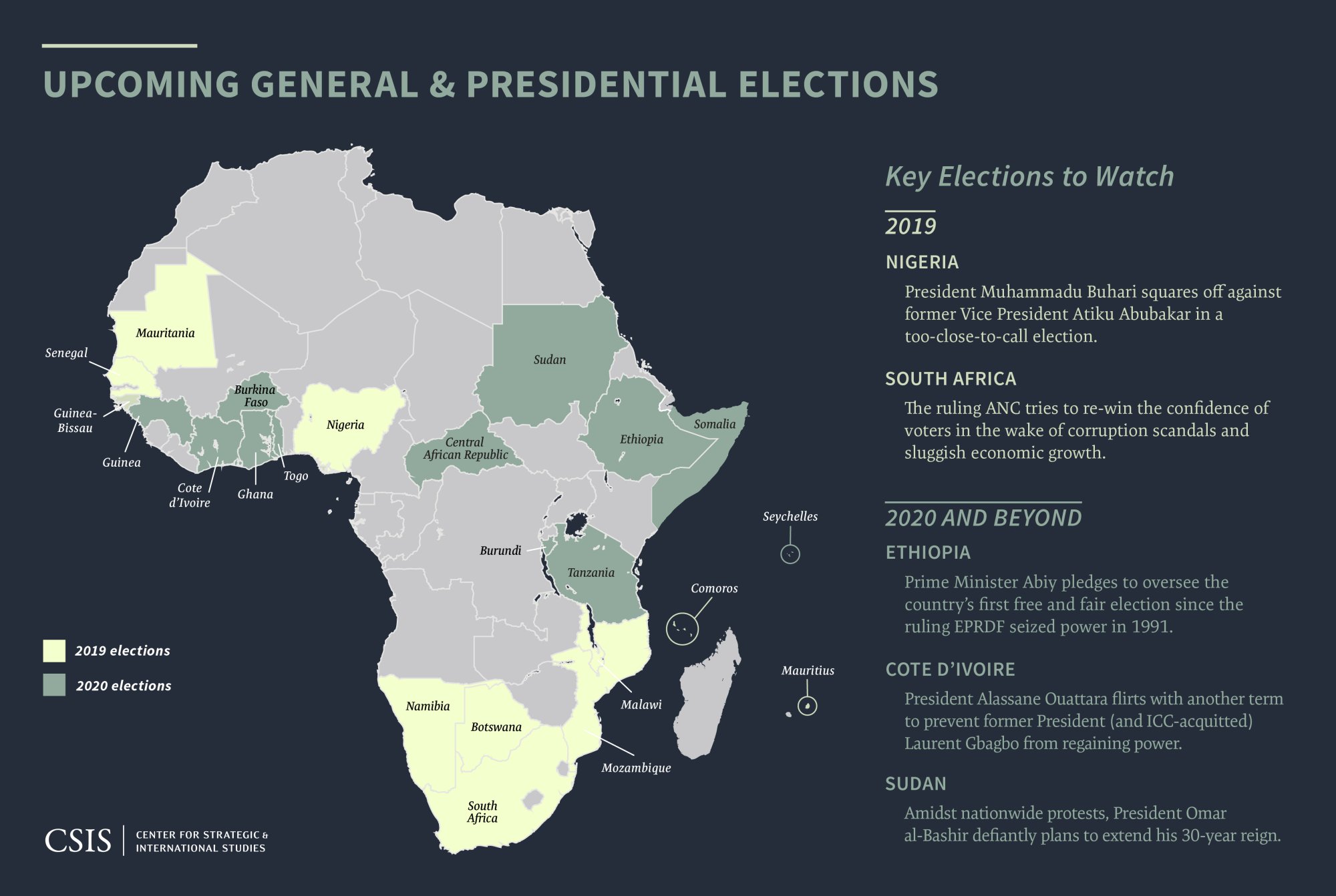
The next wave of polls is likely to exhibit more volatility in part due to urbanization, underperforming economies, and majority youth populations. In addition, greater access to technology has upset the balance of power in many countries.
In February 2018, the U.S. National Intelligence Council judged that sub-Saharan Africa is “entering a period of heightened competition between governments and their citizens over the nature of democratic governance that is likely to breed persistent volatility through 2022.”3 African elite and publics are redefining the rules of competition, showing a new willingness to protest more often and longer; spend more money on campaign spectacle and consultants; and employ a range of technological tools to mobilize, deceive, and hack. Furthermore, a new crop of politicians, outsiders, and activists are challenging the status quo.
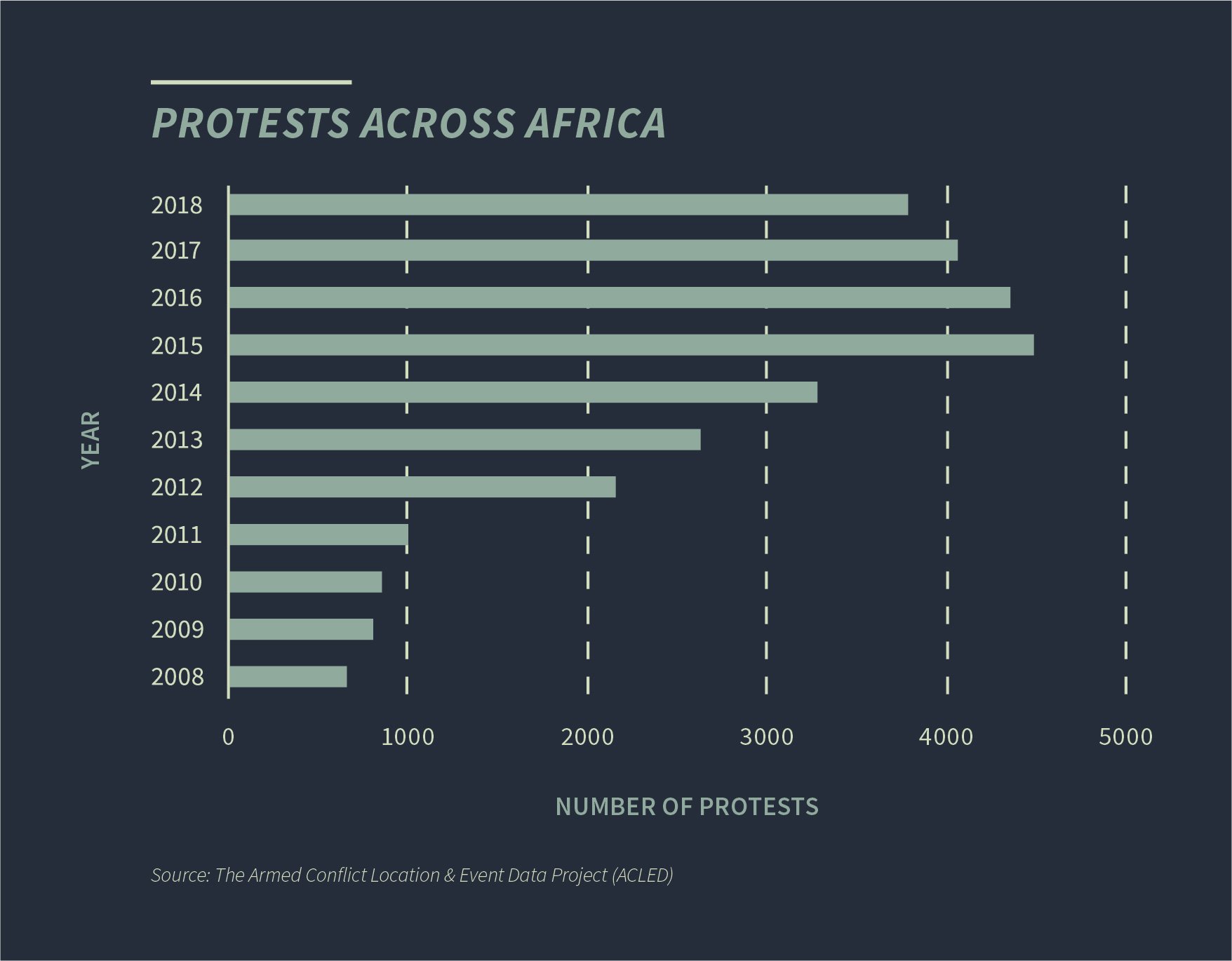
- Surging Protests. African publics are routinely taking to the streets to demand political and economic reforms, some of which relate to elections and unconstitutional term extensions. The Armed Conflict Location & Event Data Project (ACLED) recorded 3,791 protests in 2018 compared to only 653 demonstrations in 2008. In addition, these protests are considerably longer in duration. Whereas protests in previous decades lasted a few days, recent protests in Cameroon, Ethiopia, and Togo persisted for more than two years; as of February 2019, Sudanese protesters have turned out in more than two-dozen cities for two months to press President Omar al-Bashir to leave power.
- Eye-Popping Campaigns. African politicians are using spectacle and data analytics to court and target voters in more competitive races. In Madagascar, presidential candidates arranged for grand firework displays and featured an inflatable zeppelin to awe voters.4 In Tanzania, legislative aspirants chartered helicopters to access rural communities and showcase their wealth to prospective supporters.5 African political parties also are hiring foreign consultants to sharpen their campaigns and mine social media for political advantage. While Cambridge Analytica has been at the center of controversy in the United States for its acquisition and use of Facebook data, the company also played a role in elections in Nigeria and Kenya.6
- Game-Changing Technology. Similar to the rest of the world, African elections have been reshaped by technology. Political parties and individuals are using social media platforms to sow distrust or influence a close race. In Nigeria, for instance, researcher Hassan Idayat notes that Biafran separatists claimed the army was injecting school students with monkeypox to disrupt the gubernatorial poll in Anambra State in 2017.7 In Zimbabwe, ruling party operatives told rural residents that the country’s first biometric voter registration makes it possible to track people and tell which party they supported.8 African incumbents also are weaponizing technology to retain control and disguise election manipulation. The region’s governments are shutting down the internet—at least 18 times in 2018—in some cases to undercut the opposition during balloting as well as to acquire suspect electronic voting machines to tilt poll results in their favor.9;10
- Norm-Breaking Candidates. While Africa’s leadership cohort continues to feature elderly men and former military generals, a new generation of unconventional politicians and activists are rising in power and demanding to be heard. In Ethiopia, Prime Minister Abiy Ahmed, who is only 42 years old, is shaking up the status quo. In South Africa, the ruling African National Congress (ANC) will square off against political parties led by Julius Malema and Mmusi Maimane who are 37 and 38 years old, respectively. Pop music superstar, legislator, and activist Bobi Wine, born in 1981, is mulling a challenge to President Museveni in 2021.11 While sub-Saharan African publics are showing some political dynamism and reaffirming their support for free and fair elections, much of the rest of the world appears to have walked away from its commitment to democracy, human rights, and multilateralism. Afrobarometer—a non-partisan research network—reported that almost 70 percent of Africans say democracy is their preferred type of government.12 Meanwhile, U.S., UK, and some European governments are at best distracted by internal politics and at worst, fundamentally questioning some of these principles. In 2017, the Pew Research Center noted that while pro-democracy attitudes exist globally, to varying degrees, it detected a growing openness to nondemocratic forms of governance, including rule by experts, a strong leader, or the military in the 38 countries surveyed.13 The international community, consequently, seems to have little bandwidth or appetite for governance issues in sub-Saharan Africa. No wonder a BBC correspondent recently asked: “why has the mute button been pressed on Africa?”14
- Deemphasizing Democracy. The West is downplaying the importance of democracy in its foreign relations with sub-Saharan Africa. In December 2018, President Trump’s national security adviser John Bolton failed to mention “democracy” when he unveiled the administration’s Africa strategy.15 While democracy is included in the White House factsheet,16 it has certainly taken a backseat to competition with China and Russia and trade and investment priorities. The United Kingdom and the European Union have remained more faithful to and continue to engage in governance issues, but official speeches and documents underscore that strengthening trade partnerships and curbing migration have overtaken democracy as top objectives for London and Brussels.17;18;19;20
- Clashing Messages. Even when foreign governments weigh in on sub-Saharan African elections, their messaging has been periodically discordant. In January 2019, the U.S. government released a statement warmly welcoming new Congolese president Felix Tshisekedi following a fraudulent election win while the Europeans sounded a more cautious note.21;22 The U.S. embassy in Tanzania in the past year has signaled its concern about the country’s democratic trajectory, but it has not matched the World Bank and the European Union’s recent threats to cut assistance and recall diplomats.23;24
The international community, consequently, seems to have little bandwidth or appetite for governance issues in sub-Saharan Africa. No wonder a BBC correspondent recently asked: “why has the mute button been pressed on Africa?"
Transforming the Election Game
These dynamics are unsettling the status quo, even if it has muddied the picture about the state of democracy in sub-Saharan Africa. Freedom House, for instance, recently reported that 2018 marked both notable democratic progress in a number of pivotal countries and increasing threats to freedom in others.25 Whether this means the region is moving in the right or wrong direction,26 it is undeniable that the rules around elections are changing. Both incumbents and their opponents are testing new strategies to succeed in this emerging space, which partly explains some of the recent leadership turnovers, election malfeasance, legal (and extralegal) challenges, and government-sponsored violence.
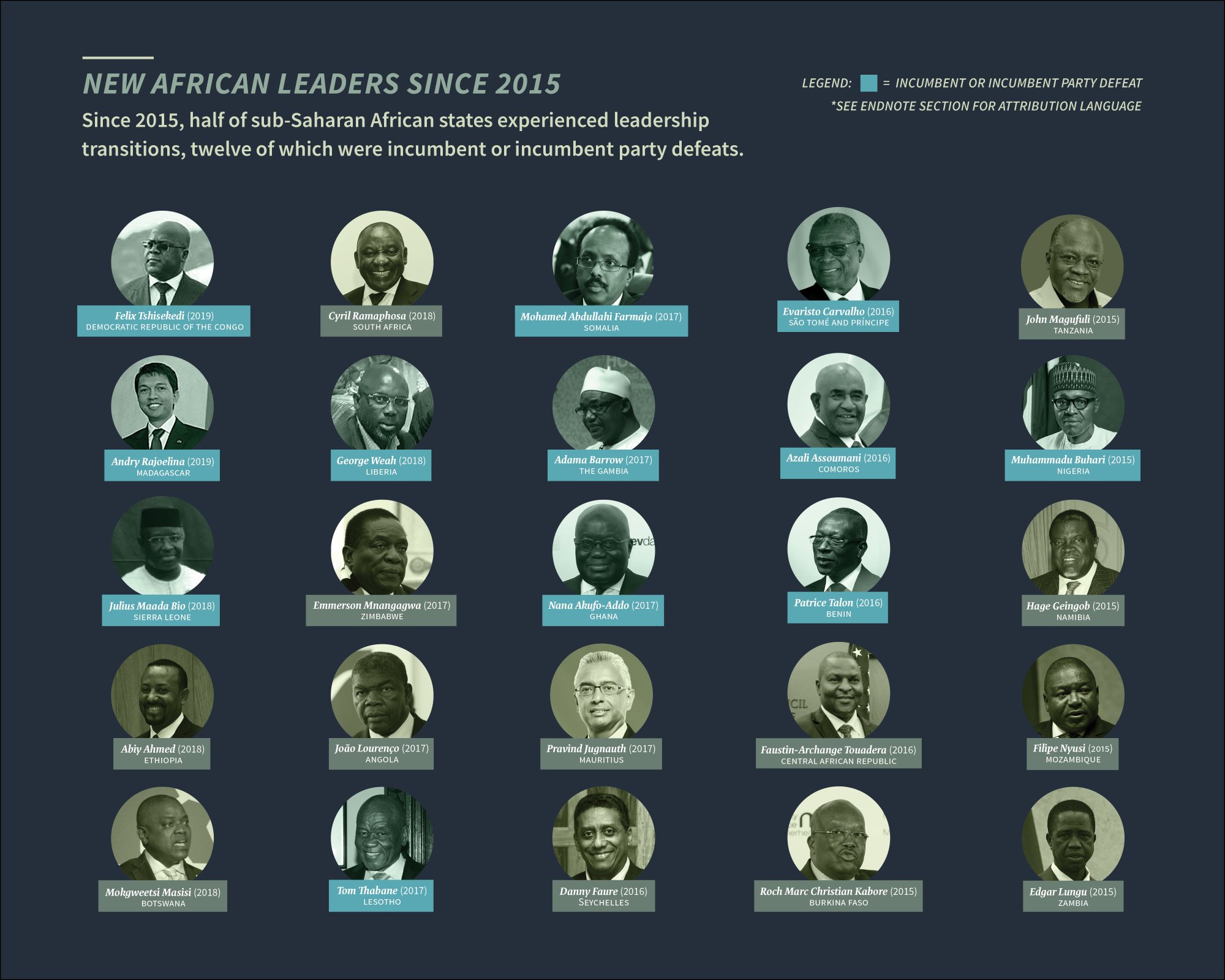
- Leadership Turnovers. Since 2015, 13 opposition parties have defeated the incumbent or incumbent party. Put it another way, the opposition is currently winning some four out of every ten presidential or general elections. This contrasts with the past two decades, where opposition parties succeed in fewer than one out of every six contests. Even in cases such as Ethiopia and South Africa, the ruling party replaced its sitting leader in part because of concerns about the party’s staying power or electoral prospects.
- Election Malfeasance. Several incumbents, who seek to remain influential in this new environment, have tested constitutional limits, manipulated eligibility rules, and partnered with strange bedfellows to protect their interests. In the Democratic Republic of Congo (DRC), for example, the government barred two leading candidates from contesting and later anointed Tshisekedi as the election victor rather than accept opposition leader Martin Fayulu’s win. Nigerien president Issoufou’s main rival, who was arrested, had to campaign from jail and later boycotted the second round in March 2016.27
- Legal (and Extralegal) Challenges. Opposition parties in Africa are more likely to reject official election sresults than anywhere else in the world, and academic research indicates the number of rejections may be rising. Of the 22 presidential elections held in Africa between 2015 and 2016, opposition candidates refused to accept the outcome in nearly two-thirds of cases.28 Moreover, when the courts uphold the incumbent’s victory, Cameroonian, Congolese, Gabonese, Kenyan, and Zimbabwean candidates have tried to stage alternate swearing-in ceremonies to claim the presidency.
- Government-Sponsored Violence. Incumbents, who had become adept at holding power without overt coercion, are again unleashing government security services to clamp down on opposition protestors and intimidate voters before and during voting. In Zimbabwe, the military opened fired on unarmed citizens, killing seven and injuring over a dozen in response to opposition protests.29 In one of Nigeria’s recent gubernatorial elections, the ruling party deployed 40,000 police to the polls, a maneuver widely viewed as disproportionate and designed to harass opposition voters.30
Both incumbents and their opponents are testing new strategies to succeed in this emerging space, which partly explains some of the recent leadership turnovers, election malfeasance, legal (and extralegal) challenges, and government-sponsored violence.
Rendering U.S. Approaches Ineffective
While the region’s governance landscape continues to shift, the United States is failing to make commensurate investments and is falling behind in revamping its policies and tactics. The United States has dedicated limited resources and personnel to allocate for most elections outside of Nigeria and possibly Ethiopia in 2020. Even when there is considerable interest and attention, the United States and other international stakeholders have missed opportunities to respond to warning signs. For instance, the joint National Democratic Institute (NDI)/International Republic Institute (IRI) delegation in September 2018 flagged vote-buying in the Nigerian gubernatorial election as a threat to credible elections.31 Aside from some public statements,32 there has not been a concerted pressure on the government to investigate and prosecute instances of vote-buying.
Moreover, U.S. and international election monitoring are “decades out of date,” according to Stephan Chan of the School of Oriental and African Studies. In a recent essay, he points out that observation missions are by nature decentralized while rigging has become more centralized.33 U.S. and other international observers, however, depend on the government to grant access to certain regions and parts of the election process; it is not as useful to observe voting at a polling station if most of the manipulation is occurring in collation centers. In addition, most observers do not have the technological expertise to counter disinformation on social media platforms, circumvent government internet controls, safeguard election results from hacking, or detect digital tampering.
U.S. and international election monitoring are “decades out of date,” according to Stephan Chan of the School of Oriental and African Studies.
Toward a New U.S. Playbook
The United States has an opportunity to update its approach to elections by reconfiguring its investments, broadening its partnerships, and committing to principled interventions because it has positive effects on core U.S. interests including economic prosperity and stability. While Africans are ultimately in the driver’s seat, the U.S. government could reinforce some of the positive democracy trends and constrain countervailing forces.
This realignment will not be quick or easy. The most recent USAID data indicates that U.S. funding for governance and civil society programming in the region typically hovered around only 250-350 million dollars a year, and that in 2018, this sum was then cut in half.34 Furthermore, in October 2018, the State Department’s Office of the Inspector General noted that the Bureau of Democracy, Human Rights, and Labor did not have enough staff to manage its 450 active awards.35
While Africans are ultimately in the driver’s seat, the U.S. government could reinforce some of the positive democracy trends and constrain countervailing forces.
It also will necessitate the training of election specialists to counter social media disinformation and electronic voting manipulation. It will entail covering more elections across the region and for longer stints. Finally, it will involve a more holistic approach, coordinating interventions with the U.S. Congress, international allies and organizations, and most importantly, civil society and influential institutions in the region.
Beginning in November 2018, the Center for Strategic and International Studies (CSIS) convened election and country subject matter experts to discuss recent polls in sub- Saharan Africa. We used a case study approach to examine elections in Zimbabwe and the DRC, as well as upcoming votes in Nigeria and Ethiopia. Based on our discussions, we identified three focus areas for reinvigorating U.S. engagement on and support for elections in the region, as well as restoring confidence in international observation missions. Below is a menu of tactics to draw from depending on specific circumstances next wave of elections.
INVESTMENTS
- Recruit, train, or contract a new cohort of election specialists who are experts on information communication technologies. In their book How to Rig an Election, Nic Cheeseman and Brian Klass indicate that electoral cybersecurity should be a top priority, and they recommend routine audits of everything from voter registration databases to tabulation.36
- Fund non-profit organizations that promote accuracy in public debate and the media in sub-Saharan Africa to discredit disinformation campaigns. For example, Africa Check, which has offices in Johannesburg, Nairobi, Lagos, Dakar, and London, produces reports in English and French testing claims made by public figures, institutions and the media against the best available evidence.
- Support non-partisan research networks that conduct public attitude surveys on democracy, governance, economic conditions, and related issues to inform U.S. engagement. Afrobarometer, which has struggled for consistent funding, released timely polling data ahead of the Zimbabwean election.
- Promote parallel vote tabulations (PVT), which involves domestic observation groups that collect results from a sample of polling stations, to deter manipulation during the counting procession. In Zimbabwe and the DRC, the Zimbabwe Election Support Network (ZESN) and Catholic Church employed PVTs or other methodologies to question the accuracy and credibility of official results.
- Prioritize training for and engage with constitutional courts, election tribunals, and regional justice systems, to insulate them from executive branch manipulation and to support non-partisan proceedings following disputed elections. In 2017, the Kenyan Supreme Court became the first African court to nullify a presidential election in part because the election commission failed to verify results before announcing them and due to suspicion that voting may have been hacked.37
- Increase access to smartphones, end-to-end encryption, and virtual private network (VPN) technology to safeguard domestic elections observation efforts and preserve communication channels during government crackdowns. In 2015, Nigerian civil society groups promoted smartphone apps to enable individuals to report election-day incidents, including voting irregularities and violence, from their polling stations.38
PARTNERSHIPS
- Promote U.S. congressional engagement, such as statements, hearings, legislation, and official trips, to increase U.S. leverage. In April 2018, five U.S. senators traveled to Zimbabwe to signal U.S. interest in the country’s election,39 and subsequently convened hearings and reauthorized the Zimbabwe Democracy and Recovery Act (ZDERA) to update the framework for U.S. relations with the government of Zimbabwe.
- Redouble efforts to coordinate with Brussels, London, Paris, and other European capitals to maintain a unified position and preclude forum-shopping by regional government and opposition parties. While there was dissonance in the international community’s statements on the DRC, the United Kingdom and the United States recently issued a joint statement threatening sanctions on individuals who take part in election violence and rigging in Nigeria.40
- Expand U.S. foreign partnerships beyond European governments to reinforce messaging and showcase credible, non-Western voices. There has been a measurable uptick in international engagement with sub-Saharan Africa, including from democracies such as India and Japan, that could inject new resources and issue statements, as South Korea did ahead of the DRC elections.41
- Reinforce and elevate U.S. engagement with the African Union and Regional Economic Communities, including the Economic Community of West African States (ECOWAS), that defend and promote democratic principles. In January 2019, the African Union issued an unprecedented call for the DRC to suspend the final results of its disputed presidential election, a demand which was subsequently ignored by the Congolese government and received scant backing from the United States.42
- Enlist the African private sector to pressure regional governments to refrain from internet shutdowns and other repressive actions. According to the Collaboration on International ICT Policy in East and Southern Africa (CIPESA), shutdowns in 10 sub- Saharan African countries eroded business confidence and led to deficits of over $235 million.43
- Support civil society groups, including trade unions and diaspora groups, and facilitate multinational exchanges between activists to share best practices. According to the National Intelligence Council, pro- democracy civil society groups across West Africa and Central are forging transitional networks to train activists in neighboring countries. 44Recently, in Sudan, protesters borrowed techniques learned from counterparts in Egypt and Tunisia, such as soaking medical masks in yeast or vinegar to fend off tear gas.45
INTERVENTIONS
- Incorporate scenario planning and exercises to develop and stress-test U.S. responses to elections. This structured tool is a regular feature of war planning, and it could assist U.S. policymakers to anticipate various outcomes in an election context. For example, this approach could have spurred U.S. stakeholders to develop a different menu of options to handle the Congolese election crisis.
- Issue positive statements, as appropriate, to reinforce Africa’s institutions, political leaders, and civil society that act in accordance with democratic values. The United States and other international actors tend to publicly comment on negative behavior. While there is a risk of discrediting key institutions, leaders, and groups, it can also affirm independent and principled stances, such as when Nigeria’s electoral commission rejected the ruling party’s gubernatorial candidate submission in Zamfara State.46
- Intercede when opposition figures, journalists, civil society activists are attacked, jailed, or worse during elections. In August 2018, the UN and foreign governments strenuously objected when opposition leader Tendai Biti was deported to Zimbabwe from Zambia where he tried to claim asylum following the elections.47
- Continue to threaten and sanction individuals who engage in anti-democratic activities and corruption. In 2015, the United States warned that it would impose visa bans on Nigerians who espouse violence or manipulate poll results. While sanctions were never levied, this threat, in combination with senior-level engagement, contributed to the first democratic transition between one party to another in Nigerian history.
- Expose and sanction foreign firms that abet stolen elections and facilitate government repression. There is growing concern that sub-Saharan African governments are contracting foreign firms, such as Israel’s Nikuv, to assist with election rigging.48 There have been similar fears that Israeli and Chinese companies are enabling the government to track and monitor regime opponents on the internet and on CCTV systems.49,50
- Offer nonpartisan tutorials on evidence-gathering to facilitate more credible, legal reviews of disputed elections. As part of ongoing assistance programs to strengthen the region’s justice system, the United States could work with judges, legislators, and professional bar associations, as well as ruling and opposition party officials to ensure the information provided by PVTs and through other means can be used in court proceedings.
- Remain engaged following the election to advocate for and work with stakeholders to implement reforms. IRI, NDI, and other democracy development organizations regularly issue comprehensive reports following election with detailed recommendations, but it is difficult for U.S. policymakers to remain focused once the immediate post-election period has concluded. It is critical to communicate long-term priorities, request new funding, and routinely press the host government, political parties, and other actors to implement essential reforms.
Judd Devermont is the director of the Africa Program at the Center for Strategic and International Studies in Washington, D.C.
This brief is made possible by the generous support of the Open Society Foundations.
Please consult the PDF for references.
CSIS BRIEFS are produced by the Center for Strategic and International Studies (CSIS), a private, tax-exempt institution focusing on international public policy issues. Its research is nonpartisan and nonproprietary. CSIS does not take specific policy positions. Accordingly, all views, positions, and conclusions expressed in this publication should be understood to be solely those of the author(s).
© 2019 by the Center for Strategic and International Studies. All rights reserved.