The Impossible State Live Podcast: Cold Peace: Engaging DPRK to Reduce Risk and Threat
May 19, 2026 • 11:00 – 11:45 am EDT
Hosted by Korea Chair

Photo: Photos for You/Getty Images
That trade and security are linked is among the oldest claims in political economy. A new paper by Ling Feng, Qiuyue Huang, Zhiyuan Li, and Christopher Meissner marks a major step forward in measuring the peace dividend credibly, and the magnitudes are striking. A doubling of bilateral trade between two countries reduces their probability of militarized conflict by roughly 30 percent. It also softens the perception of enmity that primes conflict in the first place.
Building on an earlier CSIS analysis, which demonstrated that NATO membership raises long-run bilateral trade between countries by 12–27 percent, this piece examines the converse: the security returns that trade itself generates. Together, these two arguments reveal what current policy debates—burden-sharing on one side, decoupling and de-risking on the other—are leaving off the books.
Washington keeps two ledgers that, held apart, never fully reconcile. In one room, policy analysts debate the value of alliances and burden-sharing. In another, they debate the welfare effects of trade. The cross-effects between them—how security relationships deepen economic ties, and how economic ties shape the security environment—get lost in the hallway between. And when they go uncounted, the returns the architecture has generated look like costs it imposes, and the reasons it has lasted look like reasons to abandon it.
The hypothesis that trade support peace is centuries old. Montesquieu theorized in 1748 that commerce increases mutual dependence across populations, thereby softening their manners. Immanuel Kant predicted in 1795 that the spirit of commerce, incompatible with war, would eventually imbue itself within every nation. Norman Angell, on the eve of World War I, asserted that economic interdependence had made great-power conflict too costly to pursue.
But the causal link between trade and war has been elusive precisely because commerce and conflict share so many of the same root causes. Wars suppress trade, but trade may also suppress wars; political alignment partly determines both war and trade, and geographic proximity drives all of the above. The difficulty of disentangling this causal knot has plagued empirical researchers for decades. Feng and coauthors offer a way around it, exploiting a geographical quirk that politics cannot control.
The authors find their answer in a quirk of political history, geography, and the development of aviation technology—what social scientists call a “natural experiment.” Beginning in the 1960s and accelerating in the 1980s, advances in aviation technology, such as long-range jets, dedicated freighters, and hub-and-spoke logistics, reduced the costs of moving goods between countries. But trade gains were not distributed evenly. Increases were greatest for country pairs whose sea routes are long and circuitous relative to their direct air routes. The shock came from the sky, not from politics.
Two examples illustrate the different test groups within this natural experiment (Figure 1). Shipping goods from Lithuania to Iraq by sea requires a 14,000-kilometer journey from the Baltic Sea, through the Suez Canal, and onward to the Persian Gulf. The direct air route is under 3,000 kilometers. Aviation reduced the effective shipping distance for that pair by nearly 80 percent. In the second test group, which includes Germany and Norway, country pairs were already connected by short coastal sea routes, so aviation had little effect on trade dynamics. The same global technology produced wildly different effects depending on geographical features that no one chose, and no one can change.
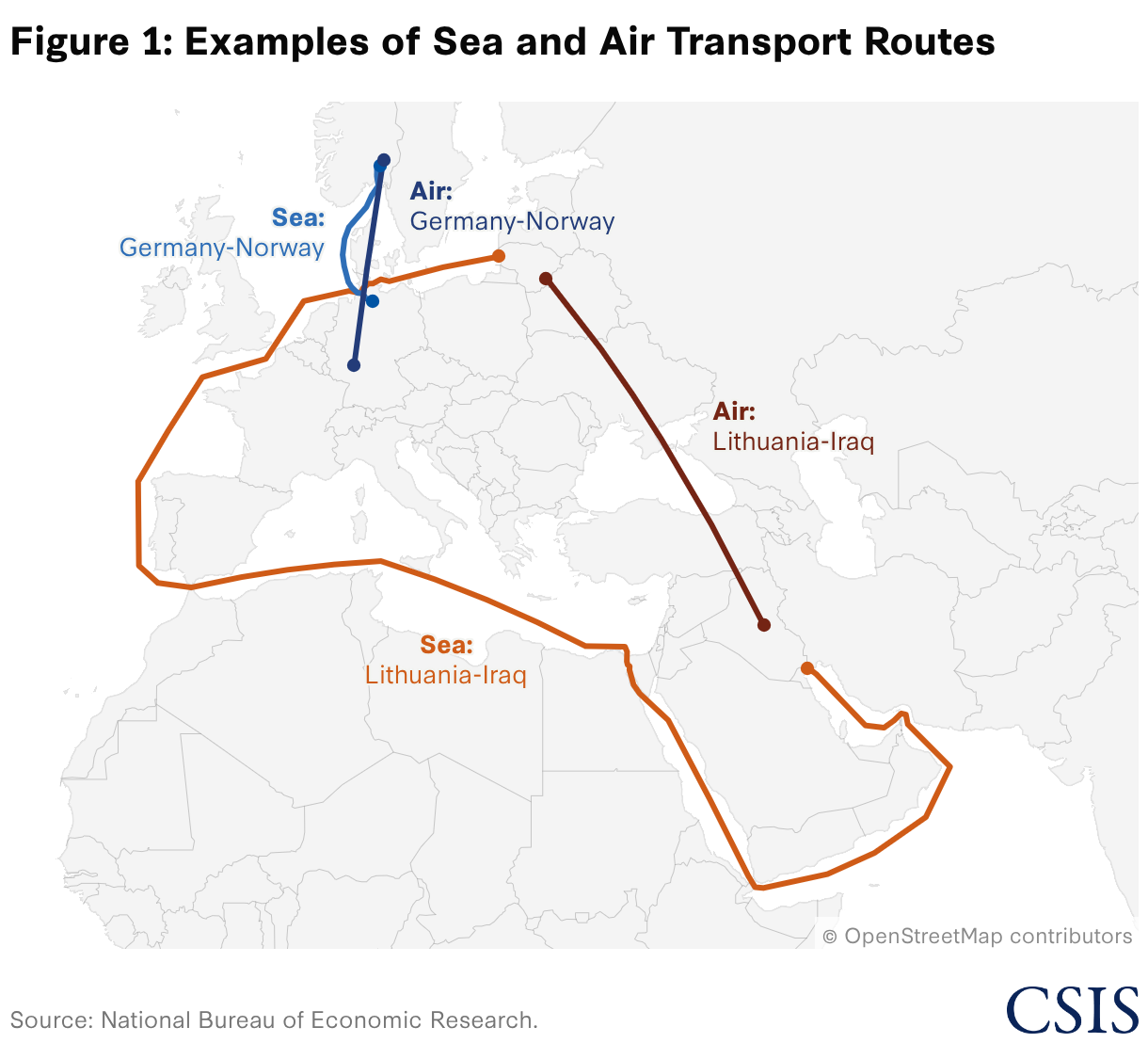
This generates variation in bilateral trade that cannot be explained by political alignment, regime type, or reverse causation. Countries with little or no part in the birth of aviation suddenly saw this new technology dramatically change the distance between them and their partners. The result is reproduced under an entirely different natural experiment: The 1985 liberalization of Soviet airspace, which, by abruptly shortening flight paths between Western Europe and East Asia, produced a sharp, time-dependent rise in trade between affected pairs. Two independent identification strategies, one answer.
According to the authors’ estimates, the doubling of bilateral trade due to reduced shipping costs of aviation reduces the probability of militarized conflict between two countries by roughly 30 percent. It also reduces the intensity of conflict when it occurs. Given the economic and human cost of conflict, this dividend of economic integration is enormous.
The largest effects accrued in the East and Southeast Asian theater, where rapid integration into global manufacturing networks coincided with the stabilization of a historically volatile region. China, South Korea, Thailand, Myanmar, and the Philippines led the leaderboard in how much trade reduced their risk of conflict. The postwar stabilization of East Asia is one of the most consequential geopolitical phenomena of the last 70 years, and these trade effects offer a plausible causal mechanism for a key contributor to how this stabilization was achieved. This is the ledger’s off-diagonal at work: Economic integration generating a security return that analysts of the decoupling trend fail to recognize.
Critically, these statistical models establish that trade not only reduces realized conflict but also dampens the perceptions of enmity that pave the way to conflict. Using a strategic rivalry dataset that measures whether governments view one another as competitive and threatening enemies, the authors find that higher bilateral trade significantly reduces the probability of strategic rivalry—the perception of hostility that shapes state behavior long before boots begin to move. Trade soothes tensions before they harden into violence.
Despite the strength of the evidence, it is also undeniable that trade creates mutual gains which, even where they temper our worst instincts, can be weaponized as coercive leverage. Albert Hirschman, in National Power and the Structure of Foreign Trade (1945), argued that asymmetric trade dependence creates leverage that one state can use to coerce another. Kenneth Waltz and Robert Gilpin extended the case: Interdependence breeds vulnerability, and vulnerability breeds conflict. The contemporary geoeconomics literature, studies by Cathrin Mohr and Christoph Trebesch as well as Christopher Clayton and coauthors, have documented how trade ties can become instruments of geopolitical influence through sanctions, export controls, and supply chain weaponization.
In 2026, the bite of these arguments is hard to miss. Europe’s reliance on Russian gas before February 2022 is one example; China’s tightening of rare earth export licenses since 2023 is another; the Strait of Hormuz is currently wreaking havoc on global supply chains. The argument that interdependence creates exploitable vulnerability is unequivocally correct. It is the reason why narrow, targeted efforts to build redundancy or limit concentration in certain commercial domains have defensible logic. Whether the broader de-risking or decoupling agenda can claim the same justification is a different question, one that this new evidence brings us one step closer to answering.
The estimates by Feng et al. imply that blanket efforts to limit dependence by reducing integration will, on average, raise the likelihood of conflict—the security cost the decoupling ledger is not pricing in.
Ultimately, security alliances generate trade returns that the burden-sharing argument has overlooked. Trade generates security returns that the decoupling agenda has taken for granted. These are the two diagonals of Washington’s policy ledger. The post-1945 architecture has been producing returns on margins that current policy debates simply do not see, and each omission makes the architecture look costlier than it is.
This does not prejudge any specific policy question. It establishes what serious cost-benefit analysis should now account for: The security dividend that broad fragmentation forfeits is no longer theoretical. The economic costs of trade restrictions are visible in price indices and trade volumes. The security costs are not, but they are no less real, and they are now quantifiable. Accounting for them is the minimum prerequisite for evaluating the merits of any fragmentation policy. What these costs imply for de-risking and decoupling debates is the subject of a forthcoming piece.
What comes next will be designed in capitals and shaped by politicians, policymakers, and pundits working from a ledger whose diagonals they have never read. They no longer have that excuse. The postwar order lasted because its architects, knowingly or not, built something whose parts reinforced each other. The next order will last only if its architects design with their eyes open.
Philip Luck is director of the Economics Program and Scholl Chair in International Business at the Center for Strategic and International Studies in Washington, D.C. Christopher M. Meissner is professor of economics at the University of California, Davis, and a research associate at the National Bureau of Economic Research.
