Capital, Consolidation, and Leadership in the New Minerals Era
October 7, 2026 • 10:00 – 10:30 am EDT
Hosted by Critical Minerals Security Program

Photo: Владимир Тюрин/Adobe Stock
Texas has a storied history as a major semiconductor innovation hub. That history began with Dallas-based Texas Instruments’ first commercial silicon transistor in 1954 and Jack Kilby’s groundbreaking invention of the integrated circuit in 1958. In recent years, Texas has become known as the “Silicon Hills” of the United States.
Texas’s semiconductor rise is best understood not as a purely free-market success story, but as the cumulative result of public procurement, state-level institution building, university investment, and private sector expansion. Federal demand for chips used in the Apollo and Minuteman programs helped establish early commercial capabilities, while the state’s successful bid for Sematech in the 1980s strengthened Austin’s role in semiconductor research. Today, Texas is entering a new phase shaped by a combination of federal and state industrial policies. The CHIPS and Science Act of 2022 provides $39 billion in subsidies for chip manufacturing on U.S. soil and a 25 percent investment tax credit for manufacturing equipment. Texas followed with its own $1.4 billion Texas CHIPS Act in 2023, which created the Texas Semiconductor Innovation Fund (TSIF) to incentivize semiconductor manufacturing and the Texas Semiconductor Innovation Consortium (TSIC) to coordinate research, design, and workforce development.
Texas’s semiconductor rise is best understood not as a purely free-market success story, but as the cumulative result of public procurement, state-level institution building, university investment, and private sector expansion.
These renewed investments give Texas the resources and momentum to build a more durable semiconductor ecosystem on its impressive assets. A semiconductor ecosystem is the integrated network of research, finance, entrepreneurship, education and training, manufacturing and distribution, and end users. It includes organizations that design, manufacture, assemble, test, package, and deploy chips as well as suppliers, universities, and public institutions. The state has significant advantages in these elements. But its long-term position will depend on execution: reliable power and water, coordinated state and federal incentives, stronger links across the value chain, and a workforce for expanding fabs, suppliers, and packaging facilities.
The first layer of Texas’s semiconductor advantage is physical infrastructure. Land, power, water, and logistical connectivity are not sufficient to create a semiconductor cluster, but they are necessary conditions for large-scale fabrication and supplier investment.
Land: Texas’s land availability gives it an important siting advantage for large semiconductor facilities. This factor has become more salient as fabs increase in scale: The first of Samsung Electronics’ new fabs under construction in Texas will be roughly the size of 11 football fields. Texas also benefits from relatively stable geology, with most of the state experiencing low seismic activity, reducing one category of operational risk for facilities that are highly sensitive to disruption.
Energy Resources: Texas is well known for its petroleum industry, but it is also a leader in renewable energy, contributing 28 percent of the nation’s wind-based electricity in 2023. Overall, Texas accounts for nearly a quarter of domestically generated U.S. energy. Abundant power is critical because semiconductor manufacturing facilities require large amounts of stable, low-cost electricity. Modern fabs can consume up to 100 megawatt-hours of energy per hour, with energy costs accounting for as much as 30 percent of production costs.
Extreme weather has tested the reliability of Texas’s electric grid in recent years, including in 2021, when outages temporarily halted production at Samsung, NXP, and Infineon fabs near Austin. Recent state reforms aimed at weatherizing the power grid may improve reliability, but grid performance will remain an important constraint to monitor as semiconductor electricity demand grows.
Water Resources: Semiconductor manufacturing is water intensive, requiring large volumes for cleaning and cooling chips and equipment. Estimates suggest that a modern fab uses an average of 5 million gallons per day. Water availability varies across Texas, and chipmakers have tended to cluster near reliable water sources. Texas Instruments’ decision to build facilities in Sherman, Texas, was shaped in part by proximity to Lake Texoma, a major reservoir. Historically, water has not been viewed as a major constraint for semiconductor manufacturing in Texas, unlike in Arizona, where limited surface water and aquifer depletion have raised persistent concerns. Texas benefits from more than 180 man-made reservoirs, numerous river basins, and major aquifers such as the Ogallala and Edwards, which support both industrial and municipal use. Long-term drought risks and infrastructure constraints remain growing concerns, but policymakers have begun to respond. Recent legislation, including Texas Senate Bill 28, aims to expand water supplies through financial assistance and conservation. Companies are also setting their own targets: Samsung’s new Taylor plant plans to reclaim or reuse 75 percent of its water and achieve a Net Positive Water Impact for the Taylor facilities. Samsung’s Austin facility, for example, recycled 960 million gallons of water in 2021, representing a recycling rate of 43.5 percent.
Connectivity: Texas also benefits from strong international trade infrastructure, including 32 ports of entry and 35 foreign trade zones. The state is home to the Port of Laredo, the third-busiest port in the United States, and the Port of Houston, the largest breakbulk and project cargo port in North America. Texas’s proximity to Mexico may create additional supply chain opportunities. The United States and Mexico, both members of the newly formed North American Ministerial Committee on Economic Competitiveness, are working together to strengthen the semiconductor supply chain. Given Mexico’s position as the United States’ largest trading partner and the two countries’ announcement of a joint semiconductor action plan, Mexico’s lower-cost labor base and close economic ties with the United States could support Texas’s semiconductor ecosystem, particularly in areas complementary to semiconductor fabrication.
These physical advantages help explain why Texas is attractive to large semiconductor projects, but they do not by themselves determine competitiveness. The more important policy question is how the state converts these inputs into a functioning innovation and production system.
Texas’s second layer of advantage is institutional. The state’s semiconductor base has been shaped by regional clusters, research universities, anchor firms, state incentives, and federal programs that together help translate infrastructure into industrial capacity.
Austin Semiconductor Hub: Austin’s development illustrates how federal initiatives and state-level mobilization helped shape Texas’s semiconductor geography. The city was selected over 57 competing locations as the site for the Microelectronics and Computer Technology Corporation (MCC), a federally created precompetitive research project active from 1983 to 1991. At a time when Japan’s national strategy was challenging U.S. leadership in semiconductors, Texas political, business, and academic leaders used the competition for MCC to reposition the state around emerging technology rather than oil. The effort coincided with a severe downturn triggered by collapsing oil prices, giving the state an additional incentive to diversify its economic base. To attract MCC, Texas assembled a package that included research fellowships, university appointments for MCC employees, subsidized home loans, and job-placement assistance for spouses.
Although MCC did not meet its original objectives and was eventually dissolved, its location decision had lasting effects on Austin’s semiconductor ecosystem. The competition catalyzed public and private investment, strengthened the state’s research infrastructure, and reinforced Austin’s national reputation in microelectronics. As part of this effort, Texas matched $32 million in philanthropic contributions to establish 32 endowed $1 million research programs at the University of Texas at Austin in fields such as microelectronics, computer-aided design and manufacturing, and materials engineering. Semiconductor pioneer Ben Streetman also returned to UT Austin in 1982 and established the Microelectronics Research Center in 1984, which he led for 12 years.
Reflecting that status, Austin was chosen in 1987 as the headquarters for Sematech, an innovative public-private partnership involving $500 million in federal support, matched by company funding, over five years. Sematech’s objective was to restore U.S. semiconductor technological leadership and manufacturing competitiveness in response to Japan’s superior manufacturing capabilities. Selected from 135 potential sites, Austin benefited from its existing semiconductor industry, the MCC’s presence, an available fabrication facility, its reputation as a leading research center, and the backing of an effective congressional delegation. By the early 1990s, Sematech had achieved its initial technical objectives, attracted 800 semiconductor-related jobs to Austin, helped catalyze industry growth in Texas, and further strengthened Austin’s reputation as a center of semiconductor innovation.
Dallas Semiconductor Ecosystem: The Dallas–Fort Worth semiconductor cluster developed through a different pathway, anchored by Texas Instruments and its relationships with federal customers and commercial markets. Federal procurement by NASA and the Department of Defense helped expand demand for Texas Instruments–engineered semiconductors, while private sector customers such as IBM reinforced the region’s electronics base. By 1988, government contracts to Dallas-based defense companies, including Texas Instruments, reached $25 billion, and employment at these companies reached approximately 100,000. Texas Instruments also helped institutionalize the region’s technical capacity by establishing in-house research institutions to train and retrain talent, including the Graduate Research Center of the Southwest, later formalized as the University of Texas at Dallas, with support from state capital.
Federal and state support for Texas Instruments’ expanding capabilities helped solidify the Dallas–Fort Worth metropolitan area as a semiconductor innovation corridor and a strong draw for talent, manufacturers, and suppliers. After Texas Instruments sold its defense division to Raytheon in 1997, the Dallas cluster shifted increasingly toward fabs serving consumer markets. In 2001, Texas Instruments made a $3 billion investment to build 300 mm fabs in Texas, then the largest such investment in the company’s history. The Texas state government also provided $135 million, while the city of Richardson, where the fab is now located, offered additional incentives, further deepening the region’s role as a semiconductor manufacturing hub.
Research Universities: Texas’s university system is central to the state’s semiconductor strategy because it links research capacity, talent development, and industry partnerships. Texas A&M University, the University of Texas, Rice University, Texas State University, and Texas Tech University all support semiconductor-related research programs backed by state and private sector funding. Texas has 11 public and private universities with semiconductor programs that partner with the Semiconductor Research Corporation or the National Nanotechnology Coordinated Infrastructure. This university base is particularly important as the state seeks to train larger cohorts of engineers and technicians for fabs, suppliers, and advanced packaging facilities.
These historical cluster strengths are reinforced by Texas’s university system, which provides the research capacity and talent pipeline needed to sustain semiconductor growth. Recognizing this advantage, Texas is providing significant state support to expand the contributions of the University of Texas at Austin and Texas A&M University in semiconductor R&D, manufacturing, and supply chain resilience.
Texas’s policy architecture builds on these institutional strengths by using state incentives to connect research, manufacturing, and workforce development priorities.
State Incentives: Texas has built a layered incentive system rather than relying on a single semiconductor program. The governor’s office identifies up to 17 different local and state incentives and grants available to semiconductor companies. These programs vary in purpose—from deal-closing grants and tax exemptions to research matching funds and workforce development—but collectively they reduce project costs, support university-industry collaboration, and signal long-term state commitment to the sector.
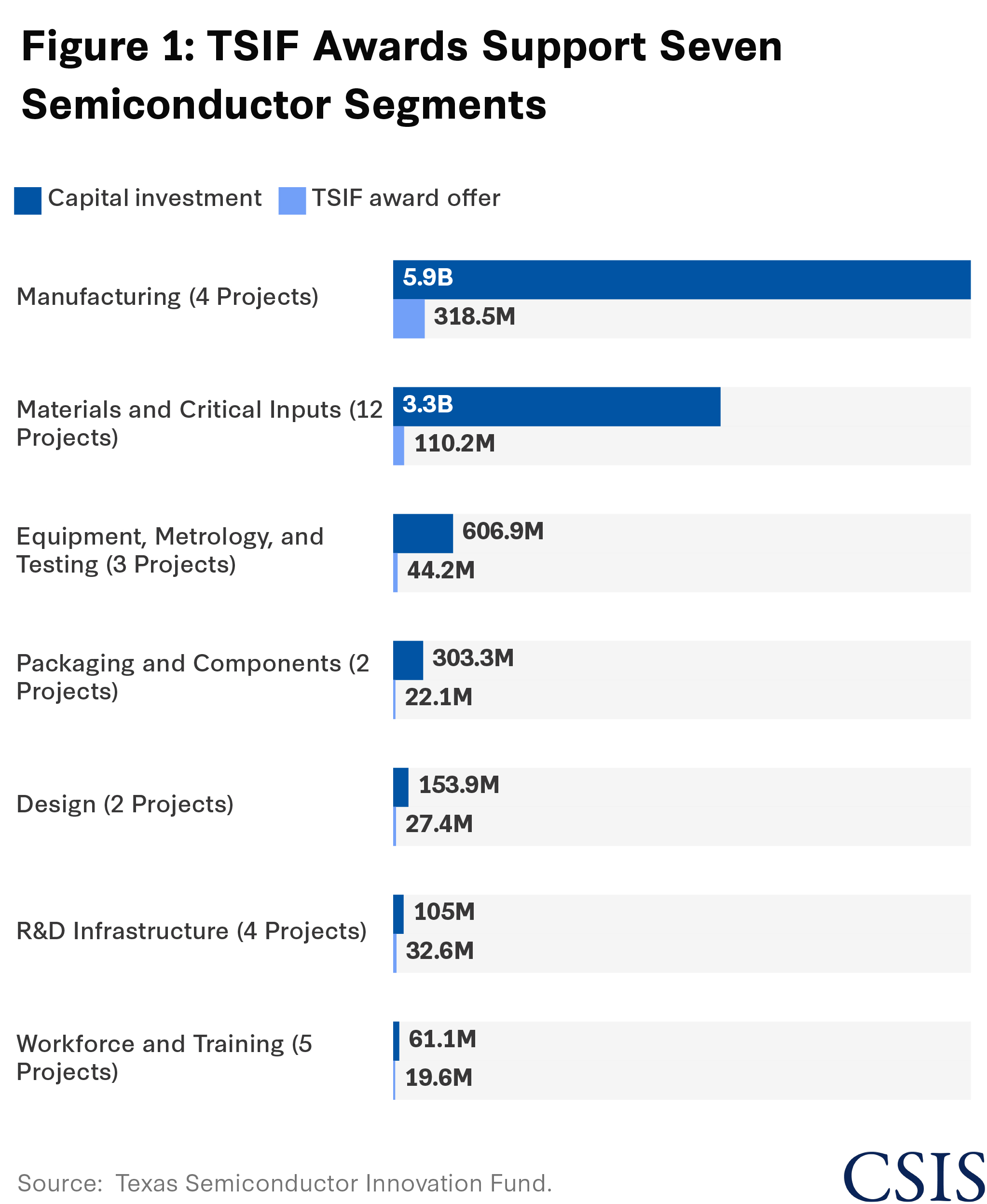
Federal Incentives: Through the CHIPS and Science Act, the U.S. government has introduced grants, investment tax credits, and R&D funding to accelerate domestic semiconductor manufacturing and innovation. These incentives target critical parts of the value chain—including fabrication, materials, packaging, and workforce development—to strengthen national supply chain resilience and technological competitiveness.
The policy significance is not simply the size of the subsidies, but the way federal incentives can complement state programs and anchor firms’ investment decisions.
Together, these instruments are helping Texas move from a collection of strong regional assets toward a more integrated semiconductor value chain. The next test is whether these assets are becoming connected across the full production system—from research and design through materials, manufacturing, packaging, and end-market demand.
The interaction of these assets is now visible across Texas’s semiconductor value chain. The state is attracting individual fabs and suppliers while also developing linkages across R&D, design, materials, equipment, manufacturing, assembly, testing, packaging, and downstream demand from AI and cloud infrastructure. The extent to which these linkages become durable will matter because semiconductor competitiveness depends on coordination among specialized capabilities, not on fabrication capacity alone.
The state’s rapid data center growth adds a demand-side dimension to this ecosystem. Texas is projected to become the largest U.S. data center market by 2030, supported by its land availability, power resources, and permissive energy regulatory environment. The build-out of data centers could increase local demand for semiconductors and related infrastructure, though the timing and scale of those effects will depend on supply chain decisions by cloud and AI infrastructure firms. This demand-side pressure makes the state’s upstream R&D, design, and prototyping capabilities more important to the overall ecosystem.
The opportunity for Texas therefore lies in converting the scale of downstream AI investment into stronger connections with the state’s design, advanced packaging, R&D, and manufacturing capabilities.
The proximity of semiconductor production and rapidly expanding AI infrastructure creates a potential advantage, but geographic proximity alone does not guarantee integration between the two ecosystems. Data center operators source advanced chips through global supply chains, and much of Texas’s existing semiconductor production serves automotive, industrial, defense, and other markets. The opportunity for Texas therefore lies in converting the scale of downstream AI investment into stronger connections with the state’s design, advanced packaging, R&D, and manufacturing capabilities.
Recent announced investments illustrate the scale and geographic breadth of this AI infrastructure build-out across Texas:
Greater collaboration among cloud providers, chip designers, research institutions, packaging facilities, and manufacturers could allow Texas to capture more of the innovation and supply chain activity associated with AI infrastructure.
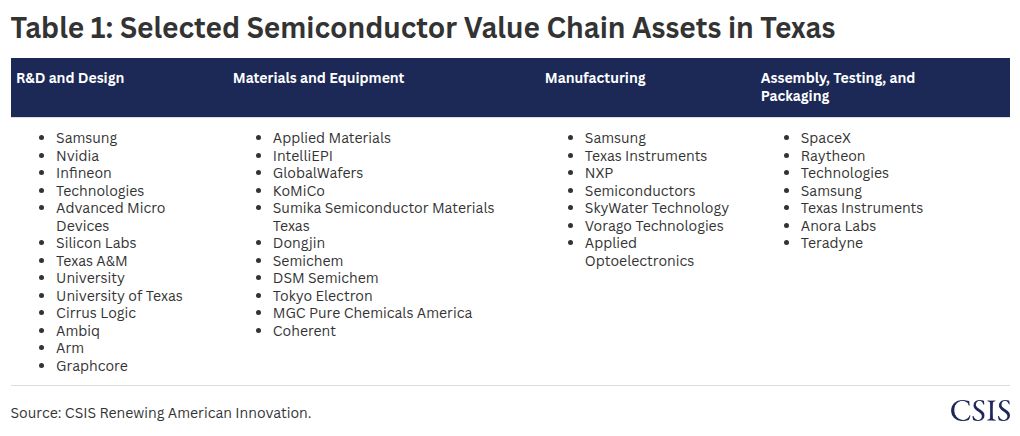
The supply-side foundations of this ecosystem begin with R&D and design. Texas has made significant strides in semiconductor R&D, supported by major investments in industry-university collaboration and advanced prototyping.
Advanced Packaging: In 2022, the University of Texas at Austin launched the Texas Institute for Electronics (TIE), a public-private partnership designed to bring together semiconductor systems firms, defense electronics companies, national laboratories, and academic institutions from across the state. The Texas legislature allocated $440 million to establish and operate advanced semiconductor R&D facilities, with a specific emphasis on strengthening the defense electronics sector and advancing advanced packaging. TIE is now leading a DARPA-backed Next-Generation Microelectronics Manufacturing program, supported by a national $840 million DARPA grant to establish an open-access R&D and prototyping fabrication facility focused on 3D heterogeneous integration and advanced packaging.
As further transistor scaling becomes more difficult and expensive, advanced packaging has become a central area of competition for performance-intensive chips. In this context, TIE is best understood as an effort to build shared infrastructure for a capability that individual firms or laboratories may struggle to develop on their own.
Leveraging state and federal investments, along with existing fabrication infrastructure, TIE is developing advanced packaging capabilities intended to lower technical and financial barriers for participating firms. Structured as a state-level entity outside the university’s traditional governance framework, TIE is designed to operate with greater flexibility while maintaining close ties to academic research. Its collaborative model brings together leading firms—including AMD, Applied Materials, Canon, Intel, Micron, Raytheon, and Resonac—to jointly develop, test, and commercialize next-generation packaging technologies while sharing technical and financial risks. Through DARPA-supported projects, TIE is also expanding collaboration between defense contractors and semiconductor companies, linking commercial innovation to national security requirements.
As further transistor scaling becomes more difficult and expensive, advanced packaging has become a central area of competition for performance-intensive chips.
TIE’s value proposition rests on its combination of technical capability, operational flexibility, and industry participation. Industry partners such as AMD view TIE as a strategic collaborator in developing advanced packaging capabilities that would be difficult to replicate independently. Beyond its commercial relevance, TIE also has potential national security implications. By expanding secure, domestic advanced packaging capacity, it could help address a critical gap in the U.S. semiconductor supply chain for the Department of Defense and defense contractors, particularly for low-volume, high-mix production that requires trusted manufacturing capabilities. Its long-term significance will depend on whether it can sustain industry participation, translate prototyping into production-relevant capabilities, and maintain alignment between commercial and defense requirements.
The Texoma Semiconductor Tech Hub points to a similar logic at the regional level. As one of the EDA’s federal tech hubs, Texoma is developing a “fablet” network of distributed prototype labs intended to integrate design, advanced packaging, and testing across northern Texas. If successful, the initiative could help address a long-standing U.S. weakness in advanced packaging for AI, defense, and high-performance computing applications, while also testing whether distributed infrastructure can operate as a coherent regional platform.
Advanced Chips: Texas A&M University received a $226 million allocation from the state government under the Texas CHIPS Act to establish a facility for quantum and AI chip manufacturing and research, including $200 million for pilot fabrication capabilities and $26.4 million for its Center for Microdevices and Systems.
Trusted Chip Architectures: Department of Defense–related facilities, such as UT Austin’s Applied Research Laboratory and the U.S. Army Futures Command in Austin, are defining and testing advanced defense systems that rely on high-performance chips.
Chip Design and Development: Texas’s design base is expanding alongside its manufacturing and packaging investments. Silicon Laboratories is investing more than $80 million to expand its R&D operations in Austin, supported by a $23.25 million TSIF grant. Industry partnerships with firms including AMD, Intel, Synopsys, and Siemens help align academic programs with workforce needs and chip design challenges. U.S. original equipment manufacturers and cloud providers such as Apple and Amazon Web Services also maintain custom chip design and development teams in the Austin area, adding demand-side pull for local engineering talent.
Taken together, these efforts suggest that Texas is developing a stronger role in semiconductor R&D and innovation. Their broader significance, however, depends on whether they connect to nearby suppliers and production assets rather than remaining isolated research initiatives.
Semiconductor manufacturing depends on a dense network of specialized suppliers providing wafers, chemicals, process equipment, cleaning services, photomasks, and other inputs required to keep fabs operating. As Texas adds fabrication capacity, the development of this upstream supplier base will be an important measure of whether the state is building an integrated semiconductor ecosystem rather than simply attracting individual manufacturing projects. Supplier proximity can shorten supply chains, improve coordination with manufacturers, and reduce exposure to disruptions involving critical inputs. Recent investments suggest that this process is beginning to take shape in Texas, with new and expanded facilities spanning silicon wafers, specialty chemicals, semiconductor equipment, and supporting services.
Taken together, these investments point to an emerging supplier network around Texas’s expanding fabrication base. Their significance lies in the range of capabilities being added: GlobalWafers strengthens domestic wafer supply; firms such as Sumika, Dongjin, DSM, and MGC expand access to specialized chemicals; Applied Materials and Tokyo Electron add equipment and technical capabilities; and KoMiCo provides services needed to maintain fabrication equipment. The strategic question is whether these investments develop into sustained relationships with Texas-based fabs and with one another. If they do, supplier density could become a reinforcing advantage for the state, making existing facilities more resilient while improving Texas’s competitiveness for subsequent semiconductor investment.
Building on these upstream capabilities, Texas has become a significant location for both advanced and foundational semiconductor production.
Texas’s semiconductor strength lies heavily in the production of foundational chips, particularly analog and mixed-signal semiconductors, a segment led by firms such as Texas Instruments, NXP, and Infineon. These chips are essential for automotive, industrial, automation, and defense applications, making them important to both commercial competitiveness and national security. At the same time, this specialization leaves Texas exposed to Chinese industrial policy, which aims to flood global markets with low-cost foundational chips. Beijing has openly pursued this strategy in auto and power semiconductor segments as part of a broader effort to undercut U.S. producers.
This specialization leaves Texas exposed to Chinese industrial policy, which aims to flood global markets with low-cost foundational chips. Beijing has openly pursued this strategy in auto and power semiconductor segments as part of a broader effort to undercut U.S. producers.
Manufacturing capacity, however, is only one part of the value chain. As fabs expand, the ability to assemble, test, and package chips closer to design and production activity becomes increasingly important. Texas is therefore also expanding its assembly, testing, and advanced packaging capabilities, areas that remain important supply chain gaps for the United States and are increasingly central to chip performance.
These investments broaden Texas’s semiconductor footprint, but their ultimate effect will depend on whether the state can supply the technicians, engineers, and production workers needed to operate new facilities.
The expansion of fabs, suppliers, and packaging facilities makes workforce development a central test of whether Texas can convert investment announcements into sustained production capacity.
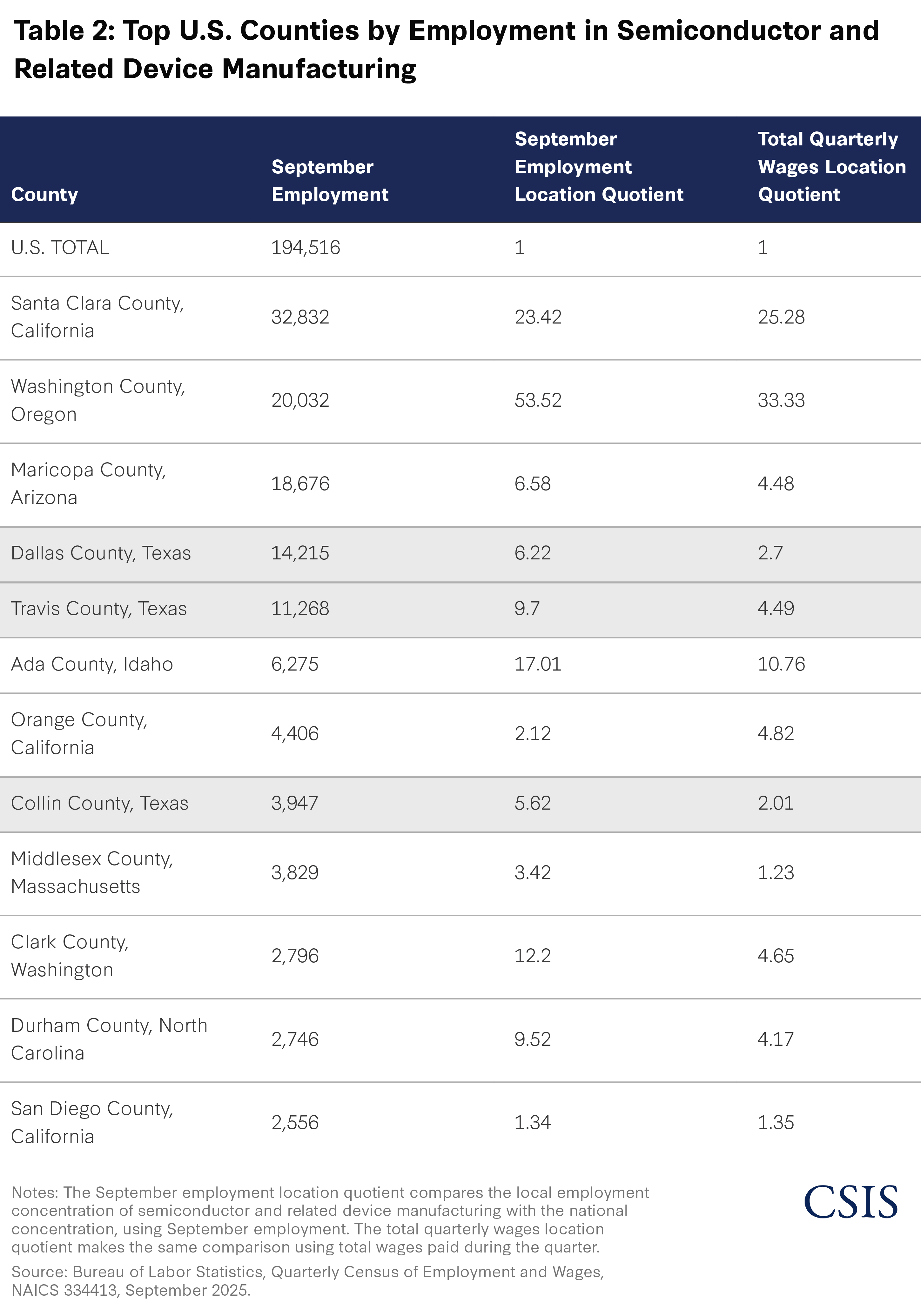
Workers in semiconductor and related device manufacturing in Texas account for almost 16 percent of the roughly 194,000 people employed in this sector across the United States. As of September 2025, Texas and California account for three of the eleven U.S. counties with more than 2,500 workers in this field. Dallas County and Travis County each have more than 10,000 people working in the sector.
Texas’s semiconductor ecosystem continues to expand as industry and educational institutions strengthen their collaboration to build a domestic talent pipeline. Austin Community College (ACC), for example, has developed comprehensive learning ladders closely aligned with industry needs for both experienced professionals and new entrants. These programs are grounded in more than a decade of feedback from industry partners. In 2014, with funding from the TSDF, ACC began developing a tailored training program for Samsung. Since then, ACC’s semiconductor programs have graduated 2,856 students. As of 2024, ACC has focused primarily on upskilling current workers, and more than 90 percent of students are incumbent employees who continue receiving their full hourly wages during training.
ACC offers a full-time, four-week program for current semiconductor employees called the Semiconductor Technician Advanced Rapid Start (STARS) Program. The program significantly shortens the pathway from entry-level assembly or operator roles, which had a maximum salary of approximately $52,000 as of 2023, to manufacturing engineer roles, which had a maximum salary of approximately $65,000. The STARS Program offers customized curricula tailored to company production cycles and operating conditions. Industry partners further support talent development by covering ACC tuition in addition to employee salaries; in 2024, partner companies covered approximately $380,000 in tuition costs.
Another program, the 8–10-week Advanced Manufacturing Program, provides initial job preparation to learners with no industry experience. Graduates either enter the workforce or continue on to take further training courses.
Credits from both programs are transferable as part of a lifelong learning pathway that allows students to earn a one-year college certificate and advance to an associate’s or bachelor’s degree program at ACC. Over the past few years, more than 150 students have advanced into ACC degree programs through this pathway. In some cases, these learning opportunities have also helped students continue into graduate study, including at UT Austin.
Four-year universities are beginning to participate in these workforce development partnerships among ACC and industry. UT Austin has begun sending undergraduate science and engineering students to ACC’s STARS Program, where hands-on training on an actual fab line helps cultivate interest in semiconductor minors and master’s degrees while also serving as a recruitment pipeline for companies.
Projects generate broader regional benefits only if facilities ramp successfully, suppliers locate nearby, and local workers can access the new employment pathways.
Regional stakeholders are making further commitments to expand ACC’s successful model. UT Austin and the Texas Institute for Electronics have awarded $11.25 million to ACC to establish a joint training center. The goal is to align educational pathways between UT and ACC, including by strengthening credit transfer arrangements, with the ultimate aim of expanding these efforts into full joint degree programs. UT Austin and ACC are also working on K–12 career awareness and recruitment initiatives. Separately, ACC has received $3.6 million in funding from the state government to establish a 2,600-square-foot semiconductor training facility and upgrade other labs.
State support is also directed toward expanding the semiconductor talent pipeline for Texas residents:
The workforce question also shapes the likely economic impact of semiconductor investment: Projects generate broader regional benefits only if facilities ramp successfully, suppliers locate nearby, and local workers can access the new employment pathways.
If Texas can sustain these connections across infrastructure, incentives, industrial capacity, and workforce development, the economic effects could be substantial. The CHIPS and Science Act’s $39 billion commitment in direct grants—including more than $8 billion for Texas—combined with investment generated by the state government, provides significant financial incentives for semiconductor companies to build fabs and expand supply chains in the state. These investments may also generate multiplier effects on Texas’s economy and employment. For example, an estimate commissioned by Samsung related to its Taylor expansion indicates that in 2023, construction activity at the campus employed more than 8,800 people and generated $4.78 billion in spending.
Combined, Samsung’s Austin and Taylor campuses are expected to create roughly 15,000 direct jobs, including temporary construction employment. The experience of GlobalFoundries in New York suggests that continued expansions and equipment installations can sustain construction activity beyond the initial build-out phase, but the durability of this employment will depend on follow-on investment and facility utilization. The fabs themselves will employ technicians and engineers, while also supporting indirect jobs in cleaning, supply, equipment maintenance, and other services required to operate advanced manufacturing facilities.
Those employees, in turn, spend income in the region, generating what economists call induced jobs. These jobs—in supermarkets, homebuilding, automotive sales, hotels, restaurants, and other local services—support both permanent employees and temporary personnel brought in to maintain fab equipment. The scale of these effects will depend on project completion timelines, hiring patterns, wage levels, and the extent to which suppliers and service providers locate within Texas.
The broader significance of these investments is that they may reinforce the self-sustaining logic of regional clusters: private sector commitments can attract suppliers, research partnerships, training programs, and additional public support, which in turn can make the state more attractive for subsequent investment. Current commitments illustrate this dynamic, with semiconductor companies—including Texas Instruments, Samsung Electronics, NXP, GlobalWafers, X-FAB, and Applied Materials—committing to invest more than $61 billion in Texas over the next decade. At least 13 new investments will receive support through CHIPS grants, the CHIPS Investment Tax Credit, or the TSIF.
The evidence presented throughout the report points to four key findings about Texas’s semiconductor ecosystem:
The findings and risks point to a central policy challenge: whether Texas can convert this wave of investment into durable comparative advantage.
These findings suggest that Texas has assembled many of the ingredients of a competitive semiconductor ecosystem, but they do not guarantee long-term success. Several risks will shape whether the state can translate current investment into durable capacity. Power and water constraints could become more important as fabs, data centers, and suppliers expand simultaneously. Workforce shortages could slow project ramp-ups if technician and engineering pipelines do not scale with announced investments. Supplier-network gaps could limit the benefits of new fabs if materials, equipment, packaging, and maintenance capabilities remain insufficiently integrated. Chinese overcapacity in foundational chips could also pressure Texas-based producers serving cost-sensitive automotive, industrial, and power semiconductor markets.
The findings and risks point to a central policy challenge: whether Texas can convert this wave of investment into durable comparative advantage. The key metric should be capital expenditure and whether public incentives help create capabilities that the market would otherwise underprovide: resilient supplier networks, advanced packaging capacity, trusted defense-relevant production, and a skilled labor pipeline. If Texas can meet these conditions while managing infrastructure, workforce, supplier, and market risks, it will be better positioned to strengthen its economic base and contribute to U.S. semiconductor resilience and technological leadership.
Hideki Tomoshige is a fellow with Renewing American Innovation at the Center for Strategic and International Studies (CSIS) in Washington, D.C. Bailey Crane is a former intern with Renewing American Innovation at CSIS.
The authors would like to thank Maryam Cope, a senior associate with Renewing American Innovation; Shruti Sharma, program manager and research associate with Renewing American Innovation; and Christina Tutino, former intern with Renewing American Innovation, for their contributions to this report.
This report is made possible by general support to CSIS. No direct sponsorship contributed to this report.


Critical Questions by Sujai Shivakumar and Chris Borges — June 26, 2023

Blog Post by Hideki Tomoshige and Bailey Crane — January 19, 2024
