The Hormuz Implications for Energy Policymaking: Japan and South Korea
August 18, 2026 • 8:00 – 9:00 am EDT

Photo: RODRIGO ARANGUA/AFP/Getty Images
The rapid expansion of AI, cloud computing, and digital services is transforming compute into one of the most important strategic resources of the twenty-first century. Meeting this demand is fueling unprecedented investment in datacenter infrastructure across the United States. This growth has generated significant debate in communities across the country, with concerns about electricity demand, water consumption, land use, and the broader impacts of large-scale facilities on local quality of life. These concerns are real and deserve careful consideration, particularly as datacenter development accelerates.
Missing from much of this discussion is the strategic role data centers play in enabling innovation. Just as electricity became a general-purpose input to twentieth-century economic growth, access to compute is becoming a foundational input to innovation in the twenty-first century. Data centers provide the computing capacity that supports AI development, advanced manufacturing, scientific research, financial services, and an increasingly digital economy. As access to compute becomes more important for innovation and competitiveness, policymakers face a key challenge: addressing legitimate community concerns while building the infrastructure needed for regions to innovate and support future economic growth.
Just as electricity became a general-purpose input to twentieth-century economic growth, access to compute is becoming a foundational input to innovation in the twenty-first century.
The location of compute infrastructure is becoming a strategic national security consideration. Domestic data centers strengthen digital resilience; reduce reliance on foreign infrastructure; protect sensitive government, commerical, and research data; and ensure that critical AI capabilities remain under U.S. jurisdiction. As AI becomes a strategic technology, expanding secure supportive domestic infrastructure is increasingly a prerequisite for U.S. technological leadership, economic competitiveness, and national security.
Figure 1: The AI Infrastructure Value Chain
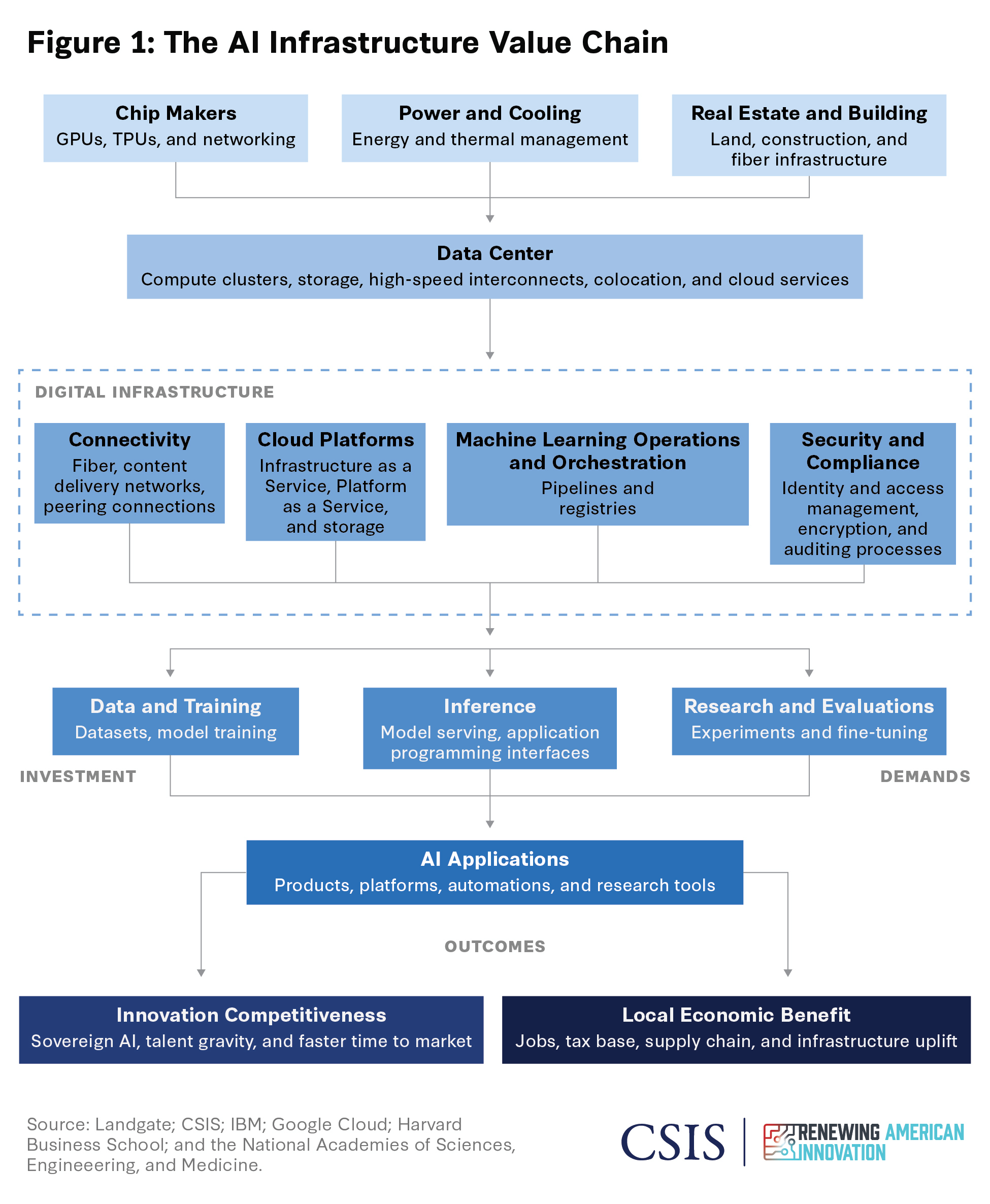
Source: Landgate; CSIS; IBM; Google Cloud; Harvard Business School; and the National Academies of Sciences, Engineering, and Medicine.
Many examples of transformative infrastructure—including railroads, ports, highways, electric transmission networks, and telecommunications systems—have historically faced local opposition, in part because the initial costs tend to be concentrated while many of the benefits are distributed more broadly. While data centers are often classified as private goods rather than traditional public goods, their economic and strategic benefits extend well beyond the firms that own and operate them. They raise issues related to land use, energy demand, water consumption, and community change, yet they also support innovation, productivity, scientific research, and technological capabilities across the broader economy. As access to compute becomes increasingly important for economic growth and technological leadership, the challenge for policymakers is to ensure that these infrastructures are developed responsibly and at sufficient scale to support future competitiveness.
Because many of these broader economic and strategic benefits are not fully captured by private developers alone, there is a strong rationale for policy intervention to align private investment with public objectives. Community benefits agreements and similar policy mechanisms can help ensure that data center projects generate local value through workforce development, infrastructure investments, digital connectivity, and compute availability, allowing host communities to share more directly in the benefits of strategically important infrastructure.
Data centers are no longer simply facilities that store information; they have emerged as foundational infrastructure that enables more productive scientific research, digital entrepreneurship, advanced production systems, better financial services, and improved government operations.
Policymakers should emphasize the broader role data centers play as strategic infrastructure for regional economic development and U.S. competitiveness. Access to compute is emerging as a critical determinant of innovation capacity, productivity growth, and regional and national competitiveness. Data centers are no longer simply facilities that store information; they have emerged as foundational infrastructure that enables more productive scientific research, digital entrepreneurship, advanced production systems, better financial services, and improved government operations. They are also foundational for participation in frontier research and technology-intensive industries.
The global race for AI leadership is, in many respects, a competition to build and sustain the infrastructure that supports innovation. Regions that successfully integrate data center development into broader strategies for workforce development, energy infrastructure, university research, and technology commercialization will be better positioned to attract investment, develop talent, and participate in emerging industries. In this sense, data centers should be viewed not merely as consumers of resources, but also as regional assets that help anchor broader networks of firms, institutions, talent, and infrastructure.
This does not diminish the importance of local concerns. Communities hosting data centers need to be assured that they will share in the benefits. This can be facilitated through transparent planning, responsible siting, infrastructure investments, workforce opportunities, and meaningful tax revenues. Together these are a means to win and maintain public trust. The challenge for policymakers is to ensure that economic competitiveness and community concerns are both advanced, rather than choosing between the two.
However, unlike manufacturing facilities, data centers generate relatively limited demand-driven spillovers in the short term because they employ relatively few workers once operational and have shorter local supply chains. Their lasting economic impact instead comes through three indirect channels: (1) creating agglomeration effects for construction and digital infrastructure that lower the cost of future investment, (2) generating tax revenues that can finance broader infrastructure development, and (3) where feasible, expanding local access to computing resources that can support innovation and business growth.
Done well, data centers can serve as the backbone of the digital economy and as catalysts for the regional innovation ecosystems that will shape the United States’ future economic competitiveness.
Ultimately, the debate over data centers is a question of how the United States can build the infrastructure required for future innovation while managing the tradeoffs. Achieving that balance will require continued technological innovation, thoughtful policymaking, and collaboration among industry, government, and local communities. Done well, data centers can serve as the backbone of the digital economy and as catalysts for the regional innovation ecosystems that will shape the United States’ future economic competitiveness.
Economic benefits are among the most contested aspects of data center development, specifically how data centers contribute to broader economic and innovation ecosystems. Critics often argue that data centers receive generous tax incentives while creating relatively few permanent jobs compared to manufacturing facilities such as semiconductor fabrication plants, although they too have been opposed in the past.
In static terms, data centers are highly automated facilities and generally employ fewer workers than traditional industrial operations once construction is complete, making it important for policymakers to evaluate whether incentive packages are proportional to the benefits generated. Yet focusing solely on direct employment seriously understates their broader economic impact. A recent analysis found that while a representative 1 gigawatt data center project could support tens of thousands of short-term construction and related jobs, it has the potential to generate substantially more economic activity through the expansion of a region’s innovation networks.
For example, a typical large data center can support up to 1,500 workers during construction and more than 50 permanent operational positions, while every direct data center job may support an additional 3.5 indirect jobs elsewhere in the regional economy through supporting infrastructure, services, and supply chains. These jobs often include electricians, engineers, and other skilled technical occupations that command wages well above local averages and do not necessarily require a four-year degree. As AI infrastructure deployment accelerates, labor demand is expected to grow substantially. According to recent CSIS modeling, AI infrastructure could require between 63,000 and more than 140,000 additional skilled trade workers, depending on the pace of AI adoption. Meeting this demand will require a significant expansion of apprenticeship and workforce training programs, underscoring that the AI boom is not only a technology story but also a major opportunity to create durable middle-income careers across the United States.
Data centers can also become significant contributors to local tax bases. Although many states offer targeted tax incentives to attract new facilities, data centers remain significant contributors through real property taxes, corporate income taxes, utility taxes, and other state and local levies. Even after qualifying for commonly available incentives, a $1 billion data center generates millions of dollars in annual state and local tax revenue, with mature facilities typically paying between $8 million and $26 million per year, depending on the jurisdiction. Because of their large physical footprint and continuous capital investment, data centers also expand local property tax bases, providing governments with additional revenue to fund schools, infrastructure, and public services.
Northern Virginia, home to roughly 13 percent of global data center capacity, offers one of the clearest examples. The data center industry contributes an estimated 74,000 jobs, $5.5 billion in labor income, and $9.1 billion in GDP to Virginia’s economy annually, with much of the economic impact stemming from construction activity and related supply chains. Data centers can also generate substantial local tax revenues, accounting for as much as 31 percent of total local government revenue in some Virginia jurisdictions.
Viewed through this lens, data centers are not simply real estate projects or utility customers. They are . . . stimulating investment in energy, telecommunications, engineering services, workforce development, and emerging technology sectors.
The broader economic significance of data centers, however, extends beyond jobs and tax revenues. As AI adoption accelerates, growing demand for compute is catalyzing investment and entrepreneurship across adjacent industries. Global demand for data center capacity could triple by 2030, driving trillions of dollars in investment across computing infrastructure, power generation, transmission, cooling systems, and related technologies. Venture capital is increasingly flowing to firms developing solutions for the power, cooling, and hardware constraints associated with AI-scale computing, including advanced energy systems and thermal storage, liquid cooling, power management software, photonics, and next-generation computing architectures. These technologies have the potential to benefit communities and improve quality of life in the long term.
Viewed through this lens, data centers are not simply real estate projects or utility customers. They are increasingly serving as anchors for dynamic local economies, stimulating investment in energy, telecommunications, engineering services, workforce development, and emerging technology sectors.
Accepting the premise that data centers are necessary, the next challenge is deciding where and how they should be built and ensuring they are built in the United States. Strategic siting can help minimize legitimate concerns related to land use, environmental impacts, electricity demand, and community disruption by prioritizing brownfields, former industrial sites, federal properties, or locations with lower agricultural value. Equally important is ensuring that host communities share in the benefits through tax revenues, infrastructure improvements, workforce development opportunities, and investments that strengthen local economic opportunities.
The AI industry is increasingly adapting its siting strategy in response to these concerns. Rather than building on productive agricultural land, developers are increasingly targeting locations where competition with existing land uses is lower. In Utah, for example, the proposed 40,000-acre Stratos Project is being developed on remote, arid land in Box Elder County and is designed to support up to 9 gigawatts of computing capacity. More broadly, developers are showing growing interest in desert and other sparsely populated areas where land is less expensive and where environmental conditions can be advantageous for operations.
Federal and previously developed sites are also emerging as important alternatives. In 2025, the Department of Energy identified four federal properties—including sites in Idaho, Kentucky, South Carolina, and Tennessee—as candidates for hyperscale AI data centers paired with energy generation infrastructure. Similarly, federal efforts are underway to accelerate the redevelopment of brownfield and former industrial sites, creating opportunities to repurpose previously disturbed land rather than converting greenfield agricultural acreage. These developments suggest that concerns over land use are increasingly influencing where and how new data center capacity is developed.
Finally, recent discussions on data center development have expanded beyond concerns over local opposition and tax revenues to focus on how host communities can share more directly in the benefits of these investments. CBAs provide one mechanism to achieve this by linking projects to commitments such as workforce development, infrastructure improvements, local hiring, digital connectivity, or access to computing resources, helping ensure that data center investments generate broader and more durable local economic value.
Recent discussions on datacenter development have expanded beyond concerns over local opposition and tax revenues to focus on how host communities can share more directly in the benefits of these investments.
As noted, new innovative technologies can reduce some of the tradeoffs associated with data center development. Advances in cooling systems, power management, facility design, and computing efficiency are enabling operators to support increasingly larger workloads while using fewer resources more effectively. While these improvements will not eliminate all concerns regarding farmland conversion or community impacts, they suggest that the relationship between data center growth and resource consumption is not fixed and is in fact likely to ease. The same innovation-based economies that data centers help enable can also contribute to addressing many of the resource challenges associated with their expansion.
Much of the public discourse surrounding data centers focuses on their energy and water requirements. While these concerns are understandable, the debate often fails to account for significant technological changes in how modern facilities are designed and operated.
For example, some communities worry that new data centers will place unsustainable pressure on local water supplies. In certain regions, particularly those already facing water stress, these concerns are valid and warrant careful scrutiny. However, water use varies considerably across facilities and depends heavily on the type of cooling technology adopted and local climate conditions. Water Usage Effectiveness (WUE)—a common industry metric that measures the amount of water consumed per kilowatt-hour of IT energy—illustrates this variation. While the industry average WUE of data centers is approximately 1.8 liters per kilowatt-hour, highly efficient facilities can achieve WUE levels below 0.2 liters per kilowatt-hour with advanced cooling technologies.
Better still, many newer facilities are relying on air cooling, closed-loop liquid cooling, liquid immersion systems, and reclaimed wastewater that can significantly reduce freshwater consumption. As demand for cloud computing and AI continues to grow, these technologies demonstrate that expanding compute capacity and managing local resource use need not be mutually exclusive objectives. In short, the assumption that all new data centers will consume large quantities of local water resources is becoming less representative of industry best practices.
Electricity demand presents a similar challenge. Data centers are unquestionably large consumers of power, and AI is accelerating this trend. According to the Electric Power Research Institute, data centers could consume up to 9 percent of U.S. electricity generation by 2030, compared to approximately 4 percent in 2023. At the same time, the industry is also driving substantial needed investment in new energy infrastructure involving major upgrades to existing grids. Moreover, high-tech companies are among the world’s largest purchasers of renewable energy through long-term power purchase agreements, helping finance more than 70 gigawatts of new clean energy capacity globally. Amazon, Google, Meta, and Microsoft have collectively become some of the largest corporate buyers of renewable electricity in the world, while also investing directly in grid infrastructure needed to support new facilities.
Beyond renewables, companies are funding emerging energy technologies that could provide reliable carbon-free power at scale. For example, Microsoft has signed agreements to purchase future fusion energy output from Helion, Google has invested in advanced geothermal projects with Fervo Energy, and several major technology firms have expressed interest in next-generation nuclear technologies, including small modular reactors. At the operational level, firms are also deploying load-shifting strategies that move non-time-sensitive computing tasks to periods and locations where electricity is cleaner or more abundant.
Although these efforts will not eliminate the need for significant grid expansion in the near future, they demonstrate that the industry’s response to rising electricity demand is increasingly to help build the infrastructure and modern energy systems needed to support it.
Data centers are increasingly recognized as foundational infrastructure for the twenty-first-century economy. While concerns regarding energy use, water consumption, land use, and community impact deserve serious attention, they can and are being addressed. They should also be weighed alongside the critical role compute plays in supporting innovation, economic growth, job creation, and technological leadership.
The issue before policymakers is how to ensure data centers are developed responsibly and in ways that benefit both host communities and the broader economy. To achieve this balance, policymakers should pursue a strategy that accelerates strategic data center development while ensuring these investments generate lasting economic and community benefits. The following recommendations outline key steps toward that goal:
Sujai Shivakumar is the director and senior fellow of Renewing American Innovation at the Center for Strategic and International Studies (CSIS) in Washington, D.C. Shruti Sharma is program manager and research associate for Renewing American Innovation at CSIS.
This report is made possible by general support to CSIS. No direct sponsorship contributed to this report.

Blog Post by Shruti Sharma and Christina Tutino — April 8, 2026

Report by Karl Smith, Joseph Majkut, Cy McGeady, and Barath Harithas — March 3, 2025

Report by Charles Wessner and Shruti Sharma — November 6, 2025