2026 Elections: New Congress, New Trade Agenda?
November 6, 2026 • 12:00 – 10:00 pm EST

Photo: AFP/Getty Images
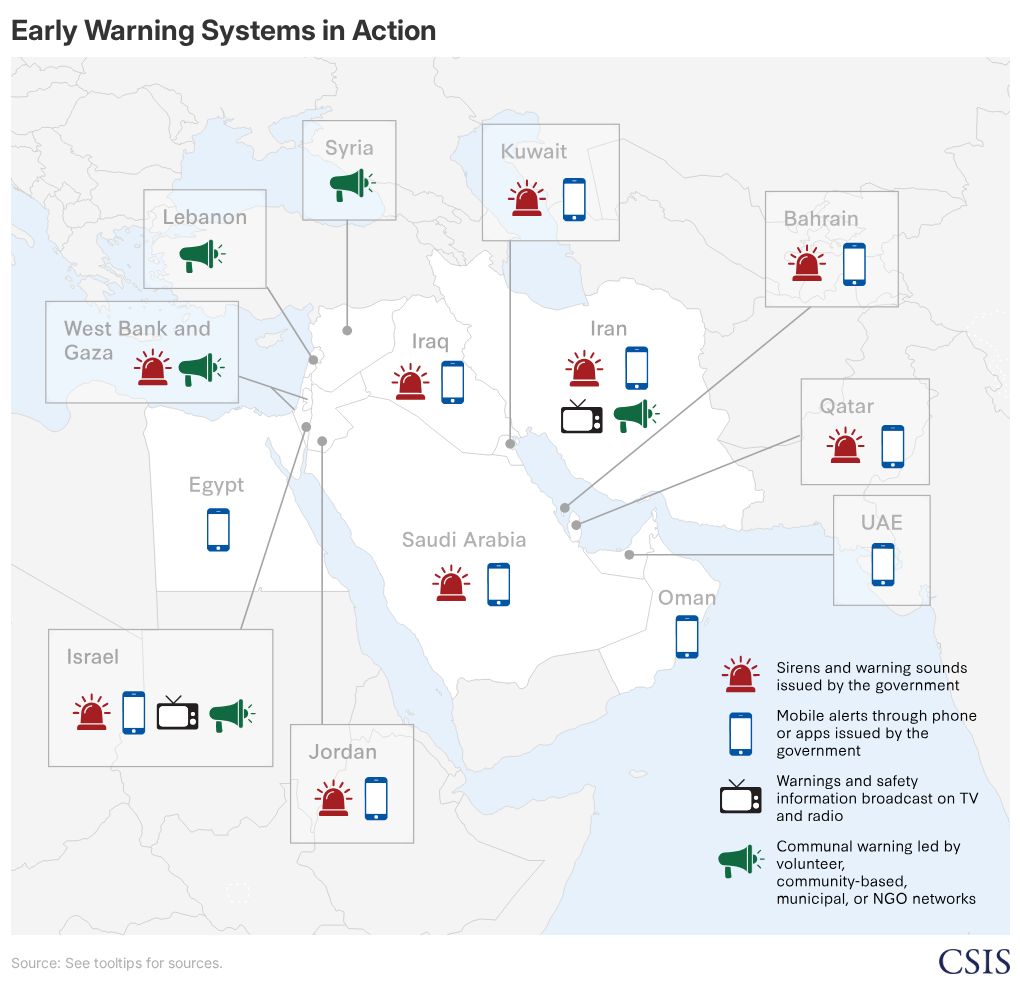
Prompted by the escalating risks facing civilians across the Gulf and Levant, governments and communities have strengthened warning systems to enhance public safety when conflict erupts. Yet, Saudi Arabia’s public warning systems fell silent ahead of the deadliest single attack on a Gulf Arab state since the start of the Iran war, raising concerns about the availability of timely warnings of incoming attacks. This installment of Charting the Middle East highlights the importance of early warning systems, emergency communications, and community-based warning mechanisms amid recurrent surges of conflict in the region.
Governments in the region are investing in the infrastructure needed to rapidly warn and evacuate residents when conflict spikes. Iran, Iraq, Jordan, and Kuwait adopted new mobile alert systems following the June 2025 12-day war and more recent regional escalations. Warning tones were adjusted in the UAE and Qatar after causing mass anxiety and stress. These systems provide timely warnings and information on the need to seek shelter, shielding residents from incoming threats. Other countries in the region, such as Lebanon and Syria, still lack a unified national warning system despite its exposure to prolonged conflict. If adequate systems were in place, more individuals may have access to life-saving information that could minimize casualty and injury rates, especially when attacks occur at night.
The expansion of early warning systems illustrates a broader shift in how regional governments are approaching conflict preparedness: protecting civilians increasingly depends not only on mitigating the effects of attacks, but on giving people enough information and resources to respond. With the persistent threat of a new escalation, the need for advanced early warning systems is more important than ever to minimize civilian harm in the region.